

Main decision tree
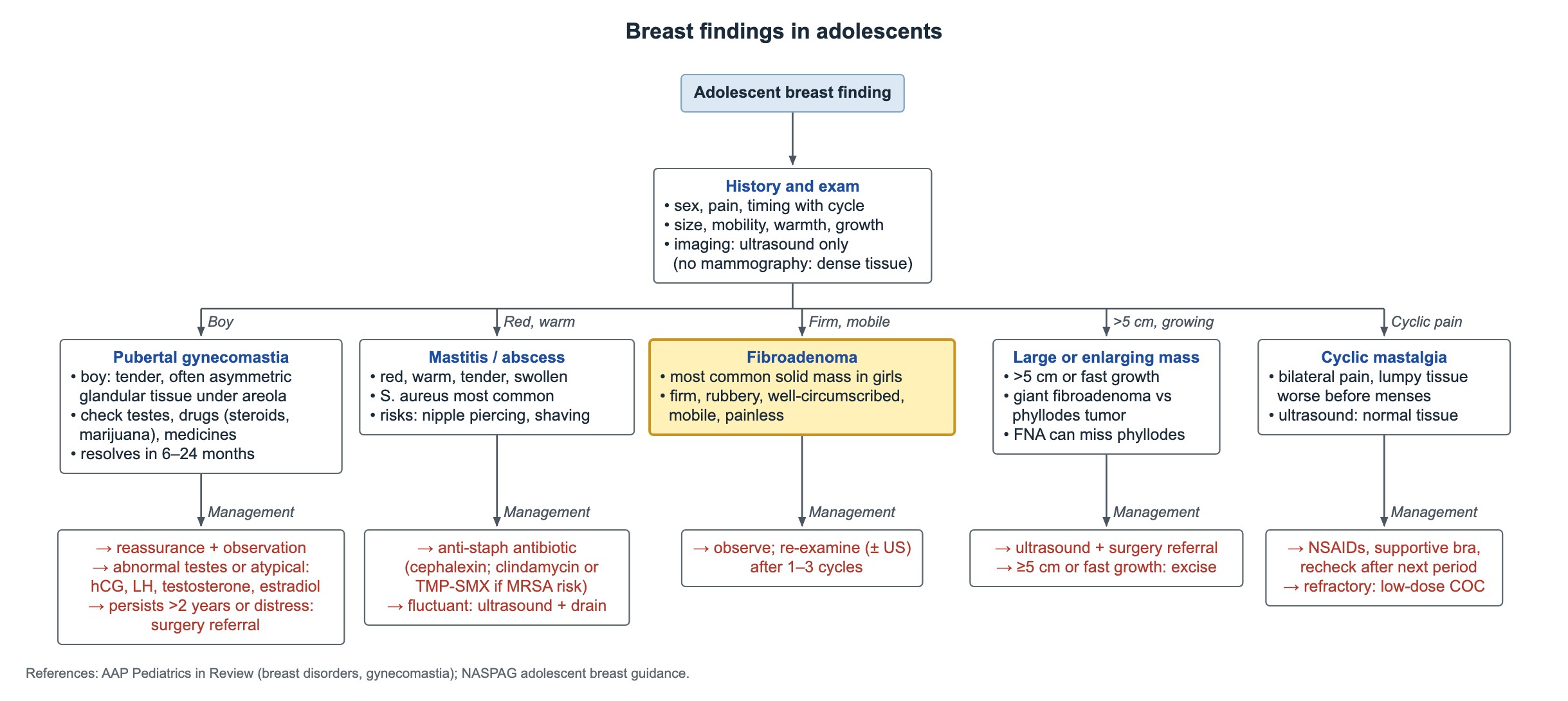
Breast findings in adolescents: fibroadenoma
Key points
- Fibroadenoma is the most common solid breast mass in adolescent girls: firm, rubbery, well circumscribed and mobile.
- Imaging in a teen is ultrasound only; mammography is not used because dense breast tissue hides lesions.
- A small typical mass: observe and re-examine (with ultrasound if needed) after 1–3 menstrual cycles.
- A mass 5 cm or larger, or one that grows quickly, needs complete surgical excision to exclude phyllodes tumor.
- Cyclic bilateral breast pain with lumpy tissue: NSAIDs and a supportive bra; low-dose combined pill if that fails.
- Mastitis is usually Staphylococcus aureus: red, warm, tender, swollen breast.
- Pubertal gynecomastia is often tender and asymmetric and usually resolves in 6–24 months.
Fibroadenoma: the common solid mass
The tree starts with history and exam: sex, pain and its timing with the cycle, then size, mobility, warmth and growth. Imaging, when needed, is ultrasound.
A fibroadenoma is the most common solid breast mass in adolescent girls. It feels firm, rubbery and well circumscribed, moves freely and is usually painless.
- Typical mass under 5 cm and not growing: observe and re-examine after 1–3 menstrual cycles, adding ultrasound if needed.
- Many fibroadenomas stay the same size or shrink over time.
- Mammography is not used in teens: dense glandular tissue makes it hard to read, and there is radiation.
Large or fast-growing mass: think phyllodes
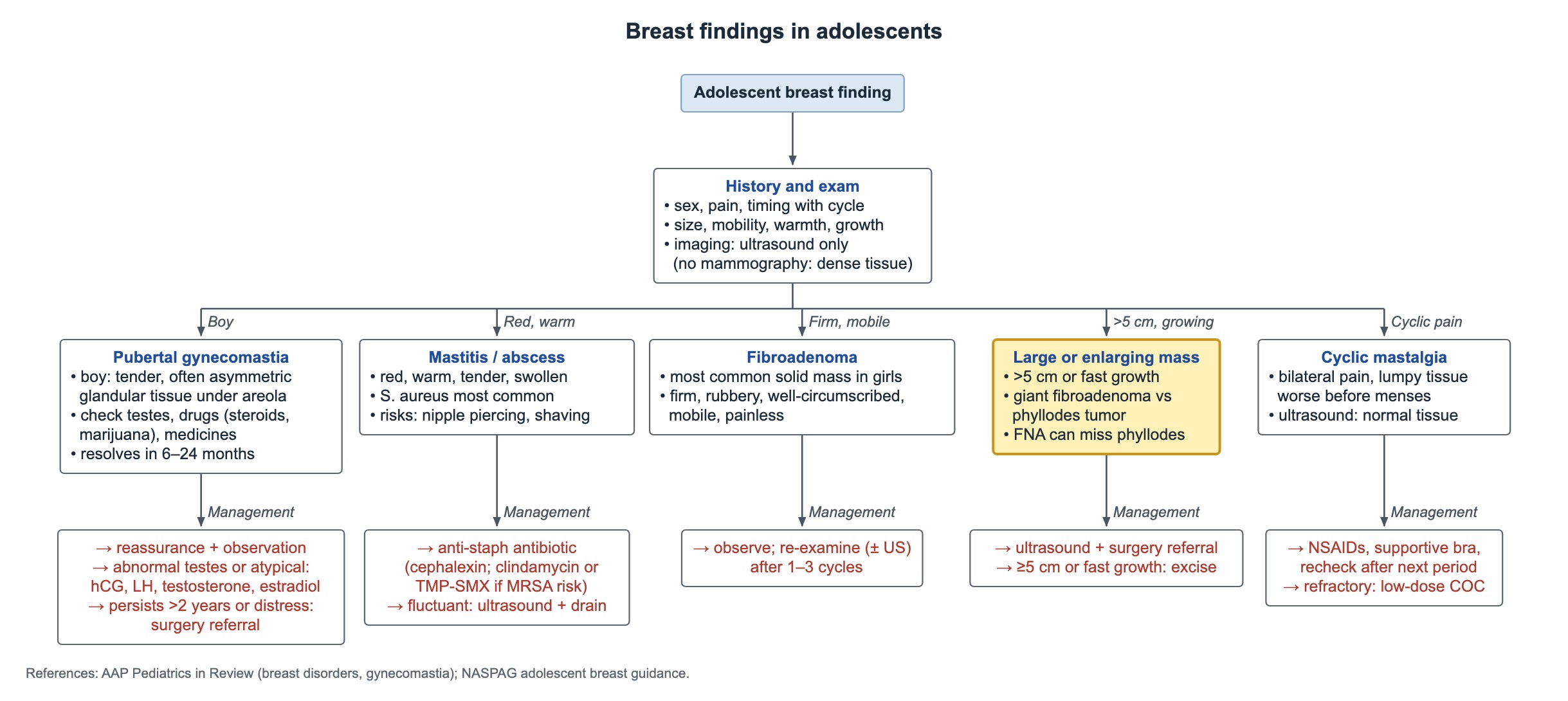
A mass larger than about 5 cm, or one that grows quickly, may be a giant (juvenile) fibroadenoma or a phyllodes tumor. Phyllodes tumors are rare in teens and usually benign, but some are malignant and they can recur.
A painless, rapidly enlarging mass is the classic phyllodes picture.
- Get an ultrasound and refer to a surgeon.
- Mass 5 cm or larger, or fast growth: complete surgical excision.
- Fine-needle aspiration is not enough: it can miss phyllodes, because the cells overlap with fibroadenoma. The whole lesion needs histology.
Cyclic breast pain and fibrocystic change
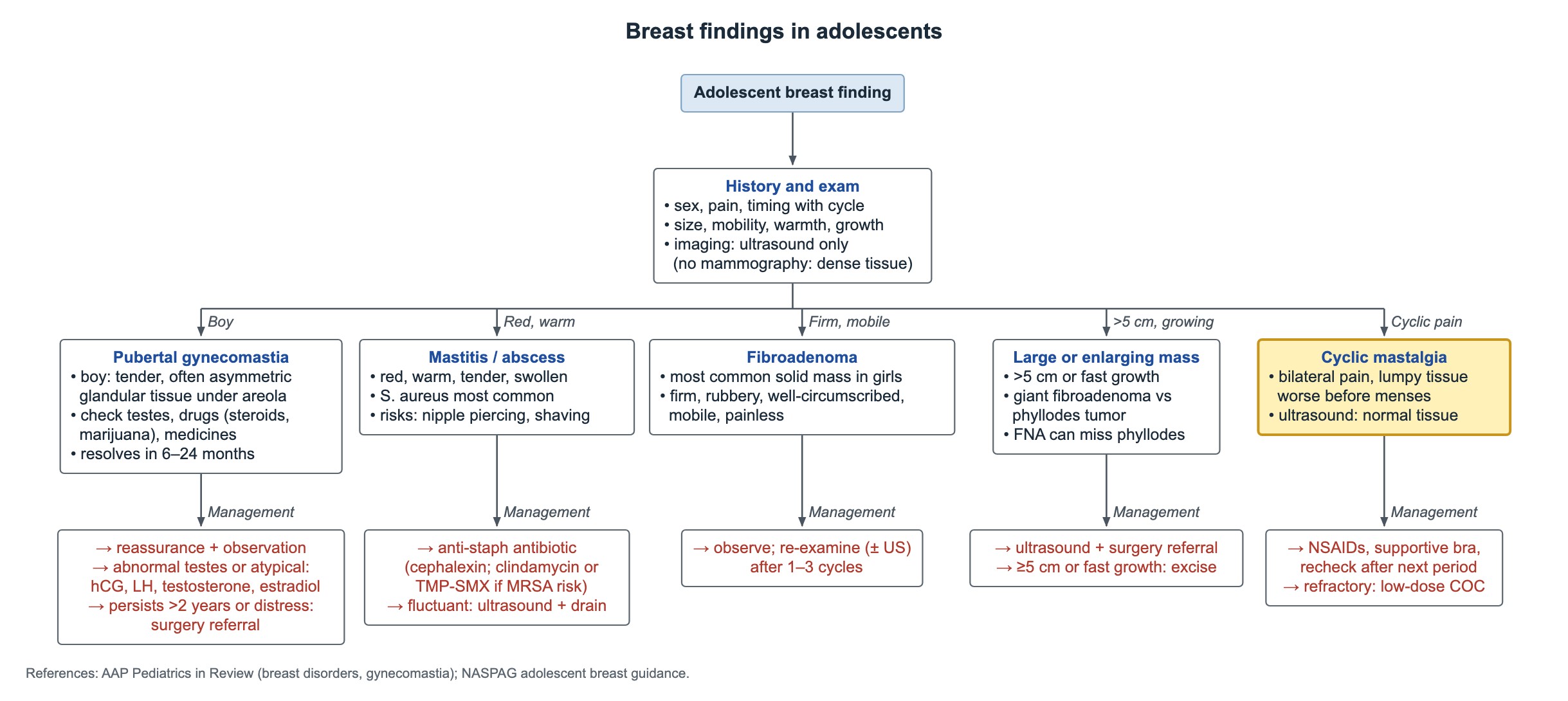
Fibrocystic change causes pain in both breasts with diffuse lumpy tissue that is worse in the days before menses. On ultrasound the tissue looks like normal breast tissue.
- First steps: an NSAID, a well-fitting supportive bra, and a recheck after the next period.
- Pain that persists despite bra and NSAIDs: a low-dose combined oral contraceptive can help.
- A discrete lump that does not change with the cycle is managed as a mass, not as cyclic change.
Mastitis and breast abscess
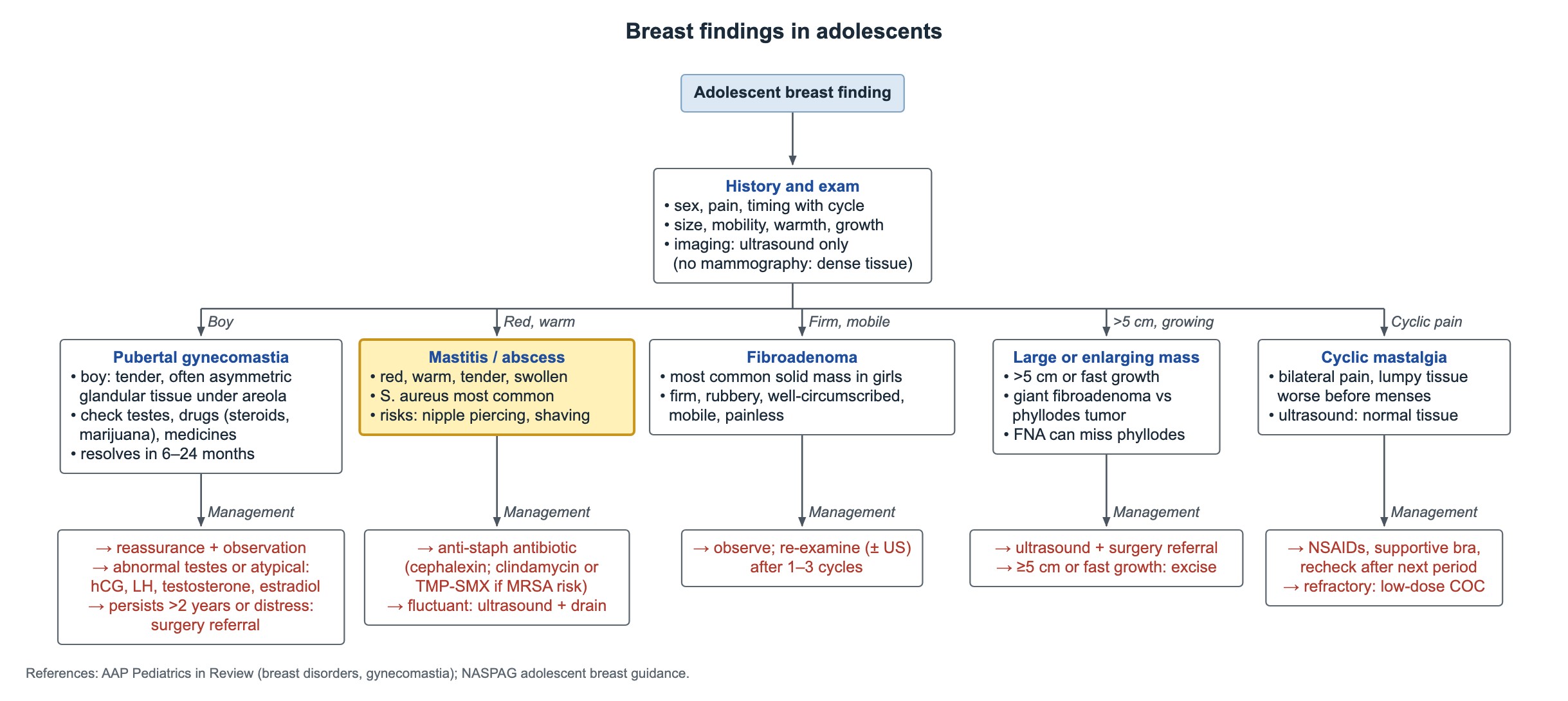
A red, warm, tender, swollen area points to mastitis, not a fibroadenoma. In a non-lactating teen the usual cause is Staphylococcus aureus; nipple piercing and shaving or plucking periareolar hair are risk factors.
- Treat with an anti-staphylococcal antibiotic such as cephalexin.
- If MRSA is a concern: clindamycin or trimethoprim-sulfamethoxazole.
- A fluctuant area suggests an abscess: confirm with ultrasound and drain.
Pubertal gynecomastia
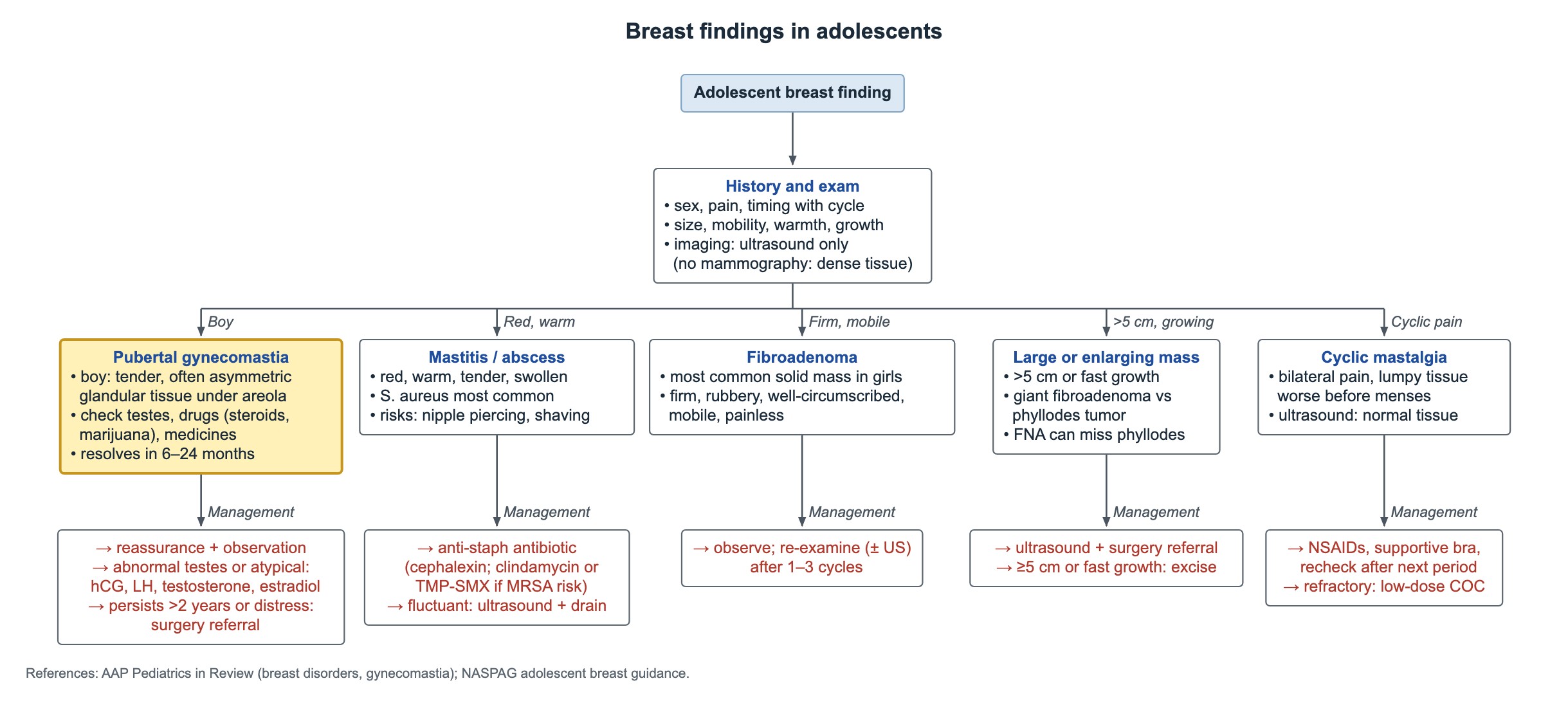
Many boys develop glandular breast tissue under the areola in mid-puberty. It is often tender and asymmetric or one-sided; these features alone do not suggest cancer.
- Examine the testes and ask about anabolic steroids, marijuana and medicines.
- Typical gynecomastia with normal testes: reassure and observe. It usually resolves over 6–24 months.
- Abnormal testes or atypical features (prepubertal, very large, fast growth): check hCG, LH, testosterone and estradiol.
- Persisting more than 2 years or causing distress: refer for surgery.
Common questions
Should a teenager with a breast lump get a mammogram?
No. Ultrasound is the imaging test for adolescents. Dense breast tissue makes mammography hard to interpret.
When is a breast lump in a teen removed?
When it is 5 cm or larger, grows quickly or persists with concerning features. Complete excision rules out a phyllodes tumor.
How long does gynecomastia last in puberty?
Most pubertal gynecomastia goes away on its own within 6 to 24 months.
Study this topic
Sources
- ACR Appropriateness Criteria: Palpable Breast Masses, 2022 update (J Am Coll Radiol)
- Breast development and disorders in children and adolescents (Curr Probl Pediatr Adolesc Health Care 2023)
- Benign and malignant breast lesions in children and adolescents (Front Pediatr 2024)
Written for Pedemy in our own words from the sources above; checked November 2026. For education only, not medical advice; check doses and local protocols before treating a patient. Pedemy is independent and not affiliated with or endorsed by the organizations cited.