

Main decision tree
Eating disorders: pattern and danger signs
Key points
- Admit for heart rate <50 awake or <45 asleep, BP <90/45, temperature <35.6 °C (96 °F), large orthostatic change, or ≤75% of median BMI.
- Bulimia nervosa: binge eating plus compensatory behavior at least once a week for 3 months.
- Vomiting causes hypochloremic, hypokalemic metabolic alkalosis; with low potassium, get an ECG first.
- Refeeding syndrome: phosphate falls first, usually on days 2–4; potassium and magnesium also fall.
- Family-based treatment is first-line therapy for adolescents with anorexia nervosa.
- ARFID: restriction without body-image concern; younger, more often male, at any weight.
- RED-S amenorrhea: restore energy availability; the combined pill does not protect bone.
Anorexia nervosa
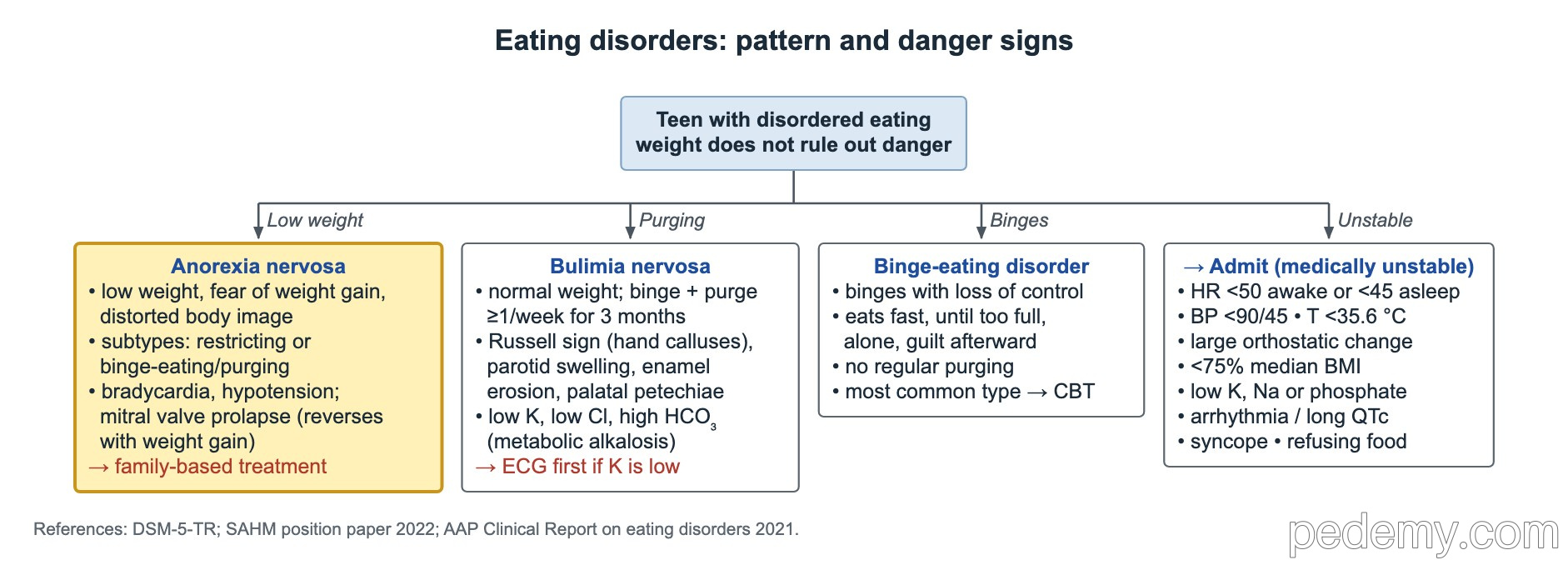
The tree sorts a teen with disordered eating by pattern: low weight, purging, binges, or medical instability. Weight alone never rules out danger.
Anorexia nervosa is restriction leading to low weight, with intense fear of weight gain and a distorted body image. DSM-5-TR asks you to specify the subtype: restricting, or binge-eating/purging.
- Common findings: bradycardia, hypotension, hypothermia and cold intolerance.
- Mitral valve prolapse is common and resolves with weight restoration.
- Atypical anorexia: all criteria, but weight is still normal or high after a large loss. The medical risks are the same.
- Treatment for a medically stable teen: family-based treatment, in which parents take charge of refeeding at home.
Bulimia nervosa and binge-eating disorder
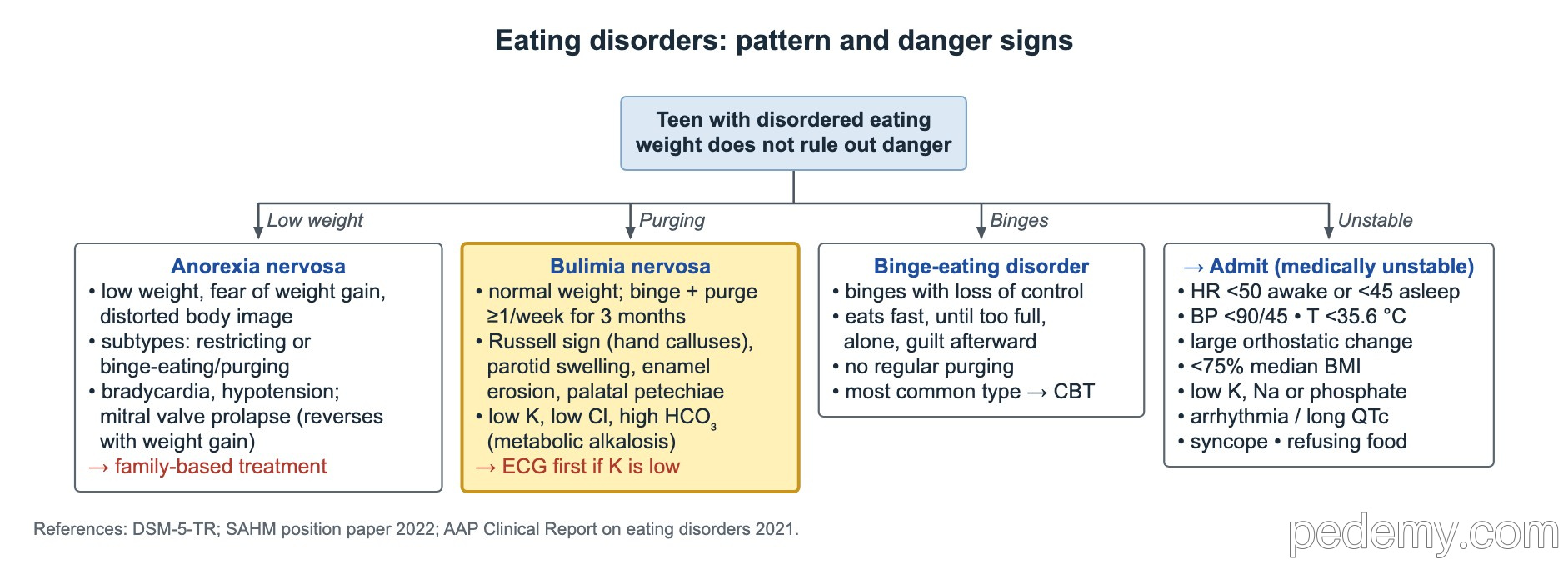
Bulimia nervosa is recurrent binge eating with compensatory behavior, such as vomiting, laxatives or exercise, on average at least once a week for 3 months. Weight is usually normal.
- Signs of vomiting: Russell sign (calluses on the back of the hand), parotid swelling, dental enamel erosion, palatal petechiae, heartburn.
- Labs: low potassium, low chloride and high bicarbonate (hypochloremic, hypokalemic metabolic alkalosis).
- Unexplained low potassium in a teen suggests hidden purging.
- Potassium very low (for example 2.8 mmol/L): get an ECG before anything else to look for arrhythmia and a long QTc.
- Binge-eating disorder: binges with loss of control, eating faster than normal, until uncomfortably full, often alone with guilt afterward, and no regular purging. It is the most common eating disorder; CBT is first-line.
Who needs admission
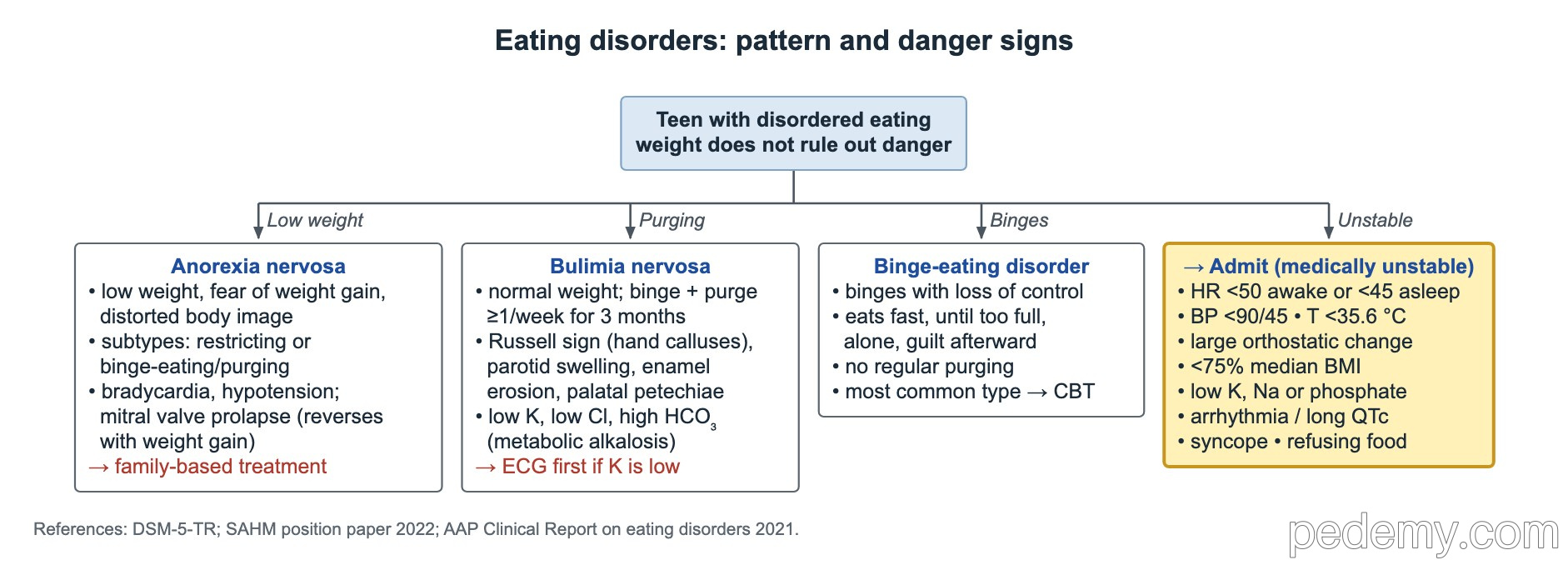
Most adolescents with eating disorders are treated as outpatients. The SAHM 2022 position paper lists findings that mean medical instability and hospital admission; any one is enough.
- Heart rate <50 beats/min awake or <45 asleep.
- Blood pressure <90/45 mm Hg.
- Temperature <35.6 °C (96 °F).
- Orthostatic heart rate rise >40 beats/min in adolescents, or a fall in BP >20 systolic or >10 diastolic.
- Weight ≤75% of median BMI for age and sex.
- Low potassium, sodium or phosphate; dehydration; arrhythmia or long QTc.
- Syncope, acute food refusal, uncontrollable bingeing and purging, or failed outpatient treatment.
Refeeding syndrome
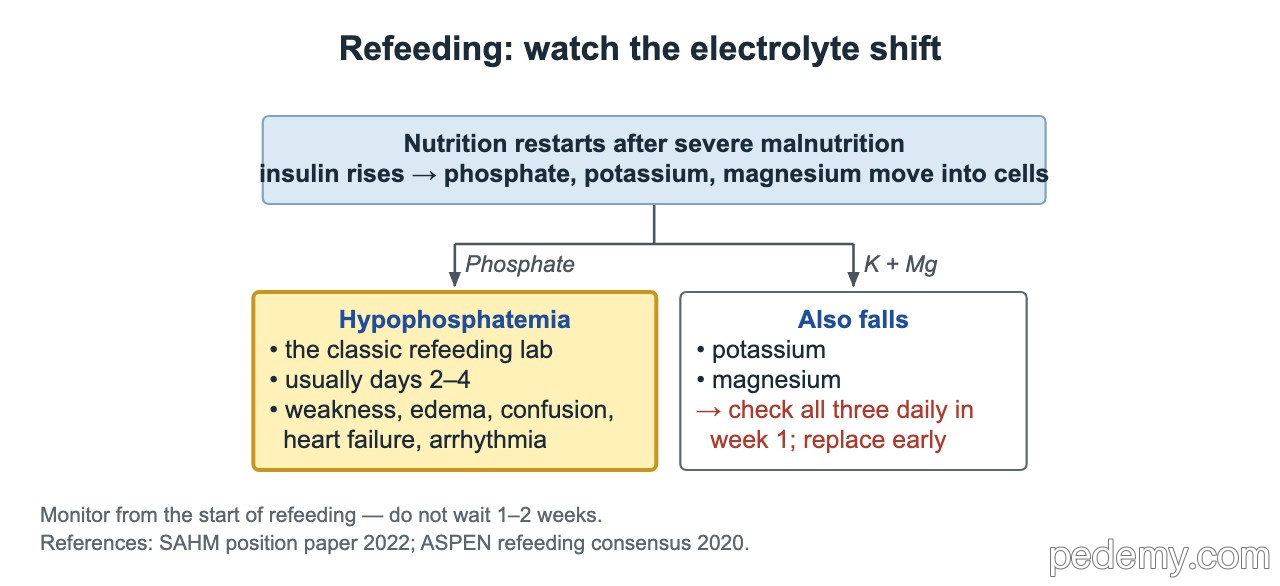
When nutrition restarts after severe malnutrition, insulin rises and drives phosphate, potassium and magnesium into cells. Low phosphate is the classic finding, usually on days 2–4.
- Signs: new weakness, edema, confusion, heart failure or arrhythmia.
- Check phosphate, potassium and magnesium daily in the first week and replace early.
- Inpatient refeeding can start at higher calories (about 2,000 kcal/day) and advance quickly, with close electrolyte monitoring.
What malnutrition does to the body
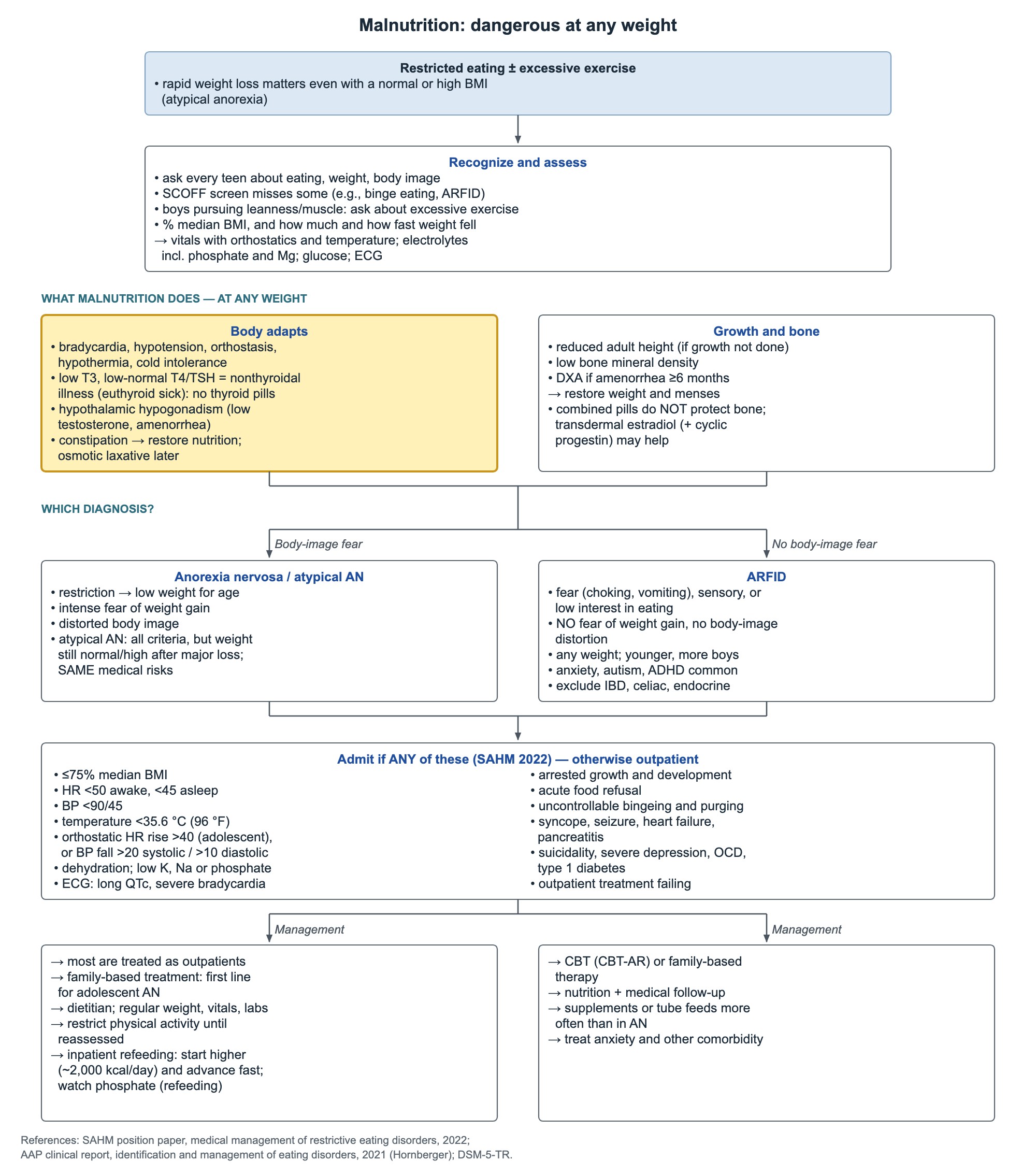
Ask every teen about eating, weight and body image. A large recent weight loss is malnutrition even if BMI is normal or high. The SCOFF questionnaire can miss binge eating and ARFID. In boys pursuing leanness or muscle, ask about excessive exercise.
| Finding | Meaning | What to do |
|---|---|---|
| Low T3 with low or low-normal T4 and TSH | Nonthyroidal illness (euthyroid sick) | No thyroid medicine; refeed |
| Low testosterone in a boy, or amenorrhea | Functional hypogonadotropic (hypothalamic) hypogonadism | Restore weight |
| Constipation | Slow gut from starvation | Nutritional rehabilitation; osmotic laxative if needed |
| Bradycardia, cold intolerance, overexercise | Energy deficit | Limit physical activity until reassessed |
| Malnutrition during puberty | Short adult height and low bone density | DXA if amenorrhea for 6 months or more; restore weight and menses |
ARFID
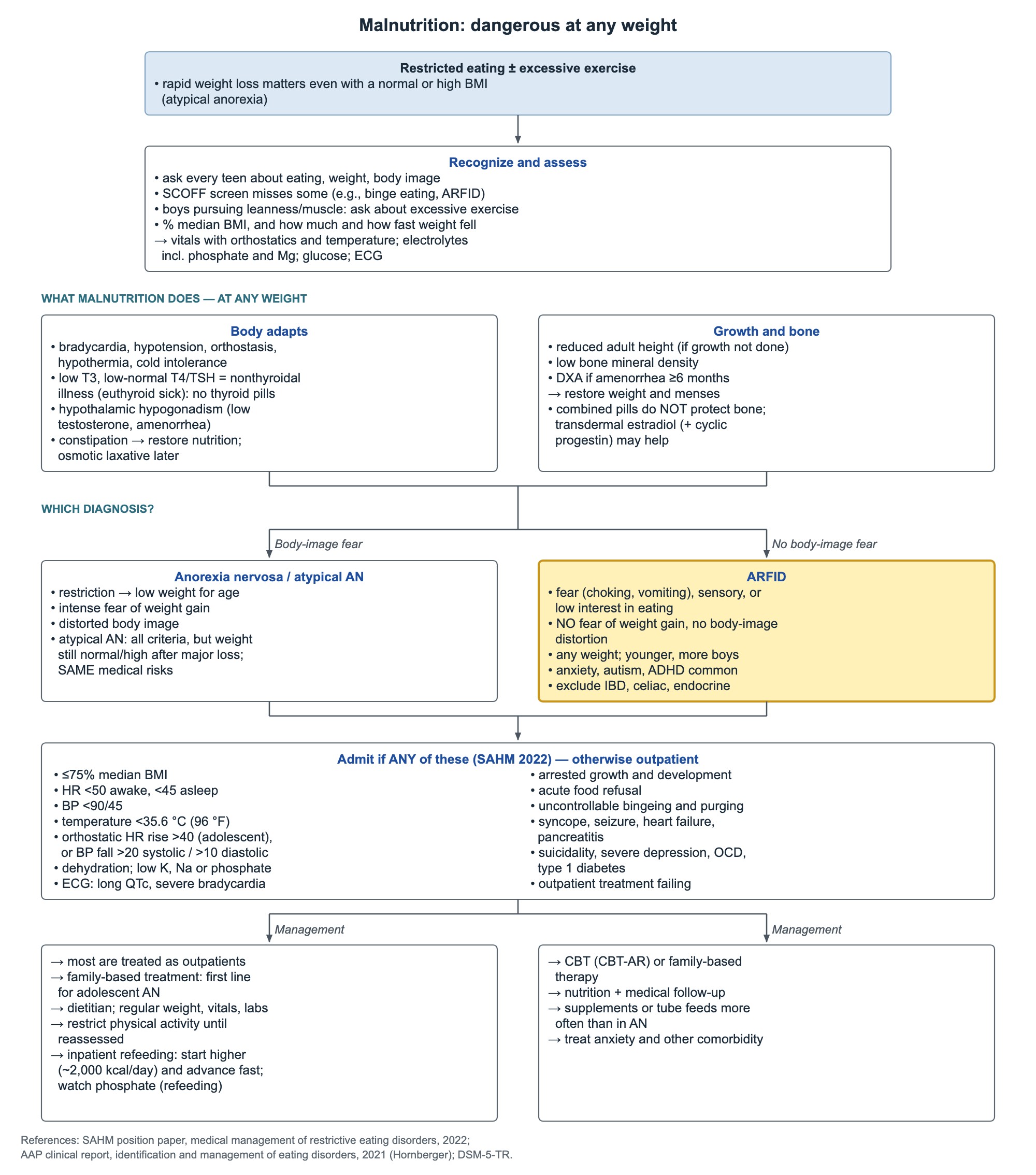
Avoidant/restrictive food intake disorder (ARFID) is food restriction without fear of weight gain or a distorted body image. It must not be explained by body-image concerns, another medical or mental condition, cultural practice or lack of food.
- Three typical drivers: low interest in eating, sensory aversion to foods, and fear of aversive consequences such as choking or vomiting.
- The patient can be underweight, normal weight or overweight.
- Compared with anorexia nervosa: younger and more often male.
- Common comorbidities: anxiety, autism spectrum disorder, ADHD and learning or developmental disorders.
- With weight loss, exclude IBD, celiac disease, malignancy and endocrine disorders.
- Treatment: CBT or family-based therapy, plus nutrition and medical monitoring. Supplements or tube feeding are needed more often than in anorexia nervosa.
RED-S and the female athlete triad
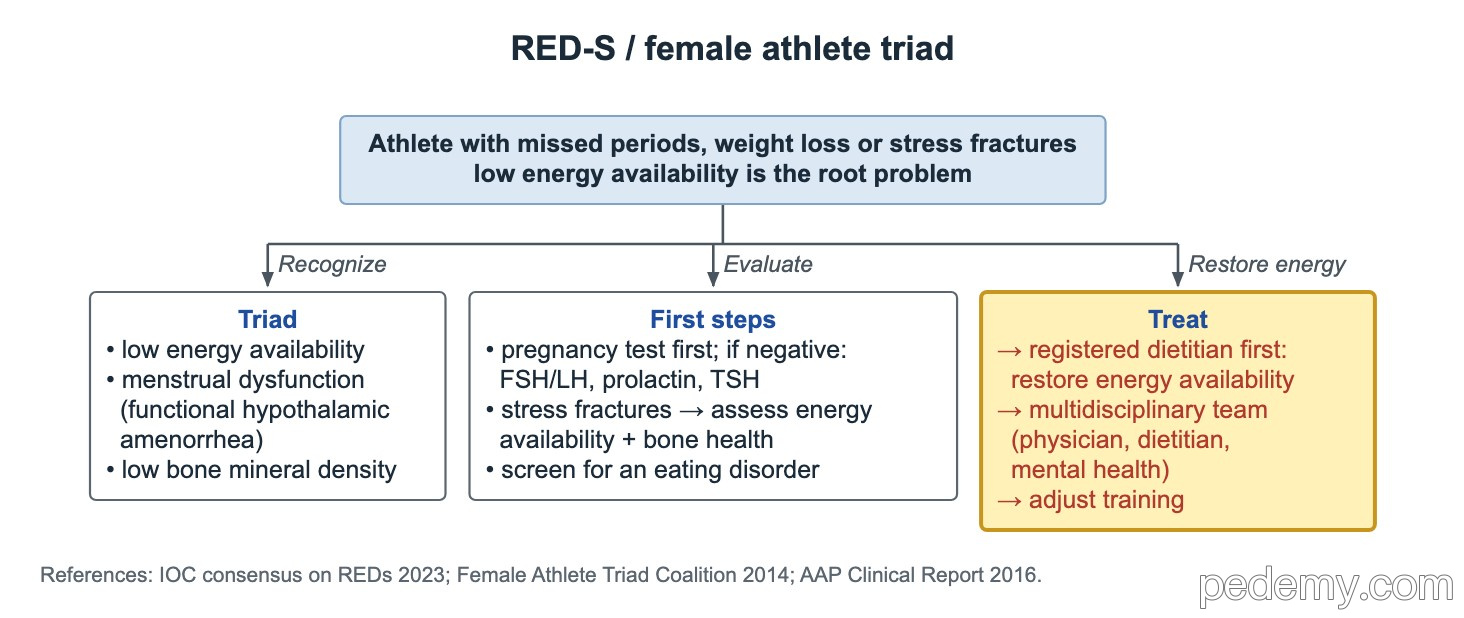
Relative energy deficiency in sport (RED-S) comes from low energy availability: too little intake for the training load. The female athlete triad is low energy availability with menstrual dysfunction and low bone mineral density.
- Athlete with amenorrhea: pregnancy test first; if negative, FSH, LH, prolactin and TSH.
- Amenorrhea with recurrent stress fractures: assess energy availability and bone health, and screen for an eating disorder.
- First referral: a registered dietitian to restore energy availability.
- Treat with a multidisciplinary team (physician, dietitian, mental health) and adjust training.
- Do not use a combined oral contraceptive to protect bone: it brings back bleeding but not bone health. Restore energy intake instead.
Common questions
What heart rate means a teen with anorexia needs to be admitted?
A heart rate below 50 beats per minute while awake, or below 45 while asleep, meets SAHM criteria for admission.
Which electrolyte drops in refeeding syndrome?
Phosphate is the classic one, usually on days 2 to 4 of refeeding. Potassium and magnesium also fall.
What is the difference between ARFID and anorexia?
Both restrict food, but ARFID has no fear of weight gain or body-image distortion. It is driven by low interest, sensory aversion or fear of choking or vomiting.
Study this topic
Sources
- SAHM 2022: Medical management of restrictive eating disorders in adolescents and young adults (J Adolesc Health)
- AAP 2021: Identification and management of eating disorders in children and adolescents (Pediatrics)
- IOC 2023 consensus statement on Relative Energy Deficiency in Sport (Br J Sports Med)
- Endocrine Society 2017: Functional hypothalamic amenorrhea guideline (J Clin Endocrinol Metab)
Written for Pedemy in our own words from the sources above; checked November 2026. For education only, not medical advice; check doses and local protocols before treating a patient. Pedemy is independent and not affiliated with or endorsed by the organizations cited.