

Main decision tree
Puberty: order of events
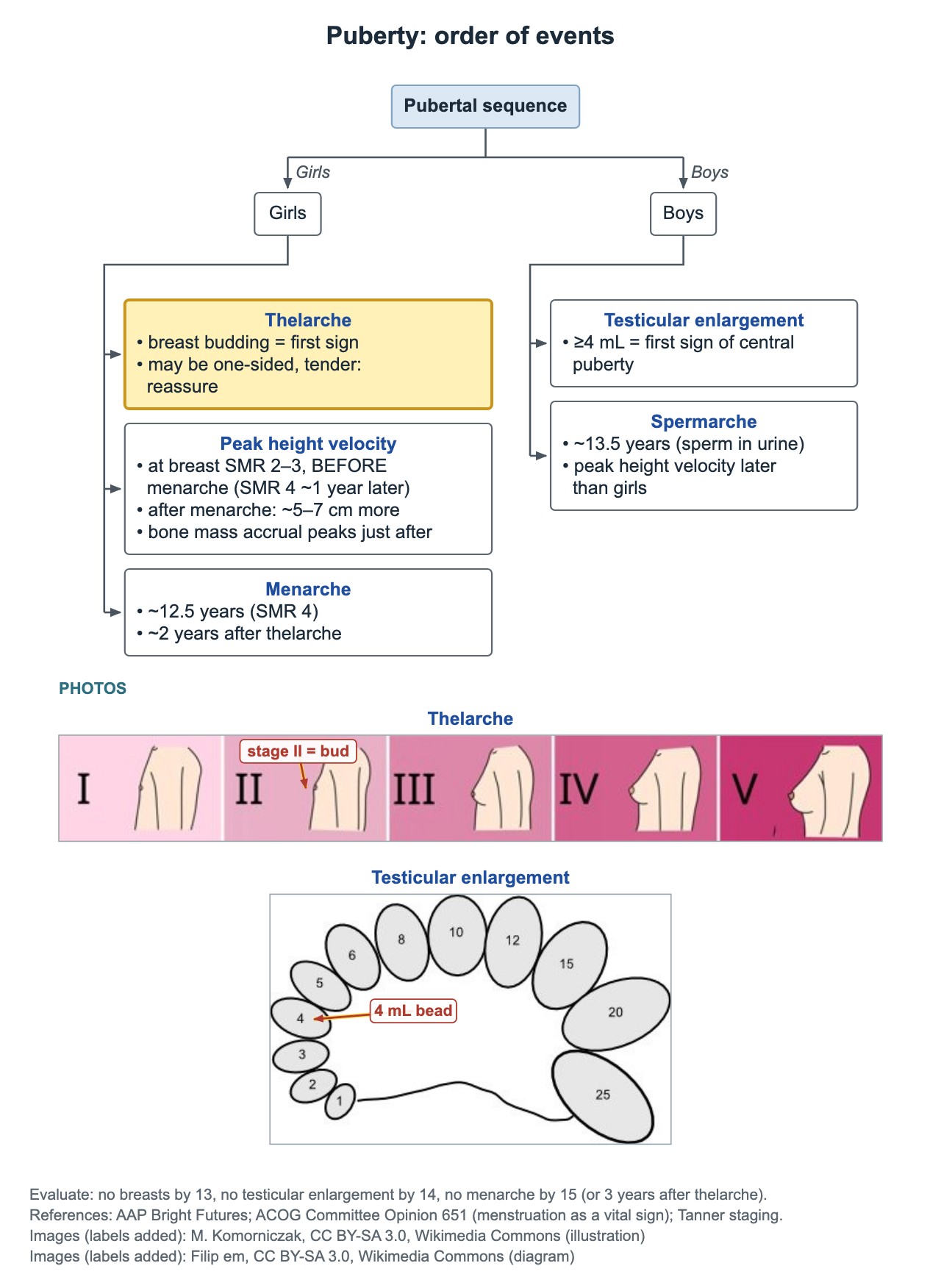
Key points
- Girls: breast budding (thelarche) is the first sign of puberty; it may start on one side and be tender.
- Boys: testicular volume ≥4 mL (or length ≥2.5 cm) is the first sign of central puberty.
- Girls reach peak height velocity at breast SMR 2–3, before menarche; boys reach it later.
- Menarche comes about 2 years after thelarche, at about 12.5 years (US median about 12.4), usually at SMR 4.
- After menarche, most girls grow only about 5–7 cm more over 1–2 years.
- Spermarche (sperm in the urine) happens at about 13.5 years.
- Evaluate: no breasts by 13, no testicular enlargement by 14, no menarche by 15 or more than 3 years after thelarche.
The order of puberty in girls
In most girls the first physical sign of puberty is a breast bud (thelarche, SMR 2): a small firm disc of tissue under the areola. Pubic hair usually follows soon after.
The order is thelarche, then the growth spurt, then menarche. A girl who has had her first period is past her fastest growth.
- A breast bud often appears on one side first, and it can be tender.
- A tender lump under one nipple in an early-pubertal girl is almost always a normal asymmetric bud: reassure and recheck.
- Do not biopsy or remove a breast bud; removing it can stop that breast from developing.
- The other breast usually catches up within months.
Peak height velocity and the growth spurt
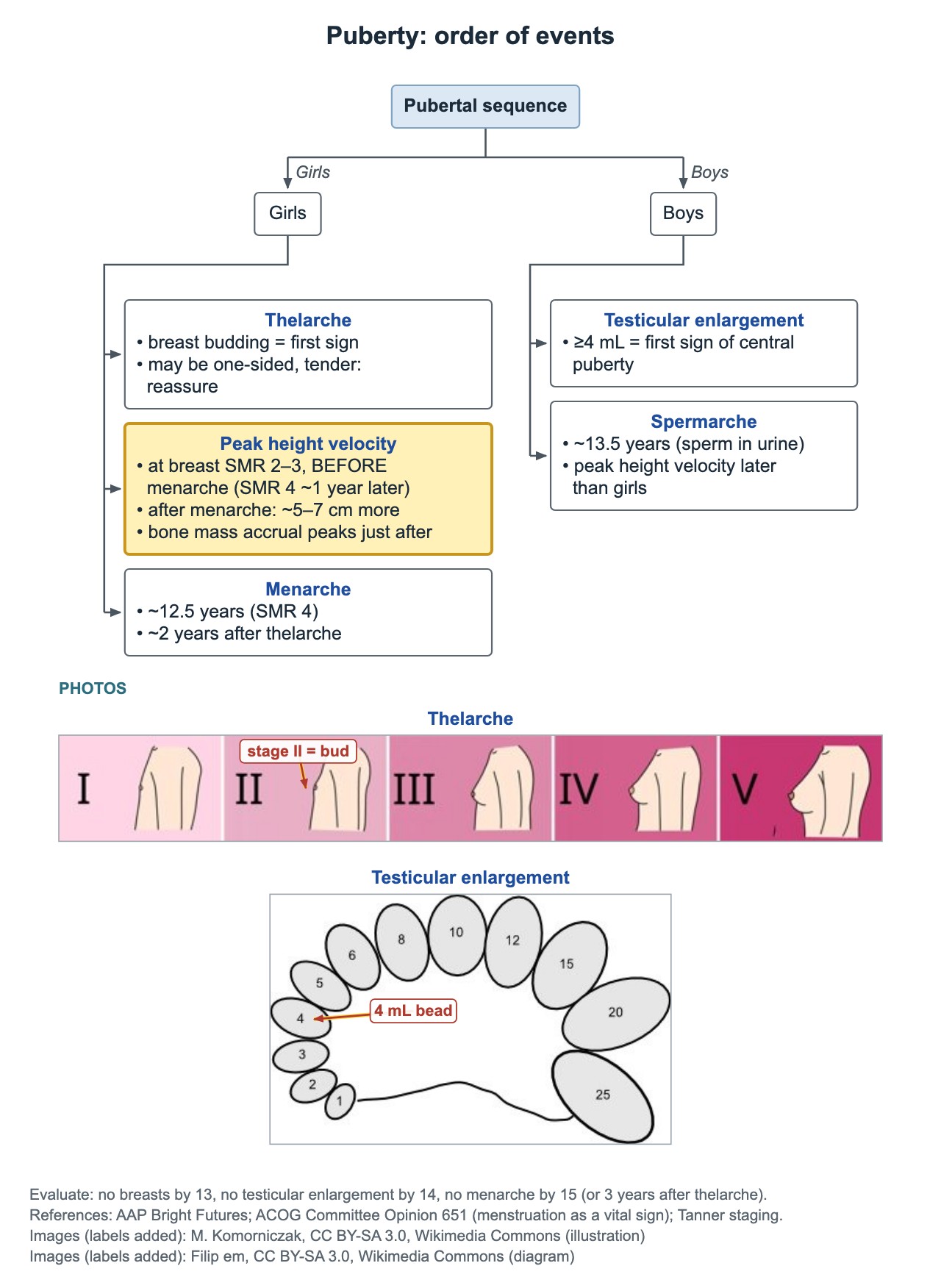
Girls have their growth spurt early in puberty, at breast SMR 2–3. About a year after peak height velocity most girls are at breast SMR 4, and menarche follows.
Because menarche comes after the growth spurt, a girl who has started her periods has only about 5–7 cm of growth left, spread over the next 1–2 years.
Boys have their growth spurt later in puberty (around genital SMR 3–4), which is one reason adult men are taller on average.
- Bone mass accrual peaks just after peak height velocity, so calcium, vitamin D and weight-bearing exercise matter most in these years.
- Organs grow too: heart weight roughly doubles during puberty.
- Lean body mass rises more in boys; body fat rises more in girls.
Menarche: when to expect the first period
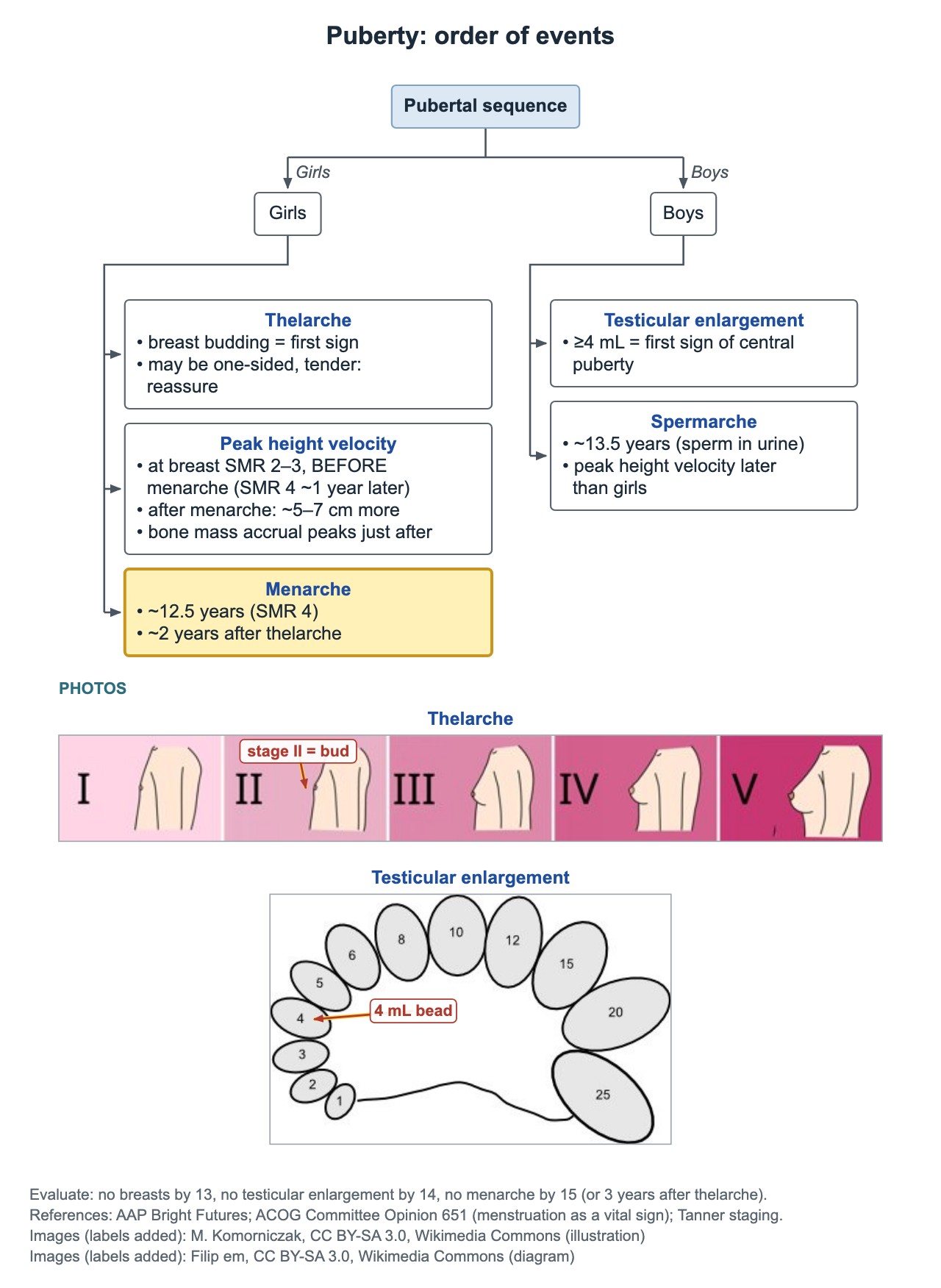
- Typical age: about 12.5 years in the US (median about 12.4 years); most girls start between 12 and 13.
- Timing: about 2 years after thelarche, usually at breast SMR 4.
- Menarche happens after peak height velocity, never before it in normal puberty.
- Early cycles are often irregular because many are anovulatory; most cycles are 21–45 days in the first years.
The order of puberty in boys
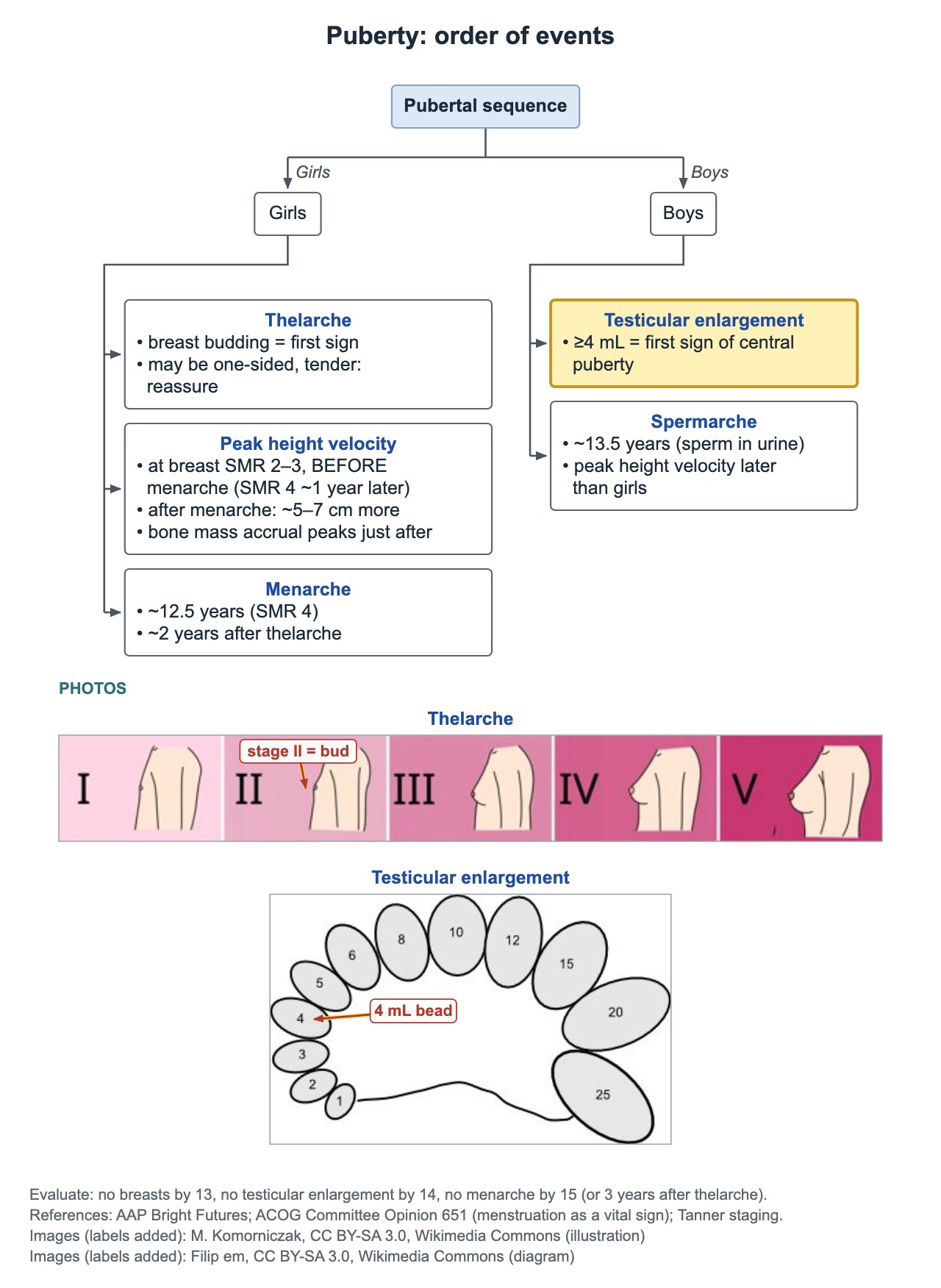
The first sign of central puberty in boys is testicular enlargement to a volume of 4 mL or more (a length of about 2.5 cm), measured with an orchidometer. Penile growth and pubic hair follow.
Spermarche, the first appearance of sperm in the urine, happens at about 13.5 years, in mid-puberty. Boys reach peak height velocity later than girls.
- Pubic hair or penile growth with small, prepubertal testes points to an adrenal or other peripheral androgen source, not central puberty.
- No testicular enlargement by age 14 needs an evaluation for delayed puberty.
When delayed puberty or amenorrhea needs a workup
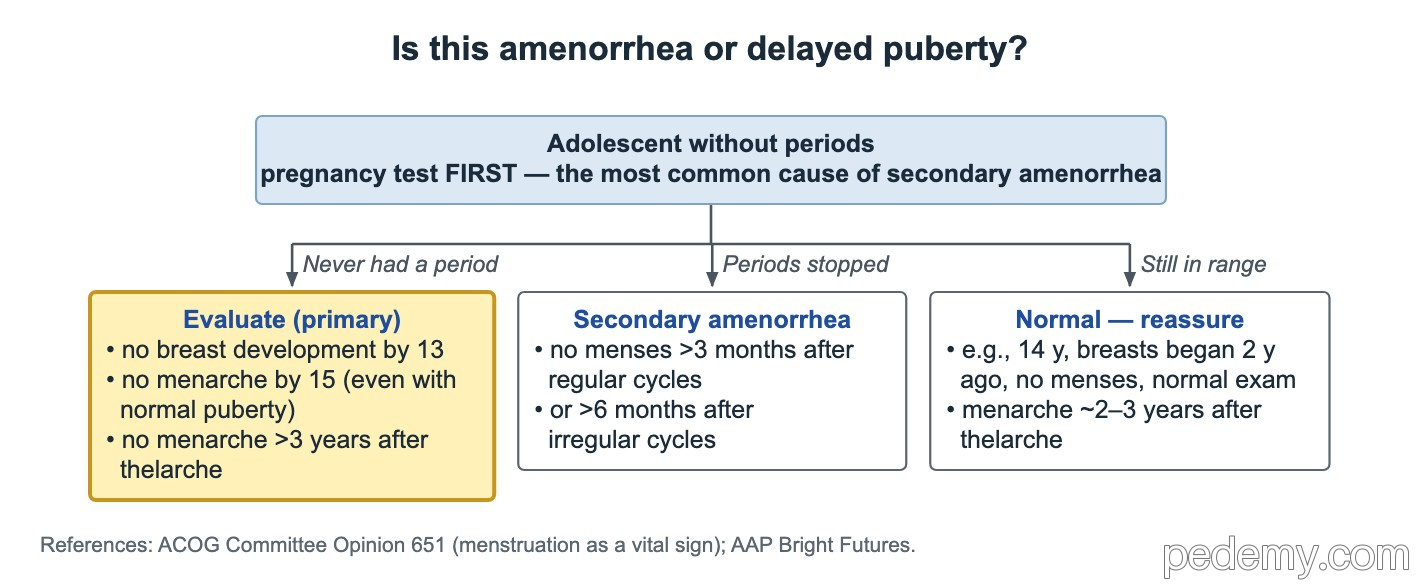
Start every evaluation of an adolescent without periods with a pregnancy test, even when she says she is not sexually active. Pregnancy is the most common cause of secondary amenorrhea.
| Finding | Action |
|---|---|
| No breast development by age 13 | Evaluate for delayed puberty |
| No menarche by age 15, even with normal breasts and pubic hair | Evaluate for primary amenorrhea |
| No menarche more than 3 years after thelarche | Evaluate for primary amenorrhea |
| No menses for more than 3 months after regular cycles, or more than 6 months after irregular cycles | Evaluate for secondary amenorrhea |
| No testicular enlargement by age 14 | Evaluate for delayed puberty |
Late but still normal
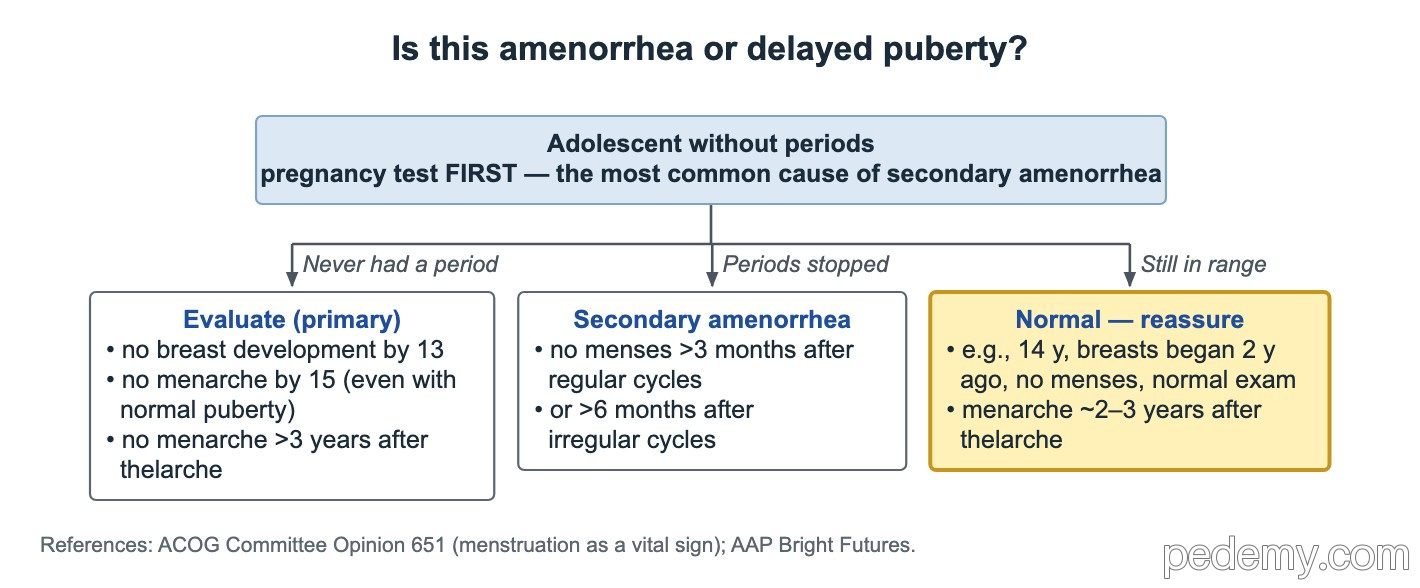
A 14-year-old whose breasts began developing 2 years ago, who has no periods yet and a normal exam, is still within the normal range. Menarche usually comes 2–3 years after thelarche.
Reassure, plot height and weight on the growth chart, and recheck. She needs an evaluation only if she reaches age 15 or 3 years past thelarche without a period, or if new concerning findings appear.
Common questions
What is the first sign of puberty in girls?
Breast budding (thelarche). It can start on one side and may be tender; this is normal.
What is the first sign of puberty in boys?
Testicular enlargement to 4 mL or more (about 2.5 cm long). Pubic hair and penile growth come later.
How much will a girl grow after her first period?
Usually about 5–7 cm (2–3 inches) more, over 1–2 years, because the growth spurt comes before menarche.
When should a girl with no period be evaluated?
If she has no period by age 15, no period more than 3 years after breast development started, or no breast development by age 13.
Study this topic
Sources
- ACOG Committee Opinion 651: Menstruation in girls and adolescents, using the menstrual cycle as a vital sign (Obstet Gynecol)
- AAP Bright Futures: Guidelines for health supervision of infants, children and adolescents
Written for Pedemy in our own words from the sources above; checked November 2026. For education only, not medical advice; check doses and local protocols before treating a patient. Pedemy is independent and not affiliated with or endorsed by the organizations cited.