

Main decision tree
Syndromes and their heart lesions: Turner
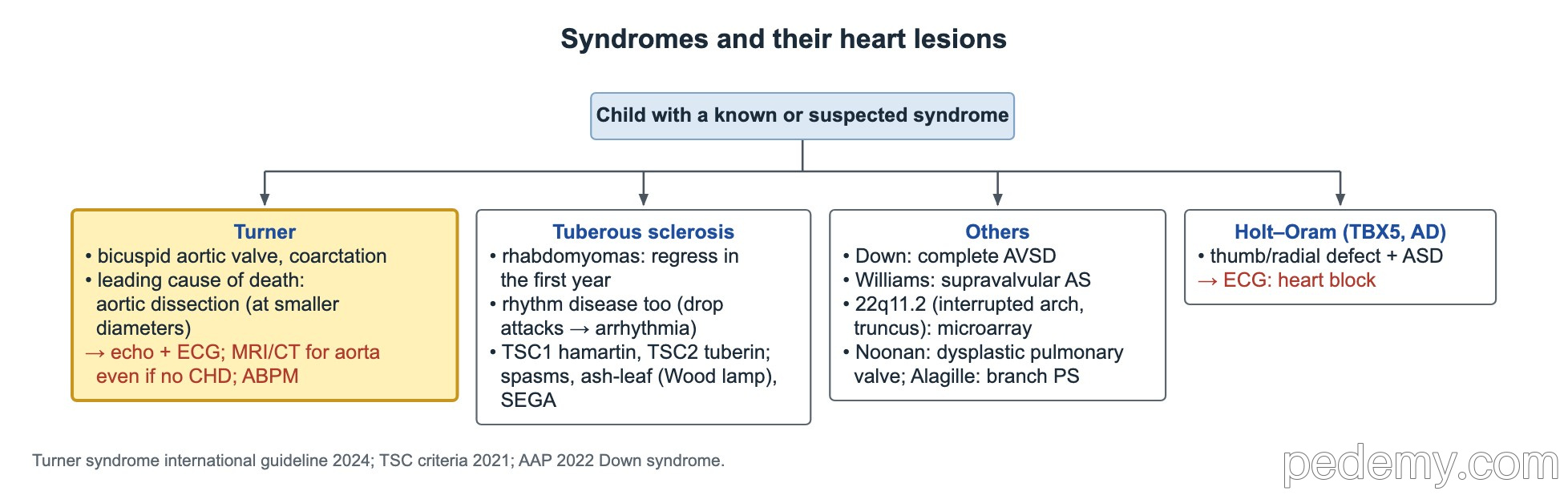
Key points
- Turner syndrome: bicuspid aortic valve and coarctation are the commonest lesions; aortic dissection is a leading cause of early death.
- New Turner diagnosis: echo and ECG; cardiac MRI (or CT) for the aorta even with a normal heart; ambulatory BP monitoring for masked hypertension.
- Down syndrome: complete AV septal defect is the commonest lesion; every newborn gets an echo, murmur or not.
- Williams syndrome: supravalvar aortic stenosis, which can involve the coronary ostia.
- Noonan: dysplastic pulmonary valve; Alagille: branch (peripheral) pulmonary artery stenosis.
- Tuberous sclerosis: cardiac rhabdomyomas that regress in early childhood; check the ECG for WPW.
- Holt-Oram (TBX5, autosomal dominant): thumb or radial defects with an ASD; ECG for heart block.
Turner syndrome
The two most common heart lesions in Turner syndrome are a bicuspid aortic valve and coarctation of the aorta. Cardiovascular disease, including aortic dissection, is a leading cause of premature death, so the aorta is watched for life.
- At diagnosis: echocardiogram and ECG.
- Aortic imaging: cardiac MRI is preferred in older children and teens; CT angiography if MRI is not available.
- Surveillance is still needed when the heart's anatomy is normal.
- Do not use adult aortic diameter cut-offs: girls with Turner syndrome are short and can dissect at smaller diameters, so the aorta is indexed to body size.
- Blood pressure can be normal in clinic but high at other times; use 24-hour ambulatory BP monitoring to find masked hypertension.
Down syndrome and the AV septal defect
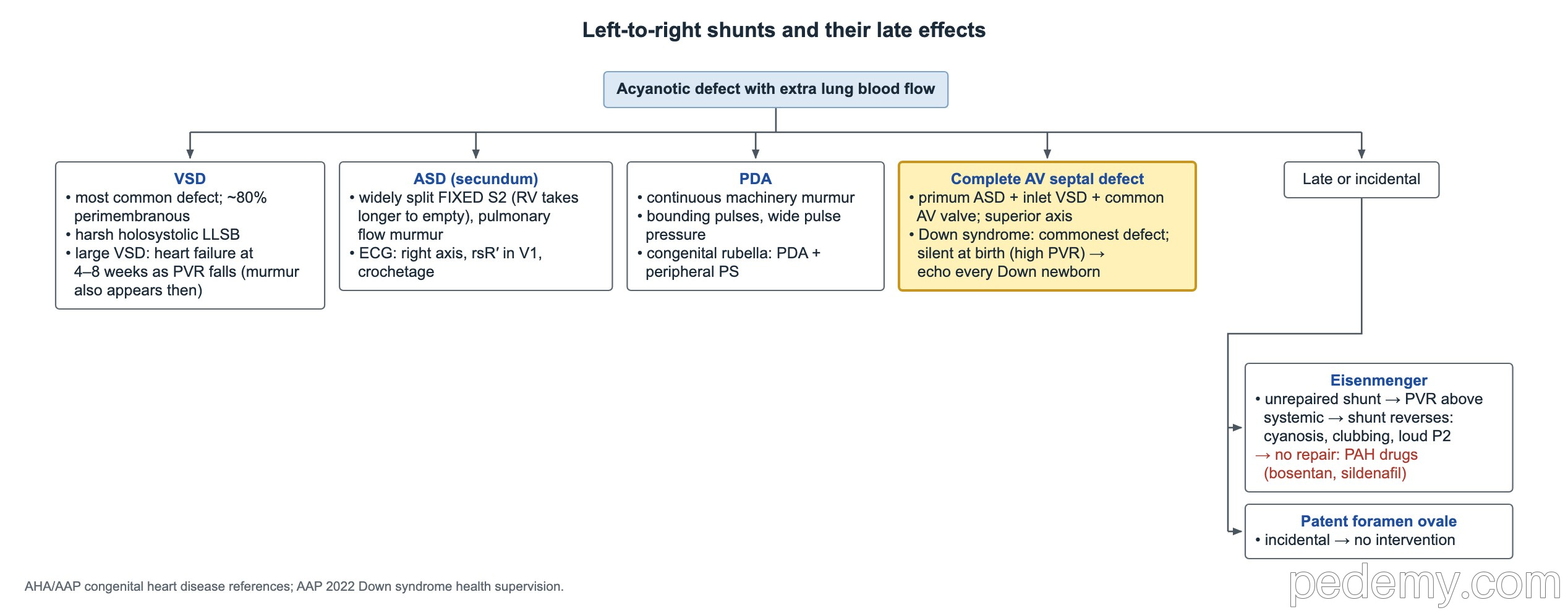
About half of children with Down syndrome have congenital heart disease. The most common lesion is a complete atrioventricular septal defect (AV canal: primum ASD, inlet VSD and a common AV valve); a VSD is next.
Every newborn with Down syndrome gets an echocardiogram read by a pediatric cardiologist, even without a murmur. Pulmonary vascular resistance is high after birth, so a large AV canal shunts little and may make no murmur at first.
Williams, 22q11.2 deletion, Noonan and Alagille
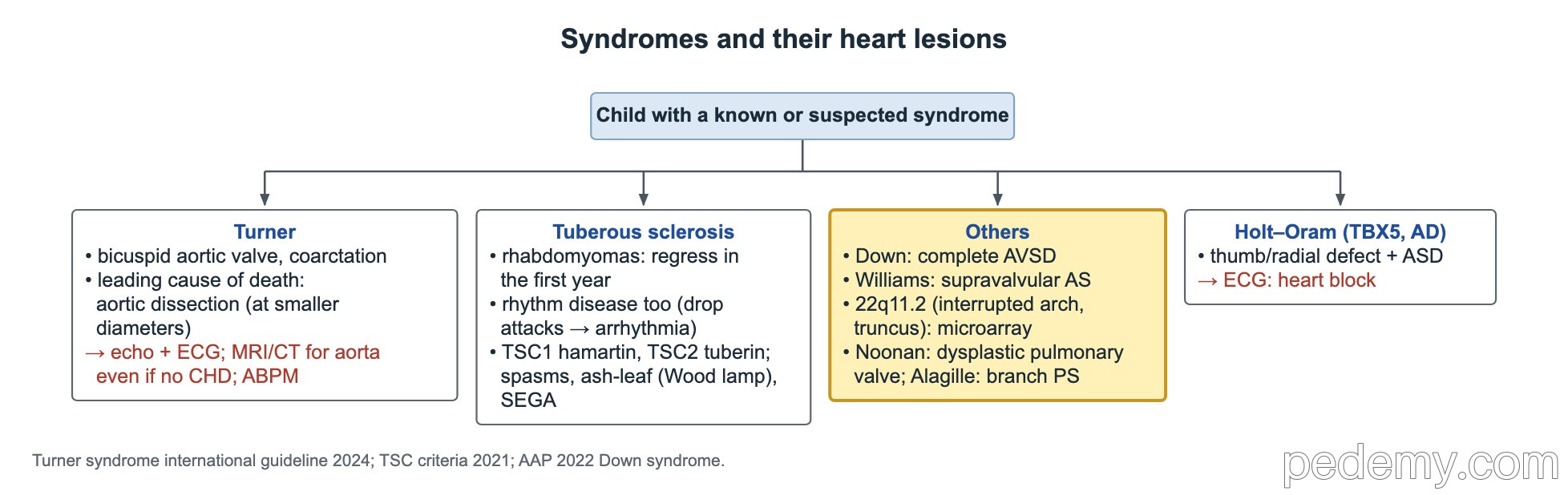
- Testing for 22q11.2 deletion in an infant with an interrupted aortic arch: chromosomal microarray, with genetics advice.
- A critically ill newborn who needs an answer in about 48 hours: FISH for 22q11.2.
| Syndrome | Heart lesion | Other clues |
|---|---|---|
| Williams (7q11.23, elastin) | Supravalvar aortic stenosis (above the valve); can narrow the coronary ostia; branch pulmonary stenosis | Elfin face, friendly personality, hypercalcemia, hypertension |
| 22q11.2 deletion | Interrupted aortic arch, truncus arteriosus, tetralogy of Fallot | Hypocalcemia, immune deficiency, cleft palate |
| Noonan | Dysplastic pulmonary valve stenosis; hypertrophic cardiomyopathy | Short stature, webbed neck, normal karyotype |
| Alagille (JAG1) | Peripheral (branch) pulmonary artery stenosis | Cholestasis from few bile ducts, butterfly vertebrae, posterior embryotoxon |
Tuberous sclerosis complex
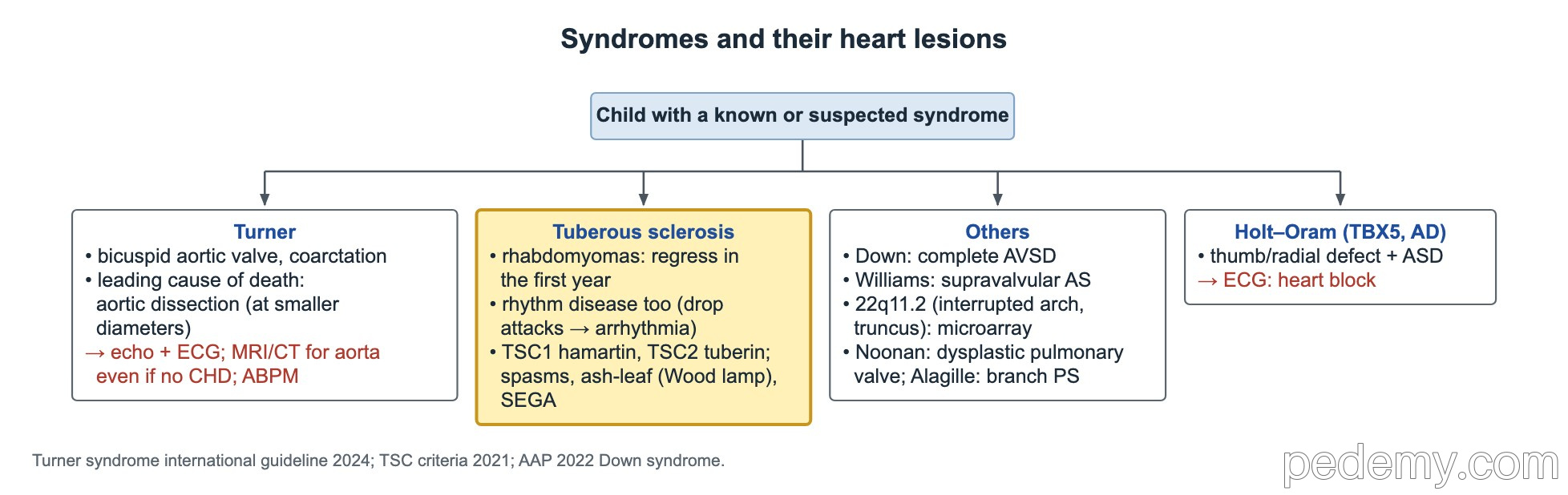
- The typical heart tumor in an infant with tuberous sclerosis is a rhabdomyoma, often seen first on prenatal ultrasound.
- Rhabdomyomas usually shrink and regress on their own in early childhood; treatment is needed only if they block flow or cause arrhythmia.
- The heart check covers structure (echo) and rhythm (ECG), because pre-excitation such as WPW and other arrhythmias occur.
- A child with TSC and sudden collapse episodes needs an arrhythmia ruled out, not only a seizure work-up.
- Typical seizure type in the first year: infantile spasms. Other clues: ash-leaf spots (Wood lamp), SEGA; genes TSC1 (hamartin) and TSC2 (tuberin).
Holt-Oram syndrome
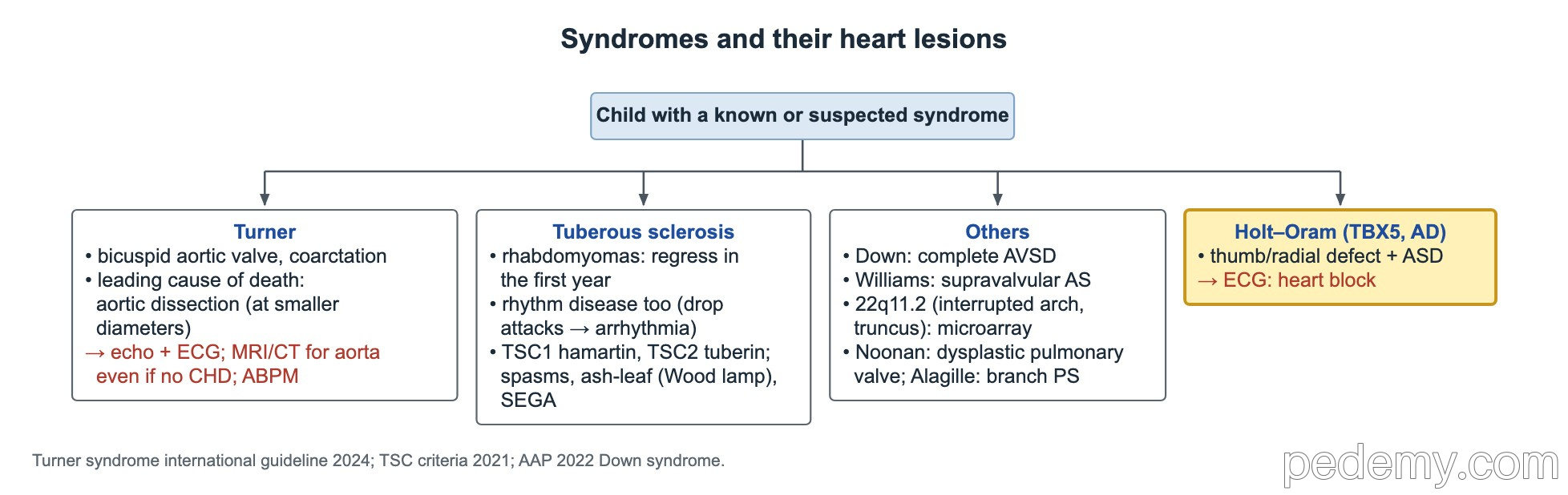
An absent, small or finger-like thumb (or another radial ray defect) with an ASD and a normal platelet count suggests Holt-Oram syndrome, caused by TBX5 variants and inherited as autosomal dominant. Normal platelets separate it from TAR syndrome.
Screen with an ECG for conduction disease: AV block can be present or develop over time.
Inherited long QT: Jervell and Lange-Nielsen
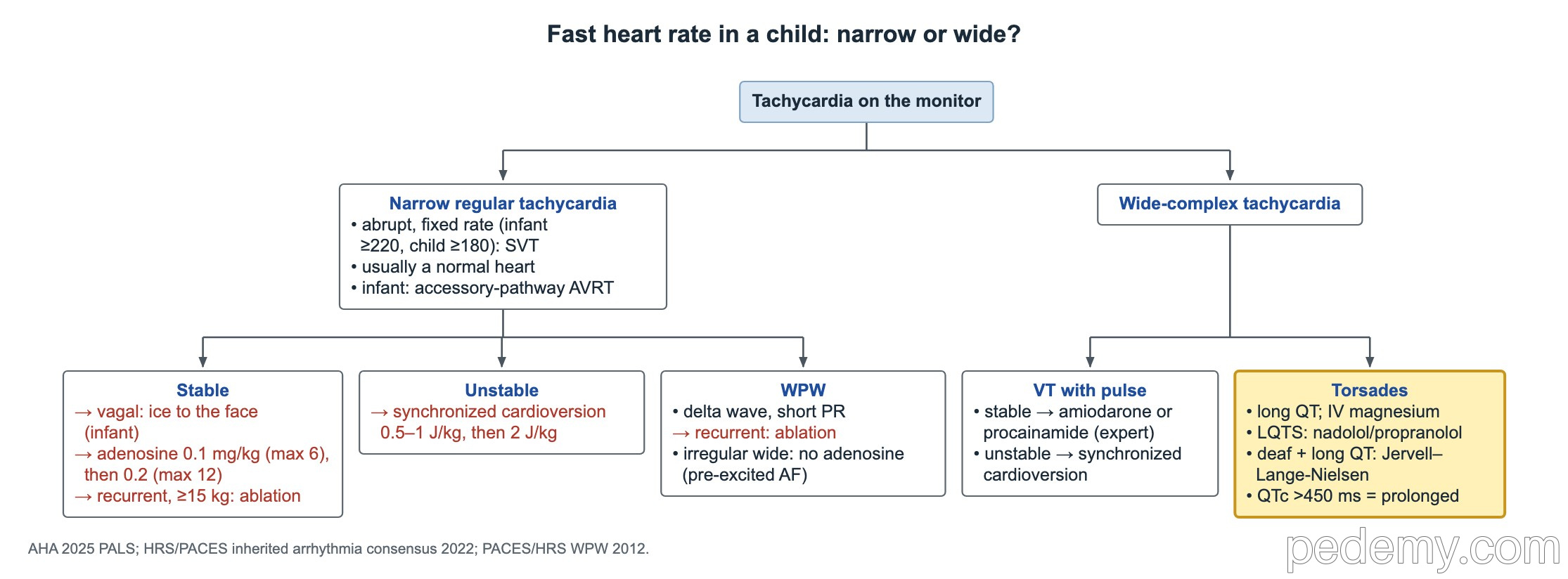
- Congenital sensorineural deafness plus a prolonged QT suggests Jervell and Lange-Nielsen syndrome, an autosomal recessive form of long QT with high risk.
- A QTc above 450 ms is prolonged in children.
- Long QT is treated with a β-blocker such as nadolol or propranolol.
- Torsades de pointes: IV magnesium.
Common questions
Why does every baby with Down syndrome need an echocardiogram?
About half have heart disease, and a large AV canal may make no murmur in the first days because pulmonary resistance is still high. The AAP advises an echo in the newborn period for every infant.
What heart problems are common in Turner syndrome?
Bicuspid aortic valve and coarctation of the aorta. Girls also need lifelong aortic monitoring because dissection can occur at smaller aortic sizes than in adults.
Which syndrome causes supravalvar aortic stenosis?
Williams syndrome, from a deletion that includes the elastin gene on chromosome 7q11.23.
Study this topic
Sources
- International Turner syndrome clinical practice guideline 2023 (Eur J Endocrinol 2024)
- AAP 2022: Health supervision for children and adolescents with Down syndrome (Pediatrics)
- AAP 2020: Health care supervision for children with Williams syndrome (Pediatrics)
- International tuberous sclerosis complex consensus recommendations 2021 (Pediatr Neurol)
Written for Pedemy in our own words from the sources above; checked November 2026. For education only, not medical advice; check doses and local protocols before treating a patient. Pedemy is independent and not affiliated with or endorsed by the organizations cited.