

Main decision tree
Chest pain in a child
Key points
- Cardiac red flags: pain or syncope during exercise, palpitations, family history of sudden death or cardiomyopathy, or an abnormal heart exam.
- Chest pain or near-syncope during exercise: get a 12-lead ECG first, looking for long QT, WPW and HCM.
- Typical vasovagal syncope with a normal ECG: reassure; more fluid and salt, warning signs, counterpressure maneuvers.
- POTS: heart rate rises ≥40/min in teens within 10 minutes of standing, without hypotension.
- A murmur that gets louder on standing or Valsalva with exertional syncope suggests obstructive HCM.
- Commotio cordis: a blow to the chest during the T-wave upstroke causes ventricular fibrillation; start CPR and use an AED.
- A laterally displaced, prominent PMI on a sports physical needs cardiology review before clearance.
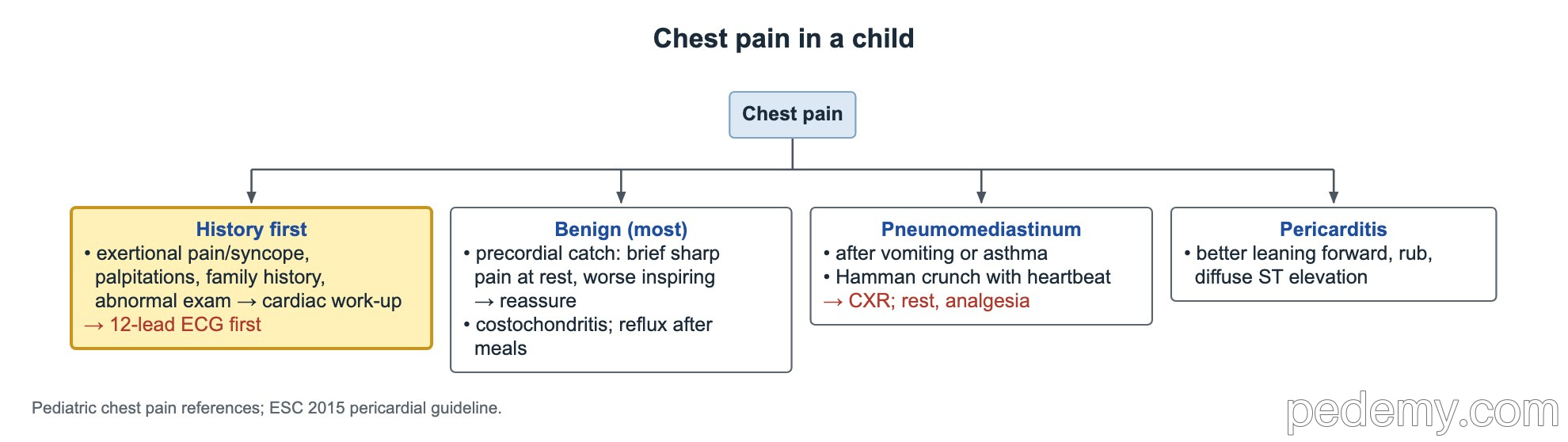
Chest pain: history first
Most chest pain in children is not from the heart. Before you call it benign, ask about the features that change the work-up.
- Pain or syncope during exertion.
- Palpitations.
- A family history of sudden death, cardiomyopathy or inherited arrhythmia.
- An abnormal heart exam: a new murmur, gallop or rub.
- With any of these, or with chest pain or near-syncope during exercise, the first test is a 12-lead ECG, looking for long QT, WPW and HCM.
- Pericarditis: pain that is better leaning forward, a rub and diffuse ST elevation.
Benign causes of chest pain
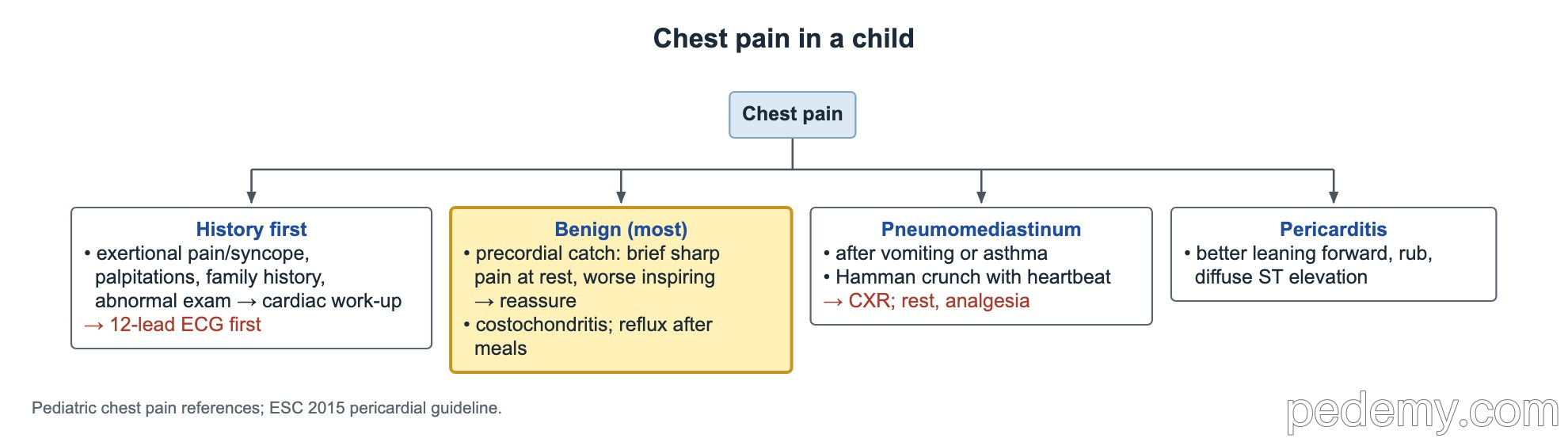
| Cause | Clues | What to do |
|---|---|---|
| Precordial catch syndrome | Brief, sharp, well-localized pain at rest, worse with deep breathing, gone within minutes | Reassure |
| Costochondritis | Sharp pain with twisting; pressing on the chest wall reproduces it; normal exam | Reassure; analgesia |
| Gastroesophageal reflux | Burning substernal pain after meals or when lying down | Treat reflux |
| Pneumomediastinum | Acute pain after vomiting or asthma; a crunching sound with each heartbeat (Hamman crunch) | Chest X-ray to confirm; rest and analgesia |
Vasovagal syncope
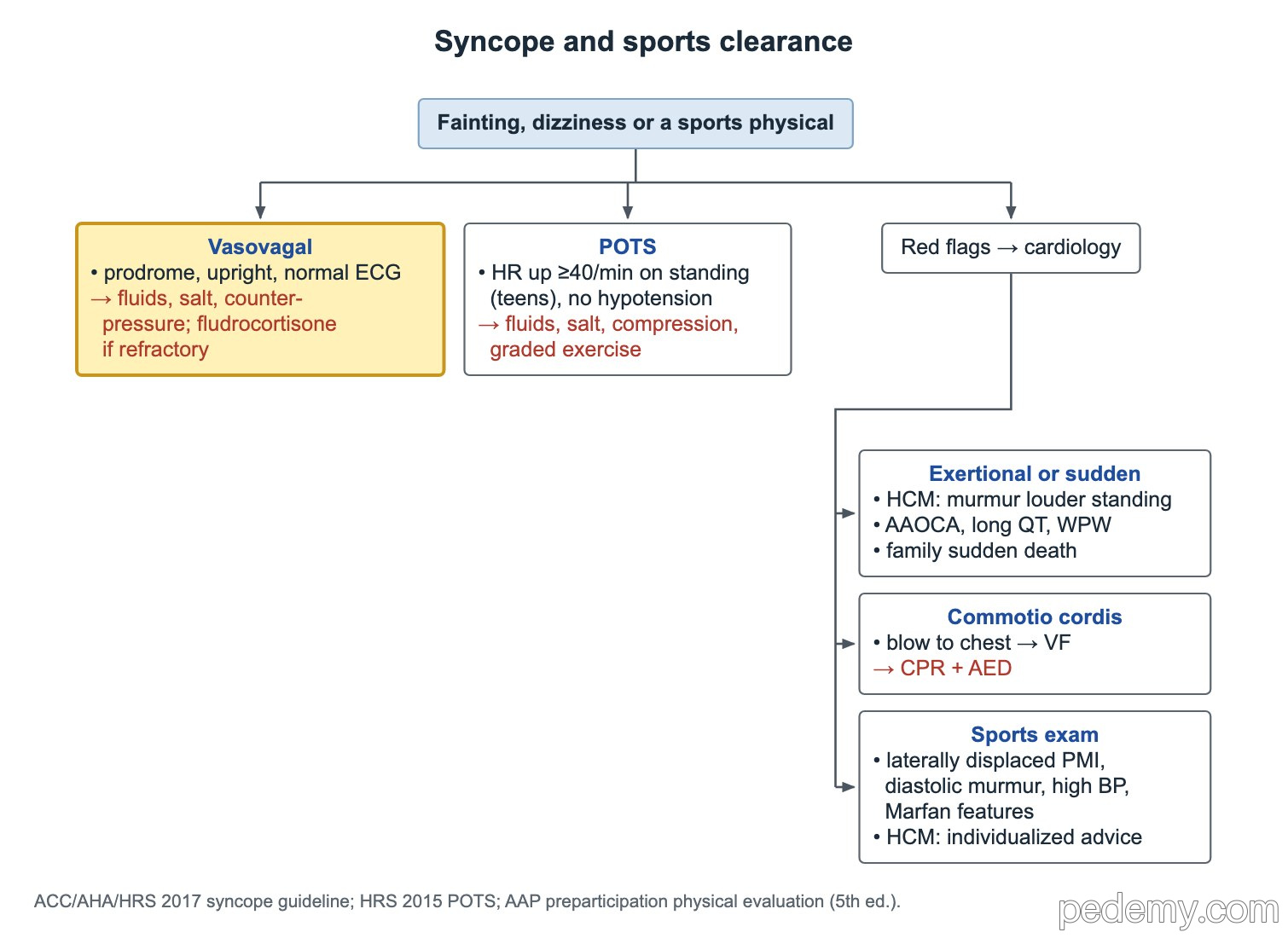
Vasovagal syncope happens after standing or a trigger, with warning symptoms first (lightheadedness, warmth, nausea, tunnel vision), and the child recovers quickly. When the story is typical and the ECG is normal, no more tests are needed.
- First steps: reassurance, more fluid and salt, learning the warning signs, and counterpressure maneuvers (crossing legs, tensing arms) or lying down when symptoms start.
- Recurrent fainting despite fluids and salt: fludrocortisone may help.
- β-blockers do not help vasovagal syncope in young people.
Postural orthostatic tachycardia syndrome (POTS)
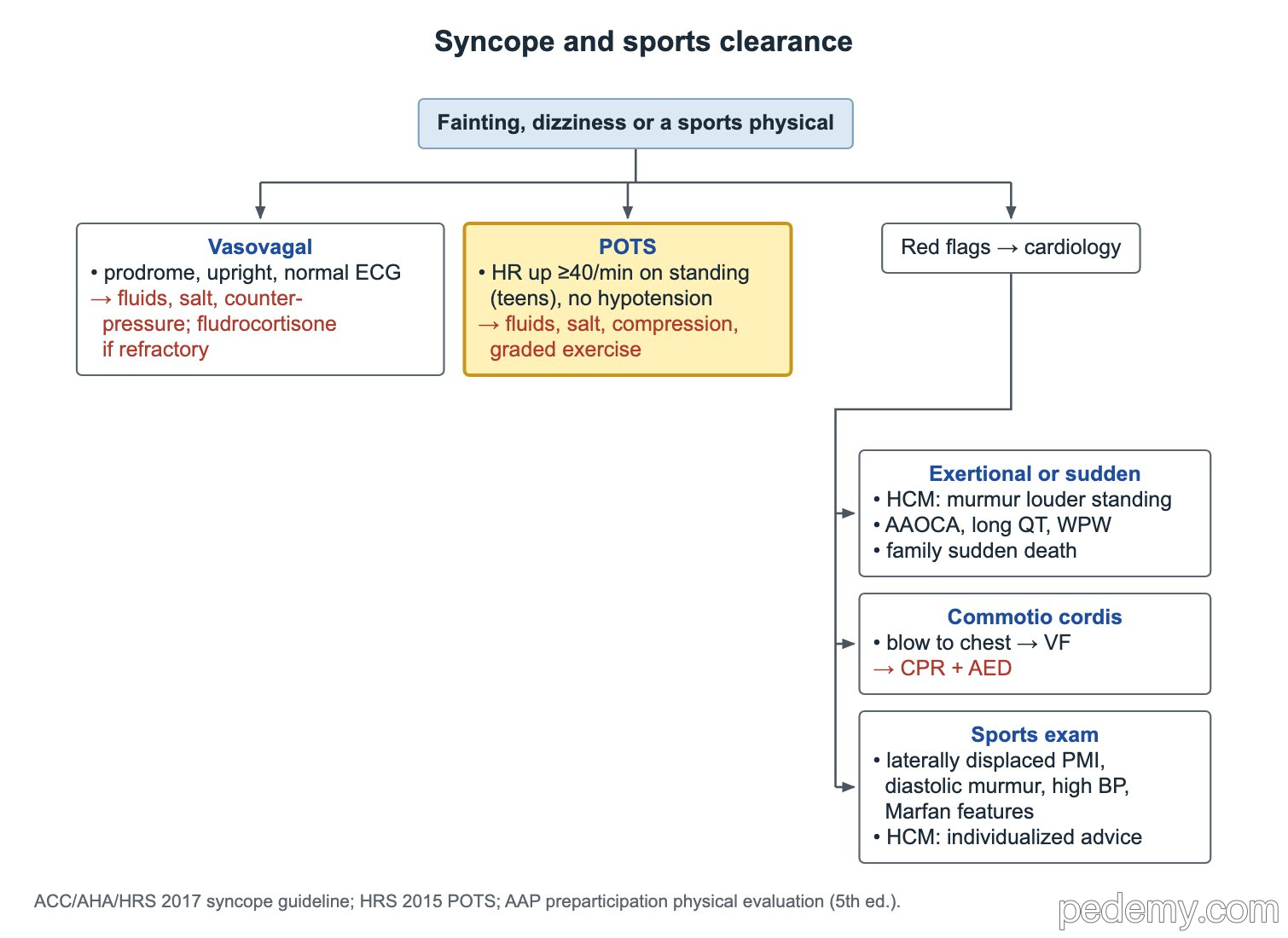
A teen with lightheadedness and palpitations on standing, whose heart rate rises by 40/min or more within 10 minutes of standing without a drop in blood pressure, has POTS. In adults the cut-off is 30/min.
- Treatment: more fluid and salt, compression garments and graded exercise, starting with exercise lying down or sitting.
Exertional syncope: HCM and coronary anomalies
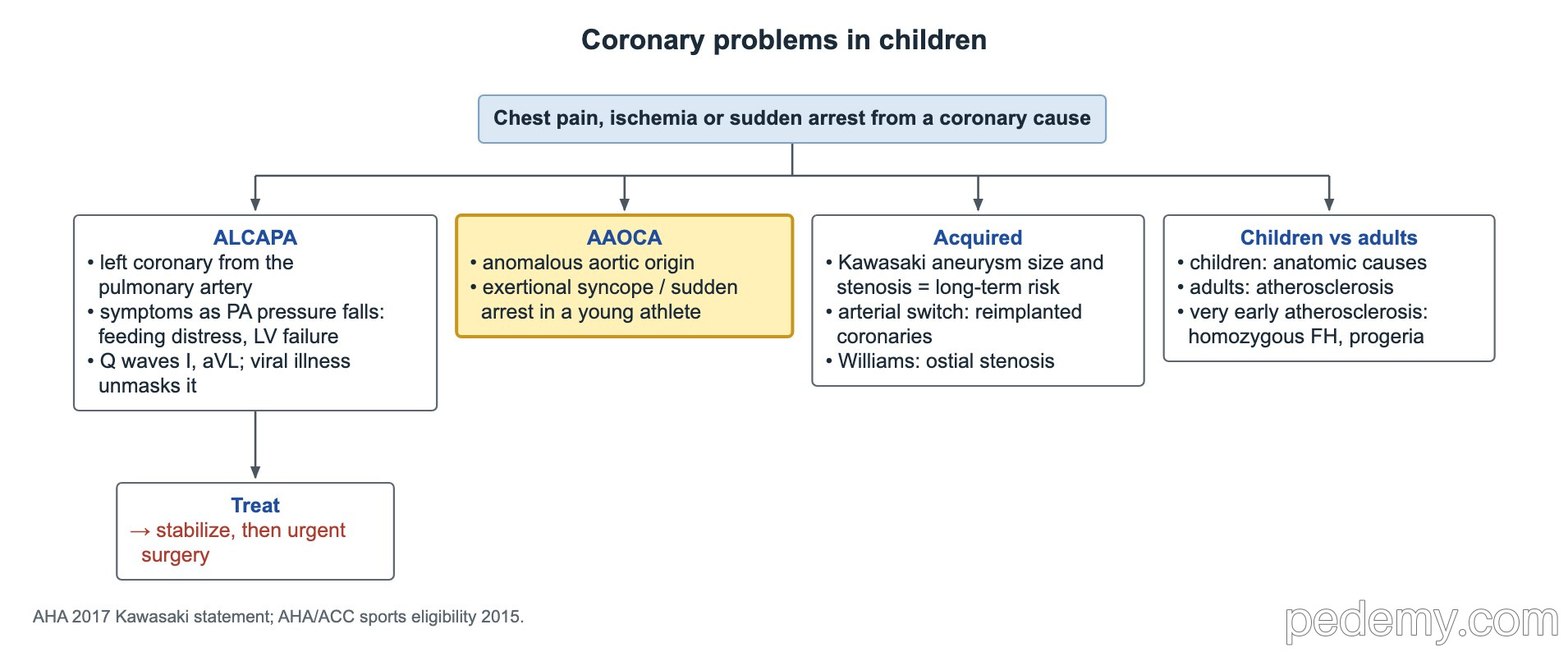
Fainting during exercise, or sudden arrest in a young athlete, is cardiac until proven otherwise.
- Anomalous aortic origin of a coronary artery (AAOCA): the coronary comes from the wrong aortic sinus; a high-risk proximal course can cause exertional syncope or sudden death.
- Obstructive hypertrophic cardiomyopathy (HCM): a systolic ejection murmur that gets louder with standing or Valsalva and softer with squatting.
- Other causes: long QT syndrome, WPW and a family history of sudden death.
- HCM does not mean every child must stop all exercise for life: exercise advice is individual, made with a specialist through shared decision-making.
Commotio cordis and the sports physical
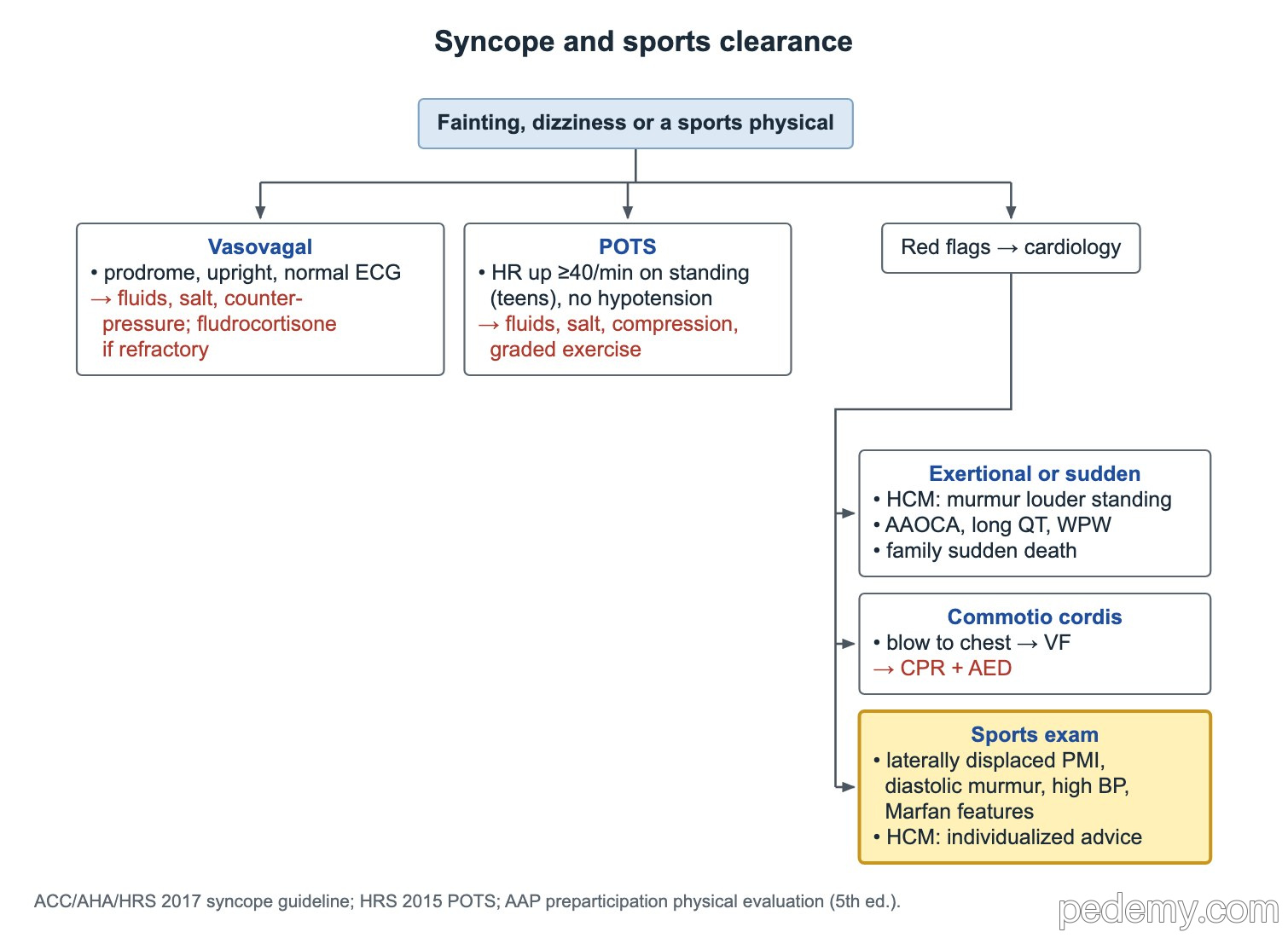
- Commotio cordis: a teen collapses after a ball or blow hits the chest. The impact during the T-wave upstroke (the heart's vulnerable period) triggers ventricular fibrillation. Start CPR immediately and use an AED.
- Sports physical findings that need cardiology review before clearance: a laterally displaced, prominent point of maximal impulse (cardiomegaly or hypertrophy), a diastolic murmur, high blood pressure and Marfan features.
- A child with HCM gets individual sports advice from the specialist.
Common questions
When is chest pain in a child serious?
When it comes with exercise, syncope or palpitations, when there is a family history of sudden death or cardiomyopathy, or when the heart exam is abnormal. These children need a 12-lead ECG and often cardiology review.
What is the heart-rate rise for POTS in teenagers?
An increase of 40 beats/min or more within 10 minutes of standing, without hypotension. The adult cut-off is 30 beats/min.
How is vasovagal syncope treated in teens?
With reassurance, more fluid and salt, learning the warning signs and counterpressure maneuvers. Fludrocortisone may help recurrent cases; β-blockers do not.
Study this topic
Sources
- ACC/AHA/HRS 2017: Guideline for the evaluation and management of syncope (Circulation)
- HRS 2015: Expert consensus statement on POTS, inappropriate sinus tachycardia and vasovagal syncope (Heart Rhythm)
- AHA/ACC 2024: Guideline for the management of hypertrophic cardiomyopathy (Circulation)
Written for Pedemy in our own words from the sources above; checked November 2026. For education only, not medical advice; check doses and local protocols before treating a patient. Pedemy is independent and not affiliated with or endorsed by the organizations cited.