

Main decision tree
Animal bites and puncture wounds
Key points
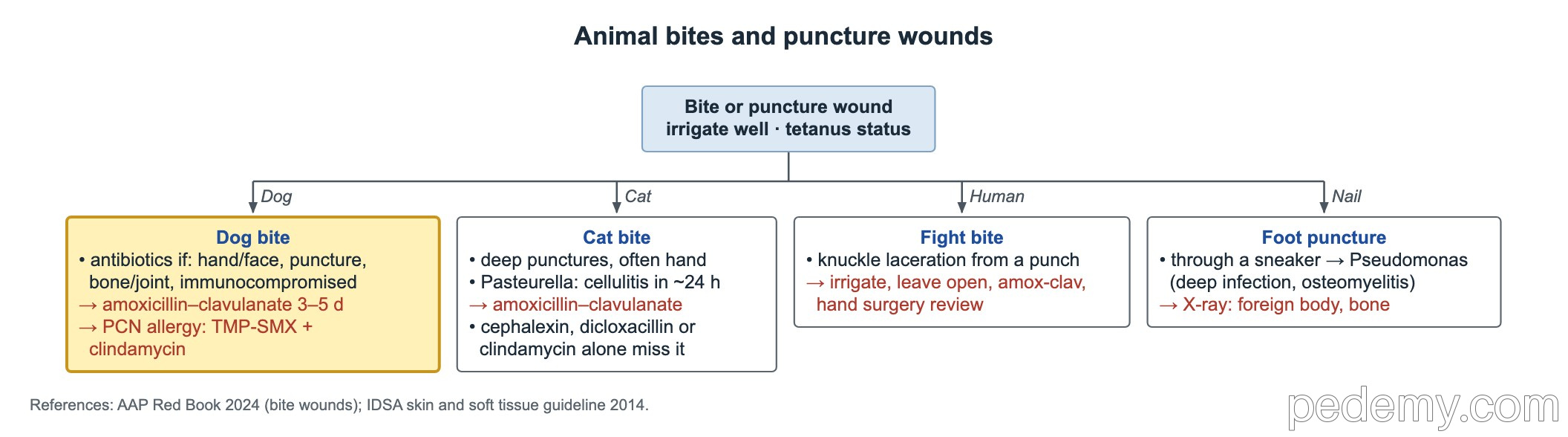
- Every bite: irrigate well, check tetanus status, and think about rabies exposure.
- High-risk bites (cat bites, punctures, hand or face, bone or joint, immunocompromise, asplenia) → amoxicillin–clavulanate for 3–5 days.
- Severe penicillin allergy: trimethoprim–sulfamethoxazole plus clindamycin.
- Cephalexin, dicloxacillin or clindamycin alone miss Pasteurella multocida.
- Fight bite over a knuckle: irrigate, leave open, amoxicillin–clavulanate and hand surgery review.
- Black widow: rigid abdomen, sweating, hypertension → opioids and benzodiazepines; brown recluse: local wound care only.
- Bark scorpion: roving eyes, drooling, tongue fasciculations → supportive care; Centruroides antivenom if severe.
Dog bites: who needs antibiotics
Start every bite or puncture wound the same way: irrigate it well, look for deep injury, and check tetanus status. Then decide on antibiotics by the type and site of the wound and by the child.
Many simple dog bites do not need antibiotics. Give a short preemptive course when the infection risk is high.
- Give preemptive antibiotics for: moderate or severe wounds, punctures, crush injury, hand or face (and genital) wounds, wounds near or into bone or joint, immunocompromise or asplenia.
- Drug of choice: amoxicillin–clavulanate for 3–5 days. It covers Pasteurella, streptococci, Staphylococcus aureus and mouth anaerobes.
- Severe penicillin allergy: trimethoprim–sulfamethoxazole plus clindamycin.
- Check tetanus: a bite is a contaminated wound (see the tetanus table below).
Cat bites and Pasteurella
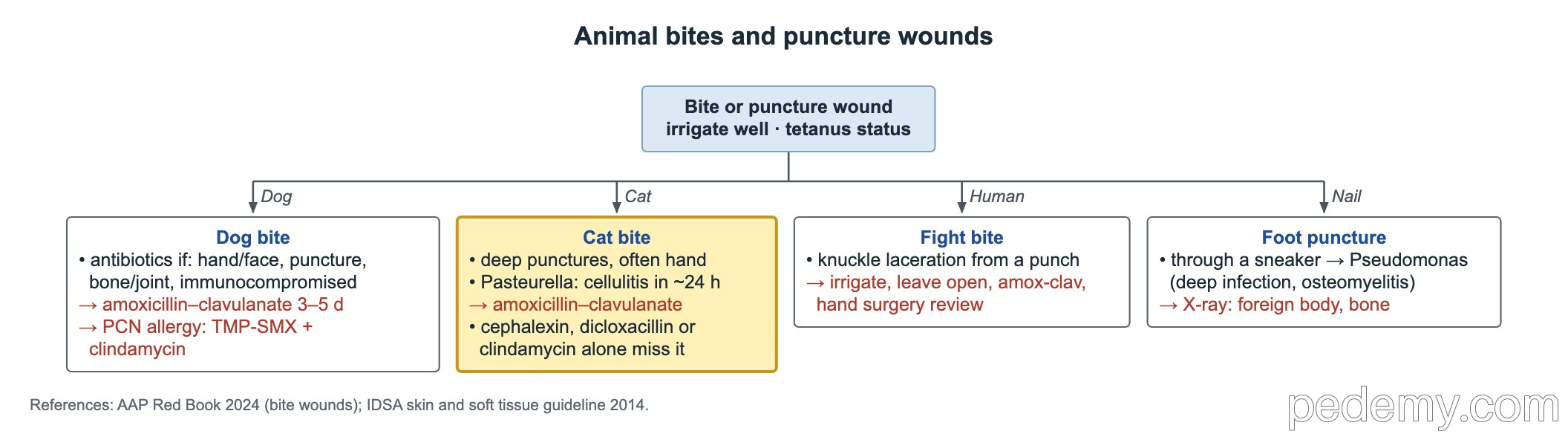
Cat teeth are thin and sharp, so cat bites are deep punctures, often on the hand. They become infected more often than dog bites.
- Pasteurella multocida causes fast cellulitis, often within 24 hours of the bite, with pain, redness and swelling.
- Give amoxicillin–clavulanate after a deep cat puncture, even if it looks clean after irrigation.
- Cephalexin, dicloxacillin and clindamycin alone have poor activity against Pasteurella, so they are not enough on their own for a dog or cat bite.
Human bites and fight bites
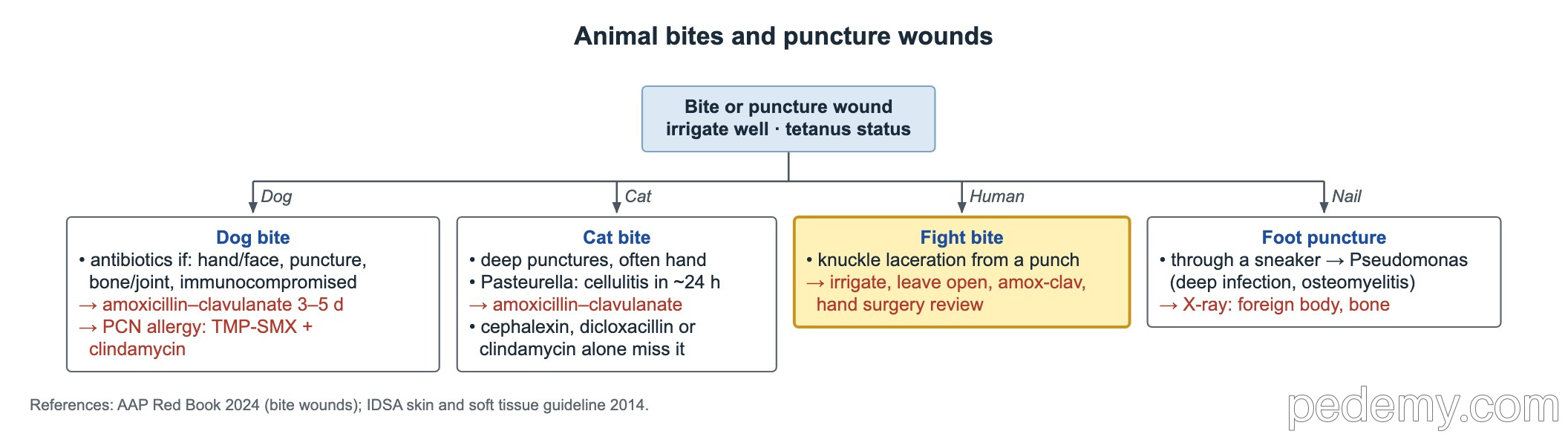
A cut over the knuckle after punching someone in the mouth is a closed-fist (fight) bite until proven otherwise. The tooth can carry mouth flora into the joint or tendon sheath.
- Irrigate copiously and leave the wound open; do not close a hand bite.
- Give amoxicillin–clavulanate, even for a shallow human bite on the hand that is not yet infected.
- Arrange hand surgery evaluation for a fight bite (joint or tendon involvement).
Foot puncture wounds
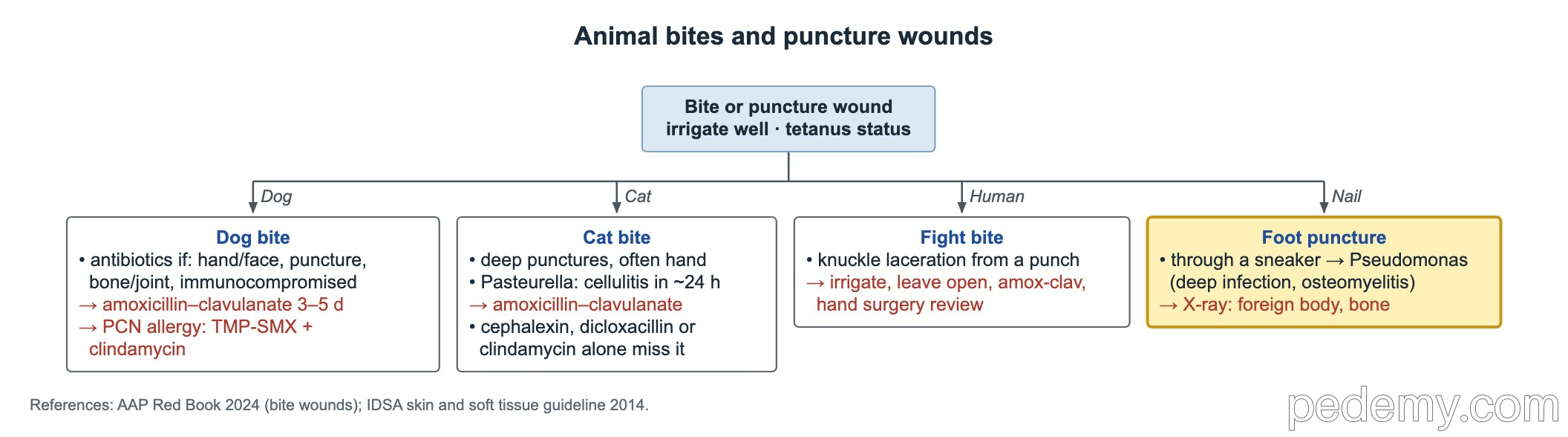
- A nail through a sneaker can carry Pseudomonas aeruginosa into the foot, causing deep infection or osteomyelitis.
- Get an X-ray for a possible retained foreign body or bone involvement.
- Irrigate, check tetanus status and arrange follow-up for late infection.
Spider bites and scorpion stings
- Any critically ill envenomated child: airway, breathing and circulation come first.
- Severe scorpion toxicity affects the autonomic, cardiovascular and nervous systems; treat hypoxemia (for example SpO2 87%) with high-flow oxygen by non-rebreather while preparing further airway support.
| Creature | Key findings | Treatment |
|---|---|---|
| Black widow (Latrodectus) | Neurotoxic venom: severe muscle cramps, rigid abdomen that mimics an acute abdomen, sweating, hypertension | Opioid pain control and benzodiazepines for spasm; antivenom only for severe toxicity |
| Brown recluse (Loxosceles) | Painful bite that can become a necrotic ulcer; rarely systemic illness with hemolytic anemia, more often in children | Local wound care; most heal without surgery. Steroids, dapsone and early excision do not help |
| Bark scorpion (Centruroides, Arizona) | Cranial nerve and motor overactivity: roving eye movements, drooling, tongue fasciculations, agitation, flailing | Supportive care; Centruroides antivenom (F(ab')2) for severe neurotoxicity |
Snake bites and jellyfish stings
- Rattlesnake (pit viper) bite first aid: call EMS, keep the child calm, remove rings and tight items, clean the wound and keep the limb still at about heart level.
- Do not use a tourniquet, ice, incision or suction.
- In the hospital, mark the edge of swelling and check blood counts and clotting tests; give crotalid antivenom for progressive swelling, coagulopathy or systemic signs.
- Nonvenomous snake bite: wound care and tetanus prophylaxis.
- Jellyfish sting in North American waters: remove tentacles, rinse with seawater (not fresh water), then immerse in hot water about 43–45 °C (110–113 °F) for 20 minutes.
Tetanus prophylaxis for wounds
Bites, punctures and dirty wounds are tetanus-prone. Use the number of prior tetanus doses to decide on vaccine and tetanus immune globulin (TIG). From age 7 years, Tdap is the preferred vaccine if the child is not fully vaccinated.
- Example: a 12-year-old with only 2 tetanus doses and a snake bite needs wound care, Tdap and TIG.
| Prior tetanus doses | Clean, minor wound | Dirty wound, bite or puncture |
|---|---|---|
| Fewer than 3 or unknown | Vaccine | Vaccine + TIG |
| 3 or more | Vaccine if 10 years or more since last dose | Vaccine if 5 years or more since last dose |
Common questions
What antibiotic is used for a dog or cat bite?
Amoxicillin–clavulanate, usually for 3–5 days when prophylaxis is needed. With a severe penicillin allergy, trimethoprim–sulfamethoxazole plus clindamycin is used.
Why is cephalexin not enough for a cat bite?
It has poor activity against Pasteurella multocida, the main cause of fast cellulitis after cat and dog bites.
Should a hand bite be stitched?
Usually not. Hand bites, including fight bites over the knuckle, are irrigated and left open, and fight bites need hand surgery review.
Study this topic
Sources
- IDSA 2014: Practice guidelines for skin and soft tissue infections, including animal and human bites (Clin Infect Dis)
- Unified treatment algorithm for crotaline snakebite in the United States (BMC Emerg Med 2011)
- AAP Red Book: Bite wounds and Pasteurella infections
Written for Pedemy in our own words from the sources above; checked November 2026. For education only, not medical advice; check doses and local protocols before treating a patient. Pedemy is independent and not affiliated with or endorsed by the organizations cited.