

Main decision tree
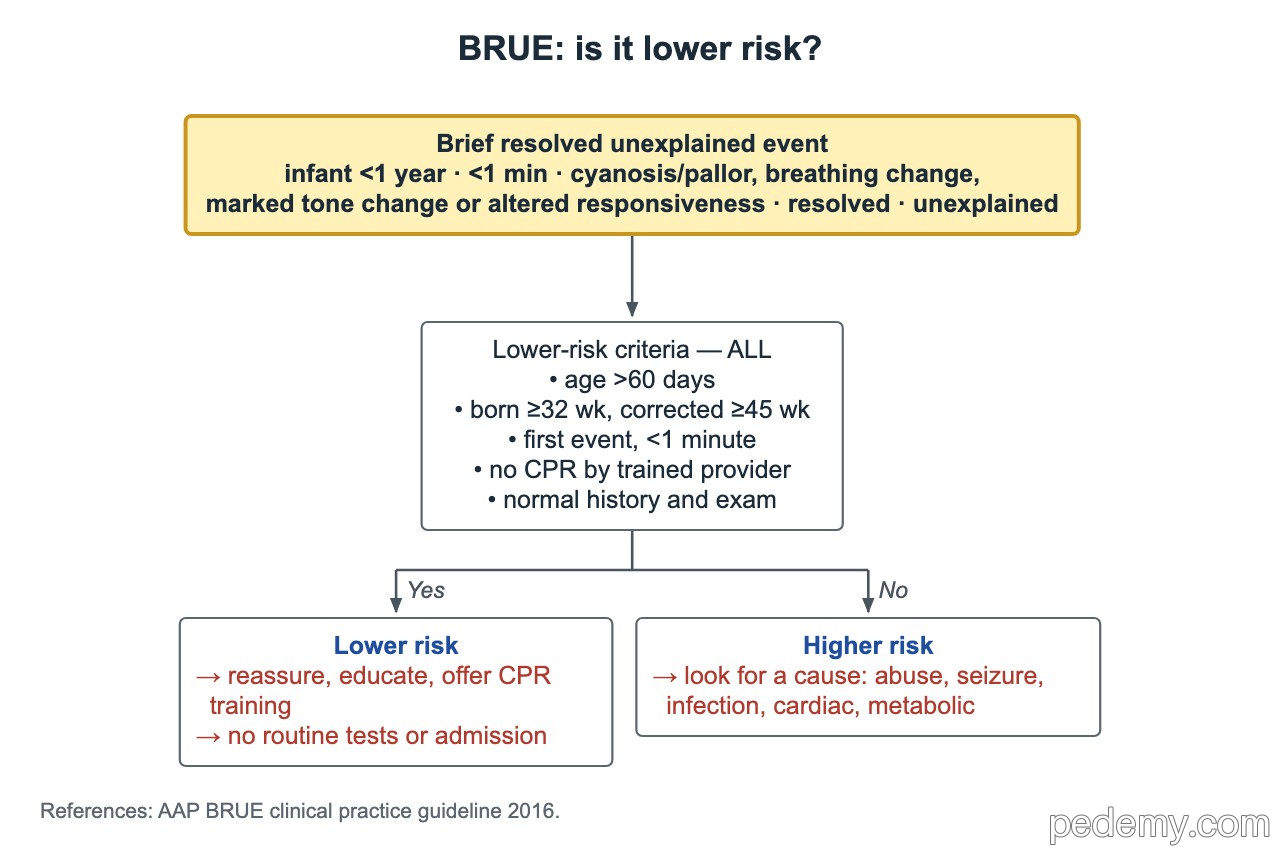
BRUE: is it lower risk?
Key points
- BRUE: infant under 1 year, episode under 1 minute, now resolved and unexplained after history and exam.
- Features: cyanosis or pallor; absent, decreased or irregular breathing; marked change in tone; or altered responsiveness.
- Lower risk needs ALL of: age over 60 days, born at 32 weeks or later with corrected age 45 weeks or more, first event, under 1 minute.
- Lower risk also needs: no CPR by a trained provider and a normal history and physical exam.
- Lower-risk infant: reassure, educate and offer CPR training; no routine labs, imaging or admission.
- Higher-risk infant: look for a cause, such as abuse, seizure, infection, heart or metabolic disease.
What counts as a BRUE
BRUE replaced the older term ALTE in 2016. The diagnosis is made by the clinician, not the caregiver: the event must be over, the infant must look well now, and nothing in the history or exam explains it.
An infant who is still unwell, or whose event has a clear cause, does not have a BRUE.
- Age under 1 year.
- Lasted less than 1 minute (usually 20–30 seconds).
- One or more of: cyanosis or pallor; absent, decreased or irregular breathing; marked change in tone (stiff or limp); altered responsiveness.
- Back to baseline at the visit.
- Not a BRUE: fever, cough or other illness signs; choking or gagging with a feed or spit-up (reflux); facial redness alone; periodic breathing of the newborn.
Lower-risk criteria
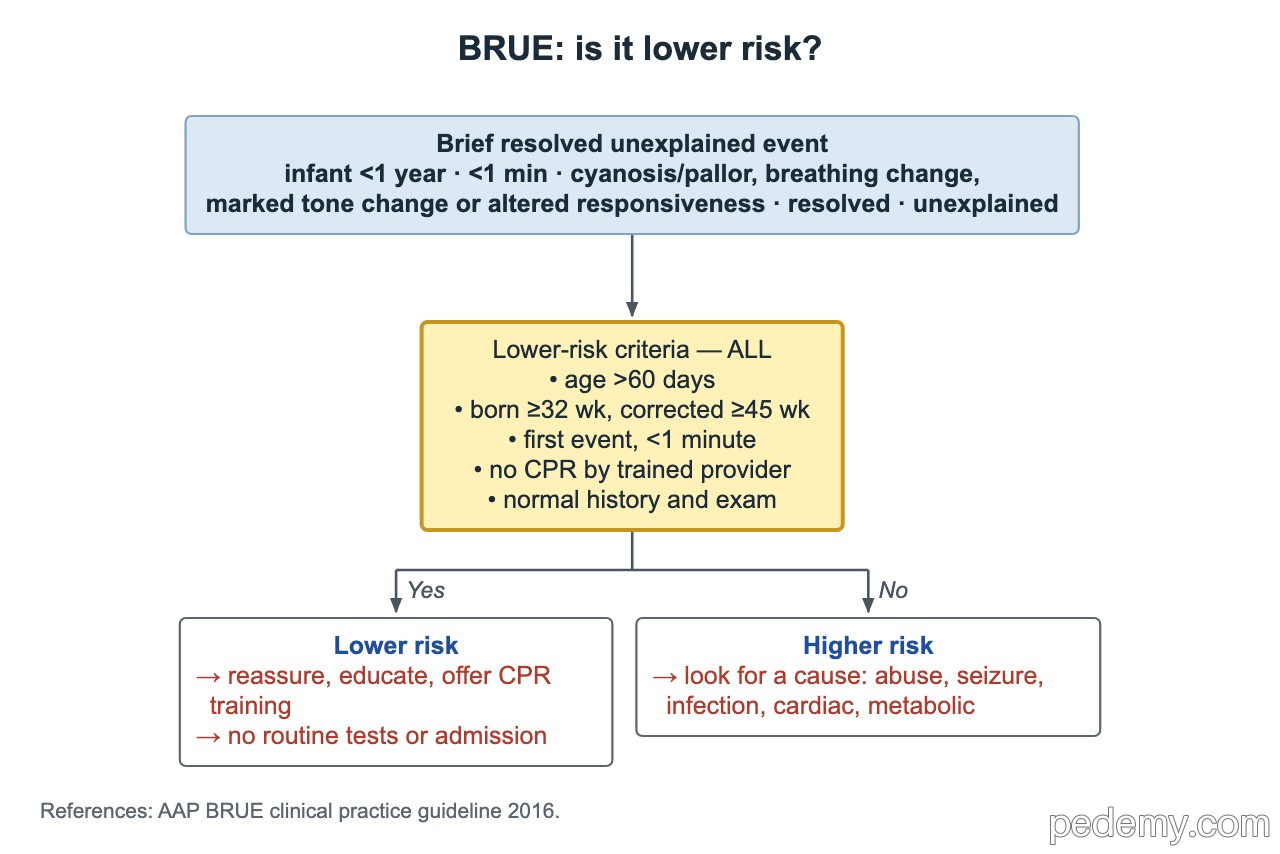
The infant is lower risk only if every criterion is met. Missing even one makes the infant higher risk.
- Age more than 60 days.
- Born at 32 weeks or later, and corrected gestational age 45 weeks or more.
- First event, not part of a cluster.
- Event lasted less than 1 minute.
- No CPR by a trained medical provider was needed.
- No concerning history (including possible abuse or a family history of sudden death) and a normal physical exam.
Managing a lower-risk BRUE
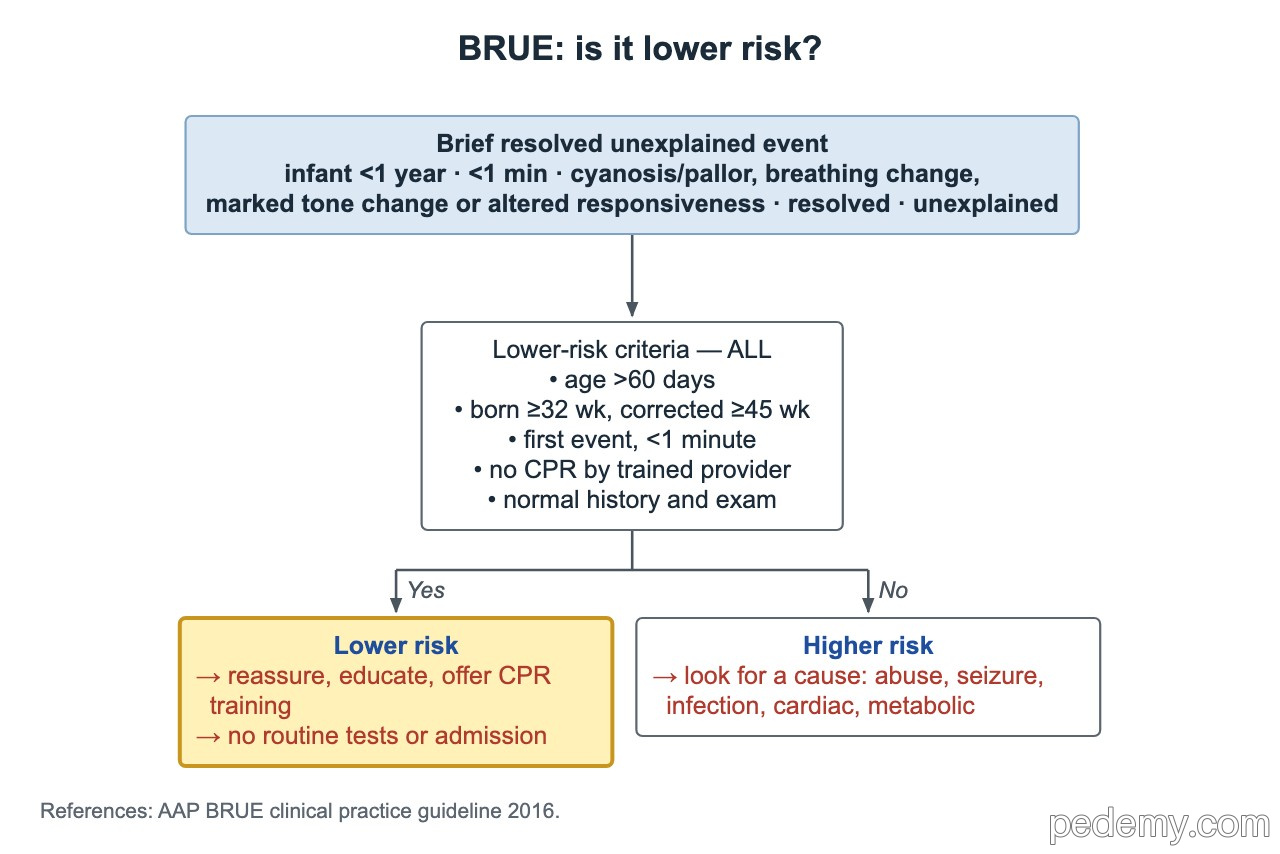
Lower-risk infants have a very small chance of a serious underlying problem. The plan is shared decision-making with the family, education about BRUE, and resources for infant CPR training.
- Should not do: routine blood tests, urine studies, chest X-ray, echocardiogram, EEG, neuroimaging, or admission for monitoring.
- Should not start acid-suppression or antiseizure medicines.
- May do: a 12-lead ECG, pertussis testing, and a brief period of observation with continuous pulse oximetry.
- Arrange follow-up with the primary care clinician, usually within 24 hours.
Higher-risk BRUE
The guideline does not give a fixed work-up for higher-risk infants. Testing follows the history and exam, looking for the conditions that can present this way.
| Possible cause | Clues |
|---|---|
| Child abuse | Inconsistent story, bruising, prior events, unexplained injuries |
| Seizure | Stiffening, eye deviation, repeated events |
| Infection | Age 60 days or less, fever, pertussis exposure |
| Cardiac | Family history of sudden death, abnormal ECG (long QT) |
| Metabolic or genetic | Recurrent events, poor growth, family history |
Common questions
What is the difference between BRUE and ALTE?
ALTE was based on how frightening the event seemed to the caregiver. BRUE is narrower: the event lasted under 1 minute, has resolved, and remains unexplained after a clinician's history and exam.
Does a lower-risk BRUE need admission?
No. Lower-risk infants do not need routine admission or tests. Clinicians may do an ECG, pertussis testing and a short observation with pulse oximetry.
Is a 45-day-old with a BRUE lower risk?
No. Infants 60 days old or younger are higher risk, even if the event was brief and the exam is normal.
Study this topic
Sources
- AAP 2016: Brief resolved unexplained events and evaluation of lower-risk infants (Pediatrics)
- AAP 2016: BRUE guideline executive summary (Pediatrics)
Written for Pedemy in our own words from the sources above; checked November 2026. For education only, not medical advice; check doses and local protocols before treating a patient. Pedemy is independent and not affiliated with or endorsed by the organizations cited.