

Main decision tree
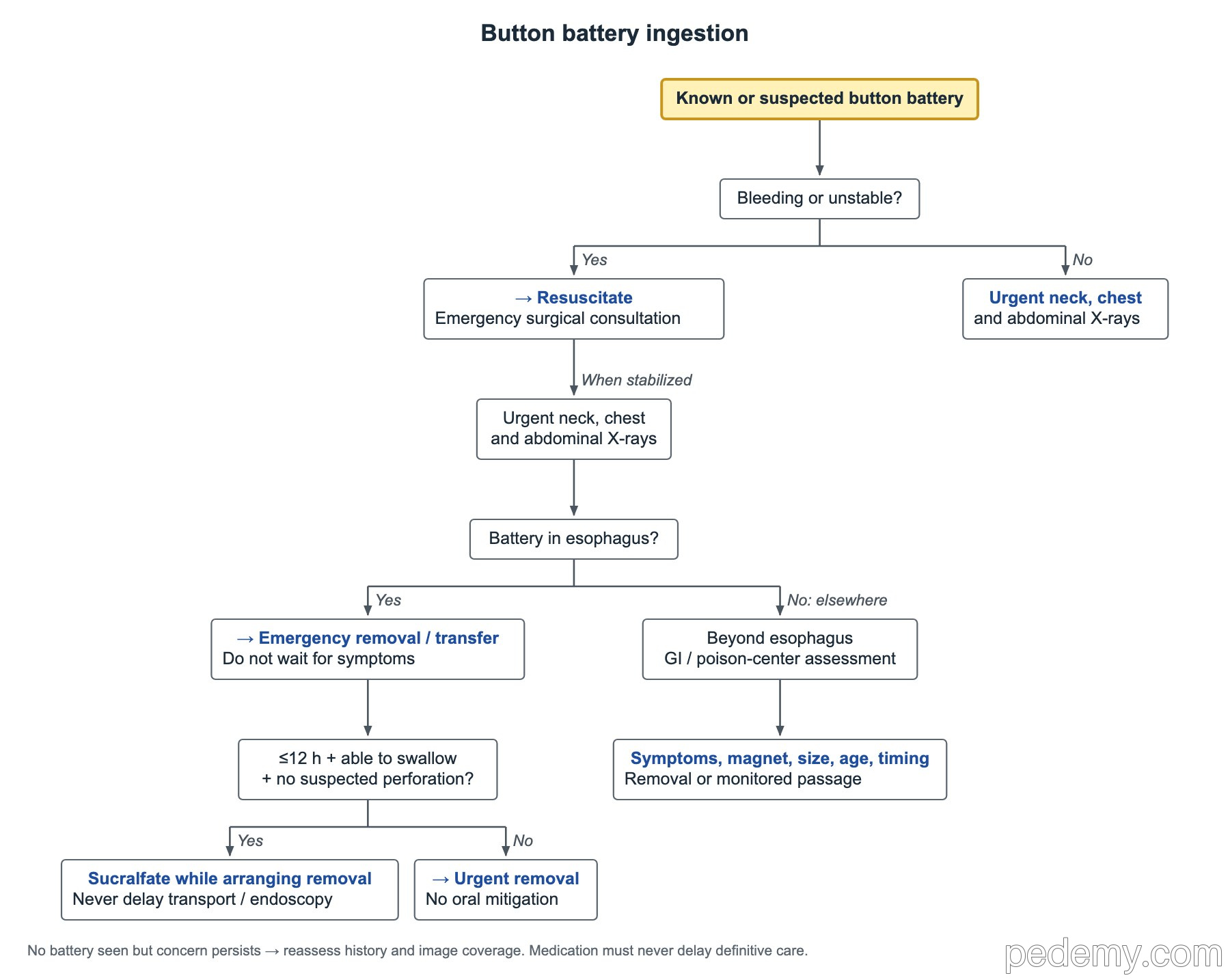
Button battery ingestion
Key points
- Order of thinking: stability → location → esophagus? → removal or specialist plan.
- Bleeding or unstable: resuscitate (ABCs) and call surgery emergently.
- Suspected ingestion in a child 12 years or younger: X-ray the neck, chest and abdomen now; do not wait for symptoms.
- Battery on X-ray: double rim (halo) on the AP view, step-off on the lateral; the narrower side is the negative pole, which causes the worst injury.
- Esophageal battery: immediate removal, usually endoscopic; transfer emergently if pediatric endoscopy is not available.
- Honey (age 12 months or older) 10 mL every 10 minutes, up to 6 doses, only within 12 hours of ingestion; never delay removal.
- Do not induce vomiting or give laxatives; a dead battery can still cause injury.
Recognizing a button battery ingestion
Many ingestions are not witnessed. A battery in the esophagus makes a current in the moist tissue, and the negative pole produces hydroxide that causes a deep alkaline burn.
Children can have an esophageal battery with no symptoms at all, so a suspected ingestion is imaged at once.
- Clues to an unwitnessed ingestion: drooling, painful or difficult swallowing, refusing to eat, vomiting, chest discomfort, or unexplained coughing or choking.
- A used or 'dead' battery can still cause serious injury.
- Lithium coin cells 20 mm or larger cause the worst esophageal injuries in young children.
- Do not induce vomiting and do not give laxatives to move the battery.
Imaging: where is the battery?
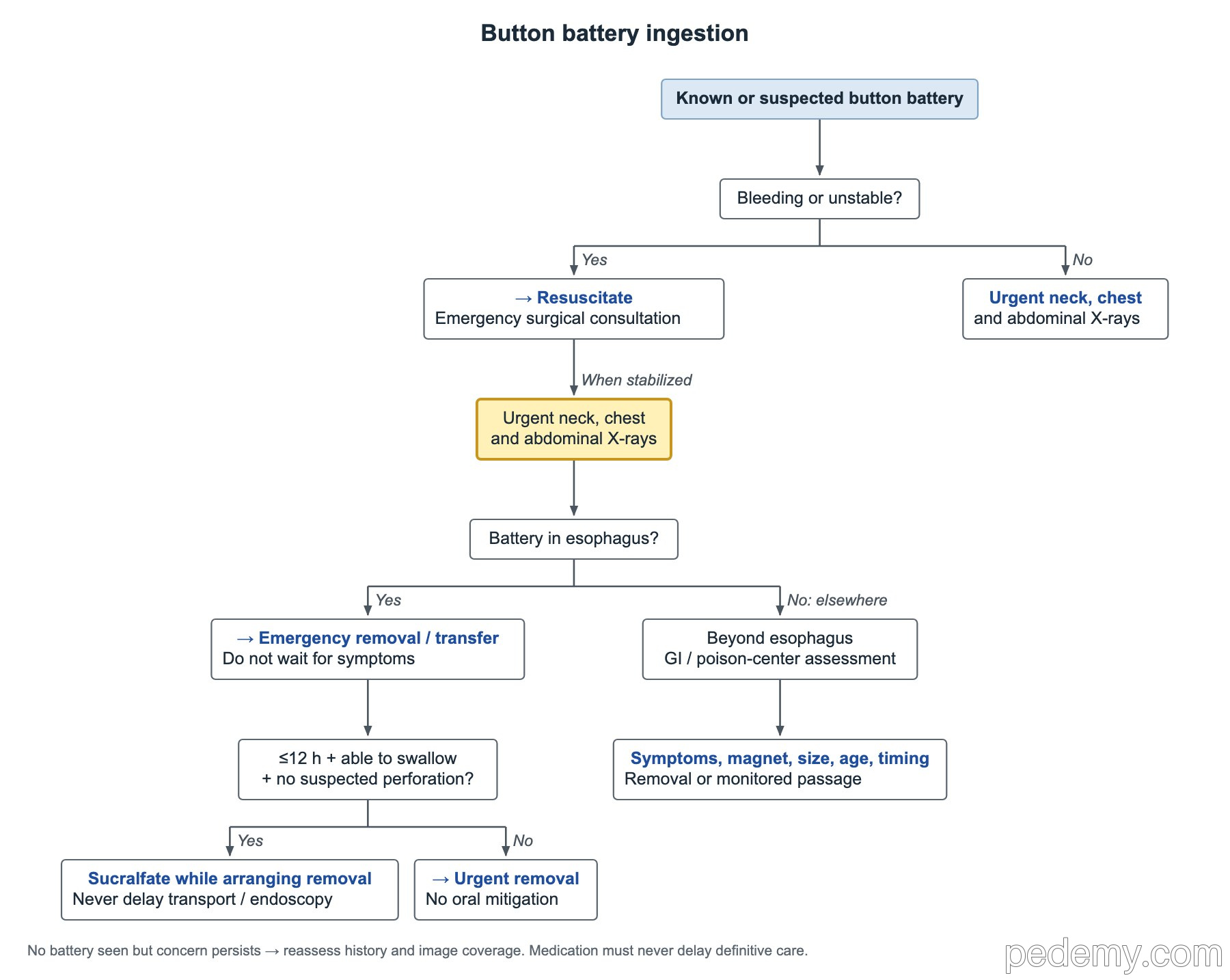
- Children 12 years and younger with a suspected ingestion: get X-rays immediately, without waiting for symptoms.
- Cover the whole neck, esophagus (chest) and abdomen, so a battery is not missed.
- AP view: a double rim or halo separates a button battery from a coin.
- Lateral view: a step-off at the edge; the narrower side is the negative pole.
- No battery seen but concern remains: review the history and make sure the images covered every area.
Battery in the esophagus: remove it now
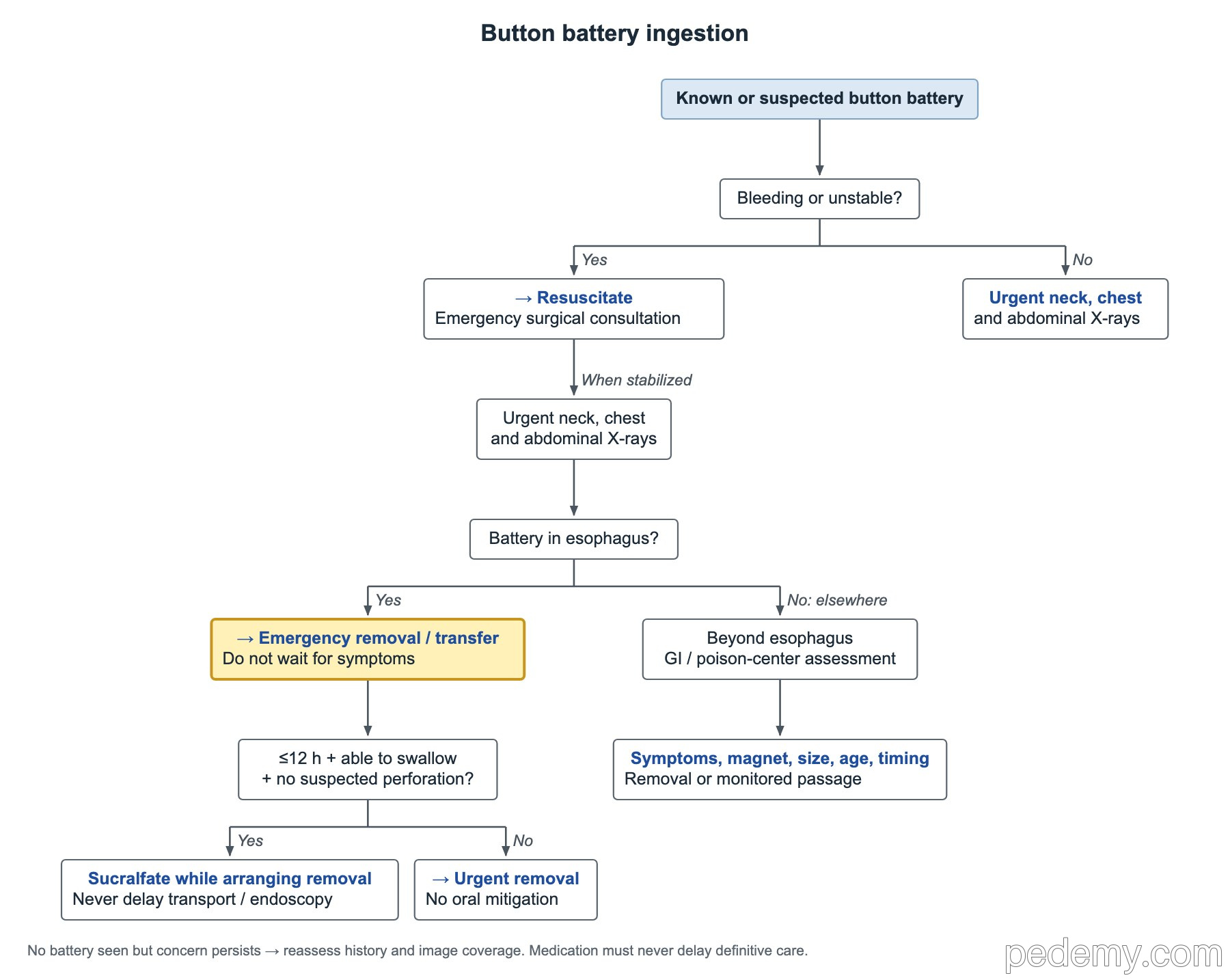
An esophageal button battery is removed immediately, usually by endoscopy. Symptoms are not required.
- If the child is bleeding or unstable: resuscitation and emergency surgical consultation come first.
- If pediatric endoscopy is not available, transfer emergently while starting initial care.
- Recent food, honey or sucralfate never delays removal.
- Removal does not end the risk: injury can keep progressing and complications can appear days to weeks later.
Honey and sucralfate while arranging removal
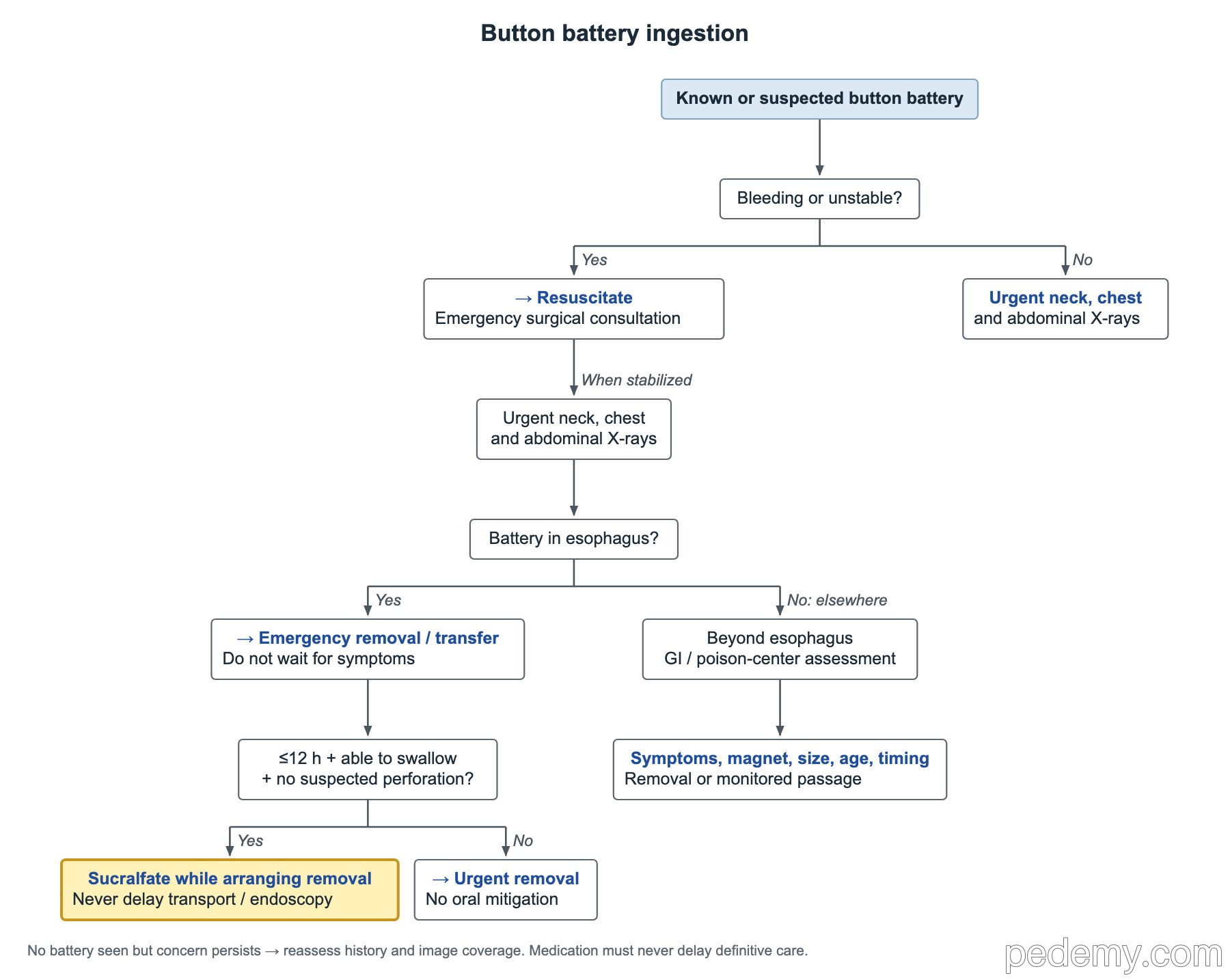
Coating the battery and tissue with honey or sucralfate can reduce the burn while the child waits for removal. Both are only bridges.
- Use only within 12 hours of ingestion, in a child who can swallow, with no suspected perforation or sepsis.
- Honey: only for age 12 months or older (infant botulism risk). Give 10 mL by mouth every 10 minutes, up to 6 doses.
- Sucralfate in the hospital: 1 g/10 mL suspension, 10 mL by mouth every 10 minutes, up to 3 doses.
- Do not give either if the battery may have been in place more than 12 hours: urgent removal without oral mitigation.
- Never delay transport or endoscopy to give them.
Battery past the esophagus
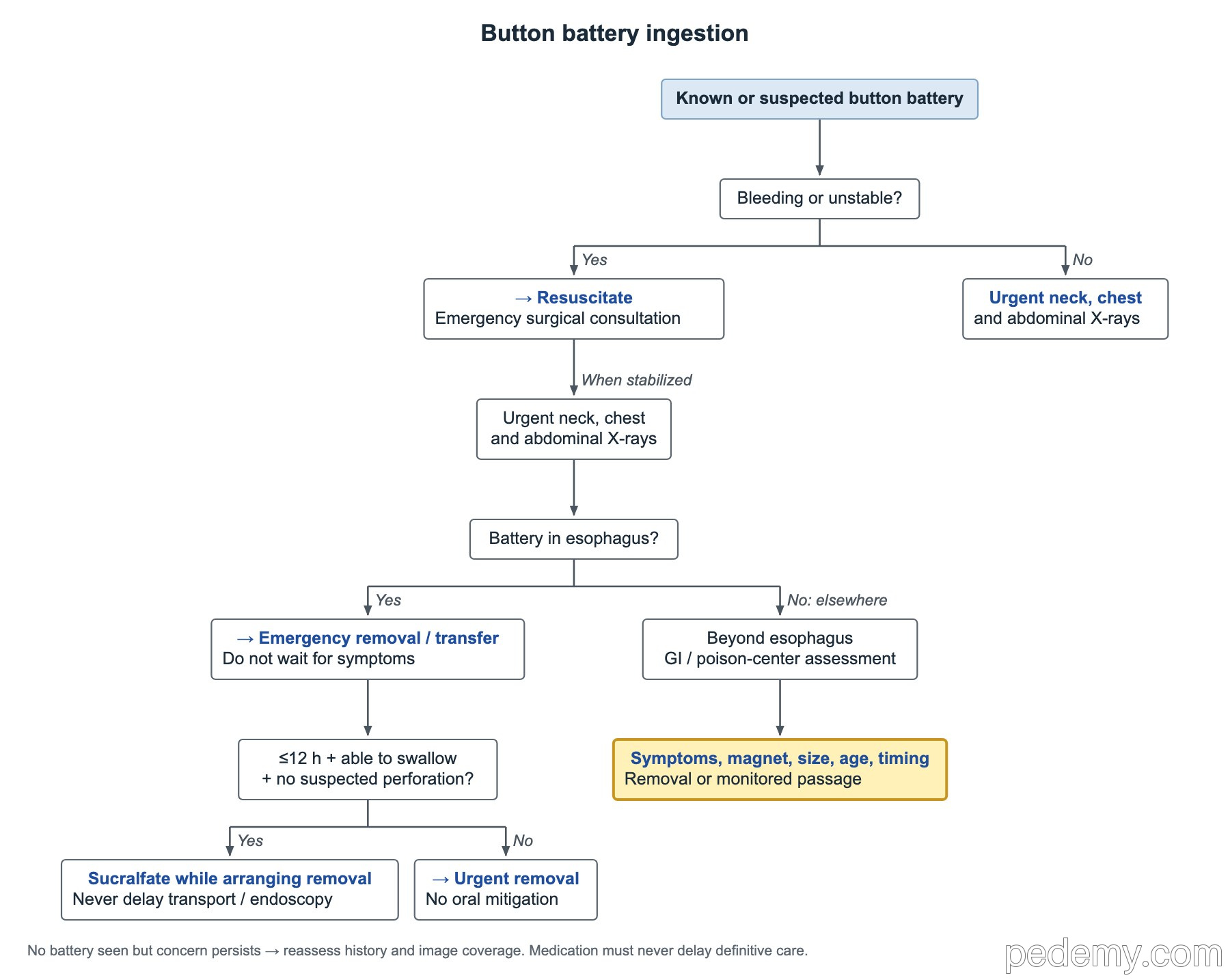
A battery in the stomach or bowel does not always need removal. The decision depends on symptoms, a co-ingested magnet, the child's age, the battery size and how long it stays.
- A co-ingested magnet is especially dangerous: the two can attract across bowel walls and cause pressure injury or perforation.
- Symptoms (pain, vomiting, bleeding) → GI consultation for removal.
- Child younger than 6 years with a battery 15 mm or larger still in the stomach at 4 days → removal.
- Observed child with no passage seen in the stool: repeat X-ray at 10–14 days to confirm passage.
- If the battery reached the stomach late (more than 12 hours after ingestion), endoscopy may still be needed to look for esophageal injury.
Delayed complications
- Esophageal perforation, mediastinitis, tracheoesophageal fistula and esophageal stricture.
- Aortoesophageal fistula with massive bleeding, sometimes weeks after removal.
- Hematemesis after ingestion or removal needs emergency reassessment for severe injury or a vascular fistula.
- Children with esophageal injury need specialist follow-up with planned imaging and diet advice.
Common questions
How do you tell a button battery from a coin on X-ray?
A button battery shows a double rim or halo on the AP view and a step-off on the lateral view. A coin has neither.
When can honey be given for a swallowed button battery?
For a child 12 months or older, within 12 hours of ingestion, who can swallow: 10 mL every 10 minutes for up to 6 doses, without delaying removal.
Does a button battery in the stomach need to come out?
Not always. Removal depends on symptoms, a co-ingested magnet, age, size and how long it stays; a battery 15 mm or larger still in the stomach of a child under 6 years at 4 days is removed.
Study this topic
Sources
- National Capital Poison Center: Button battery ingestion triage and treatment guideline
- NASPGHAN 2015: Management of ingested foreign bodies in children (J Pediatr Gastroenterol Nutr)
Written for Pedemy in our own words from the sources above; checked November 2026. For education only, not medical advice; check doses and local protocols before treating a patient. Pedemy is independent and not affiliated with or endorsed by the organizations cited.