

Main decision tree
Suspected physical abuse: work-up and duty
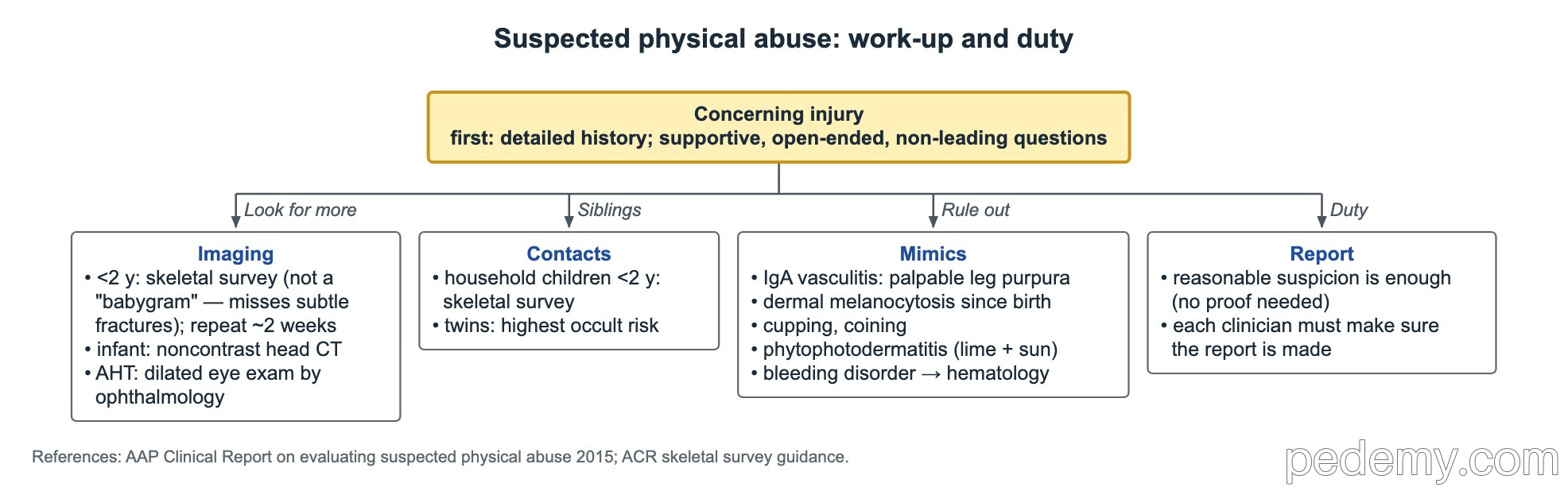
Key points
- Neglect is the most common form of maltreatment in the US.
- Any bruise in a nonmobile infant, or on the ears, neck, torso or face of a child under 4, is a red flag (a possible sentinel injury).
- Skeletal survey for suspected physical abuse under 2 years; repeat it about 2 weeks later.
- Classic metaphyseal lesions and posterior rib fractures are highly specific for abuse; CPR rarely breaks ribs in children.
- Head injury is the leading cause of death from physical abuse; get a dilated eye exam by ophthalmology.
- Reporting needs only reasonable suspicion, not proof, and each clinician owns the duty to report.
- The most common anogenital exam finding after sexual abuse is a normal exam.
Approach to a concerning injury
Start with a detailed history from the caregivers: what happened, when, who saw it, and what the child can do developmentally. A well, walking 3-year-old with bruises on the shins and nothing else most likely has normal play injuries, but the history comes first.
If a child discloses abuse, stay calm and ask open-ended, non-leading questions ("Tell me more"). Write down the child's exact words.
- Red flags in the history: no explanation, a story that changes, a mechanism that does not fit the injury or the child's development, or a delay in seeking care.
- Examine the whole child, including the scalp, ears, mouth and frenulum, and the genital area.
- Poverty, family structure or a parent's job do not prove or disprove abuse; base the decision on the injury, the history and the child's development.
- Reporting threshold: reasonable suspicion. Proof, positive imaging or a confession are not needed.
- Every clinician who suspects abuse must make sure the report is made; telling a supervisor does not end a trainee's duty.
Bruises, burns and their mimics
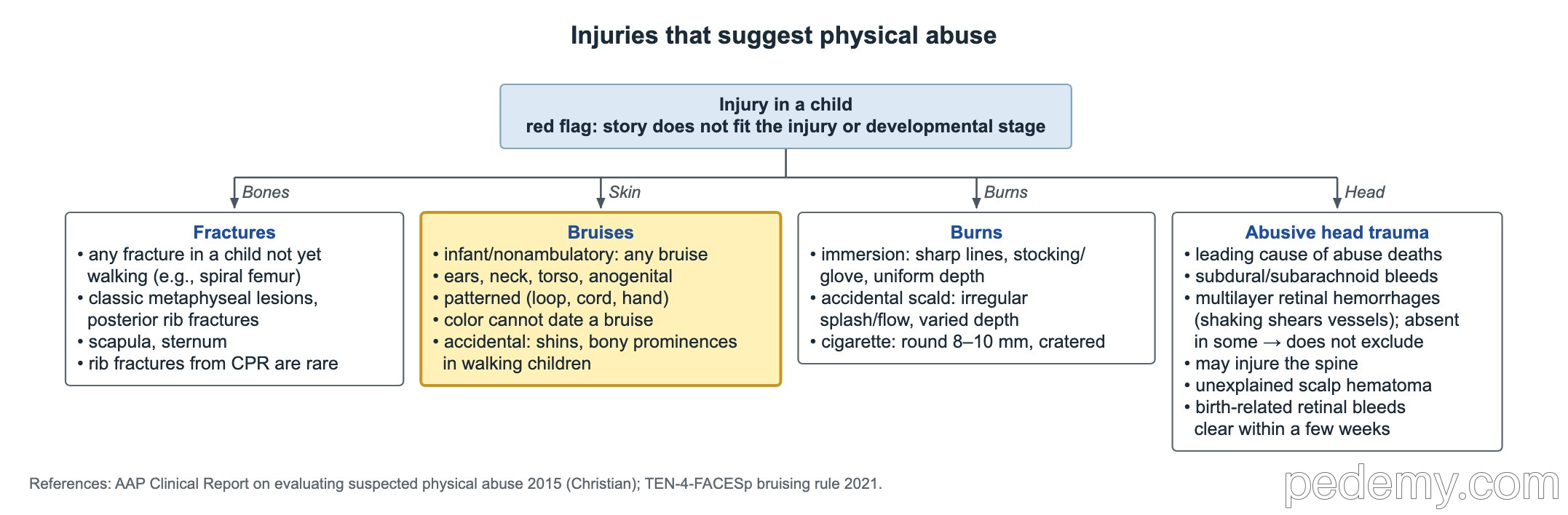
Accidental bruises in walking children sit over bony prominences: shins, knees and forehead. Bruise color cannot reliably date a bruise.
The TEN-4-FACESp rule (children under 4 years) flags bruising on the Torso, Ears or Neck; any bruise in an infant 4.99 months or younger; bruising of the Frenulum, Angle of the jaw, fleshy Cheeks, Eyelids or Subconjunctivae; and patterned bruises.
- Sentinel injury: a small bruise or mouth injury in a young infant that is often missed before more severe abuse. Bruising of the ear or genitals in an infant needs a full abuse evaluation.
- Patterned bruises: loop or U-shaped marks (cord or belt), hand marks, bite marks.
- Inflicted burns: immersion pattern with sharp lines, stocking or glove distribution, uniform depth, and sparing of flexed creases; contact burns shaped like an object.
- Cigarette burn: round, 8–10 mm, cratered. With no clear story, report to child protective services.
- Accidental scald: irregular splash or flow pattern with varied depth, for example on the chest after pulling down a hot cup.
| Mimic | Clue |
|---|---|
| Congenital dermal melanocytosis | Blue-gray sacral or back patches present since birth; do not change over days |
| IgA vasculitis (HSP) | Palpable purpura on the legs and buttocks |
| Cupping or coining | Round or linear marks; ask about folk remedies |
| Phytophotodermatitis | Brown streaks or drip marks after lime juice and sun |
| Bleeding disorder | Many bruises with an abnormal coagulation screen → hematology |
Fractures and imaging
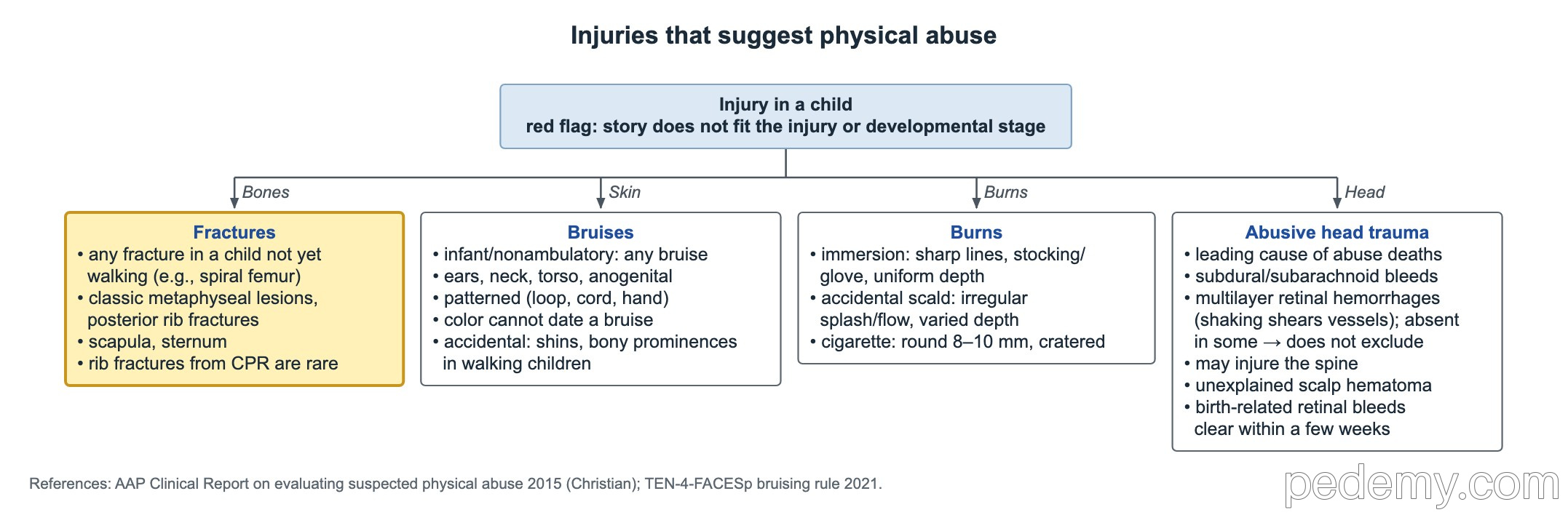
A fracture is most worrying when the child is not yet walking and the mechanism is unexplained. A spiral femur fracture in a nonambulatory 6-month-old needs an abuse evaluation. A spiral fracture is a concern whenever the story does not fit the injury or the child's stage.
- High specificity: classic metaphyseal lesions, posterior rib fractures, scapula, sternum and spinous process fractures.
- Also concerning: multiple fractures, fractures of different ages.
- Rib fractures from CPR are uncommon in children.
- Infant skull fracture: complex, diastatic, depressed or multiple fractures are worrying. A simple linear fracture with a consistent witnessed fall, prompt care and no other injuries is less concerning.
- Skeletal survey: for suspected physical abuse in children under 2 years. It is a set of dedicated views; a single whole-body "babygram" misses subtle fractures.
- Repeat the skeletal survey about 2 weeks later to find healing fractures that were invisible at first.
- Household contacts under 2 years of an abused child may also need a skeletal survey; twins have the highest risk of hidden injury.
Abusive head trauma
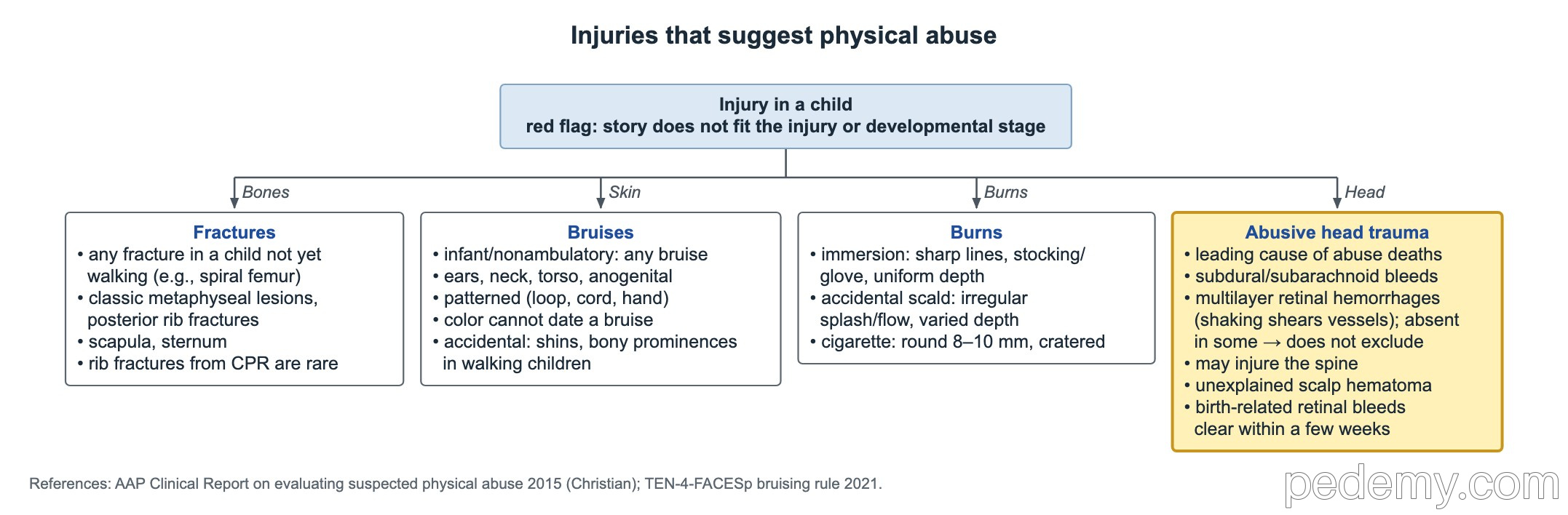
Abusive head trauma (AHT) is the leading cause of death from physical abuse. Think of it in any infant with serious head injury, an unexplained scalp hematoma, or vague signs such as vomiting, irritability, lethargy or apnea with no clear cause.
- Typical bleeds: subdural and/or subarachnoid hemorrhage.
- Retinal hemorrhages that are many, multilayered and reach the periphery are typical; repeated acceleration–deceleration (shaking) shears retinal vessels.
- Get a dilated retinal exam by an ophthalmologist. Absent retinal hemorrhages do not exclude AHT.
- Birth-related retinal hemorrhages usually clear within the first few weeks.
- AHT can coexist with spinal injury; image the spine when indicated.
Suspected sexual abuse: what findings mean
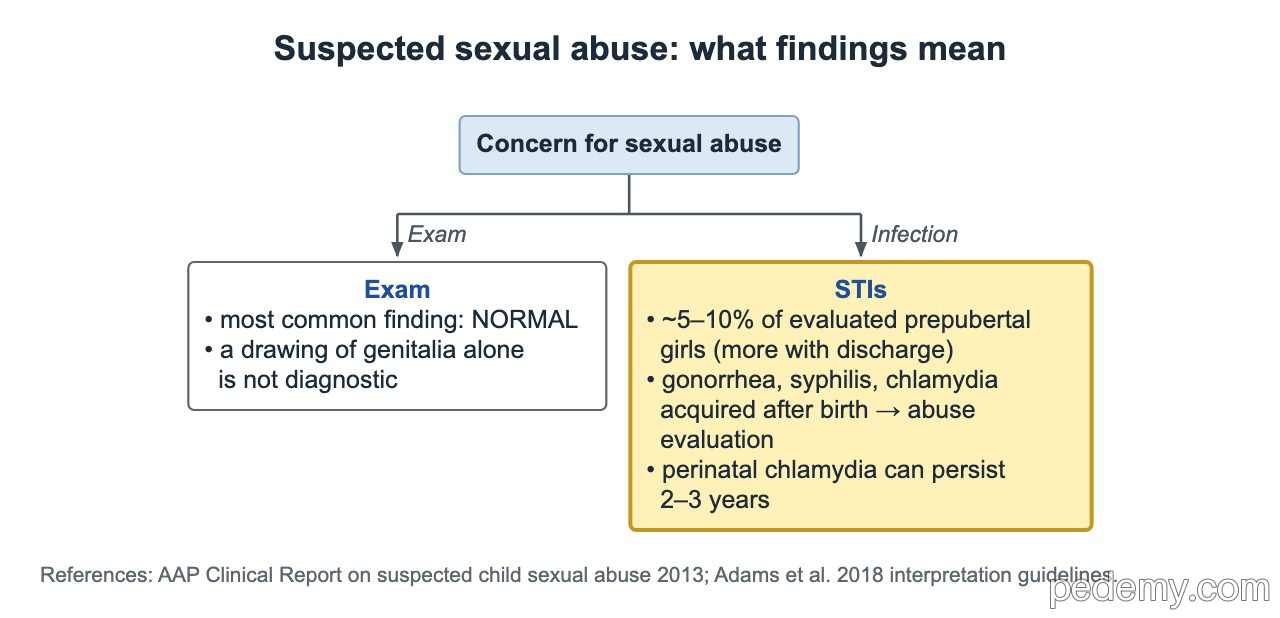
- The most common anogenital exam finding in a child evaluated for sexual abuse is a normal exam; the history is the key evidence.
- A child drawing genitalia may prompt a careful, open-ended assessment, but the drawing alone is not diagnostic.
- Most prepubertal children evaluated for sexual abuse do not have an STI; rates are higher when there is vaginal discharge.
- Gonorrhea, syphilis or chlamydia acquired after the newborn period in a prepubertal child warrants evaluation for sexual abuse, after perinatal transmission is excluded.
- Perinatally acquired chlamydia can persist for 2–3 years.
Medical child abuse (caregiver-fabricated illness)
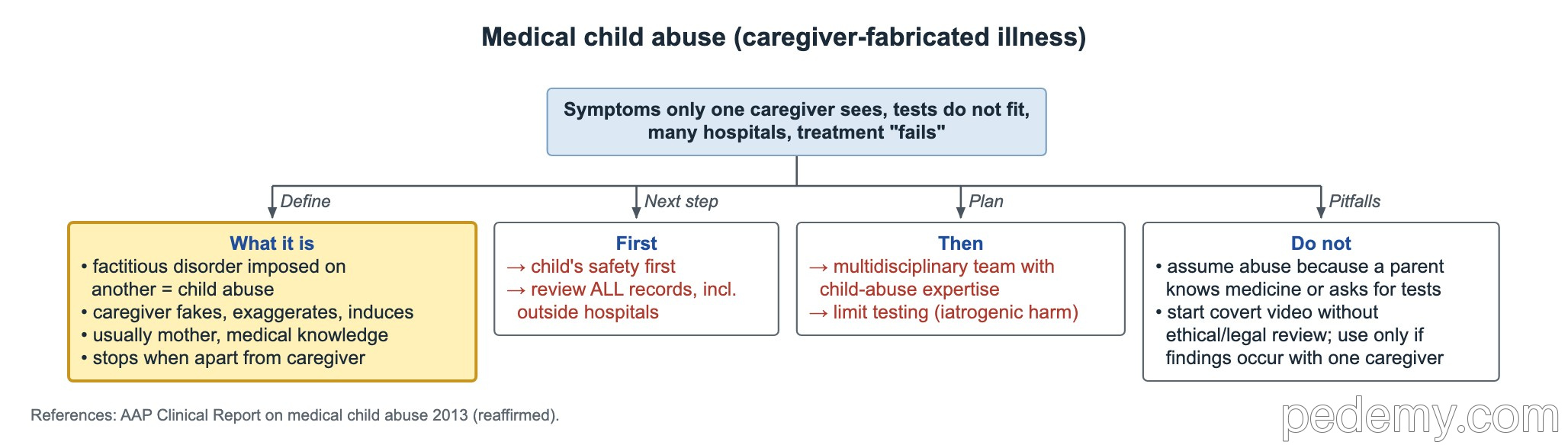
In caregiver-fabricated illness (factitious disorder imposed on another), a caregiver falsifies, exaggerates or induces symptoms, so the child gets unneeded tests and treatment. It is child abuse. The caregiver is usually the mother, often with some medical knowledge.
Suspect it when symptoms are seen only by one caregiver, tests do not fit, care is spread across many hospitals and treatment keeps "failing". Symptoms stop when the child is apart from that caregiver.
- Top priority: protect the child from further harm.
- First step: review all medical records, including those from other hospitals.
- Plan care with a multidisciplinary team that has child-abuse expertise, and limit testing: extensive empiric testing causes iatrogenic harm.
- A parent with health care training who asks for tests is not by itself evidence of abuse.
- Covert video monitoring is not a routine first step; it needs ethical and legal review and fits only when findings occur with one caregiver.
Neglect, emotional abuse, risk and prevention
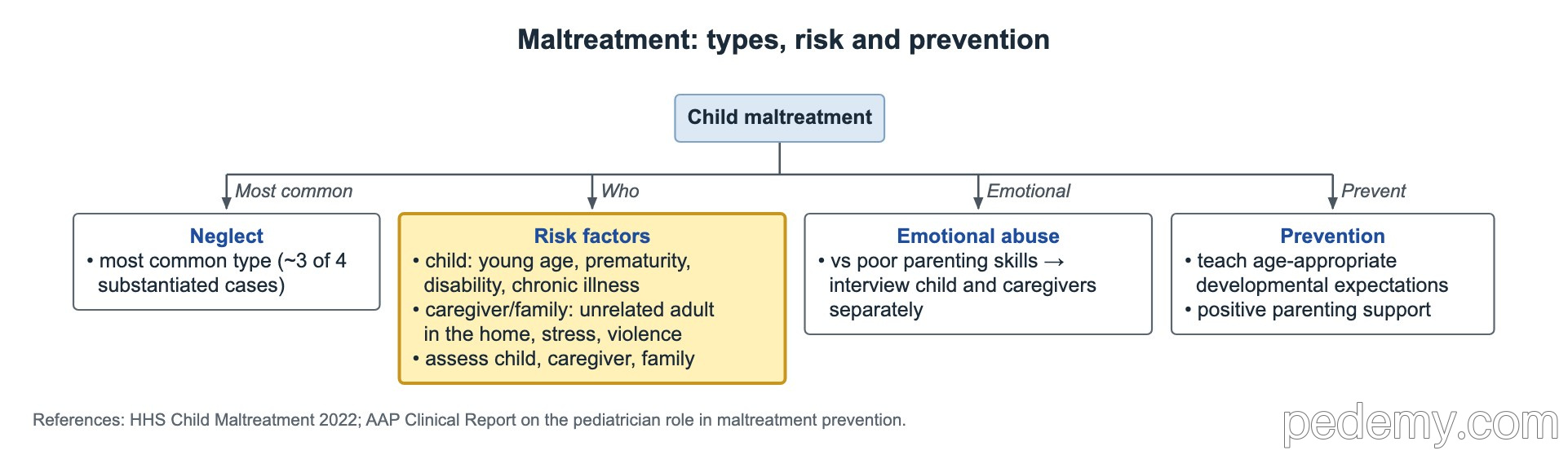
- Neglect is the most common type of substantiated maltreatment in the US.
- Child risk factors: young age, prematurity, disability (including intellectual disability) and chronic illness.
- Household risk factors: an unrelated adult living in the home, caregiver stress, substance use and intimate partner violence.
- Assess risk at three levels: child, caregiver and family.
- Suspected emotional abuse vs poor parenting skills: interview the child and caregivers separately first.
- Prevention: teach parents what is normal behavior at each age, so expectations are realistic, and support positive, nonviolent discipline.
Common questions
When should a child get a skeletal survey for suspected abuse?
For suspected physical abuse in children under 2 years, and often for household contacts under 2 years. A follow-up survey about 2 weeks later finds fractures that were not visible at first.
Do you need proof before reporting child abuse?
No. Every US state requires a report on reasonable suspicion. Child protective services and law enforcement investigate; the clinician does not need to prove abuse.
What is TEN-4-FACESp?
A bruising rule for children under 4 years: bruises on the torso, ears or neck; any bruise at 4.99 months or younger; bruises on the frenulum, angle of the jaw, cheeks, eyelids or subconjunctivae; or patterned bruises should prompt an abuse evaluation.
Study this topic
Sources
- AAP 2015: The evaluation of suspected child physical abuse (Pediatrics)
- AAP 2014: Evaluating children with fractures for child physical abuse (Pediatrics)
- AAP 2020: Abusive head trauma in infants and children (Pediatrics)
- Pierce et al. 2021: TEN-4-FACESp bruising clinical decision rule (JAMA Netw Open)
- AAP 2013: Caregiver-fabricated illness in a child (Pediatrics)
Written for Pedemy in our own words from the sources above; checked November 2026. For education only, not medical advice; check doses and local protocols before treating a patient. Pedemy is independent and not affiliated with or endorsed by the organizations cited.