

Main decision tree
Calcium and phosphate disorders: hypoparathyroidism
Key points
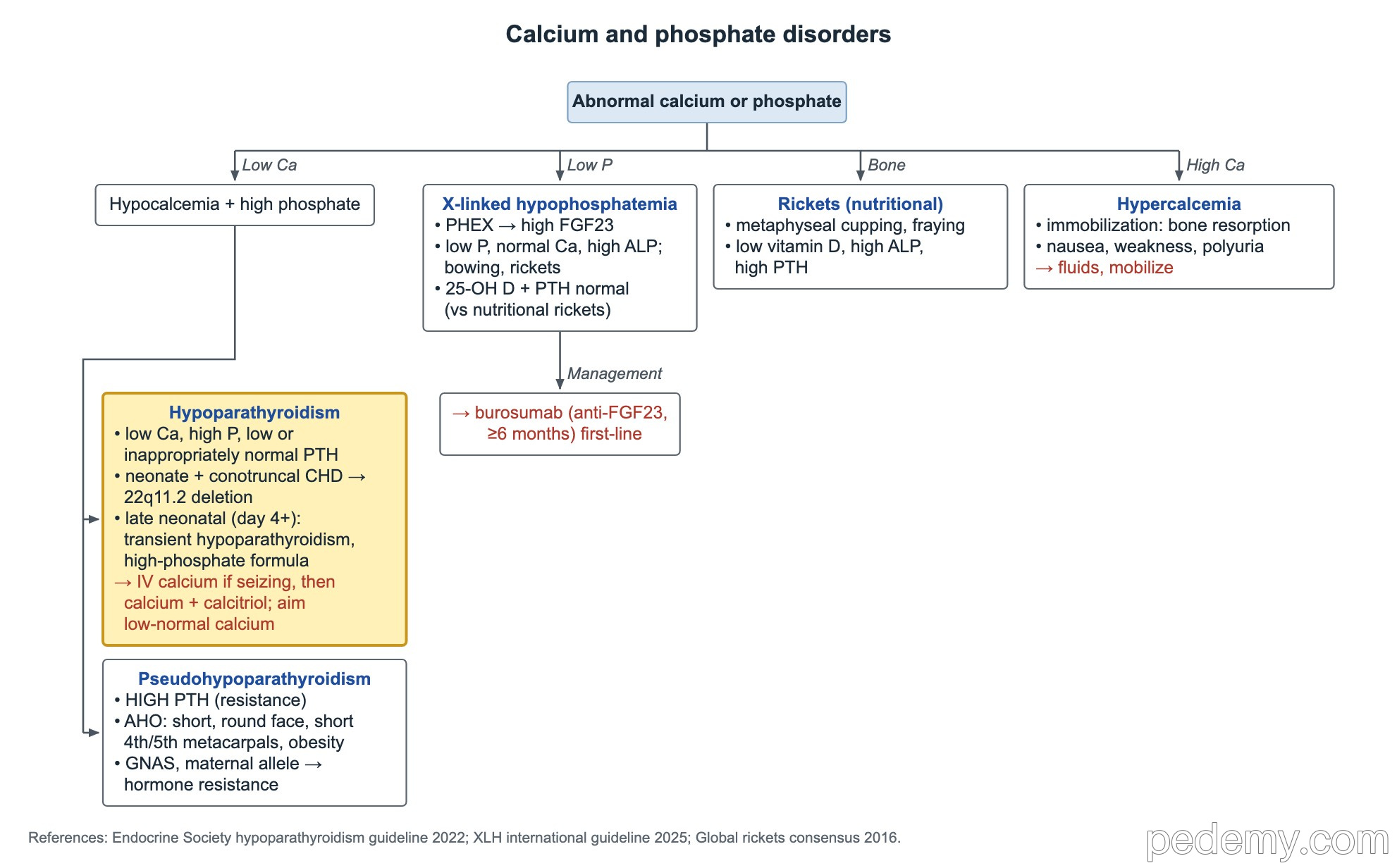
- Low calcium with high phosphate and low or inappropriately normal PTH = hypoparathyroidism.
- Treat hypoparathyroidism with calcium plus calcitriol and aim for LOW-normal calcium to avoid hypercalciuria.
- Low calcium, high phosphate and HIGH PTH = pseudohypoparathyroidism (PTH resistance, GNAS).
- Nutritional rickets: low 25-OH D, high PTH, high ALP; treat with vitamin D ≥2000 IU/day for at least 3 months plus calcium 500 mg/day.
- XLH: low phosphate, normal calcium, high ALP, normal 25-OH D and PTH; burosumab from 6 months of age.
- Neonatal hypocalcemia: early (first 72 hours) mostly prematurity; late (after day 3) mostly high phosphate intake or transient hypoparathyroidism.
- About 90% of peak bone mass is gained by about 18 years in girls and 20 years in boys.
Hypocalcemia and hypoparathyroidism
PTH raises calcium by releasing it from bone, by holding it in the kidney, and by stimulating renal 1α-hydroxylase to make calcitriol, which increases gut absorption. PTH also makes the kidney excrete phosphate. Without PTH, calcium falls and phosphate rises because the kidney excretes less phosphate.
- Signs: tetany, paresthesias, carpopedal spasm, Chvostek and Trousseau signs, laryngospasm, seizures, long QT.
- A PTH in the normal range is inappropriately normal when calcium is low and still means hypoparathyroidism.
- Neonate with hypocalcemic seizure, high phosphate and a conotruncal heart defect: think 22q11.2 deletion.
- Early neonatal hypocalcemia (first 72 hours): prematurity is the commonest cause; also infants of diabetic mothers and perinatal asphyxia.
- Late neonatal hypocalcemia (after day 3): transient hypoparathyroidism, often with a high phosphate load; also maternal hyperparathyroidism, maternal vitamin D deficiency and low magnesium.
- Also check magnesium: low magnesium blocks PTH release and action.
Treating hypoparathyroidism
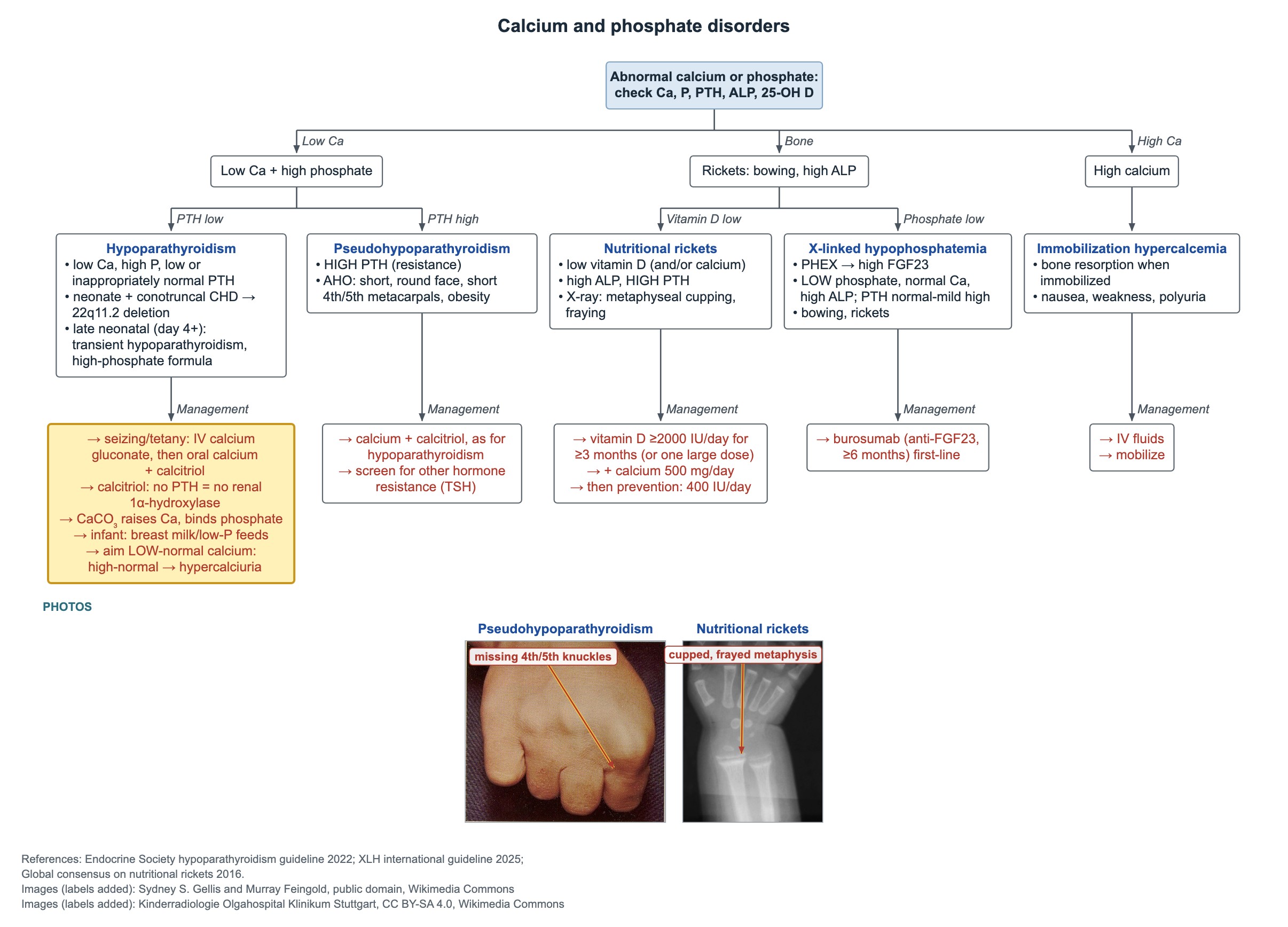
- Seizure or tetany: IV calcium gluconate slowly with cardiac monitoring, then oral calcium plus calcitriol.
- Calcitriol, not plain vitamin D: without PTH the kidney cannot activate vitamin D through 1α-hydroxylase.
- Oral calcium carbonate both raises calcium and binds dietary phosphate.
- Infants: breast milk or a low-phosphate formula.
- Aim for calcium in the low-normal range. Pushing it to high-normal causes hypercalciuria, with nephrocalcinosis and kidney stones; monitor urine calcium.
Pseudohypoparathyroidism
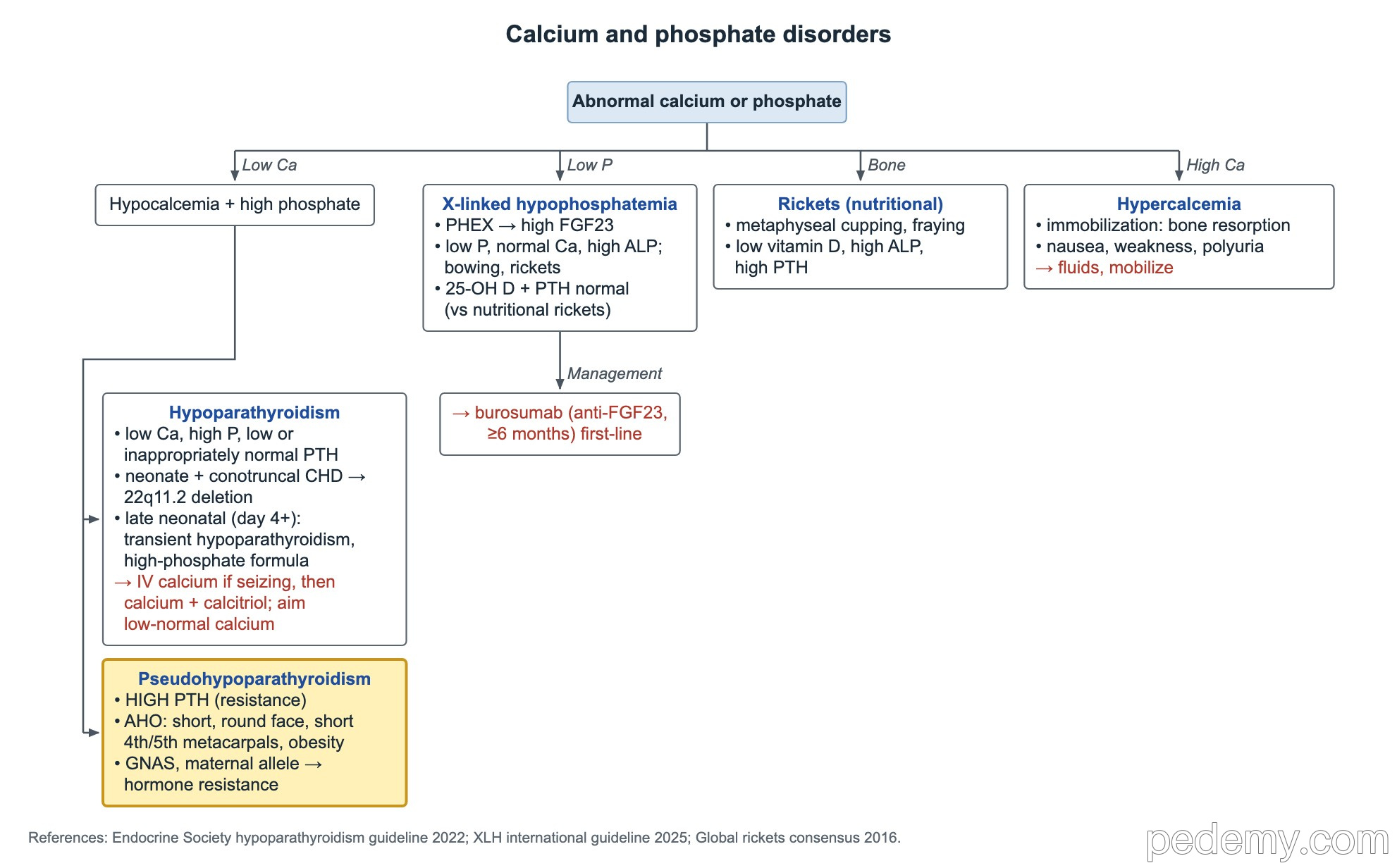
In pseudohypoparathyroidism the kidney does not respond to PTH. Labs look like hypoparathyroidism, low calcium and high phosphate, but PTH is HIGH.
- Type 1a has Albright hereditary osteodystrophy: short stature, round face, obesity, short 4th and 5th metacarpals (missing knuckles on a fist), subcutaneous ossification.
- Cause: inactivating GNAS variants, autosomal dominant with imprinting. Inherited from the mother, they cause hormone resistance (PTH, and often TSH and gonadotropins).
- The same variant inherited from the father gives the AHO body features without hormone resistance (pseudopseudohypoparathyroidism).
- Treatment: calcium plus calcitriol as in hypoparathyroidism; screen for other hormone resistance, such as a high TSH.
Nutritional rickets
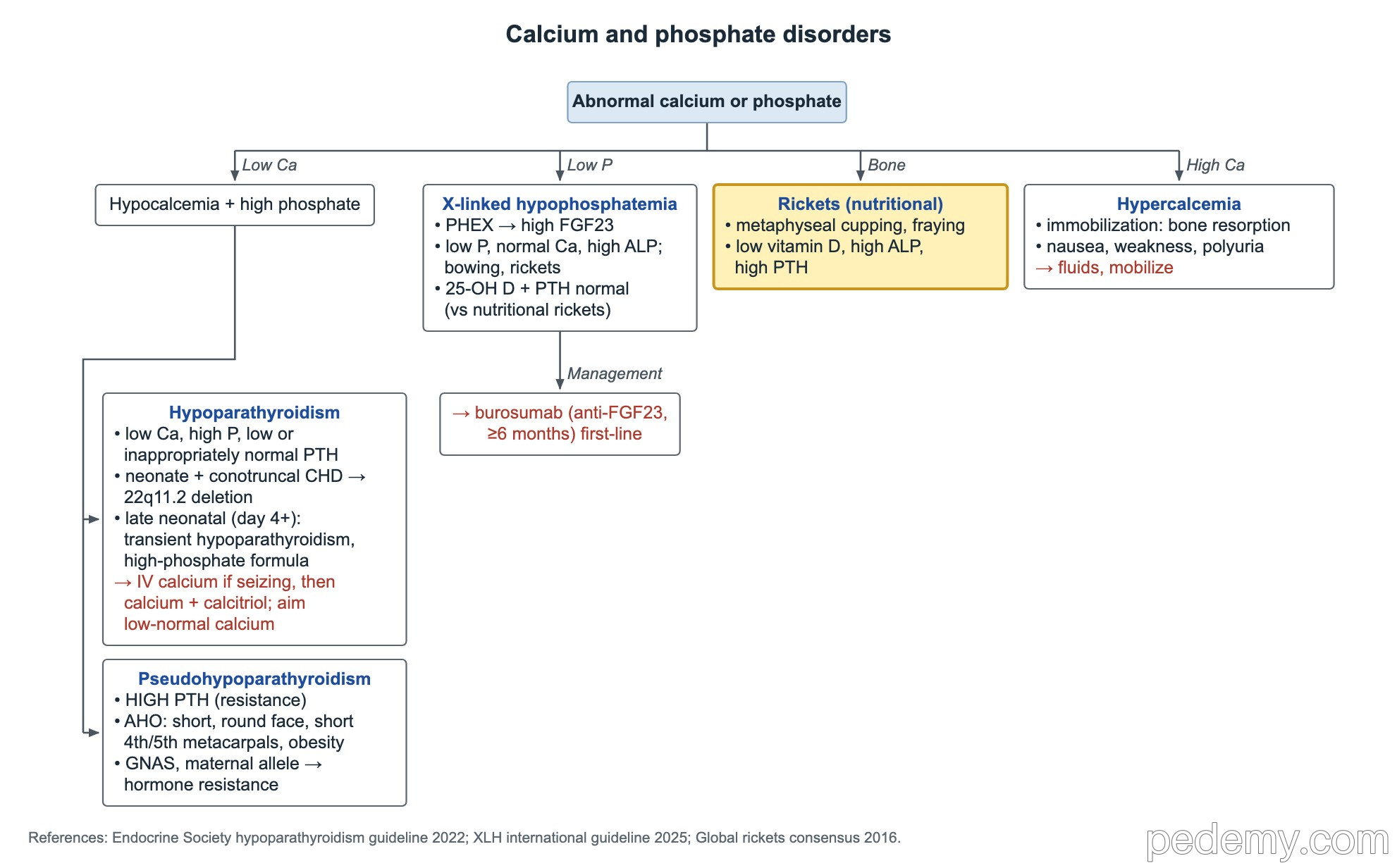
Rickets is failed mineralization at the growth plate. Nutritional rickets comes from too little vitamin D, too little calcium, or both.
- Labs: low 25-OH vitamin D, high PTH, high alkaline phosphatase; calcium low or normal, phosphate often low.
- Wrist or knee X-ray: widened, cupped and frayed metaphyses.
- Signs: bowed legs, widened wrists, rachitic rosary, delayed fontanelle closure, delayed walking.
- Treatment (global consensus 2016): vitamin D at least 2000 IU/day for at least 3 months, or one large dose, plus calcium 500 mg/day.
- Then prevention: 400 IU/day of vitamin D for infants, including all breastfed infants.
X-linked hypophosphatemia (XLH)
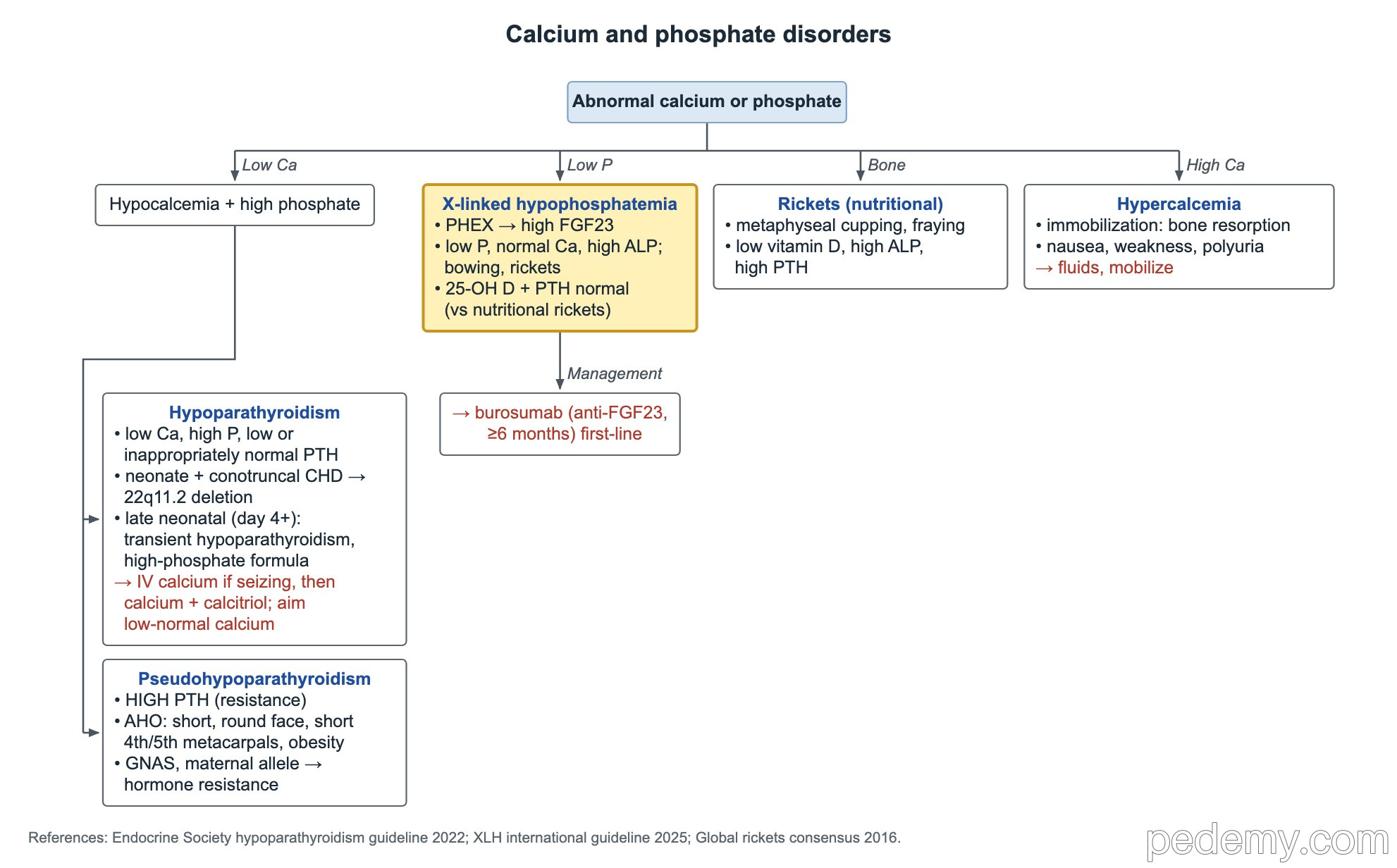
PHEX variants raise FGF23, which makes the kidney waste phosphate and keeps calcitriol inappropriately low. It is the commonest inherited rickets. It is X-linked dominant: an affected father passes it to all daughters and no sons.
- Treatment of choice in children (international guideline 2025): burosumab, an anti-FGF23 antibody, from 6 months of age.
- Oral phosphate with calcitriol is the alternative when burosumab is not available.
- Vitamin D alone does not heal XLH.
| Test | Nutritional rickets | XLH |
|---|---|---|
| Phosphate | Low or normal | Low |
| Calcium | Low or normal | Normal |
| Alkaline phosphatase | High | High |
| 25-OH vitamin D | Low | Normal |
| PTH | High | Normal or mildly high |
Hypercalcemia of immobilization
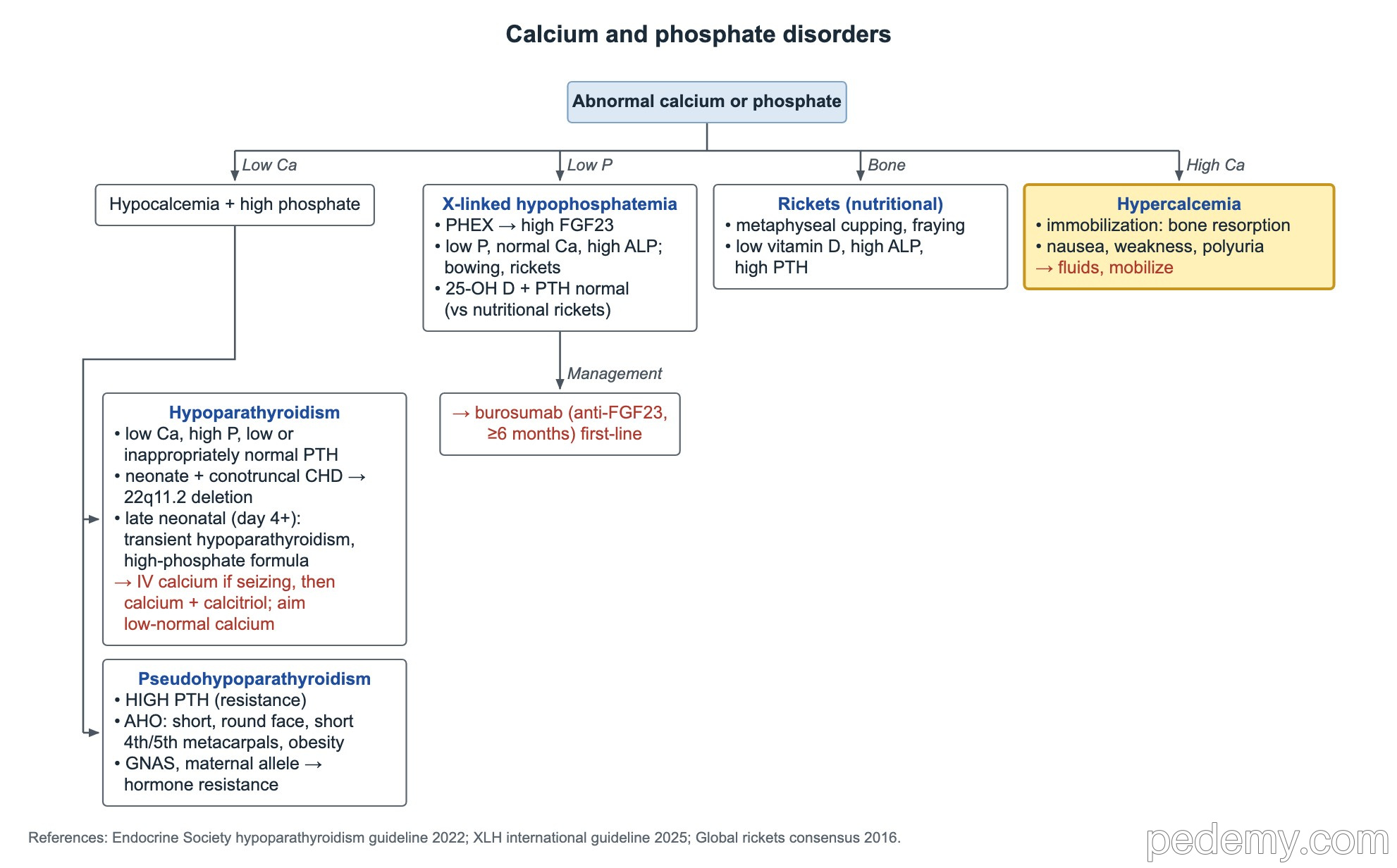
Prolonged immobilization, for example after a femur fracture, spinal cord injury or traction, speeds bone resorption. Growing adolescents with rapid bone turnover are most at risk.
- Symptoms: nausea, vomiting, constipation, weakness, polyuria and thirst, confusion.
- Labs: high calcium with suppressed PTH and high urine calcium.
- Treatment: IV fluids and mobilization as early as possible; bisphosphonates for severe or persistent cases.
Peak bone mass and bone health
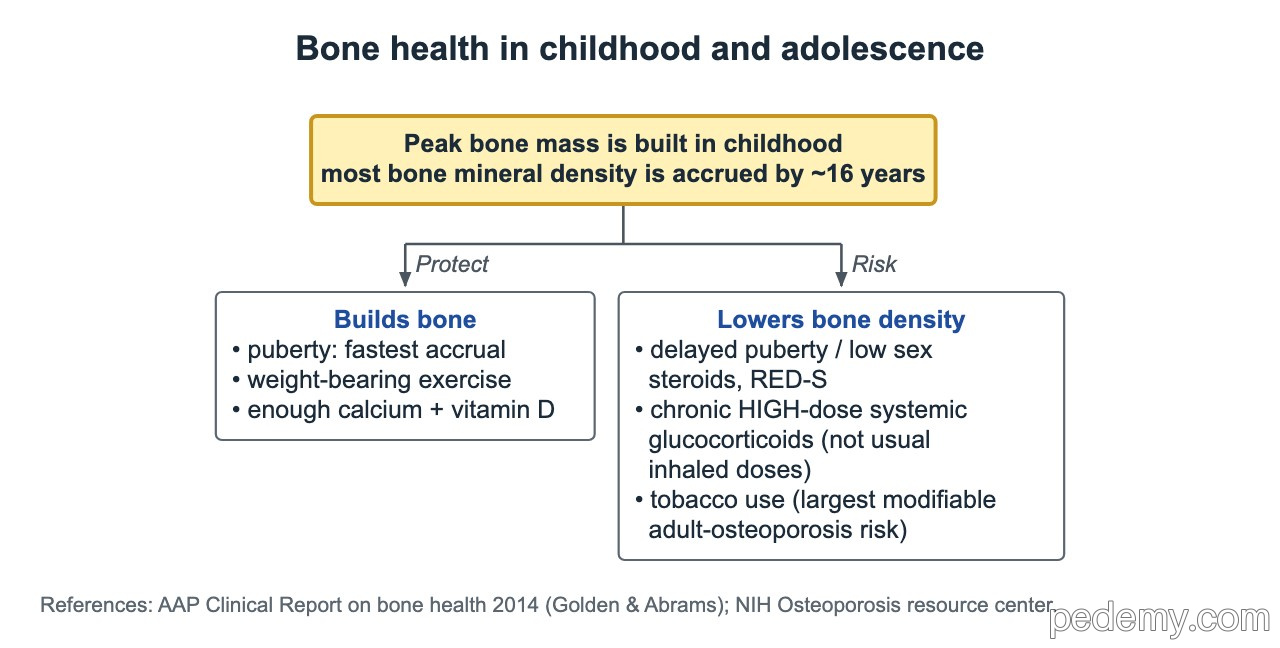
Adult bone strength depends on the peak bone mass built in childhood. About 90% of peak bone mass is gained by about 18 years in girls and 20 years in boys, with the fastest gain around puberty, so adolescence is the key time for counseling.
- Builds bone: weight-bearing exercise and enough calcium and vitamin D (1300 mg calcium and 600 IU vitamin D a day for ages 9–18).
- Late puberty or hypogonadism lowers bone mineral density, because sex steroids drive accrual; so does energy deficiency (RED-S, anorexia nervosa).
- Chronic high-dose systemic glucocorticoids are the most harmful steroid exposure; usual inhaled corticosteroid doses have little effect on bone.
- Cigarette smoking is a bigger long-term bone threat than appropriately dosed inhaled steroids.
Common questions
How do you treat nutritional rickets?
Vitamin D at least 2000 IU a day for at least 3 months (or one large dose) plus calcium 500 mg a day, then 400 IU a day to prevent relapse in infants.
How is XLH different from vitamin D–deficiency rickets?
In XLH phosphate is low but 25-OH vitamin D and PTH are normal, because the problem is FGF23-driven phosphate wasting. In nutritional rickets 25-OH vitamin D is low and PTH is high.
Why give calcitriol instead of vitamin D in hypoparathyroidism?
PTH is needed for the kidney's 1α-hydroxylase to activate vitamin D. Without PTH, only the active form, calcitriol, raises gut calcium absorption.
Study this topic
Sources
- Second International Workshop 2022: Evaluation and management of hypoparathyroidism (J Bone Miner Res)
- International Working Group 2025: X-linked hypophosphatemia management in children (J Clin Endocrinol Metab)
- Global consensus 2016: Prevention and management of nutritional rickets (J Clin Endocrinol Metab)
- International consensus 2018: Diagnosis and management of pseudohypoparathyroidism (Nat Rev Endocrinol)
- AAP 2014: Optimizing bone health in children and adolescents (Pediatrics)
Written for Pedemy in our own words from the sources above; checked November 2026. For education only, not medical advice; check doses and local protocols before treating a patient. Pedemy is independent and not affiliated with or endorsed by the organizations cited.