

Main decision tree
Early puberty: central, peripheral or benign?
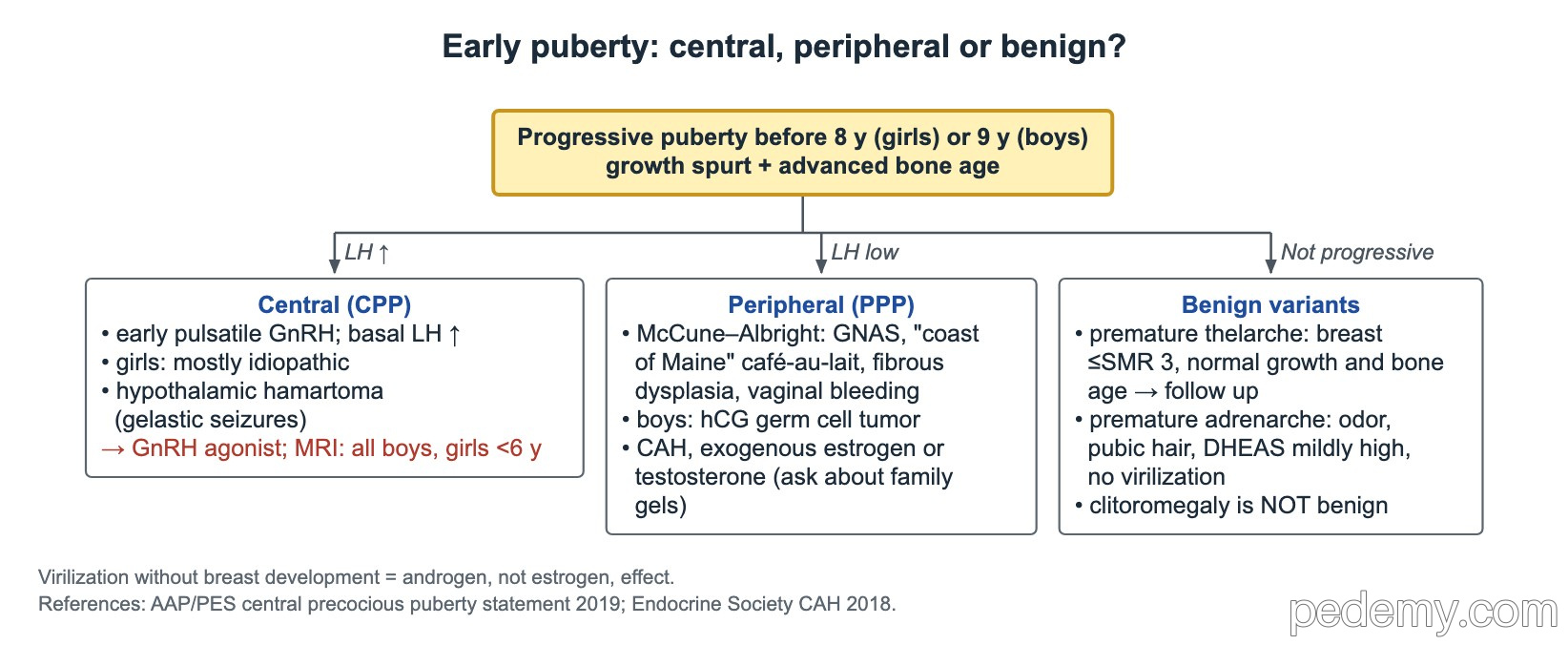
Key points
- Evaluate progressive puberty before age 8 years in girls or 9 years in boys; testicular volume of 4 mL or more marks male gonadarche.
- Central precocious puberty: basal LH above about 0.2–0.3 mIU/mL; mostly idiopathic in girls; brain MRI for all boys and girls under 6.
- Peripheral precocious puberty has low LH: think McCune–Albright, hCG-secreting tumors in boys, CAH and exogenous sex hormones.
- Delayed puberty: no breasts by 13 years or testes under 4 mL by 14 years; constitutional delay is the commonest cause.
- Turner (45,X) and Klinefelter (47,XXY) give high FSH and LH; confirm with a karyotype (at least 30 cells for Turner).
- Adolescent PCOS needs both irregular cycles for gynecologic age and hyperandrogenism; pelvic ultrasound is not used.
- Pubertal gynecomastia: tender disc 4 cm or less in mid-puberty, resolves in about 2 years; evaluate if over 5 cm, over 2 years, or at SMR 1 or 5.
Early puberty: central, peripheral or benign?
Normal puberty starts when pulsatile GnRH from the hypothalamus drives LH and FSH. Evaluate true, progressive pubertal development that starts before 8 years in girls or 9 years in boys. A growth spurt and advanced bone age show that sex steroids are acting.
Adrenarche and gonadarche are separate. Adrenarche is adrenal androgen effect: body odor, pubic and axillary hair, acne. Gonadarche is gonadal activation: breast development in girls, testicular enlargement to 4 mL or more in boys.
- History: age of onset, speed of progression, growth spurt, headache or other neurologic symptoms, and exposure to sex hormones.
- First tests: bone age and a morning basal LH by an ultrasensitive assay, with estradiol or testosterone.
- High LH: central (gonadotropin-dependent). Low LH: peripheral (gonadotropin-independent). Not progressive: a benign variant.
- Virilization without breast development points to an androgen effect, not estrogen.
Benign variants: premature thelarche and premature adrenarche
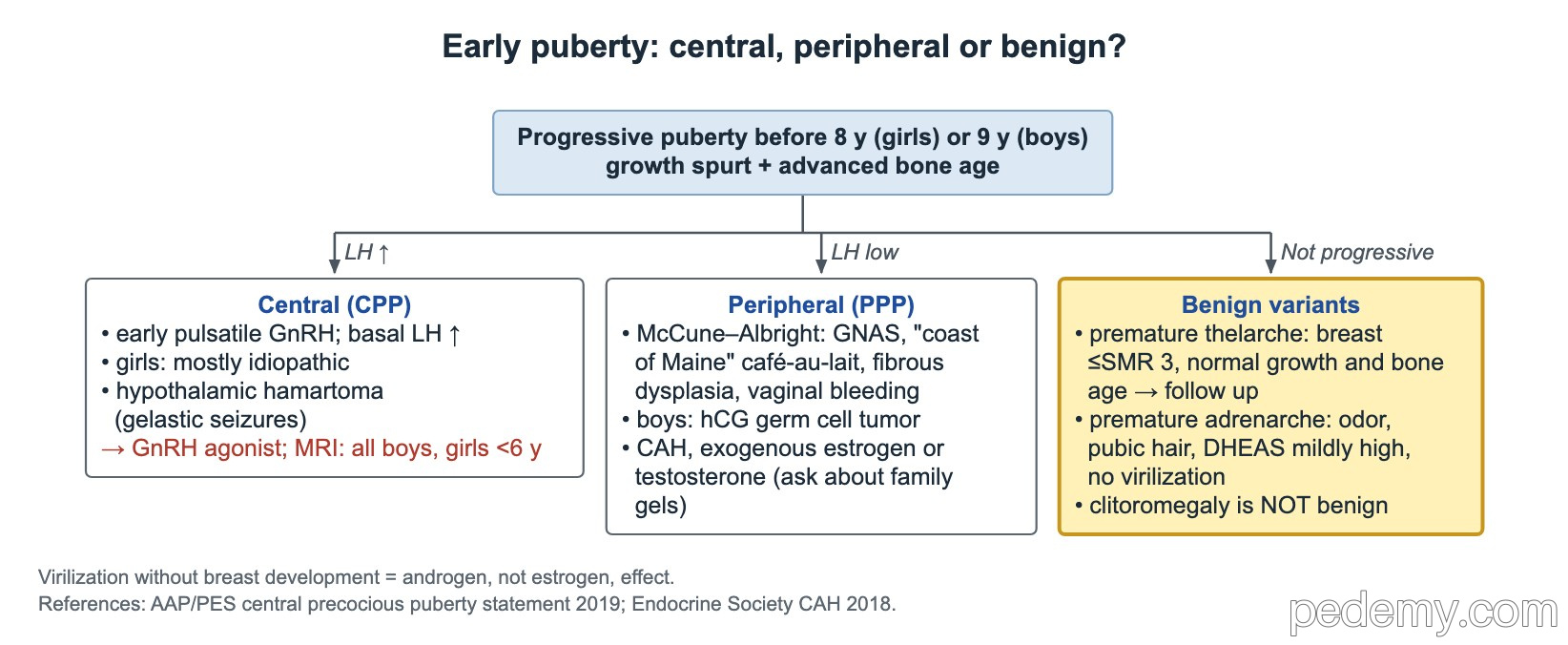
- Premature thelarche: isolated breast tissue, usually in a toddler, no more than SMR 3, with normal height velocity and bone age. Follow clinically; no labs needed.
- Premature adrenarche: body odor and pubic hair in a young child, normal or slightly advanced bone age, no virilization. DHEAS is mildly high for age.
- Clitoromegaly, rapid progression or a growth spurt is not premature adrenarche and needs evaluation.
- Early pubic hair with clearly advanced bone age: check an early-morning 17-hydroxyprogesterone to screen for nonclassic CAH.
- Rapid virilization with hypertension or Cushing features suggests an adrenocortical tumor.
Central precocious puberty
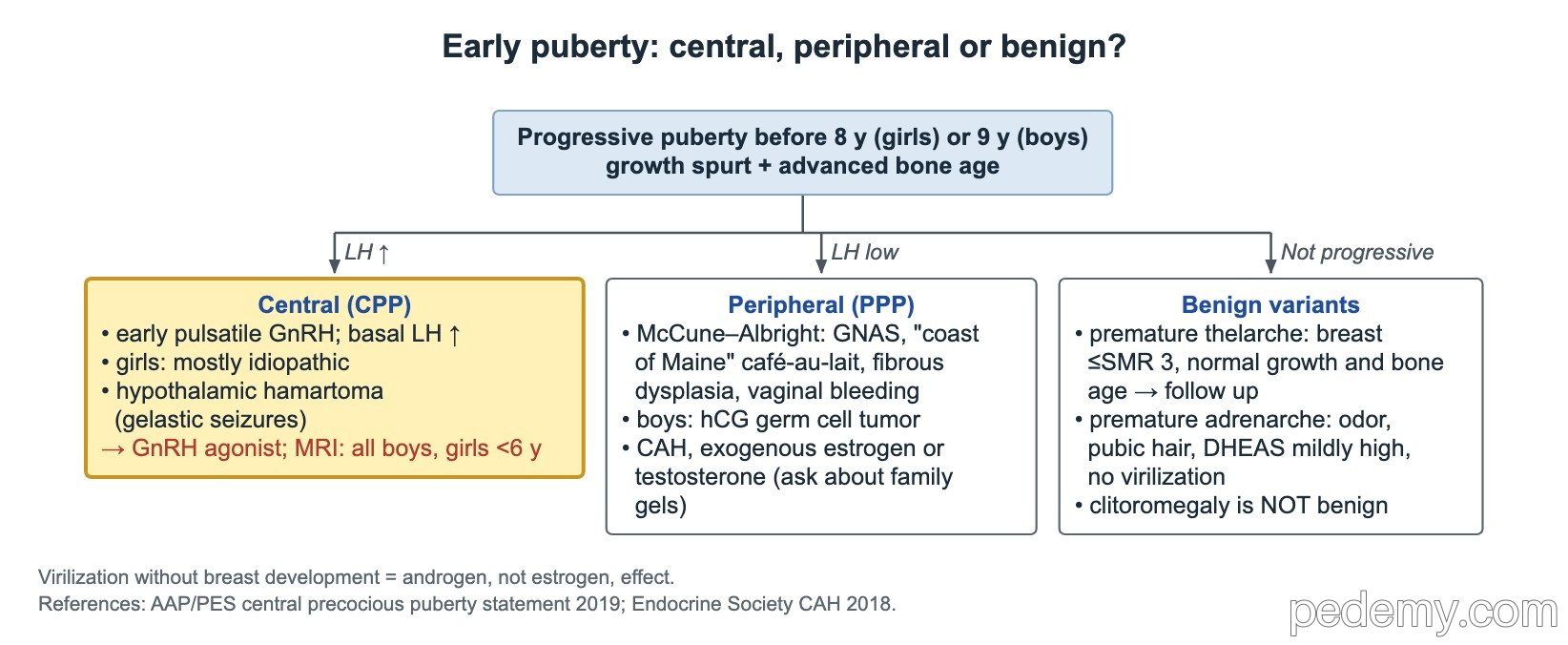
Central precocious puberty is early activation of pulsatile GnRH. A basal LH above about 0.2–0.3 mIU/mL on an ultrasensitive assay supports it; a GnRH or GnRH-agonist stimulation test is used when basal LH is unclear.
- Girls: mostly idiopathic. Boys: a brain lesion is found much more often.
- Brain and pituitary MRI for all boys and for girls under 6 years; it is considered case by case in girls aged 6–8.
- Hypothalamic hamartoma is the classic congenital lesion, sometimes with gelastic (laughing) seizures.
- Slowing growth with polyuria and thirst in a child with early puberty suggests a CNS tumor with GH, TSH and AVP deficiency.
- Treatment: a GnRH agonist such as leuprolide or a histrelin implant.
- During treatment, track pubertal stage, growth velocity, reliable delivery of the doses and side effects.
Peripheral precocious puberty
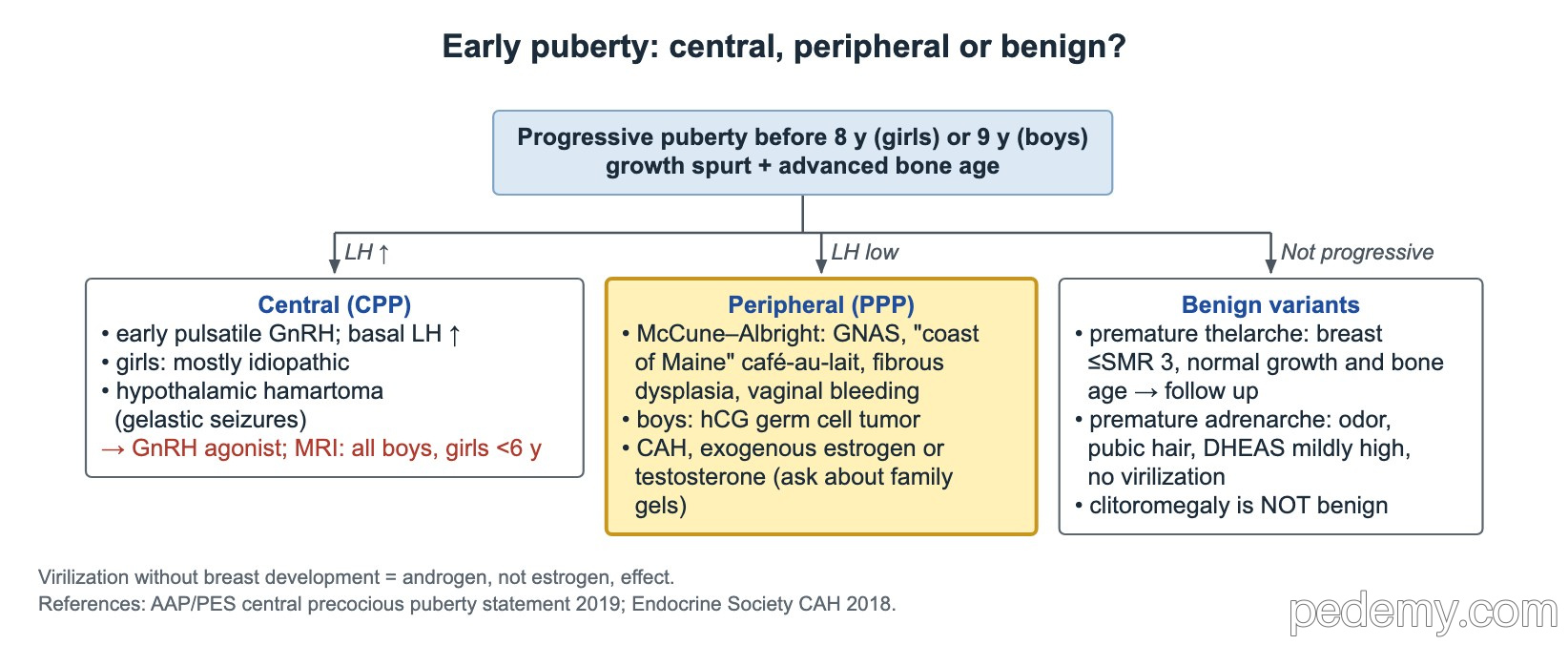
In peripheral precocious puberty, sex steroids come from the gonads, adrenals, a tumor or an outside source, and LH is suppressed.
- McCune–Albright syndrome: postzygotic activating GNAS variant. Triad of irregular 'coast of Maine' café-au-lait macules, fibrous dysplasia of bone and gonadotropin-independent precocious puberty. Girls often present with breast growth and vaginal bleeding from ovarian cysts.
- Fibrous dysplasia on X-ray: expansile lucent lesion with a ground-glass matrix. Other endocrine problems include hyperthyroidism with nodular goiter.
- hCG-secreting germ cell tumors (CNS, mediastinal) and hepatoblastoma: hCG binds the LH receptor on Leydig cells and raises testosterone. This causes puberty mainly in boys, because the ovary also needs FSH.
- Exogenous hormones: ask about estrogen creams and a parent's testosterone gel. A young girl with pubic hair and clitoromegaly but no breasts, whose parent uses testosterone gel, has secondary exposure (FDA boxed warning).
- CAH and adrenal tumors cause androgen excess without breast development in girls.
Delayed puberty and hypogonadism
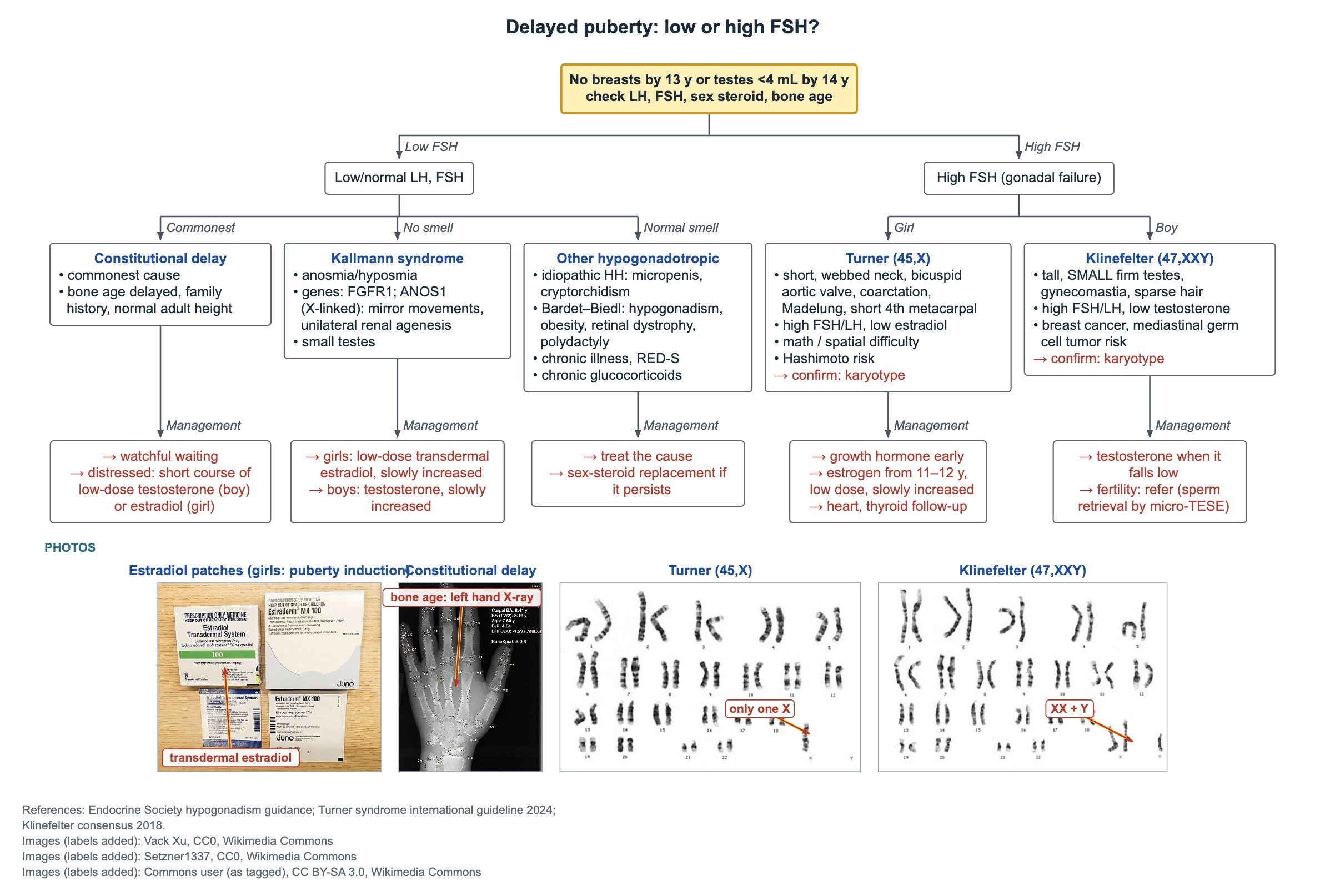
Evaluate when there is no breast development by 13 years in a girl or testes still under 4 mL by 14 years in a boy. Check LH, FSH, estradiol or testosterone, and a bone age.
- Kallmann genes: ANOS1 (X-linked) causes mirror movements (bimanual synkinesia) and renal agenesis. FGFR1 is the most common gene; cleft lip or palate and missing teeth favor it. It disrupts migration of GnRH and olfactory neurons.
- Some pubic hair in hypogonadotropic hypogonadism is expected, because adrenarche does not depend on gonadotropins.
- Puberty induction in a girl with GnRH deficiency: low-dose transdermal estradiol increased gradually, with a progestin added later.
- Turner: confirm with a karyotype of at least 30 cells. Mosaic 45,X/46,XX can have some breast development. Typical learning difficulty is math and visual-spatial skills, with good verbal skills. Higher risk of Hashimoto thyroiditis.
- Klinefelter: the most consistent finding is small, firm testes; confirm with a karyotype. Testosterone does not reverse established gynecomastia (surgery may be needed). Higher risk of breast cancer, mediastinal germ cell tumors and non-Hodgkin lymphoma.
| Cause | Key features | Management |
|---|---|---|
| Constitutional delay (commonest) | Delayed bone age, family history of late puberty, normal adult height | Watchful waiting; a short course of low-dose testosterone (boy) or estradiol (girl) if distressed |
| Kallmann syndrome | Hypogonadotropic hypogonadism with anosmia or hyposmia; small prepubertal testes; unilateral renal agenesis | Low-dose sex steroid, increased slowly |
| Other hypogonadotropic causes | Normosmic idiopathic HH (micropenis, cryptorchidism); Bardet–Biedl (obesity, retinal dystrophy, polydactyly, kidney anomalies); chronic illness, RED-S, chronic glucocorticoids | Treat the cause; sex steroids if it persists |
| Turner syndrome (45,X) | Short stature, webbed neck, bicuspid aortic valve, coarctation; high FSH and LH with low estradiol | Growth hormone early; estrogen from 11–12 years, low dose, slowly increased |
| Klinefelter syndrome (47,XXY) | Tall, small firm testes, gynecomastia, sparse body hair; high FSH and LH with low or low-normal testosterone | Testosterone when levels fall; refer for fertility (micro-TESE) |
Pubertal gynecomastia and adolescent PCOS
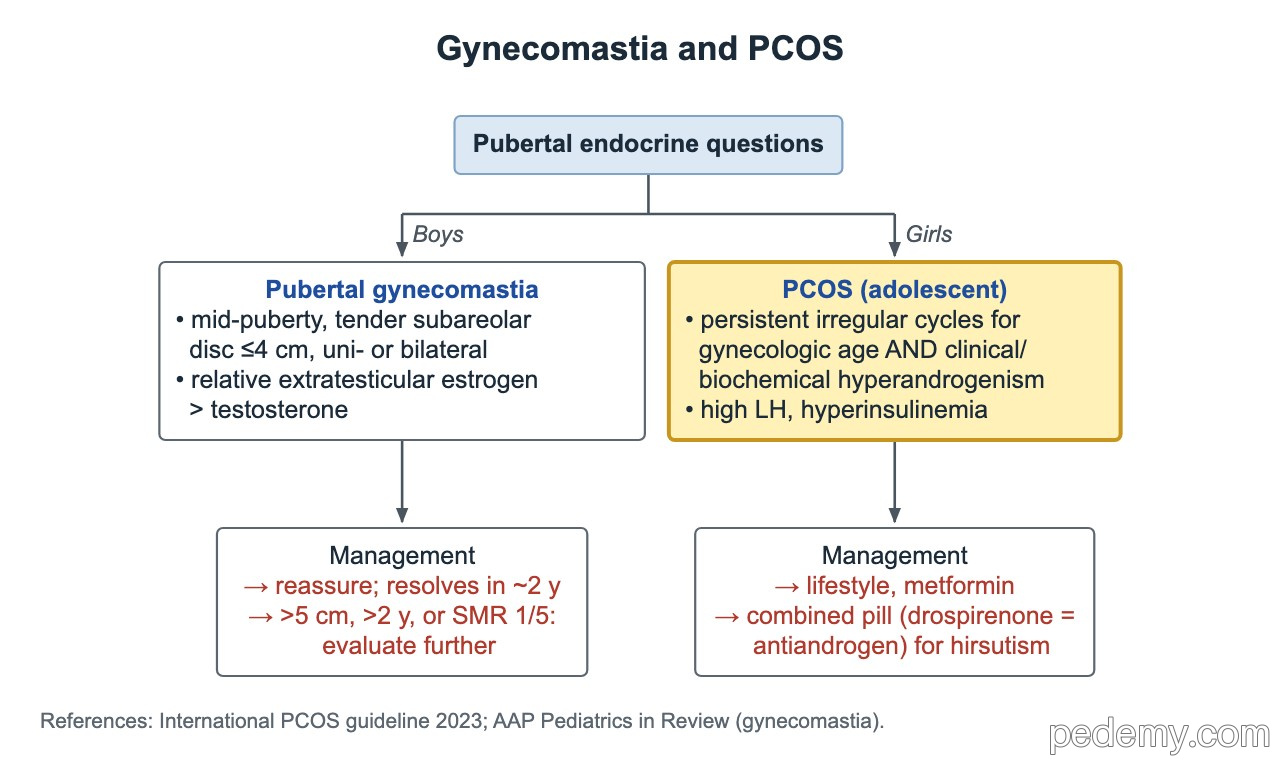
Pubertal gynecomastia is common in mid-puberty: a tender subareolar disc of 4 cm or less, on one or both sides. It comes from a relative excess of estrogen (from aromatization outside the testis) over testosterone. Reassure and follow; most resolve within about 2 years. Evaluate further if it is over 5 cm, lasts over 2 years, or appears at SMR 1 or 5.
Adolescent PCOS (2023 international guideline) needs both persistent menstrual irregularity for gynecologic age and clinical or biochemical hyperandrogenism, after mimics are excluded.
- Irregular cycles 1 to under 3 years after menarche: under 21 or over 45 days.
- Irregular cycles 3 or more years after menarche: under 21 or over 35 days, or fewer than 8 cycles a year.
- Pelvic ultrasound and AMH are not used to diagnose PCOS in adolescents.
- Exclude pregnancy, thyroid disease, hyperprolactinemia and nonclassic CAH; look for a tumor if virilization is rapid.
- LH is often high and drives ovarian androgen production; insulin resistance is the linked metabolic problem.
- Management: healthy lifestyle; combined oral contraceptive for irregular cycles, acne and hirsutism; metformin for metabolic features. Drospirenone is a progestin with antiandrogen activity.
Differences of sex development
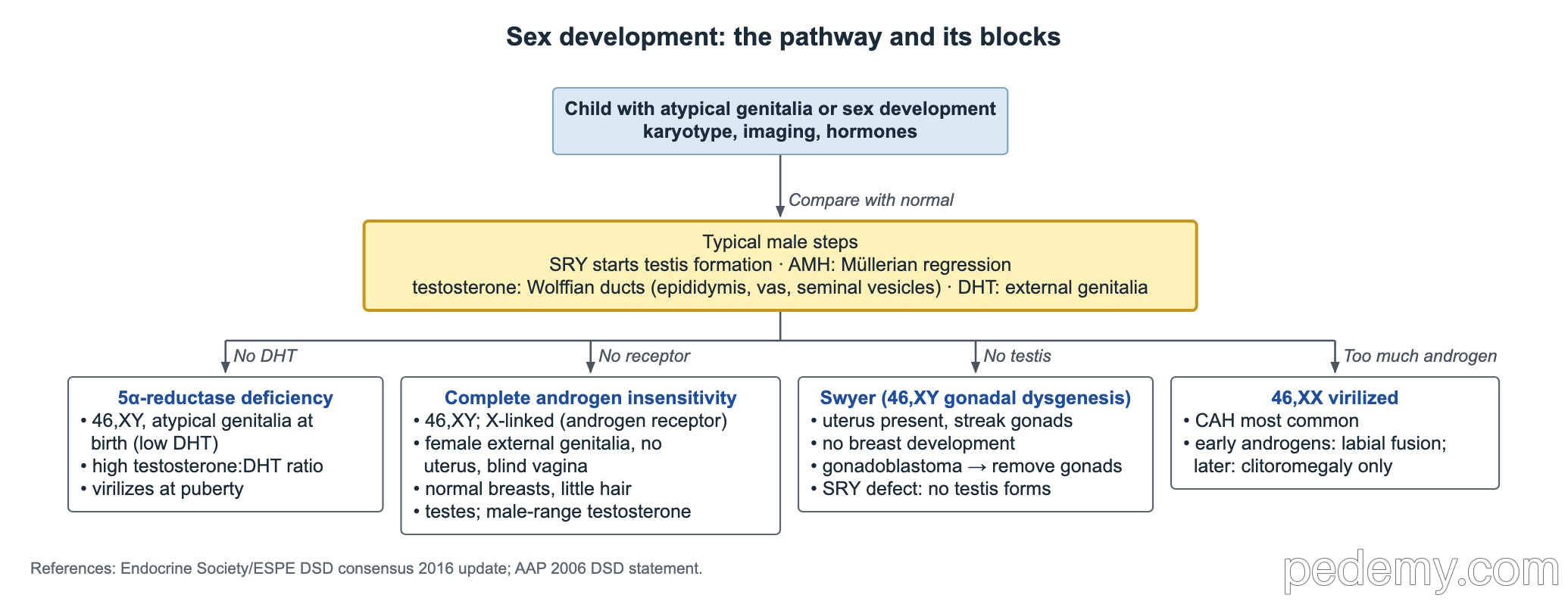
Typical male steps: SRY on the Y chromosome starts testis formation. Sertoli cells make anti-Müllerian hormone, which makes the Müllerian ducts regress. Leydig cell testosterone keeps the Wolffian ducts (epididymis, vas deferens, seminal vesicles). 5α-reductase turns testosterone into DHT, which masculinizes the external genitalia.
A child with atypical genitalia needs a karyotype, pelvic imaging and hormone tests, with an experienced DSD team.
- Prenatal dexamethasone for CAH would have to start before about 8 weeks of gestation, before the genitalia form. The Endocrine Society 2018 guideline considers it experimental, for research settings only.
| Condition | Block | Key findings |
|---|---|---|
| 5α-reductase type 2 deficiency | No DHT | 46,XY, atypical genitalia at birth, high testosterone-to-DHT ratio; marked virilization at puberty |
| Complete androgen insensitivity | No androgen receptor (X-linked) | 46,XY, female external genitalia, no uterus, blind vagina; primary amenorrhea with normal breasts, scant pubic hair and male-range testosterone |
| Swyer syndrome (46,XY complete gonadal dysgenesis) | No testis (often SRY) | Uterus present, streak gonads, no breast development; gonadoblastoma risk, so gonads are removed |
| 46,XX virilized | Too much androgen (CAH most common) | Early exposure causes labial fusion; exposure after the fusion window causes mainly clitoral enlargement |
Common questions
At what age is puberty considered early?
Progressive pubertal changes before 8 years in girls or 9 years in boys should be evaluated.
What counts as delayed puberty?
No breast development by 13 years in girls, or testicular volume under 4 mL by 14 years in boys.
Does a teen need an ultrasound to diagnose PCOS?
No. In adolescents PCOS is diagnosed by irregular cycles for gynecologic age plus hyperandrogenism; ultrasound is not recommended.
When is gynecomastia in a teen boy a concern?
When it is over 5 cm, lasts more than 2 years, appears before puberty or after puberty is complete, or comes with small testes.
Study this topic
Sources
- AAP 2016: Evaluation and referral of children with signs of early puberty (Pediatrics)
- Global consensus 2019: Diagnosis and treatment of central precocious puberty (Horm Res Paediatr)
- International guideline 2023: Assessment and management of PCOS (J Clin Endocrinol Metab)
- International Turner syndrome guideline 2024 (Eur J Endocrinol)
- Global DSD update since 2006 (Horm Res Paediatr 2016)
Written for Pedemy in our own words from the sources above; checked November 2026. For education only, not medical advice; check doses and local protocols before treating a patient. Pedemy is independent and not affiliated with or endorsed by the organizations cited.