

Main decision tree
Craniofacial anomaly
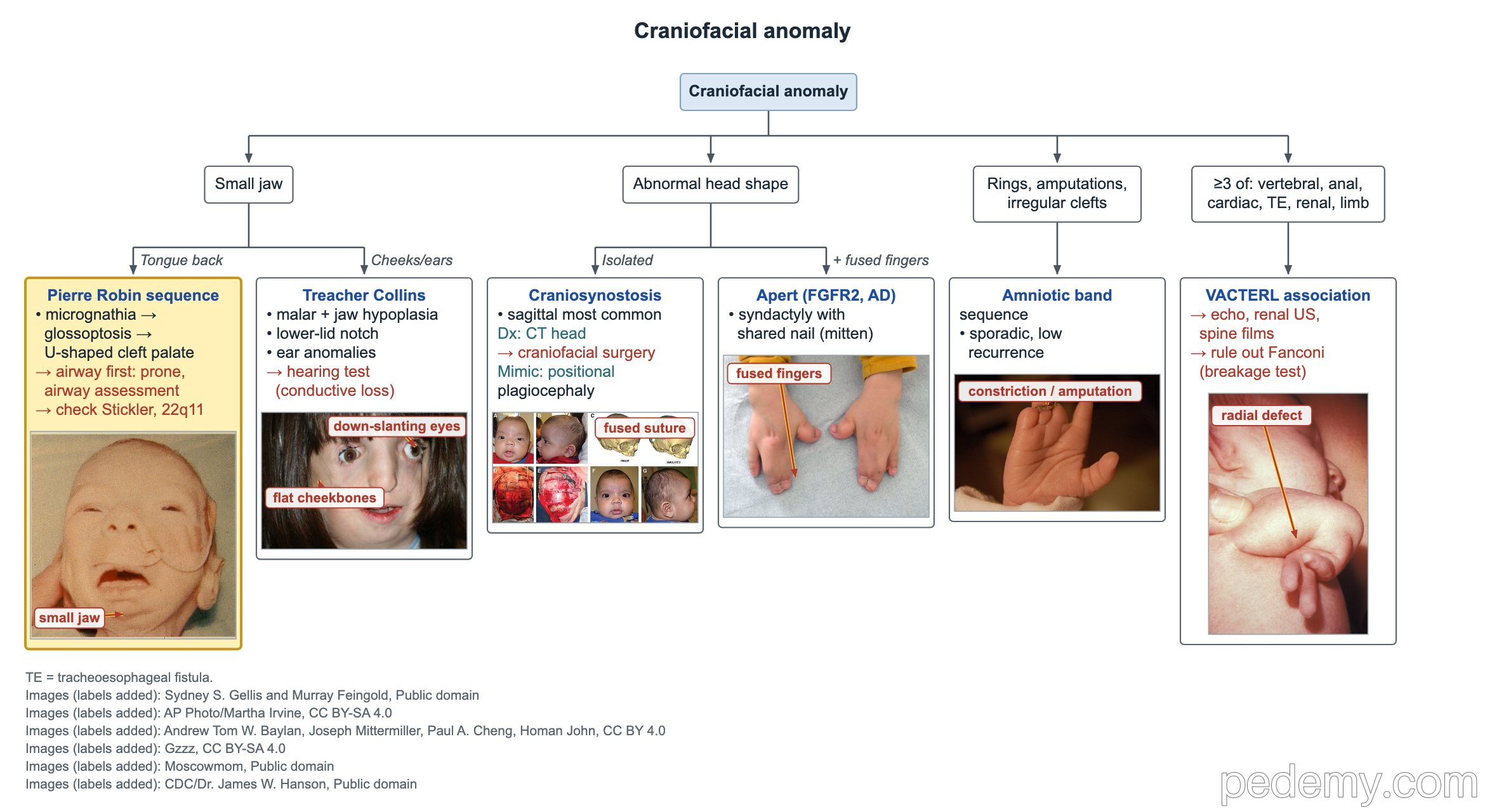
Key points
- Robin sequence: small mandible → glossoptosis → U-shaped cleft palate; airway and feeding come first.
- Robin sequence: get an echo and a dilated eye exam; Stickler syndrome and 22q11.2 deletion are the commonest causes.
- Craniosynostosis + mitten syndactyly with a shared nail = Apert; broad thumbs and great toes = Pfeiffer; normal hands and feet = Crouzon.
- Treacher Collins (mandibulofacial dysostosis): conductive hearing loss, often treated with a bone-conduction hearing aid.
- Amniotic bands cause disruption: constriction rings, amputations and irregular clefts; recurrence is low.
- VACTERL is an association: at least 3 of vertebral, anal, cardiac, TE fistula, renal and limb defects.
- VACTERL features + low blood counts or café-au-lait spots → rule out Fanconi anemia with a chromosome breakage test.
Sorting a craniofacial anomaly
Start with the most striking finding. A small jaw with the tongue falling back is Robin sequence; a small jaw with flat cheekbones and ear anomalies is Treacher Collins. An abnormal head shape means craniosynostosis, and fused fingers point to Apert syndrome.
Rings, amputations and irregular clefts suggest amniotic bands. Three or more defects of the spine, anus, heart, trachea and esophagus, kidneys or limbs suggest VACTERL association.
Robin sequence: airway, feeding and causes
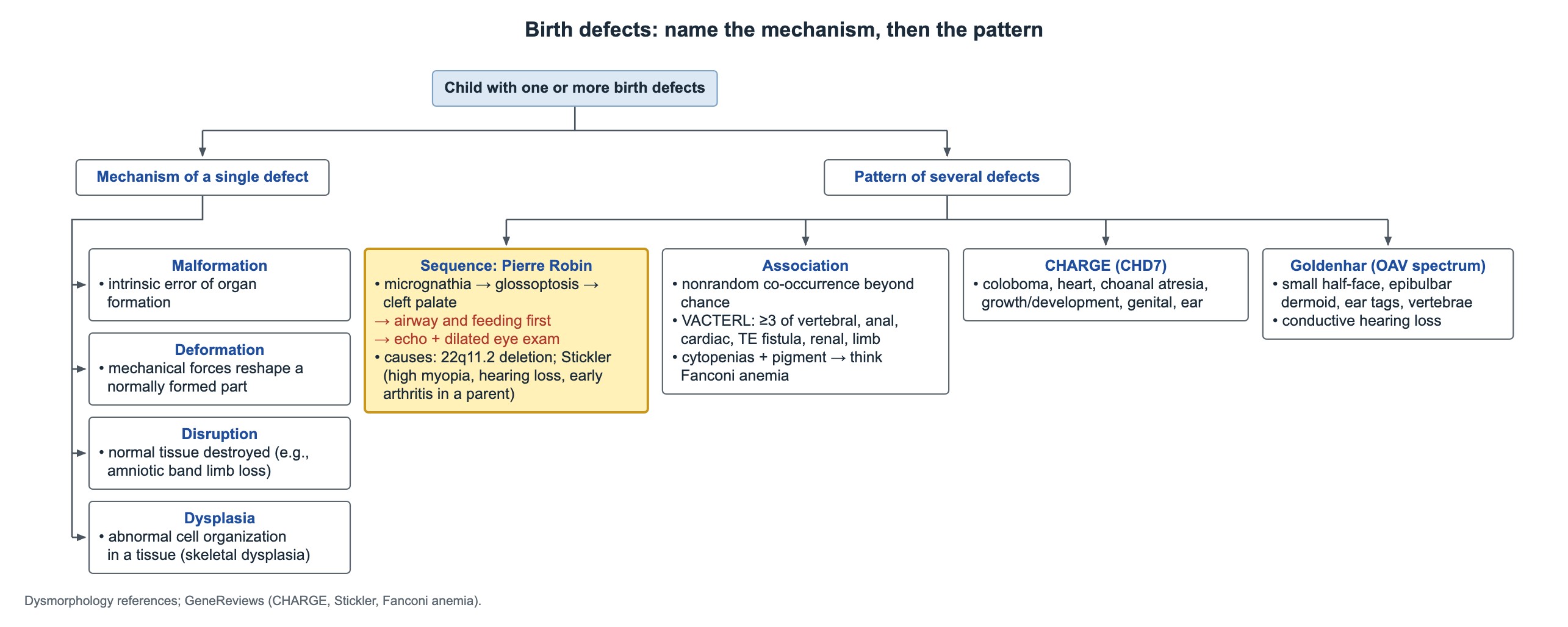
Robin sequence is a chain of events. The primary problem is a small, underdeveloped mandible (micrognathia). The tongue sits too far back (glossoptosis), blocks the airway and keeps the palate shelves from closing, which leaves a U-shaped cleft palate.
The two early goals are a safe airway and enough feeding for weight gain.
- First airway step: side-lying or prone positioning under monitoring, then a nasopharyngeal airway if obstruction continues.
- Severe cases may need mandibular distraction, tongue-lip adhesion or a tracheostomy.
- Baseline studies: echocardiography and a dilated eye exam.
- Stickler syndrome is the commonest single-gene cause: look for high myopia, retinal detachment risk, hearing loss and early arthritis in a parent.
- 22q11.2 deletion is the commonest chromosomal cause.
Syndromic craniosynostosis: look at the hands and feet
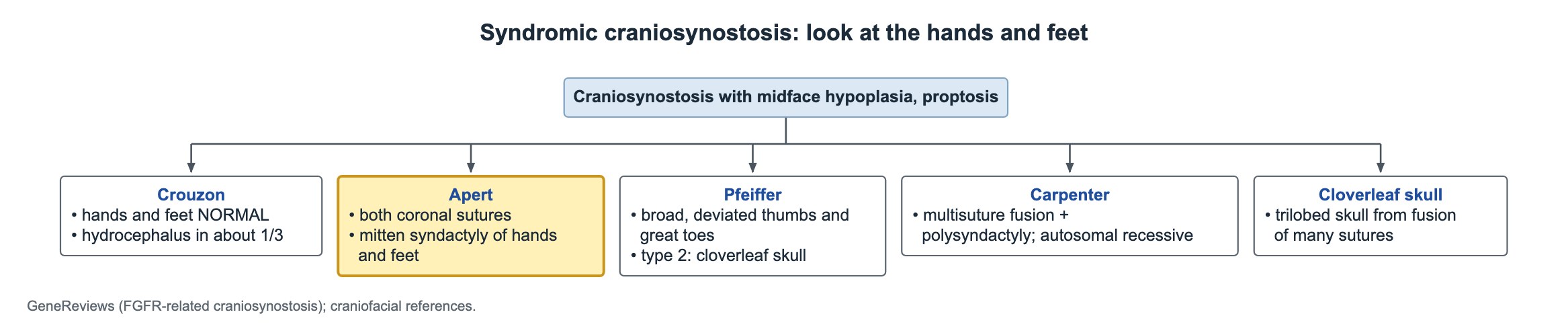
Sagittal synostosis is the commonest isolated form; positional plagiocephaly is a mimic without suture fusion. Syndromic craniosynostosis adds midface hypoplasia and proptosis, and the limbs tell the syndromes apart. Most are autosomal dominant FGFR disorders.
| Syndrome | Hands and feet | Other clues |
|---|---|---|
| Crouzon | Normal | Proptosis, midface hypoplasia; hydrocephalus in about one-third |
| Apert | Mitten syndactyly: fused fingers sharing one nail | Both coronal sutures; autosomal dominant (FGFR2) |
| Pfeiffer | Broad, deviated thumbs and great toes | Type 2 has a cloverleaf skull |
| Carpenter | Polysyndactyly | Multisuture fusion; autosomal recessive |
| Cloverleaf skull | Varies with cause | Trilobed skull from fusion of many sutures |
Treacher Collins and Goldenhar syndrome
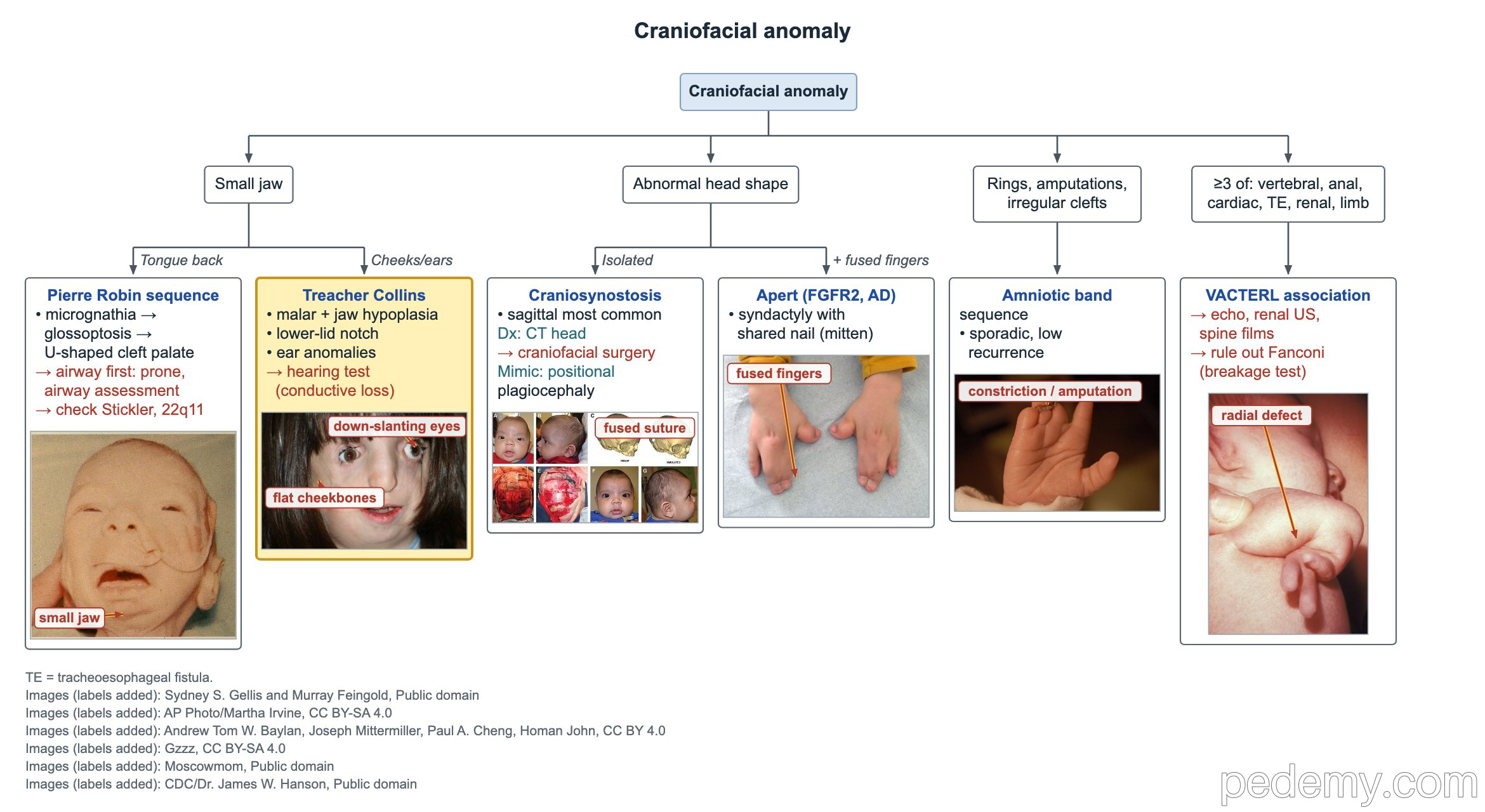
| Feature | Treacher Collins | Goldenhar (oculo-auriculo-vertebral spectrum) |
|---|---|---|
| Other name | Mandibulofacial dysostosis | Hemifacial microsomia |
| Symmetry | Both sides | Usually one side |
| Face | Flat cheekbones, small jaw, down-slanting eyes, lower-eyelid notch (coloboma) | Small half-face, epibulbar dermoid, ear tags |
| Other | Ear anomalies | Vertebral defects |
| Hearing | Conductive loss; bone-conduction hearing aid | Conductive loss |
Mechanisms of a single defect
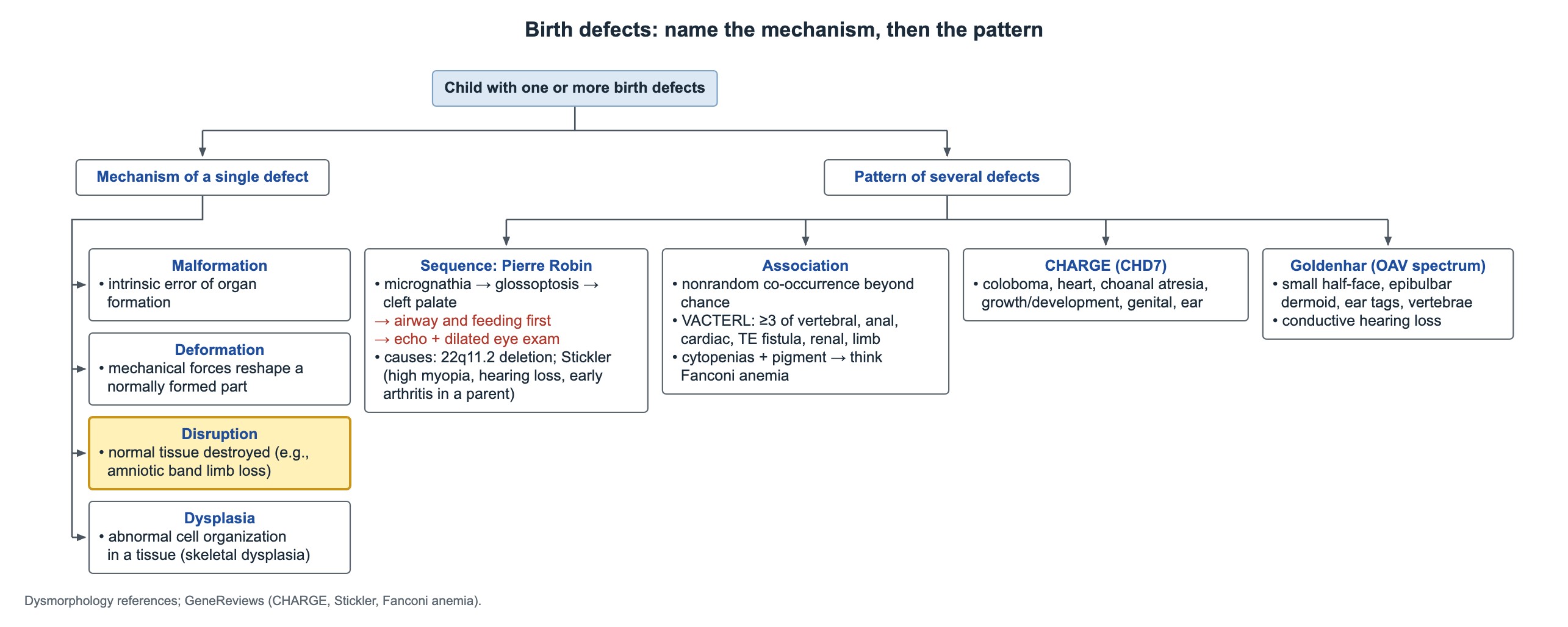
- Malformation: an intrinsic error of organ formation from the start.
- Deformation: mechanical forces, such as oligohydramnios or uterine constraint, mold a normally formed part.
- Disruption: normal tissue is destroyed, for example limb loss from amniotic bands.
- Dysplasia: abnormal organization of cells within a tissue, for example achondroplasia and other skeletal dysplasias.
- Amniotic band sequence: constriction rings, amputated digits and irregular facial clefts; usually sporadic, with no known inherited cause.
Associations: VACTERL and CHARGE
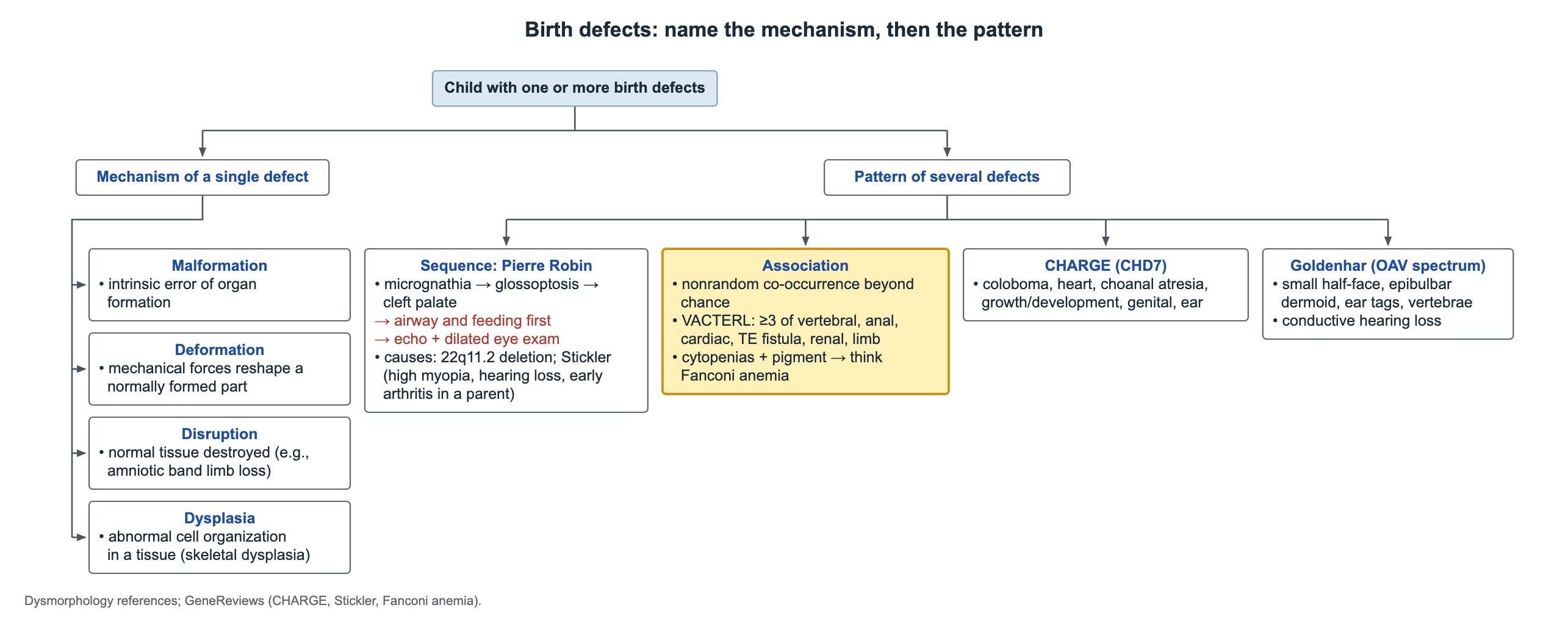
An association is a group of malformations that occur together more often than chance, without one unifying cause. VACTERL is the classic example; it is not a single defined syndrome. CHARGE was once called an association but is now known to be a syndrome, usually from CHD7 variants.
- VACTERL: vertebral defects, anal atresia, cardiac defects, tracheoesophageal fistula, renal anomalies and limb (often radial or thumb) anomalies.
- At least 3 features are needed for the diagnosis.
- Work-up: echo, kidney ultrasound and spine X-rays.
- Low blood counts, café-au-lait spots or radial defects: rule out Fanconi anemia with a chromosome breakage test.
- CHARGE: coloboma, heart defects, choanal atresia, growth and developmental delay, genital hypoplasia, ear anomalies and deafness.
Williams syndrome
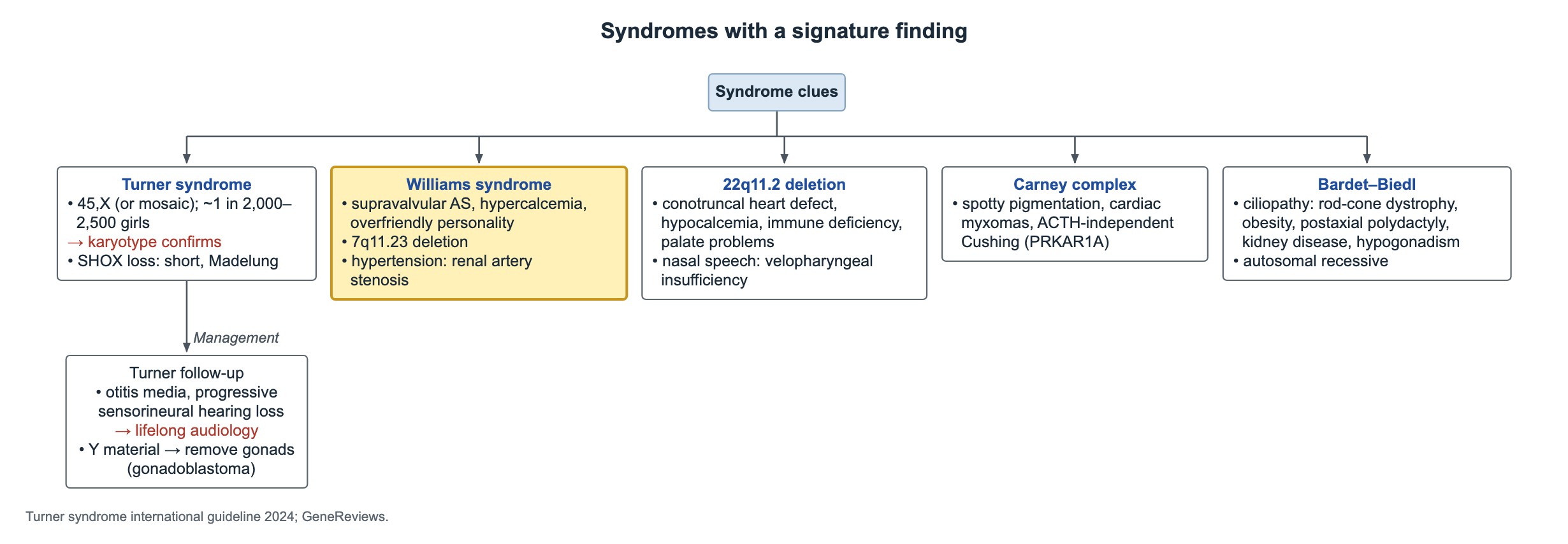
- Elfin facies with periorbital fullness, a wide mouth and stellate irises.
- Overly friendly, sociable personality.
- Supravalvar aortic stenosis and high calcium.
- Hypertension, sometimes from renal artery stenosis: check blood pressure at every visit.
- Cause: 7q11.23 deletion that includes the elastin gene.
Common questions
What is the difference between a sequence and an association?
A sequence is a chain of problems that follows from one primary defect, such as the small jaw in Robin sequence. An association is a group of defects that occur together more often than chance without one known cause, such as VACTERL.
How is a baby with Pierre Robin sequence positioned?
Side-lying or prone positioning is the first airway step, with monitoring. A nasopharyngeal airway or surgery is used if obstruction continues.
How many features are needed to diagnose VACTERL association?
At least 3 of the 6 component defects, after similar conditions such as Fanconi anemia have been considered.
Study this topic
Sources
- Best practices for the diagnosis and evaluation of infants with Robin sequence (JAMA Pediatr 2016)
- VACTERL/VATER association review (Orphanet J Rare Dis)
- AAP: Health care supervision for children with Williams syndrome (Pediatrics 2020)
- GeneReviews: FGFR-related craniosynostosis syndromes
Written for Pedemy in our own words from the sources above; checked November 2026. For education only, not medical advice; check doses and local protocols before treating a patient. Pedemy is independent and not affiliated with or endorsed by the organizations cited.