

Main decision tree
Overgrowth syndromes
Key points
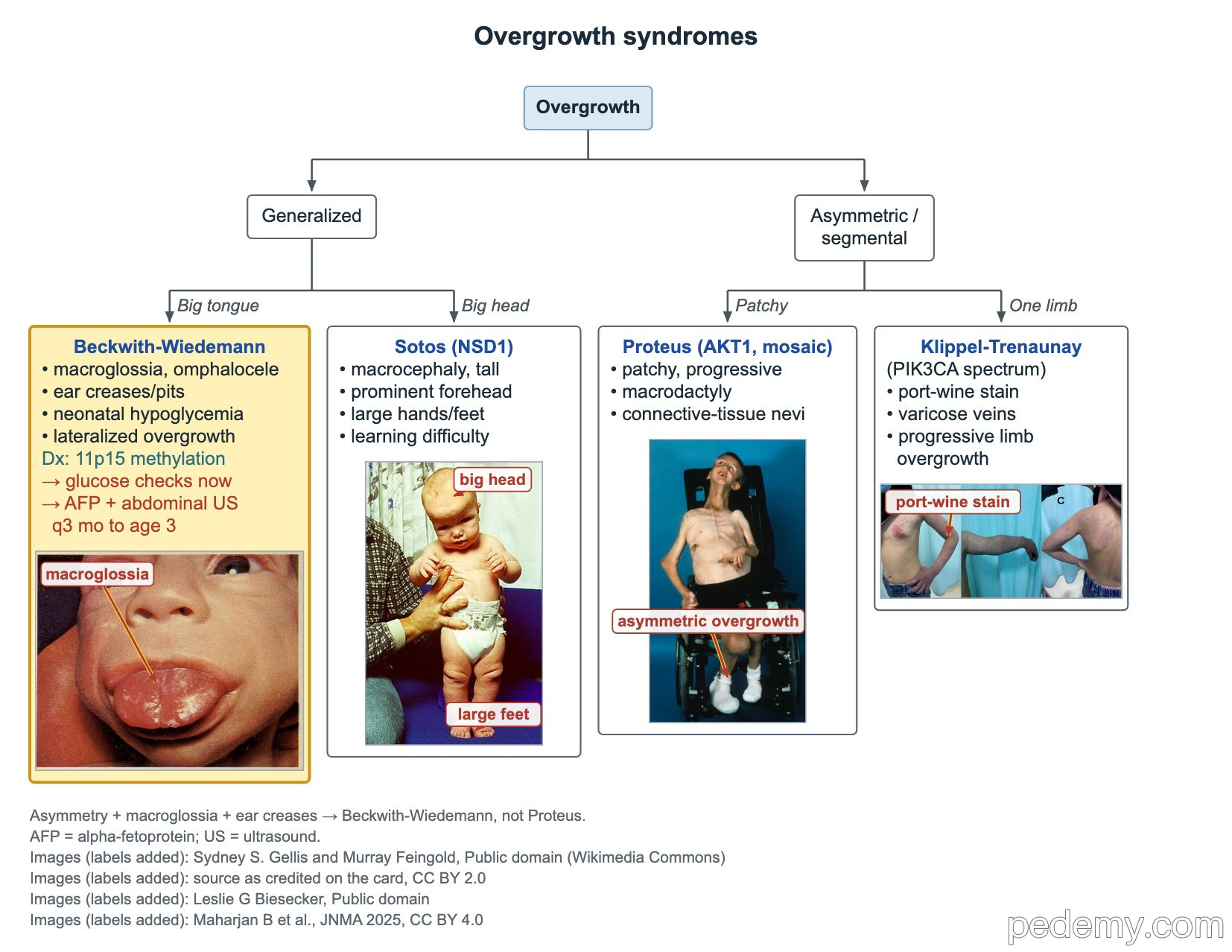
- Beckwith–Wiedemann: macroglossia, omphalocele, ear creases or pits, lateralized overgrowth, neonatal hypoglycemia from hyperinsulinism.
- Beckwith–Wiedemann tumors: Wilms tumor and hepatoblastoma; AFP plus abdominal ultrasound every 3 months through the 3rd birthday.
- Sotos syndrome: NSD1, autosomal dominant; big head, large hands and feet, advanced bone age; adult height usually normal.
- Proteus syndrome: mosaic AKT1 variant; patchy, progressive overgrowth with connective-tissue nevi.
- Klippel–Trenaunay (PIK3CA spectrum): port-wine stain, varicose veins and progressive limb overgrowth.
- Silver–Russell: SGA, relatively large head, triangular face, body asymmetry; most often 11p15 hypomethylation.
- Cornelia de Lange (NIPBL): growth restriction, synophrys, long lashes, hirsutism, small hands and limb defects.
Beckwith–Wiedemann spectrum
Beckwith–Wiedemann syndrome (BWS) is an imprinting disorder of chromosome 11p15. The diagnosis is confirmed with 11p15 methylation testing, and the molecular subtype predicts tumor risk.
Lateralized (asymmetric) overgrowth with macroglossia and ear creases points to BWS rather than Proteus syndrome.
- Newborn clues: macrosomia, macroglossia, omphalocele, linear ear-lobe creases or pits, umbilical hernia, large organs.
- Neonatal hypoglycemia is caused by hyperinsulinism: check glucose early and treat promptly.
- Tumors: Wilms tumor and hepatoblastoma are the main risks.
- Hepatoblastoma screening (2024 AACR update): AFP plus complete abdominal ultrasound every 3 months through the 3rd birthday.
- Wilms tumor screening: kidney ultrasound every 3 months, continuing longer through early childhood (to about the 7th birthday).
Sotos syndrome
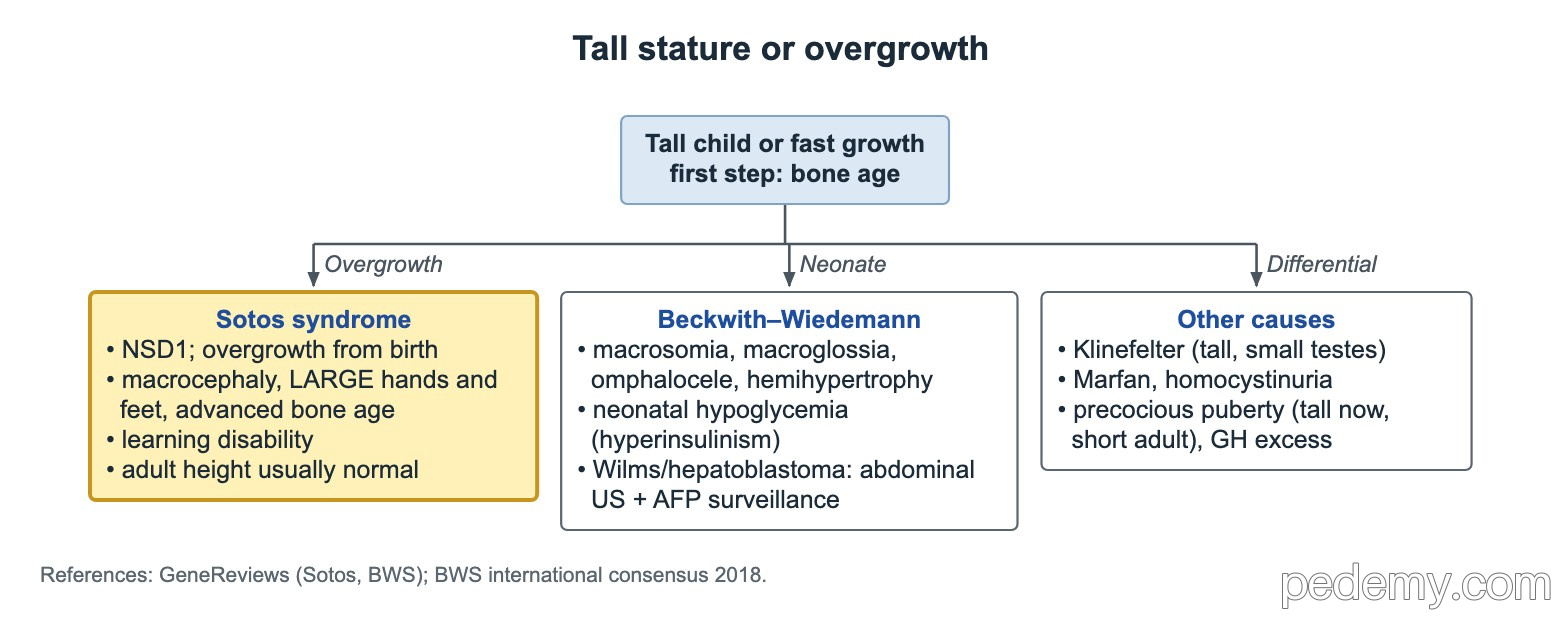
Sotos syndrome is caused by NSD1 variants and is autosomal dominant, though most cases are new (de novo). Overgrowth starts before birth and is fastest in early childhood.
Bone age is advanced and growth plates close early, so adult height is usually within the normal range.
- Macrocephaly with a prominent forehead and a long face.
- Large hands and feet.
- Learning disability or developmental delay.
- First step for any tall or fast-growing child: a bone age X-ray.
Patchy and one-limb overgrowth: Proteus and Klippel–Trenaunay
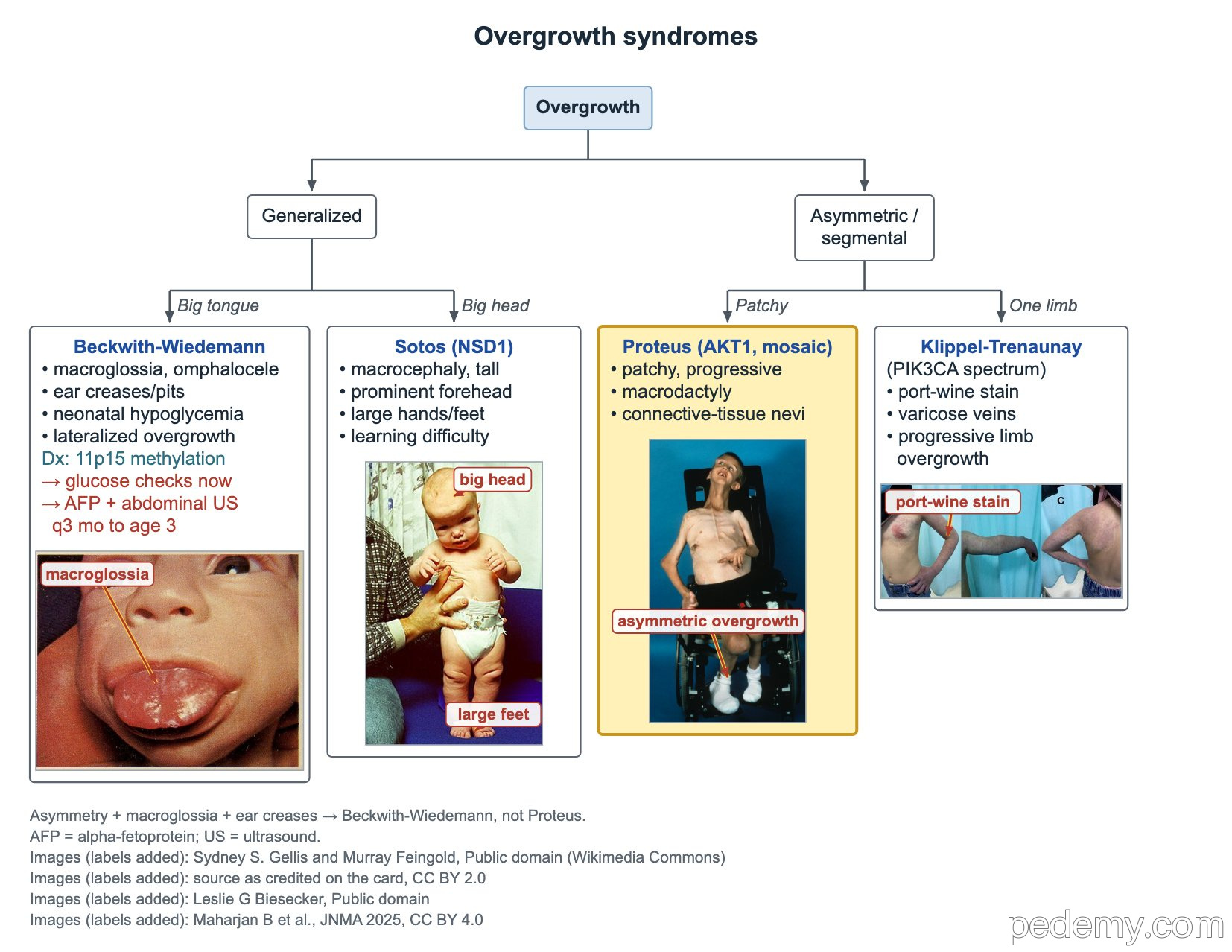
| Feature | Proteus syndrome | Klippel–Trenaunay syndrome |
|---|---|---|
| Cause | Mosaic AKT1 variant | Mosaic PIK3CA variant (PIK3CA-related overgrowth spectrum) |
| Pattern | Patchy, disproportionate, progressive overgrowth; macrodactyly | Overgrowth of usually one limb, progressive |
| Skin | Connective-tissue (cerebriform) nevi, epidermal nevi | Port-wine stain (capillary malformation) |
| Vessels | Vascular malformations, clot risk | Varicose veins and venous malformations |
Growth restriction syndromes
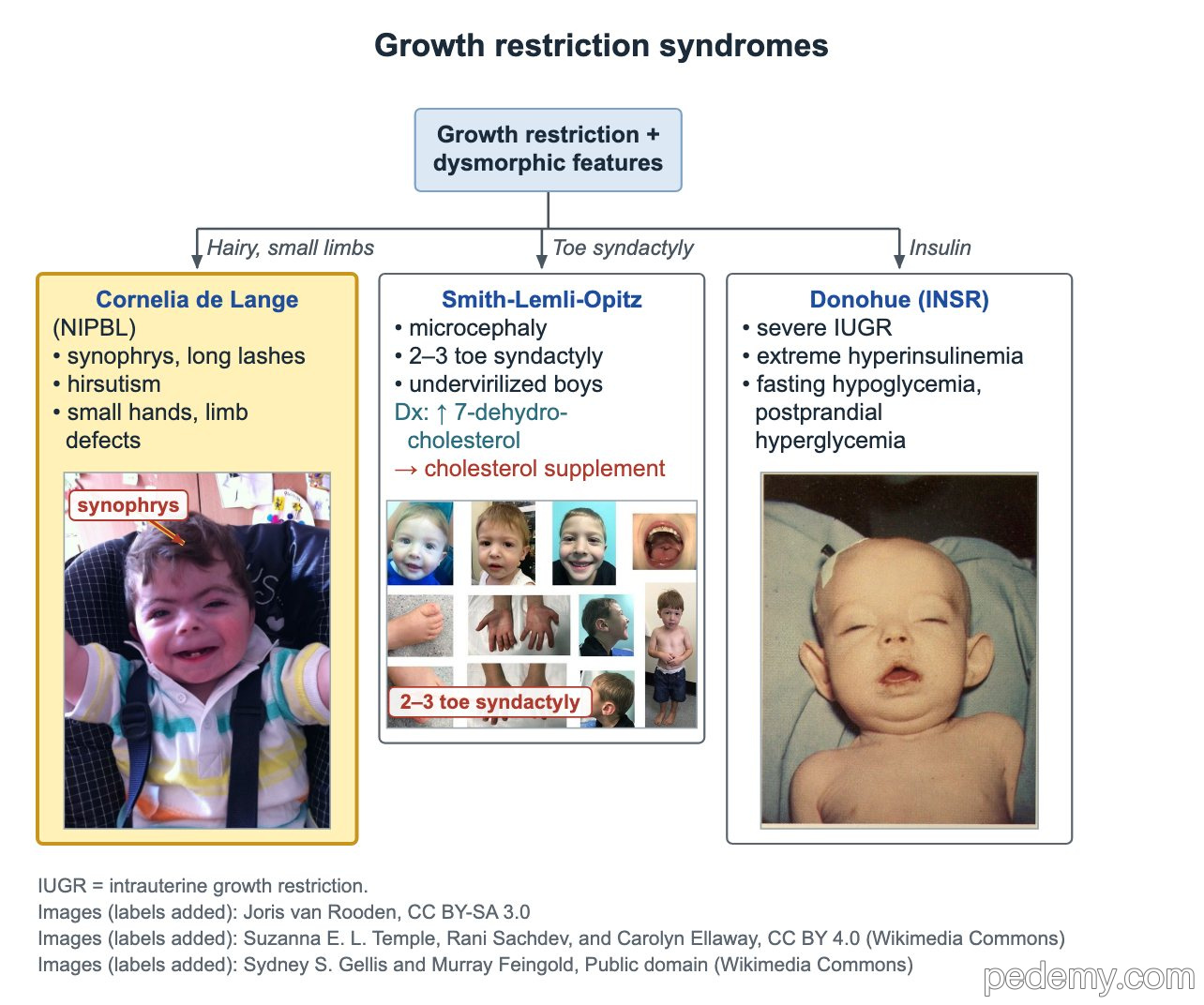
Cornelia de Lange syndrome is the opposite of an overgrowth syndrome: growth is restricted before and after birth. NIPBL is the gene most often involved.
Silver–Russell syndrome also starts small: the infant is small for gestational age but the head is relatively large. The main cause is loss of methylation at 11p15; maternal uniparental disomy of chromosome 7 is the next most common cause.
- Cornelia de Lange: synophrys, long eyelashes, hirsutism, small hands, limb reduction defects, intellectual disability.
- Silver–Russell: SGA, relative macrocephaly, triangular face, prominent forehead, limb or body asymmetry, feeding problems.
- Smith–Lemli–Opitz: microcephaly, 2–3 toe syndactyly, undervirilized boys; high 7-dehydrocholesterol; treated with cholesterol supplementation.
Donohue syndrome
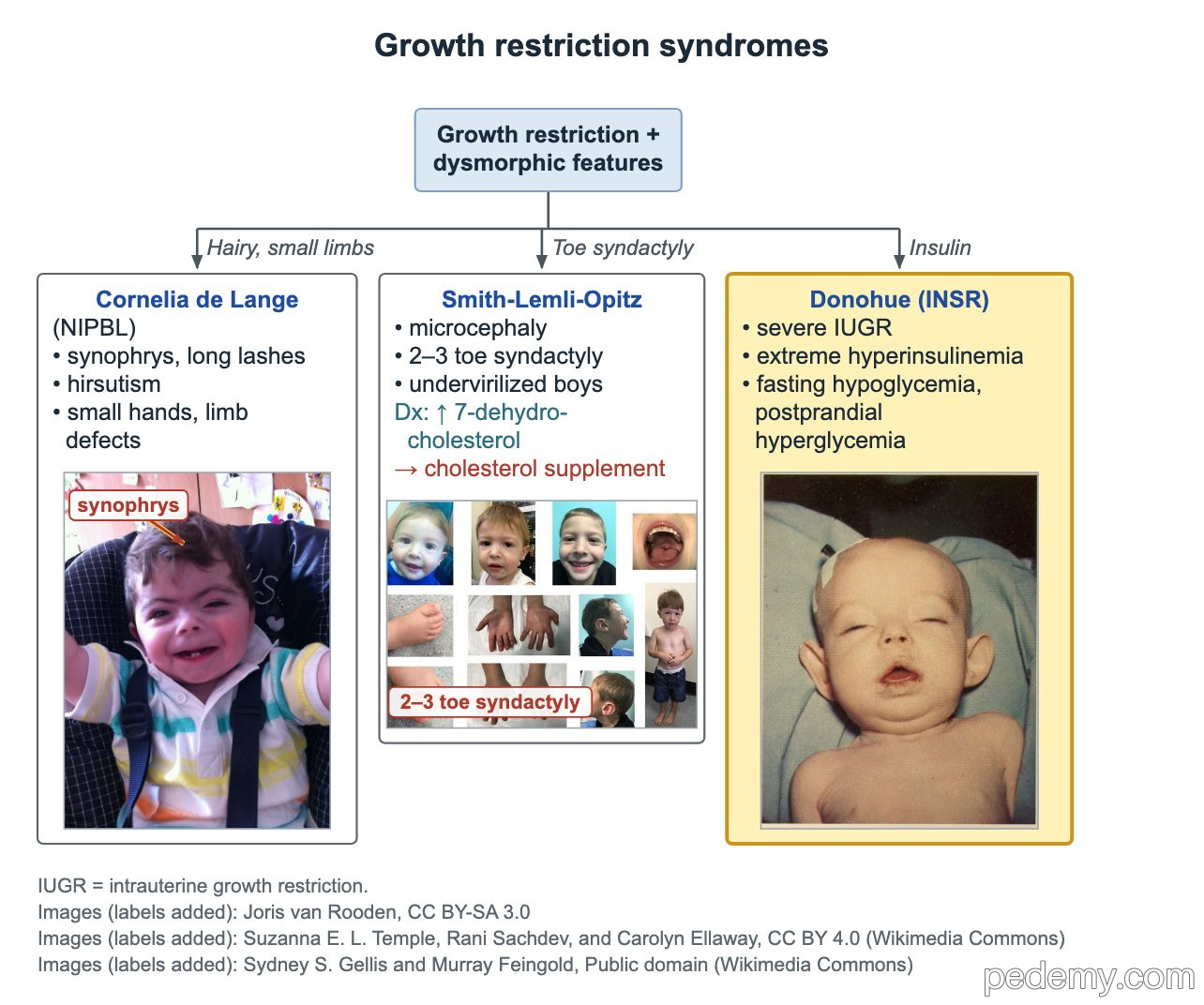
Donohue syndrome is severe insulin resistance from INSR variants. The insulin receptor does not work, so insulin levels are extremely high.
- Severe prenatal growth restriction.
- Extreme hyperinsulinemia.
- Fasting hypoglycemia with high glucose after feeds.
Common questions
Why do babies with Beckwith–Wiedemann syndrome have low blood sugar?
Because of hyperinsulinism: the pancreas makes too much insulin. Glucose should be checked early after birth.
What tumor screening is needed in Beckwith–Wiedemann syndrome?
Children at relevant risk get abdominal ultrasound every 3 months for Wilms tumor and hepatoblastoma, plus AFP every 3 months through the 3rd birthday for hepatoblastoma.
Are children with Sotos syndrome tall as adults?
Usually not very tall. Growth is fast early, but bone age is advanced and growth plates close early, so adult height is usually normal.
Study this topic
Sources
- AACR 2024: Surveillance for Wilms tumor and hepatoblastoma in Beckwith–Wiedemann and other syndromes (Clin Cancer Res)
- Beckwith–Wiedemann syndrome: international consensus statement (Nat Rev Endocrinol 2018)
- Silver–Russell syndrome: second international consensus statement (Nat Rev Endocrinol 2026)
Written for Pedemy in our own words from the sources above; checked November 2026. For education only, not medical advice; check doses and local protocols before treating a patient. Pedemy is independent and not affiliated with or endorsed by the organizations cited.