

Main decision tree
Pedigree: mode of inheritance
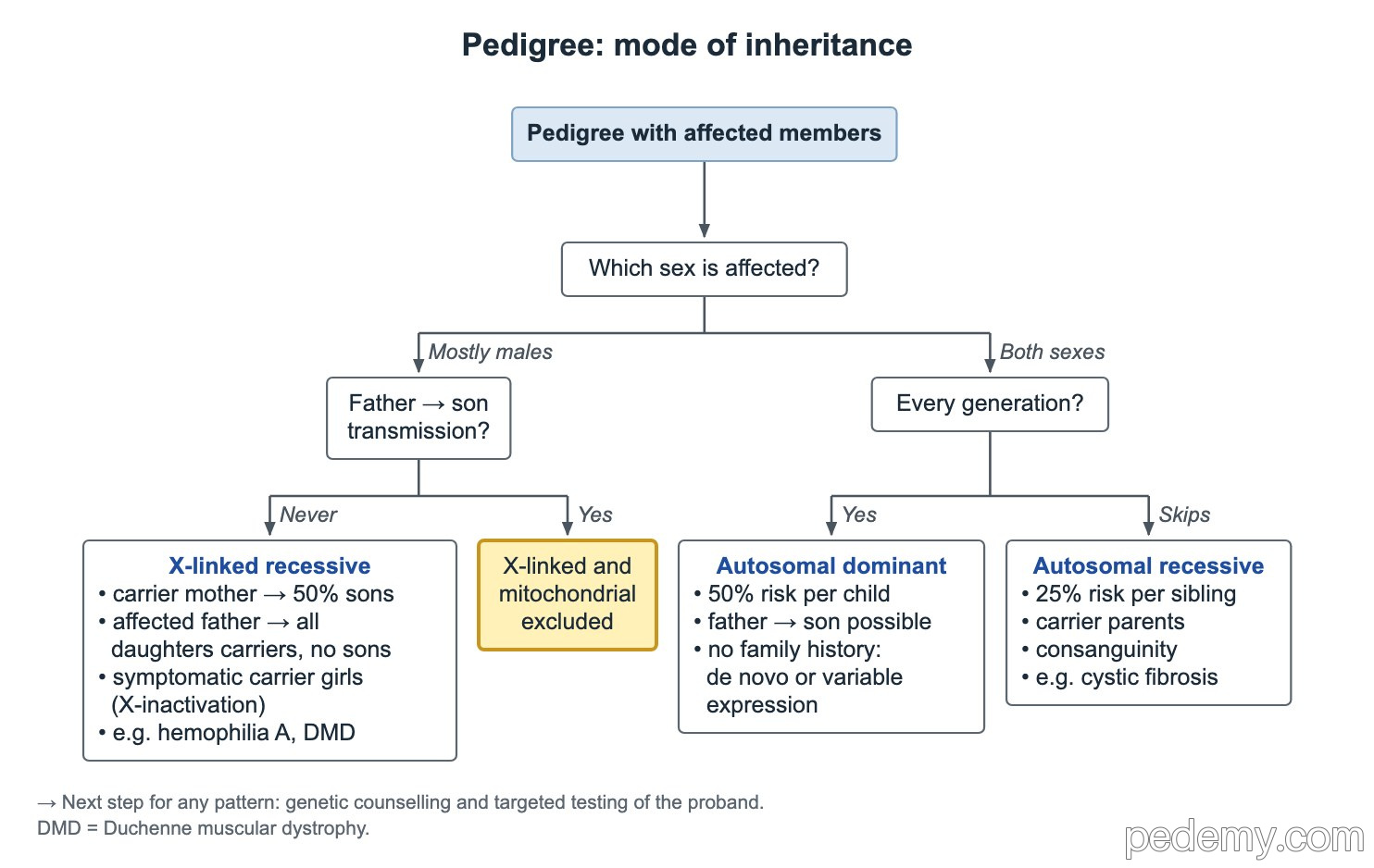
Key points
- Autosomal dominant: both sexes, every generation, father-to-son transmission possible; 50% risk per child.
- An AD disorder can appear with unaffected parents through a new (de novo) variant.
- Autosomal recessive: two altered copies; carrier parents have a 25% risk of an affected child each pregnancy.
- Father-to-son transmission excludes X-linked and mitochondrial inheritance.
- X-linked recessive: an affected father passes his X to all daughters (carriers) and to no sons.
- Both parents with sickle cell trait: 25% disease, 50% trait each pregnancy; HbSS × trait: 50% disease.
Reading a pedigree
Start with the sex of affected people. If mostly males are affected, ask whether any father passes the condition to a son. A man gives his Y chromosome to every son, never his X, and mitochondria come only from the mother.
So father-to-son transmission excludes X-linked and mitochondrial inheritance. When both sexes are affected, ask whether every generation is affected (dominant) or the condition skips generations (recessive).
Whatever the pattern, the next step is genetic counseling and targeted testing of the affected person.
Autosomal dominant
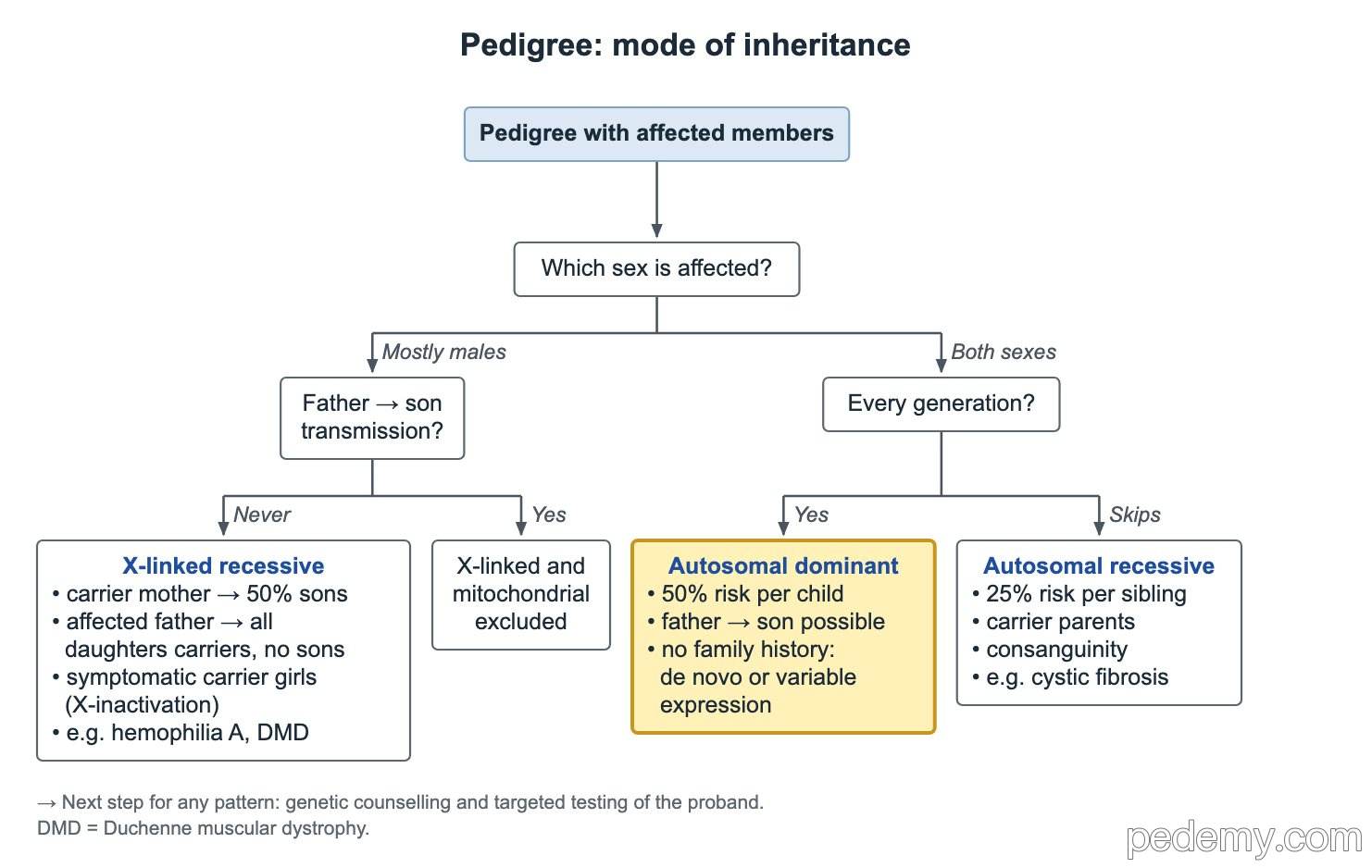
- One altered copy is enough to cause disease.
- Both sexes are affected, usually in every generation (vertical transmission).
- Father-to-son transmission is possible.
- A heterozygous affected parent passes the variant to each child with a 50% chance.
- No family history does not exclude AD disease: a de novo variant can start a new family case, and variable expression or reduced penetrance can hide a mildly affected parent.
Autosomal recessive
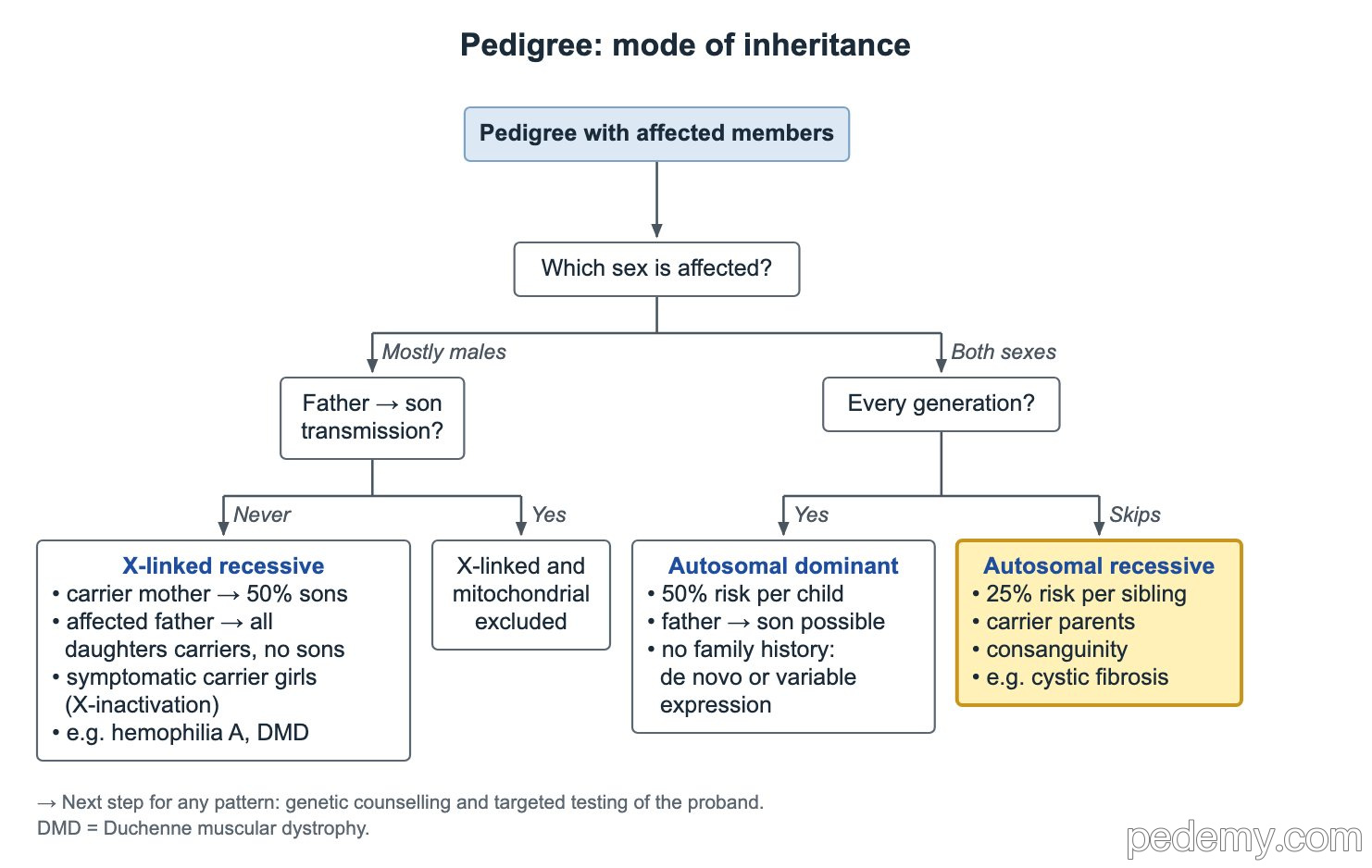
Disease usually needs two altered copies, one from each parent. Parents are usually healthy carriers, and affected children appear as siblings in one generation. Consanguinity raises the chance that both parents carry the same variant. Cystic fibrosis is the classic example.
| Parents | Each pregnancy |
|---|---|
| Both carriers (e.g., both sickle cell trait) | 25% affected, 50% carrier, 25% unaffected non-carrier |
| Affected (e.g., HbSS) × carrier (sickle trait) | 50% affected, 50% carrier |
| Affected × non-carrier | All children carriers, none affected |
X-linked recessive and X-linked dominant
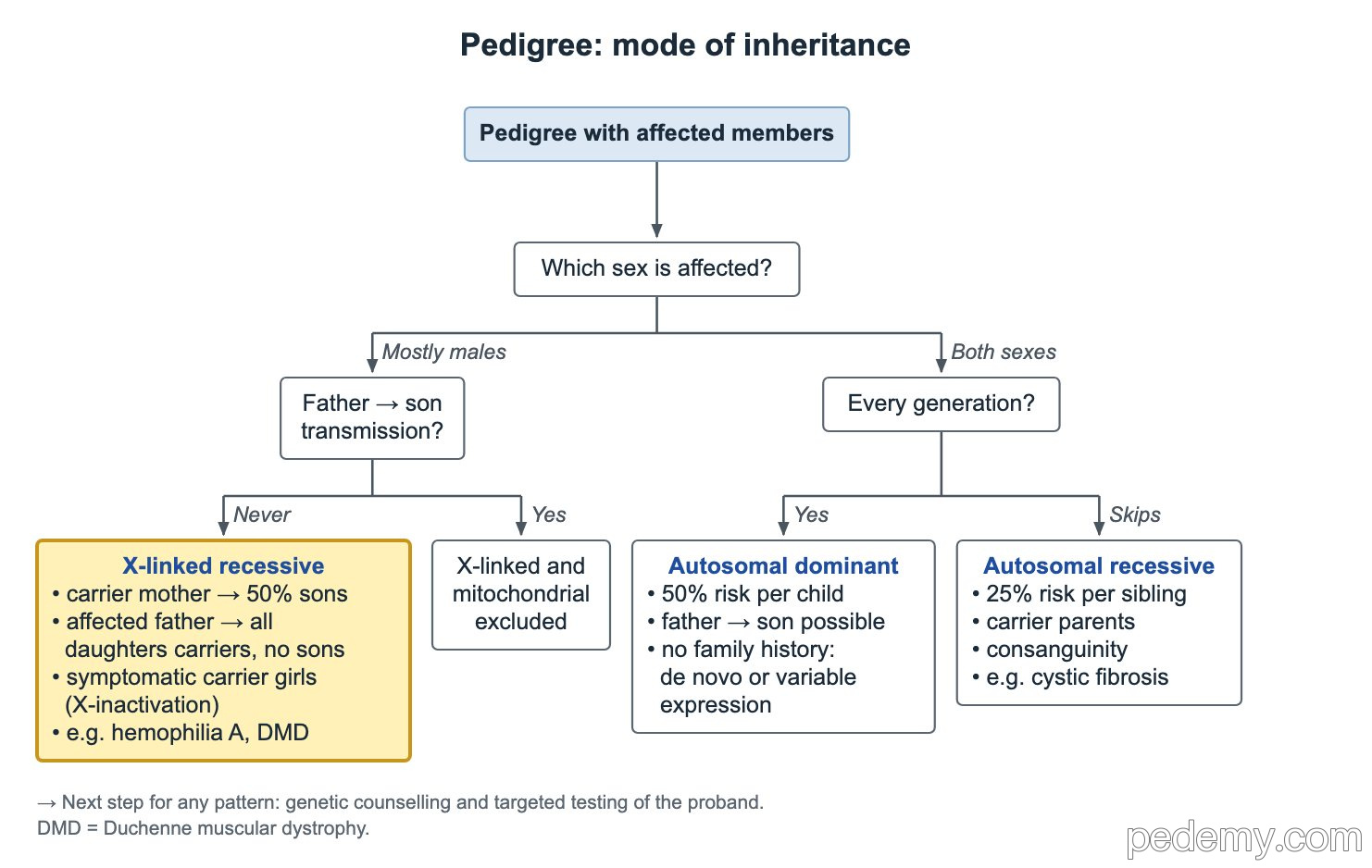
X-linked recessive conditions mostly affect males, with no father-to-son transmission. Hemophilia A and Duchenne or Becker muscular dystrophy are classic examples.
A carrier woman can have symptoms because X-inactivation is random and may by chance silence more of her normal X.
- Carrier mother: each son has a 50% chance of being affected; each daughter a 50% chance of being a carrier.
- Affected father: all daughters are carriers; no sons are affected.
- X-linked dominant: an affected father passes it to all daughters and no sons; an affected mother passes it to half of her children of either sex.
Common questions
If both parents have sickle cell trait, what is the chance their child has sickle cell disease?
25% with each pregnancy. Each child also has a 50% chance of having sickle cell trait.
Can a child have an autosomal dominant condition if neither parent has it?
Yes. A new (de novo) variant can arise in the egg or sperm. A parent may also be mildly affected or carry the variant in some cells only.
Which inheritance patterns does father-to-son transmission rule out?
X-linked inheritance, because fathers give sons a Y chromosome, and mitochondrial inheritance, because mitochondria come from the mother.
Study this topic
Sources
- MedlinePlus Genetics: What are the different ways a genetic condition can be inherited?
- NHLBI: Evidence-based management of sickle cell disease, expert panel report
Written for Pedemy in our own words from the sources above; checked November 2026. For education only, not medical advice; check doses and local protocols before treating a patient. Pedemy is independent and not affiliated with or endorsed by the organizations cited.