

Main decision tree
Congenital heart disease: is there a syndrome?
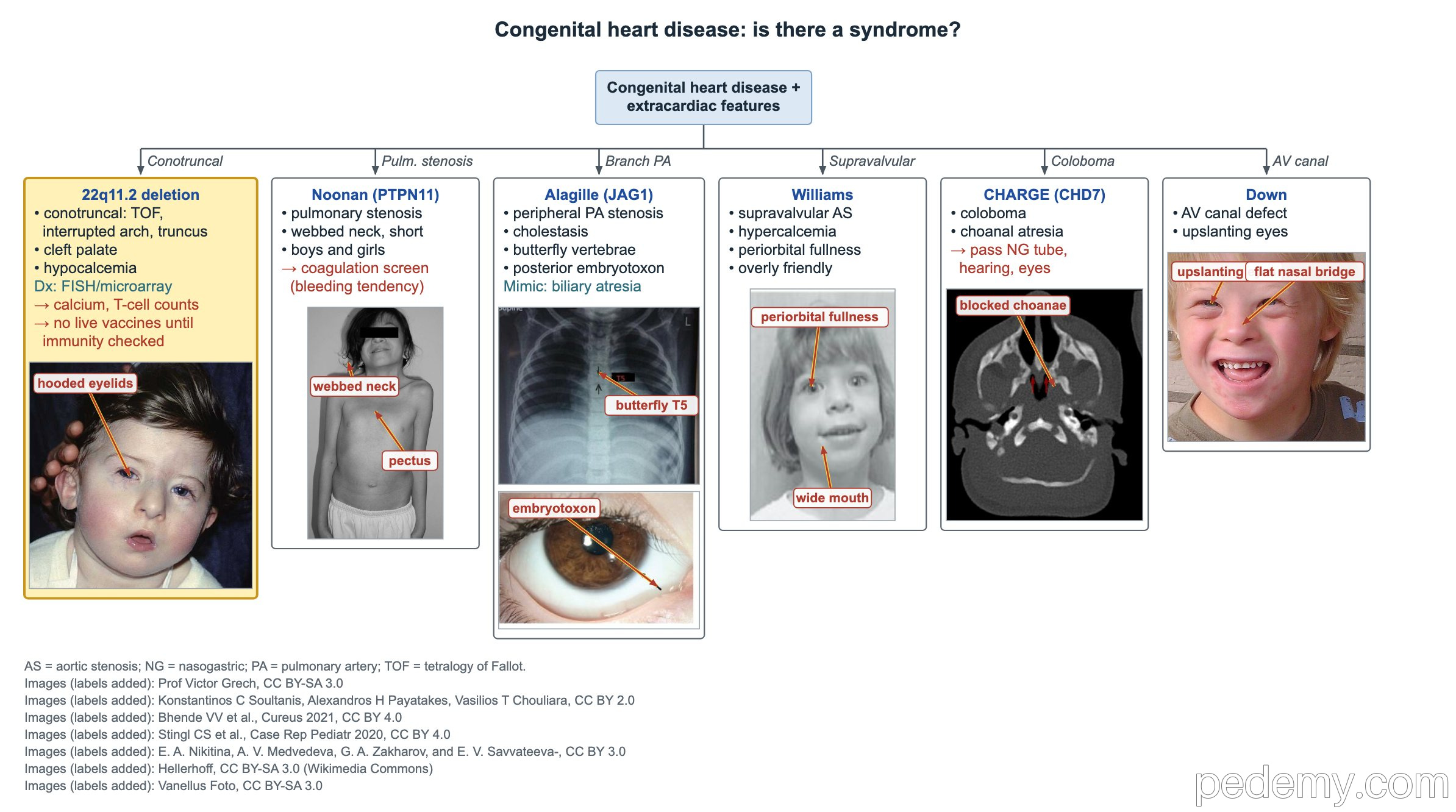
Key points
- 22q11.2 deletion: conotruncal heart defect (tetralogy of Fallot, interrupted aortic arch, truncus) + hypocalcemia + T-cell deficiency + palate problems.
- Noonan syndrome: autosomal dominant, PTPN11 in about half; pulmonary valve stenosis is the commonest heart defect; factor XI deficiency is the commonest bleeding defect.
- Alagille syndrome: cholestasis with too few bile ducts + peripheral pulmonary artery stenosis + butterfly vertebrae + posterior embryotoxon; JAG1, autosomal dominant.
- CHARGE: coloboma, heart, choanal atresia, restricted growth and development, genital and ear anomalies; CHD7, autosomal dominant, usually de novo.
- Waardenburg type I (PAX3) and branchio-oto-renal syndrome (EYA1) are both autosomal dominant causes of syndromic hearing loss.
- Fanconi anemia: autosomal recessive chromosome instability; abnormal thumbs or radii, marrow failure, cancer risk; diagnose with a chromosome breakage test.
- Obesity + retinal dystrophy: postaxial polydactyly points to Bardet–Biedl; hearing loss, cardiomyopathy and type 2 diabetes without extra digits point to Alström.
22q11.2 deletion syndrome
The tree starts from a child with congenital heart disease plus features outside the heart and sorts by the type of heart lesion. A conotruncal defect points to 22q11.2 deletion, the commonest microdeletion syndrome.
Confirm the deletion with chromosomal microarray; FISH can miss atypical deletions. Most deletions are de novo, but an affected parent passes it on with a 50% chance.
- Heart: tetralogy of Fallot, interrupted aortic arch (type B), truncus arteriosus, VSD.
- Calcium: hypoparathyroidism can cause neonatal hypocalcemia and seizures; check calcium and PTH, and recheck during illness, surgery and puberty.
- Immunity: thymic hypoplasia lowers T cells; check a CBC and T-cell counts and hold live vaccines until immune testing is reviewed.
- Palate: cleft or submucous cleft palate; nasal (hypernasal) speech with a normal-looking palate means velopharyngeal insufficiency.
- Later: feeding problems, learning difficulty, autism, anxiety and a raised risk of schizophrenia in adolescence and adulthood.
| Syndrome | Typical heart lesion |
|---|---|
| 22q11.2 deletion | Conotruncal: tetralogy of Fallot, interrupted arch, truncus |
| Noonan | Pulmonary valve stenosis; hypertrophic cardiomyopathy |
| Alagille | Peripheral (branch) pulmonary artery stenosis |
| Williams | Supravalvular aortic stenosis |
| CHARGE | Many types, often conotruncal |
| Down syndrome | Atrioventricular canal and other septal defects |
Noonan syndrome
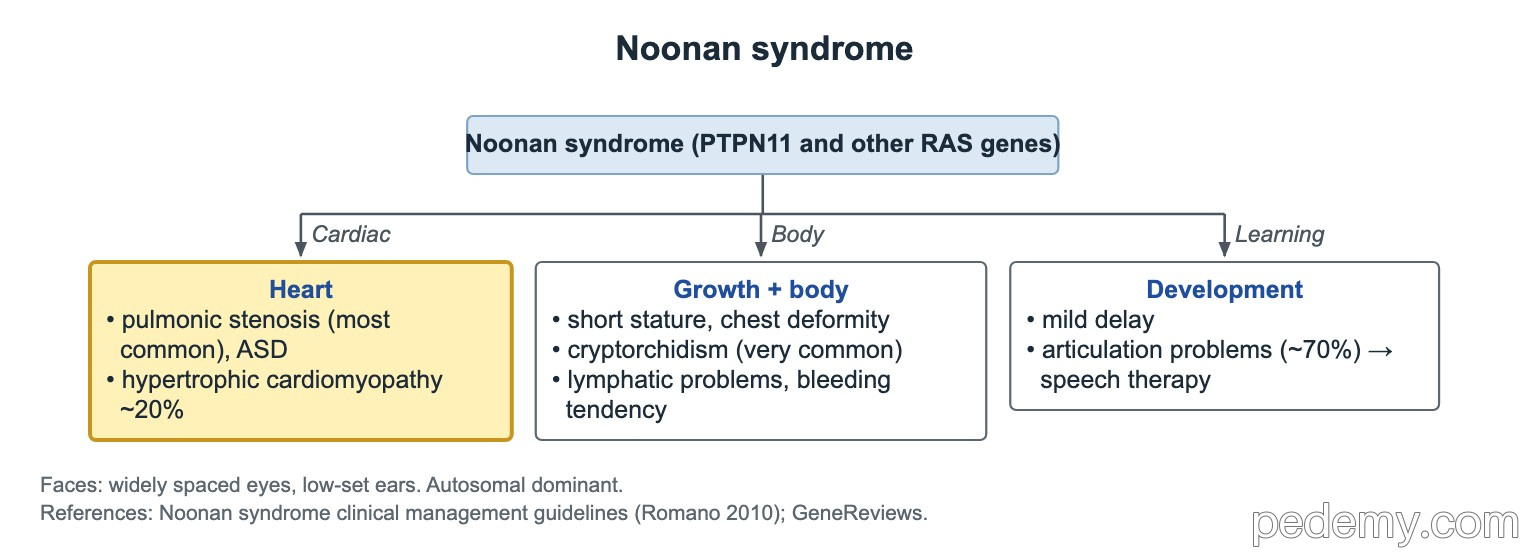
Think of Noonan syndrome in a boy or a girl with short stature, a webbed neck and pulmonary valve stenosis. Unlike Turner syndrome, the karyotype is normal and boys are affected.
It is autosomal dominant and caused by RAS-pathway genes; PTPN11 accounts for about half of cases. The face shows widely spaced eyes, downslanting eyelids and low-set, posteriorly rotated ears.
- Heart: pulmonary valve stenosis (often a dysplastic valve) is the most common defect; ASD; hypertrophic cardiomyopathy in about 20%.
- Growth and body: short stature, chest deformity (pectus), cryptorchidism in most boys, lymphatic problems.
- Bleeding: a bleeding tendency is common; factor XI deficiency is the most frequent single defect. Screen coagulation before surgery.
- Development: usually mild delay; articulation (speech) problems are common and respond to speech therapy.
Alagille syndrome
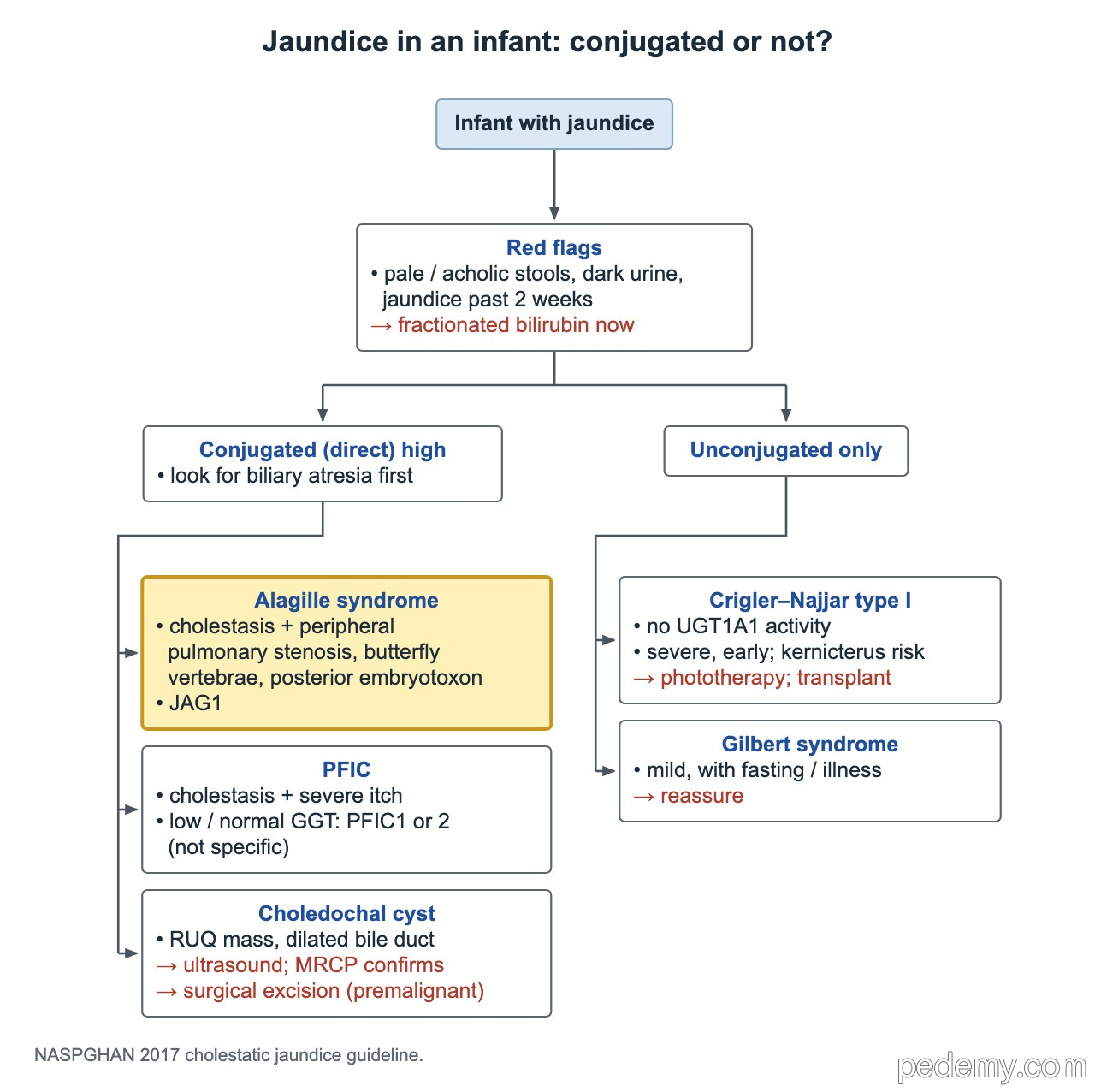
An infant with conjugated (direct) hyperbilirubinemia needs a fractionated bilirubin and a work-up for biliary atresia first. Alagille syndrome is a key mimic: liver biopsy shows too few bile ducts (bile-duct paucity).
JAG1 is the major gene; a few families have NOTCH2 variants. Inheritance is autosomal dominant with very variable expression, so a parent may be mildly affected.
- Liver: cholestasis, itch, xanthomas.
- Heart: peripheral or branch pulmonary artery stenosis.
- Spine: butterfly vertebrae on x-ray.
- Eye: posterior embryotoxon, a prominent line at the edge of the cornea.
- Face: broad forehead, deep-set eyes and a pointed chin; kidney anomalies also occur.
CHARGE syndrome
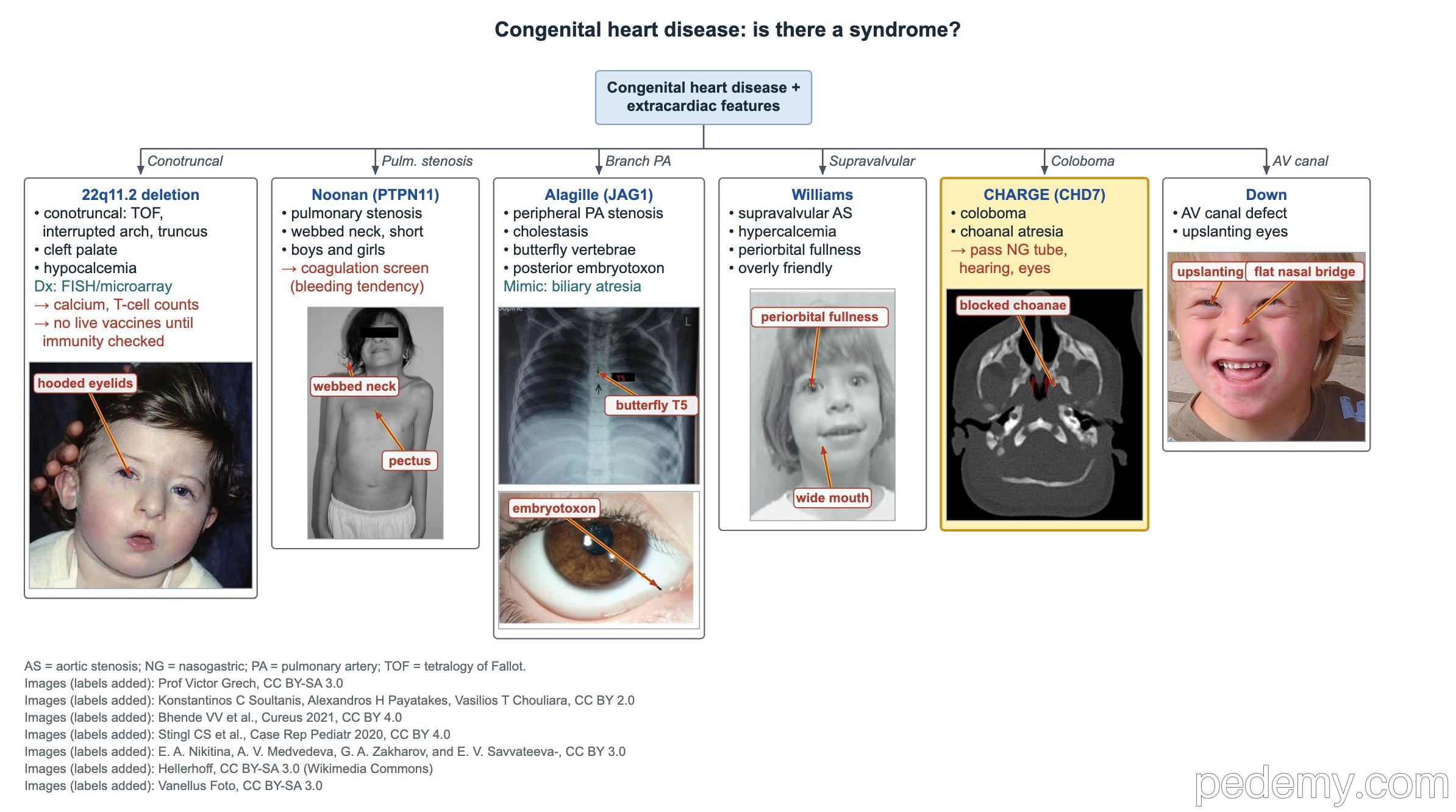
CHARGE is caused by CHD7 variants. It is autosomal dominant, but most cases are de novo.
In the newborn, a nasogastric tube that will not pass, or cyanosis that improves with crying, suggests choanal atresia. Every child needs hearing, eye and heart evaluation.
| Letter | Feature |
|---|---|
| C | Coloboma of the eye |
| H | Heart defects |
| A | Atresia of the choanae (posterior nasal openings) |
| R | Restricted growth and development |
| G | Genital anomalies, such as a small penis or hypogonadism |
| E | Ear anomalies and hearing loss |
Hearing loss plus another clue: Waardenburg and BOR
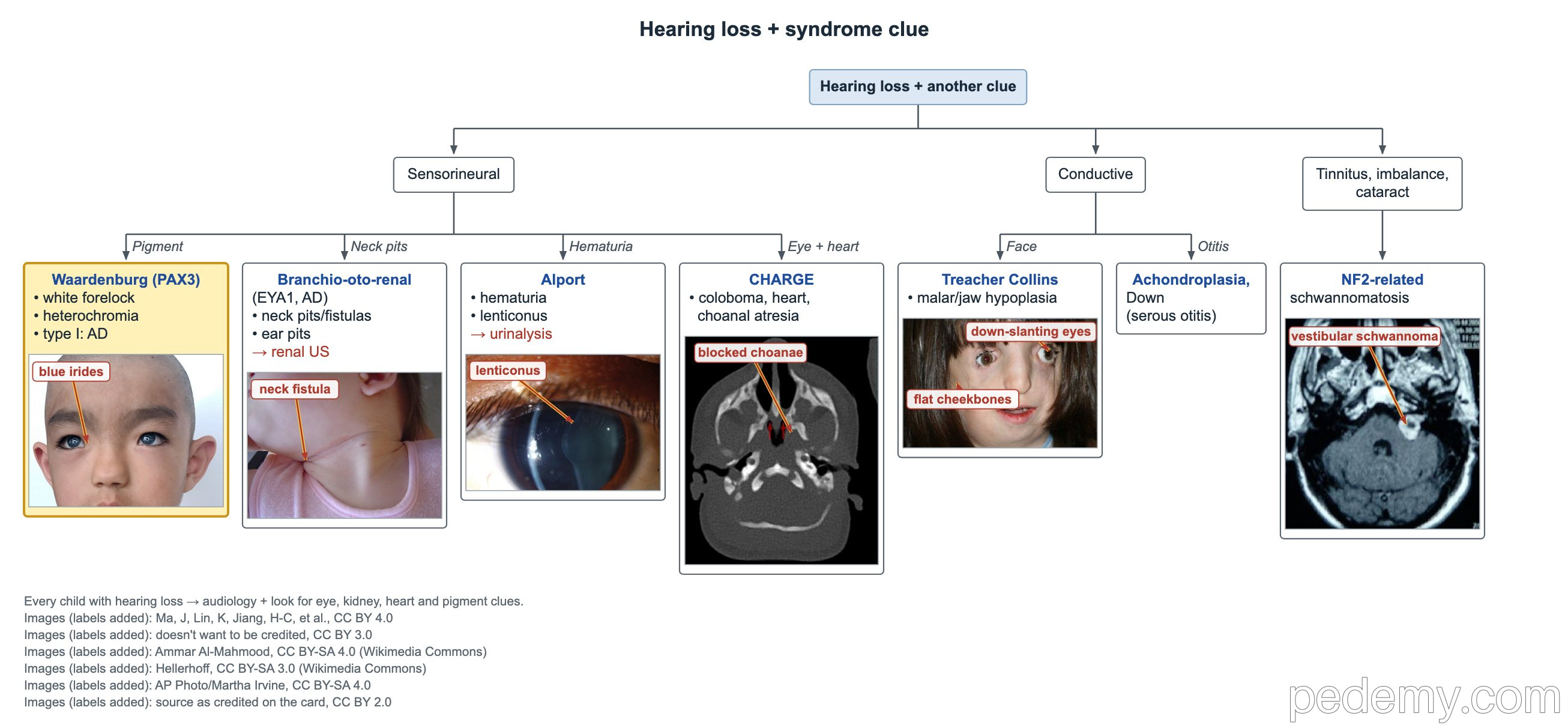
Every child with hearing loss needs a formal hearing test and a look for eye, kidney, heart and pigment clues. A pigment clue points to Waardenburg syndrome; neck pits point to branchio-oto-renal syndrome.
- Waardenburg type I: white forelock, iris heterochromia or bright blue irides, congenital sensorineural deafness and patchy depigmented skin.
- Waardenburg type I is autosomal dominant (PAX3) and has wide-set inner canthi (dystopia canthorum).
- Branchio-oto-renal (BOR) syndrome: branchial cleft cysts or fistulas, ear pits, hearing loss and renal dysplasia.
- BOR is autosomal dominant (often EYA1); get a renal ultrasound.
- Other pairings: Alport (hematuria), CHARGE (coloboma, heart), NF2-related schwannomatosis (tinnitus, imbalance, cataract).
Fanconi anemia and hereditary hemorrhagic telangiectasia
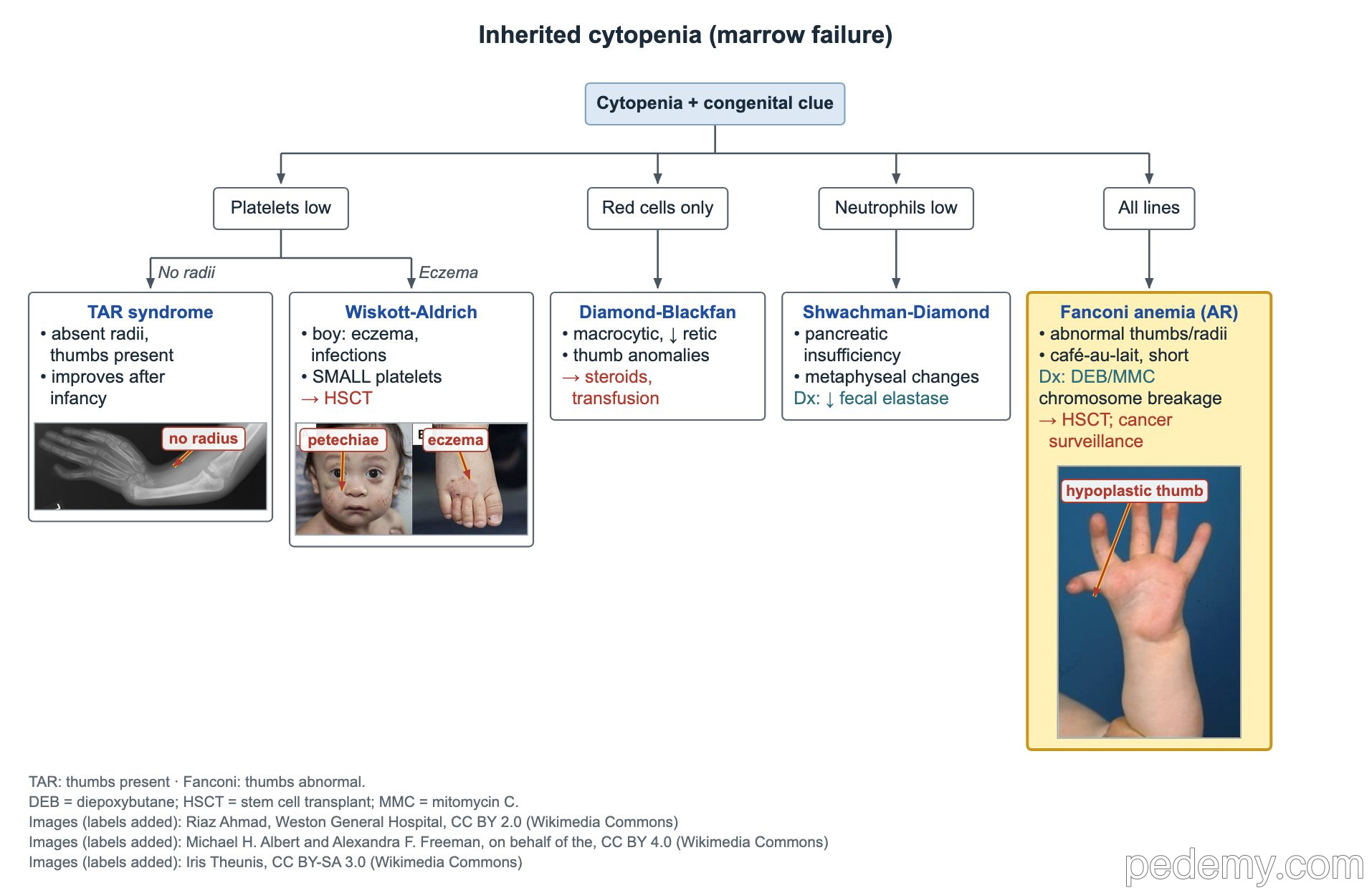
Fanconi anemia is a chromosome instability (DNA repair) disorder, usually autosomal recessive. Look for abnormal thumbs or radii, café-au-lait spots and short stature, then marrow failure affecting all cell lines in childhood.
Diagnose with a chromosome breakage test (diepoxybutane or mitomycin C). Treatment is stem cell transplant, with lifelong surveillance for leukemia and squamous cell cancers. TAR syndrome differs: radii are absent but thumbs are present, and only platelets are low.
- HHT: recurrent nosebleeds, telangiectasias on the lips, tongue and fingers, visceral AVMs and an affected first-degree relative.
- HHT is autosomal dominant (ENG, ACVRL1; SMAD4 when juvenile polyposis is also present).
- Screen for pulmonary AVMs, which can cause hypoxemia, stroke and brain abscess; a contrast (bubble) echo is the usual test, with pulse oximetry and chest x-ray as simpler options in children.
- Screen children with HHT for brain AVMs with MRI, and offer genetic testing to at-risk relatives.
Obesity with retinal dystrophy: Bardet–Biedl or Alström
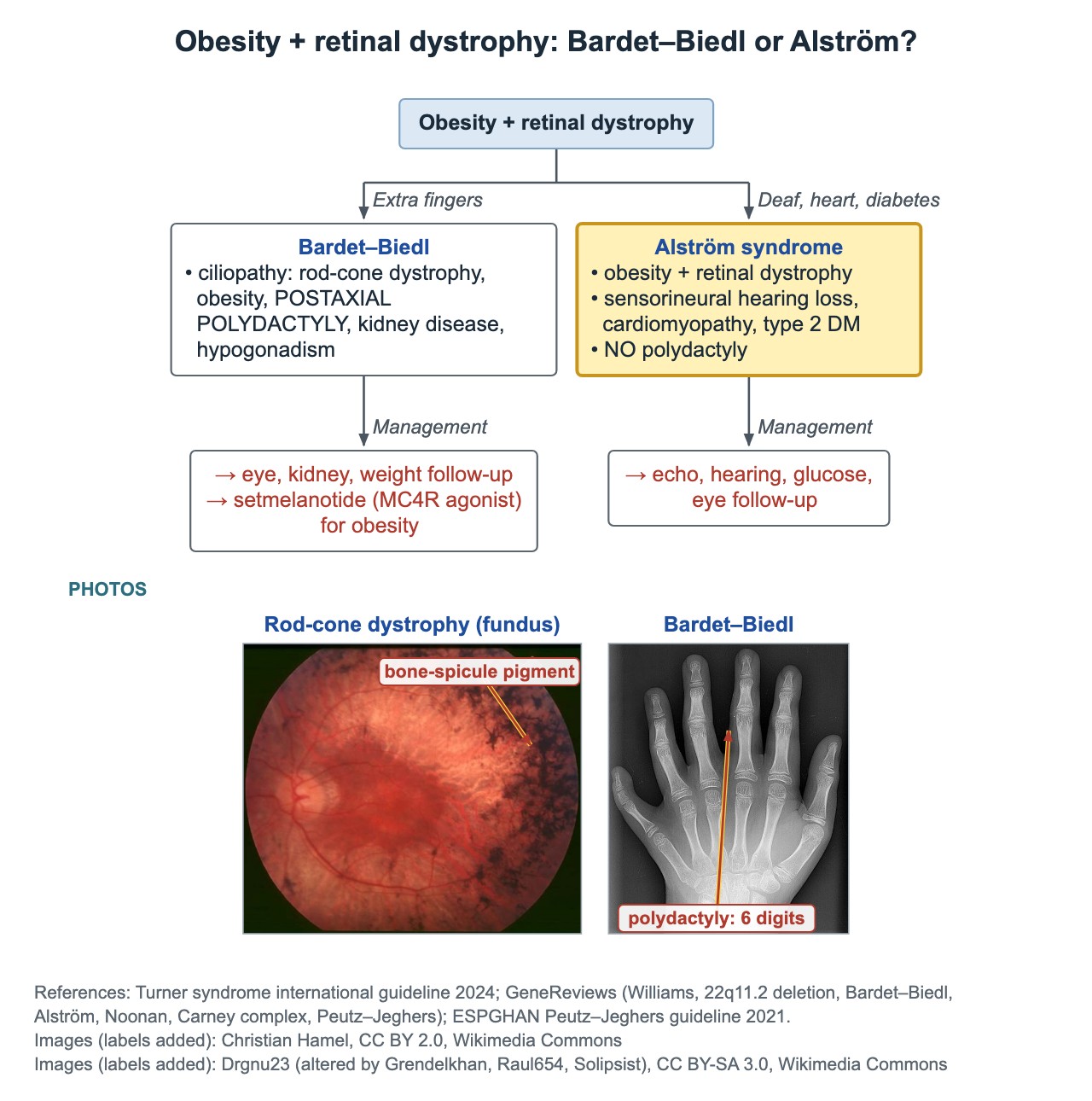
Both are autosomal recessive ciliopathies that start with obesity and a rod-cone (retinal) dystrophy. Extra fingers or toes separate them.
| Feature | Bardet–Biedl | Alström |
|---|---|---|
| Postaxial polydactyly | Yes | No |
| Other key features | Kidney disease, hypogonadism, learning difficulty | Sensorineural hearing loss, cardiomyopathy, type 2 diabetes |
| Follow-up | Eye, kidney and weight follow-up; setmelanotide (MC4R agonist) for obesity | Echo, hearing, glucose and eye follow-up |
Common questions
What are the features of 22q11.2 deletion syndrome?
A conotruncal heart defect, low calcium from hypoparathyroidism, low T cells from a small thymus, palate problems with nasal speech, learning difficulty and later psychiatric illness.
What is the most common heart defect in Noonan syndrome?
Pulmonary valve stenosis, often with a dysplastic valve. Hypertrophic cardiomyopathy occurs in about 1 in 5.
How is Alagille syndrome different from biliary atresia?
Both cause conjugated jaundice in infants. Alagille syndrome has bile-duct paucity on biopsy plus heart, spine and eye findings, and is caused by JAG1 or NOTCH2 variants.
Study this topic
Sources
- Updated clinical practice recommendations for managing children with 22q11.2 deletion syndrome (Genet Med 2023)
- Noonan syndrome: clinical features, diagnosis and management guidelines (Pediatrics 2010)
- NASPGHAN/ESPGHAN guideline for the evaluation of cholestatic jaundice in infants (JPGN 2017)
- Second International Guidelines for the Diagnosis and Management of HHT (Ann Intern Med 2020)
Written for Pedemy in our own words from the sources above; checked November 2026. For education only, not medical advice; check doses and local protocols before treating a patient. Pedemy is independent and not affiliated with or endorsed by the organizations cited.