

Main decision tree
Social connection and thinking
Key points
- Object permanence: knowing that things still exist when out of sight; it starts after 6 months and is reliable by 8–12 months.
- 9 months: looks for a dropped object and bangs two objects together.
- 12 months: finds a toy hidden while watching and puts an object into a container.
- 18 months: copies chores and plays with toys in a simple way, such as pushing a car.
- 2 years: tries switches and knobs and holds a container in one hand while taking the lid off with the other.
- 30 months: knows at least one color; 4 years: names a few colors.
- 5 years: counts to 10, names some letters and numbers 1–5, uses time words and pays attention for 5–10 minutes.
Object permanence
Object permanence means a child understands that a person or toy still exists after it disappears from view. It begins after 6 months and is reliable by about 8–12 months.
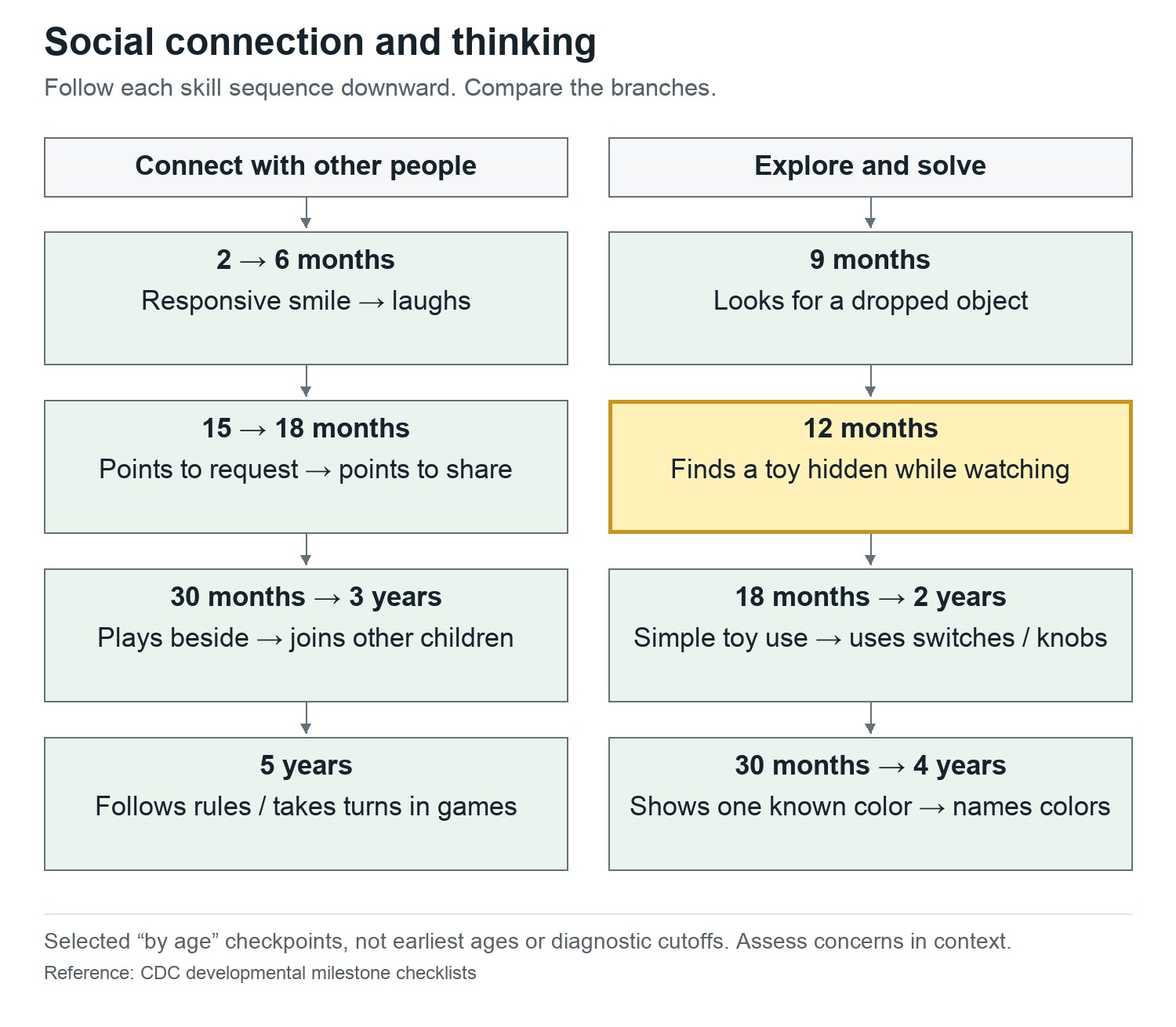
The tree shows the two steps: at 9 months a child looks for an object dropped out of sight; at 12 months a child finds a toy hidden under a blanket while watching. Peek-a-boo, which most 9-month-olds enjoy, plays on the same skill.
Birth to 12 months: watching, mouthing and searching
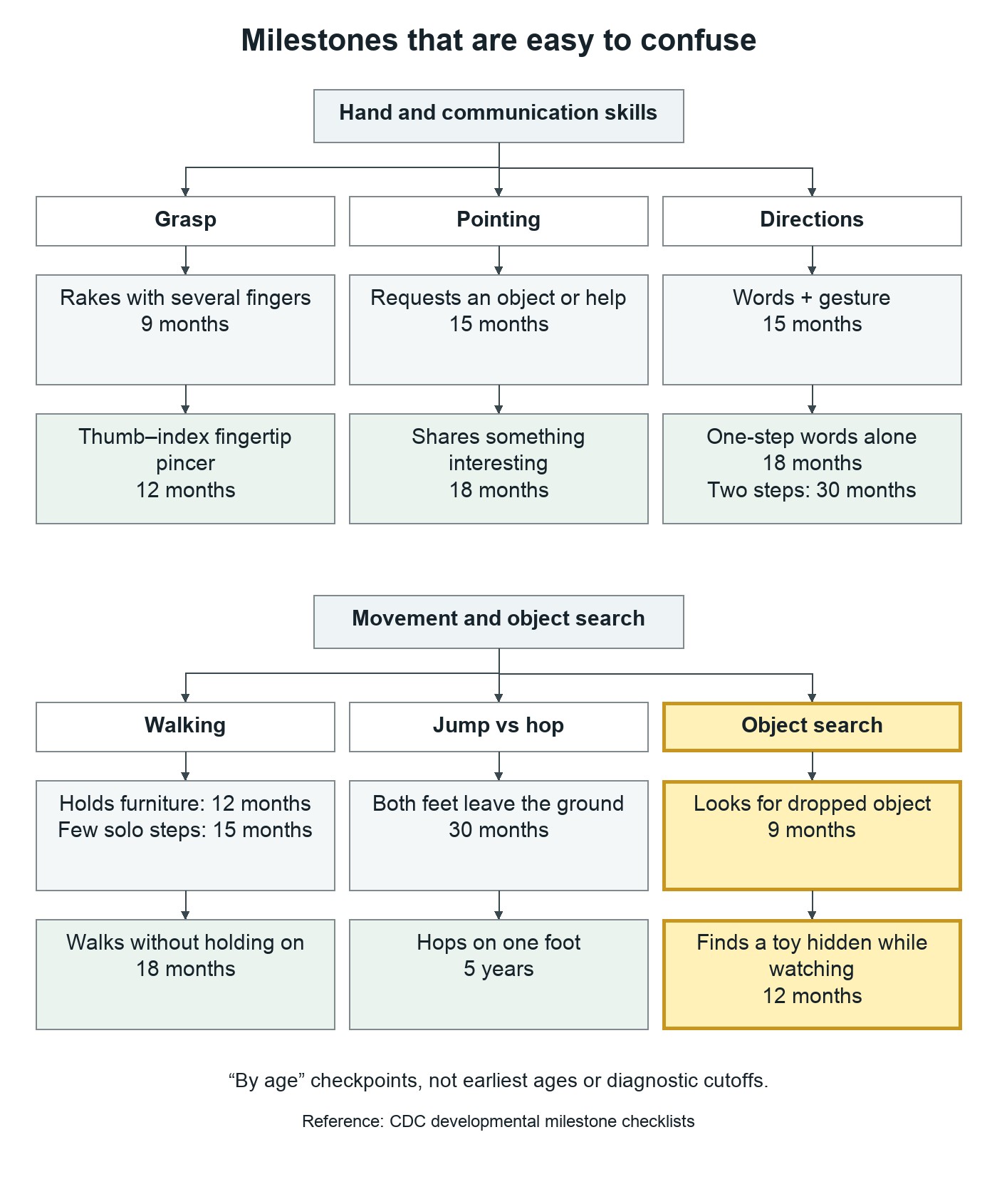
Young infants learn through looking and mouthing. Objects become things to reach for, then to bang, drop and find again.
- A 6-month-old who already searches for dropped toys and bangs objects together is ahead in the cognitive domain.
| Age | Most children by this age |
|---|---|
| 2 months | Watch a person moving nearby; look at a toy for several seconds |
| 4 months | Look at their own hands with interest |
| 6 months | Put objects in the mouth to explore them; reach to grab a wanted toy; close the lips to refuse more food |
| 9 months | Look for an object dropped out of sight; bang two objects together |
| 12 months | Look for a toy they saw you hide; put an object into a container |
15 months to 2 years: using objects the right way
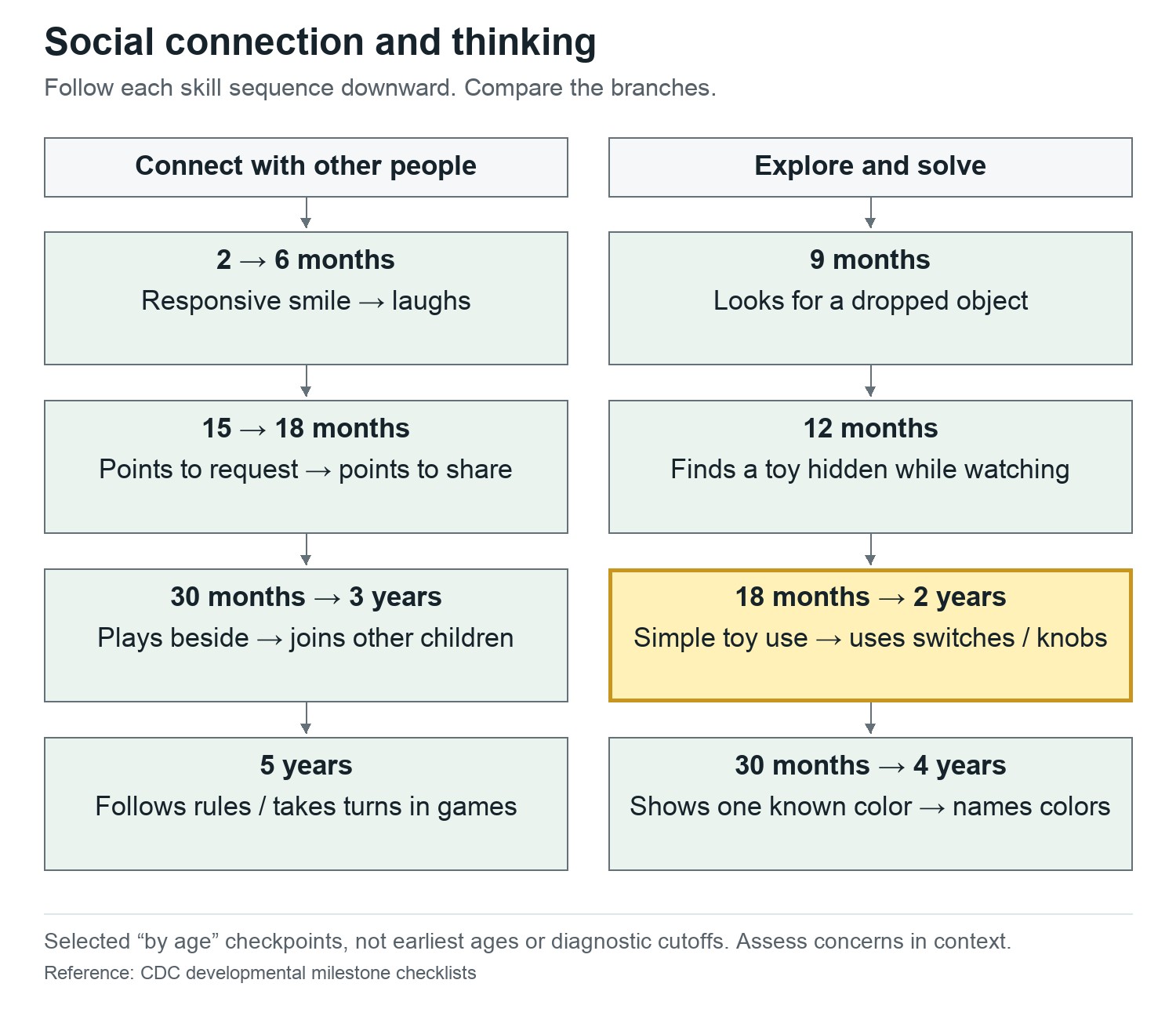
Toddlers move from exploring objects to using them for their purpose and copying what adults do.
| Age | Most children by this age |
|---|---|
| 15 months | Try to use a phone, cup or book the usual way; stack at least 2 small objects |
| 18 months | Copy a simple chore such as sweeping; play with a toy in a simple way, such as pushing a toy car |
| 2 years | Try switches, knobs or buttons on a toy; hold a container in one hand and take the lid off with the other; combine two toys in play, such as toy food on a plate |
30 months to 5 years: colors, stories and early school skills
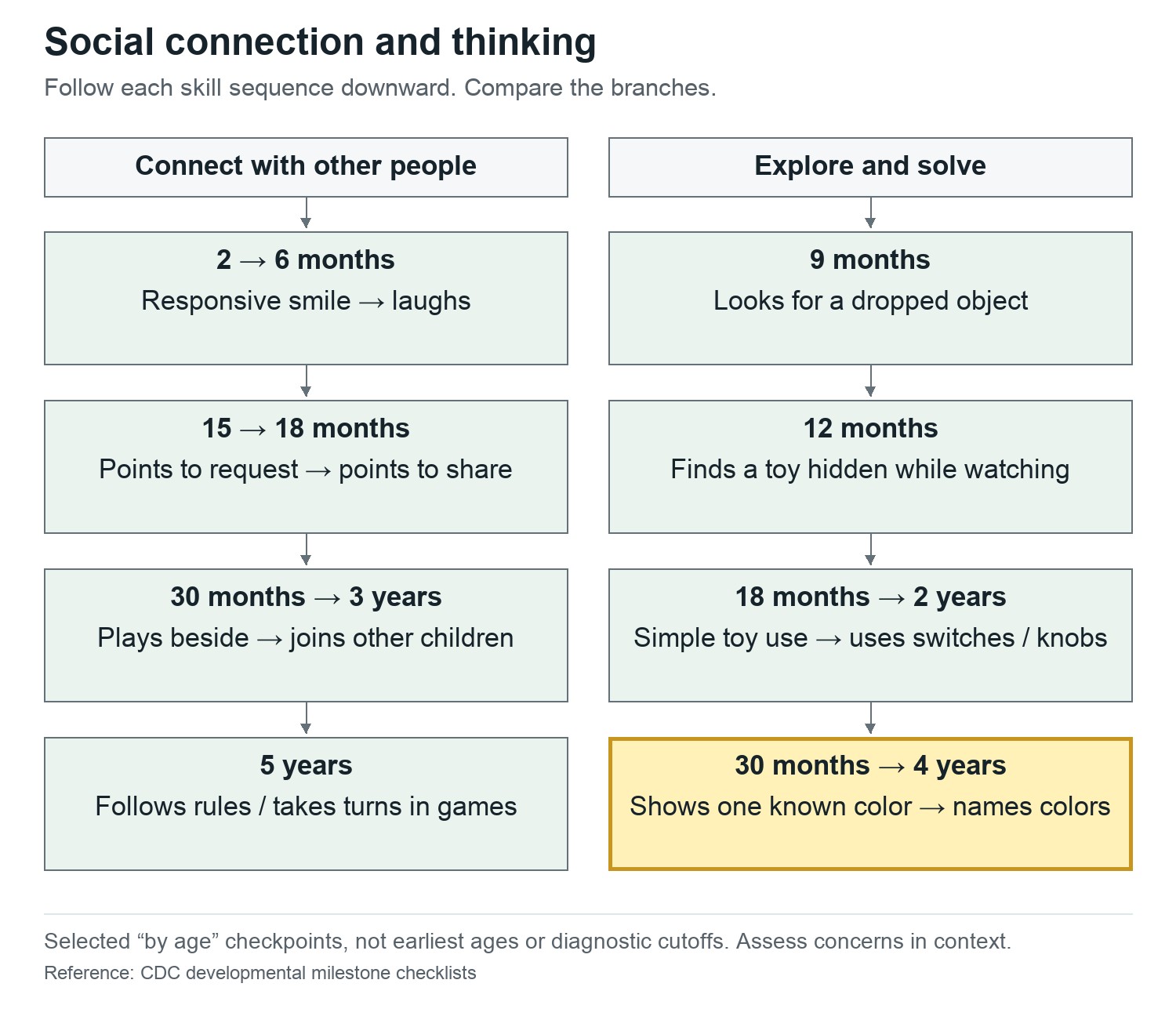
The tree pairs the two color steps: showing one known color at 30 months, naming a few colors at 4 years.
| Age | Most children by this age |
|---|---|
| 30 months | Show they know at least one color; use objects to pretend; follow two-step instructions |
| 3 years | Copy a circle after you show how; avoid touching a hot object when warned |
| 4 years | Name a few colors; say what happens next in a familiar story; draw a person with 3 or more body parts |
| 5 years | Count to 10; name some numbers between 1 and 5 and some letters when pointed to; use time words such as yesterday and tomorrow; pay attention to an activity for 5–10 minutes (screens do not count); write some letters of their name |
When a cognitive milestone is missed
- Milestones on the CDC checklists are skills at least 75% of children have by that age, so a missed milestone is a reason to act, not to wait.
- Missing a milestone, losing a skill, or a parent concern at any visit → standardized developmental screening or direct referral.
- AAP: developmental surveillance at every well visit; standardized screening at 9, 18 and 30 months; autism screening at 18 and 24 months.
- Check hearing and vision, and ask about loss of skills, which always needs prompt evaluation.
Common questions
At what age does object permanence develop?
It begins after 6 months. Most children look for a dropped toy by 9 months and find a toy hidden while they watch by 12 months.
When should a child know colors?
On the CDC checklists most children show they know at least one color by 30 months and name a few colors by 4 years.
By what age can most children count to 10?
By 5 years, along with naming some letters and numbers from 1 to 5.
Study this topic
Sources
- Zubler et al. 2022: Evidence-informed milestones for developmental surveillance tools (Pediatrics)
- CDC Learn the Signs. Act Early.: Milestones by age
- AAP 2020: Developmental surveillance and screening clinical report (Pediatrics)
Written for Pedemy in our own words from the sources above; checked November 2026. For education only, not medical advice; check doses and local protocols before treating a patient. Pedemy is independent and not affiliated with or endorsed by the organizations cited.