

Main decision tree
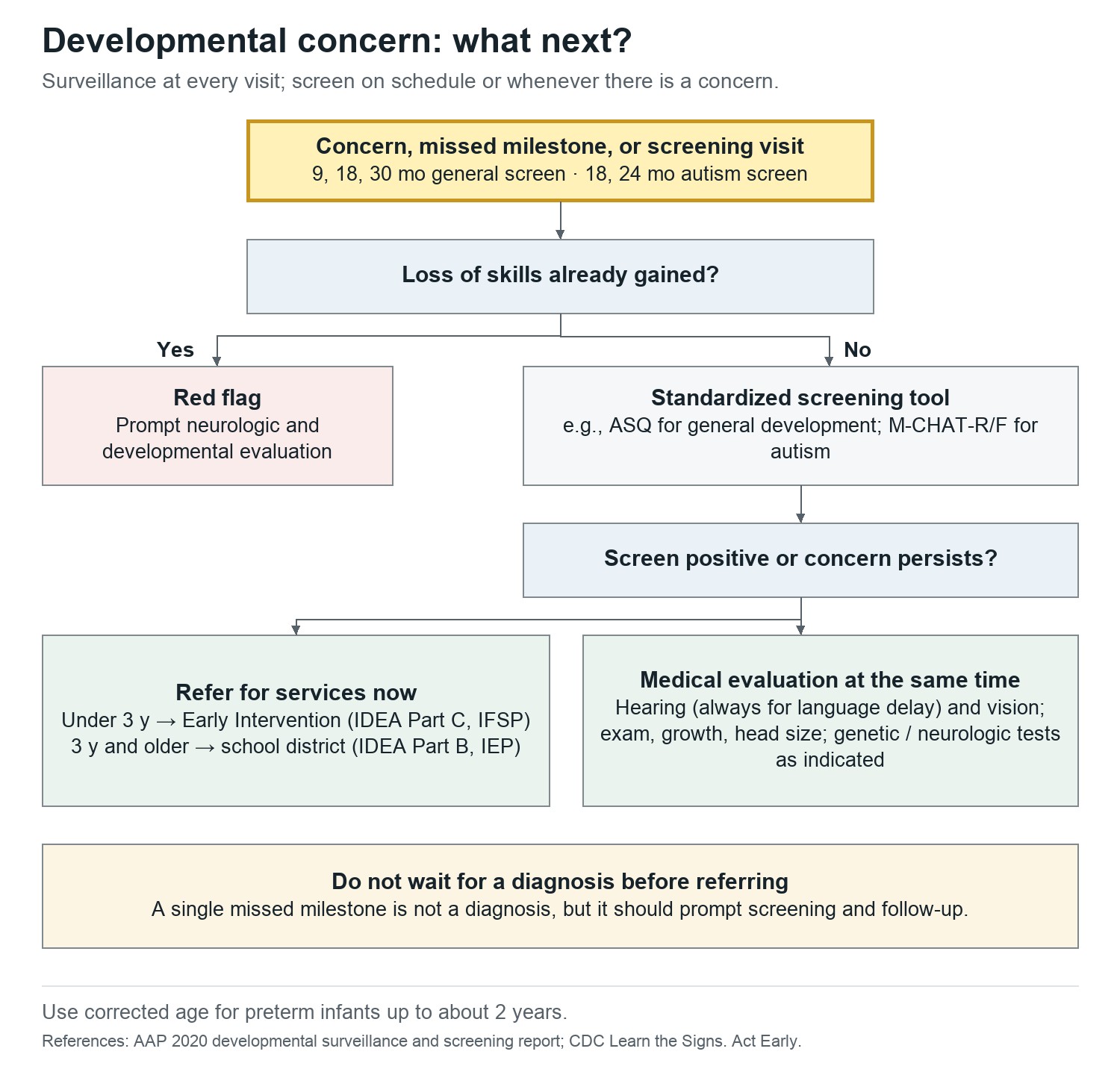
Developmental concern: what next?
Key points
- General developmental screening with a standardized tool at the 9-, 18- and 30-month visits.
- Autism-specific screening (e.g., M-CHAT-R/F) at 18 and 24 months; it screens for risk and does not diagnose.
- Loss of skills already gained is always a red flag: prompt developmental and neurologic evaluation.
- Positive screen under 3 years → Early Intervention (IDEA Part C); 3 years and older → school district (IDEA Part B).
- Every child with a language delay needs a formal hearing test, even after a passed newborn hearing screen.
- Use corrected age for preterm infants when tracking milestones up to about 2 years.
- Global developmental delay: significant delay in 2 or more domains in a child under 5 years.
Surveillance and the screening schedule
Surveillance happens at every well visit: ask about parent concerns, review milestones, observe the child and note risk factors. Screening means giving a validated tool, such as the ASQ for general development.
The AAP recommends a standardized general screen at the 9-, 18- and 30-month visits, and an autism-specific screen at 18 and 24 months. A concern at any other visit also triggers a screen or a direct referral.
- The M-CHAT-R/F estimates autism risk; a positive result needs the follow-up interview and, if still positive, a diagnostic evaluation.
- For a child born preterm, compare milestones against corrected age (age minus weeks born early) until about 2 years.
- A single missed milestone is not a diagnosis, but it should lead to screening and follow-up.
Loss of skills: a red flag
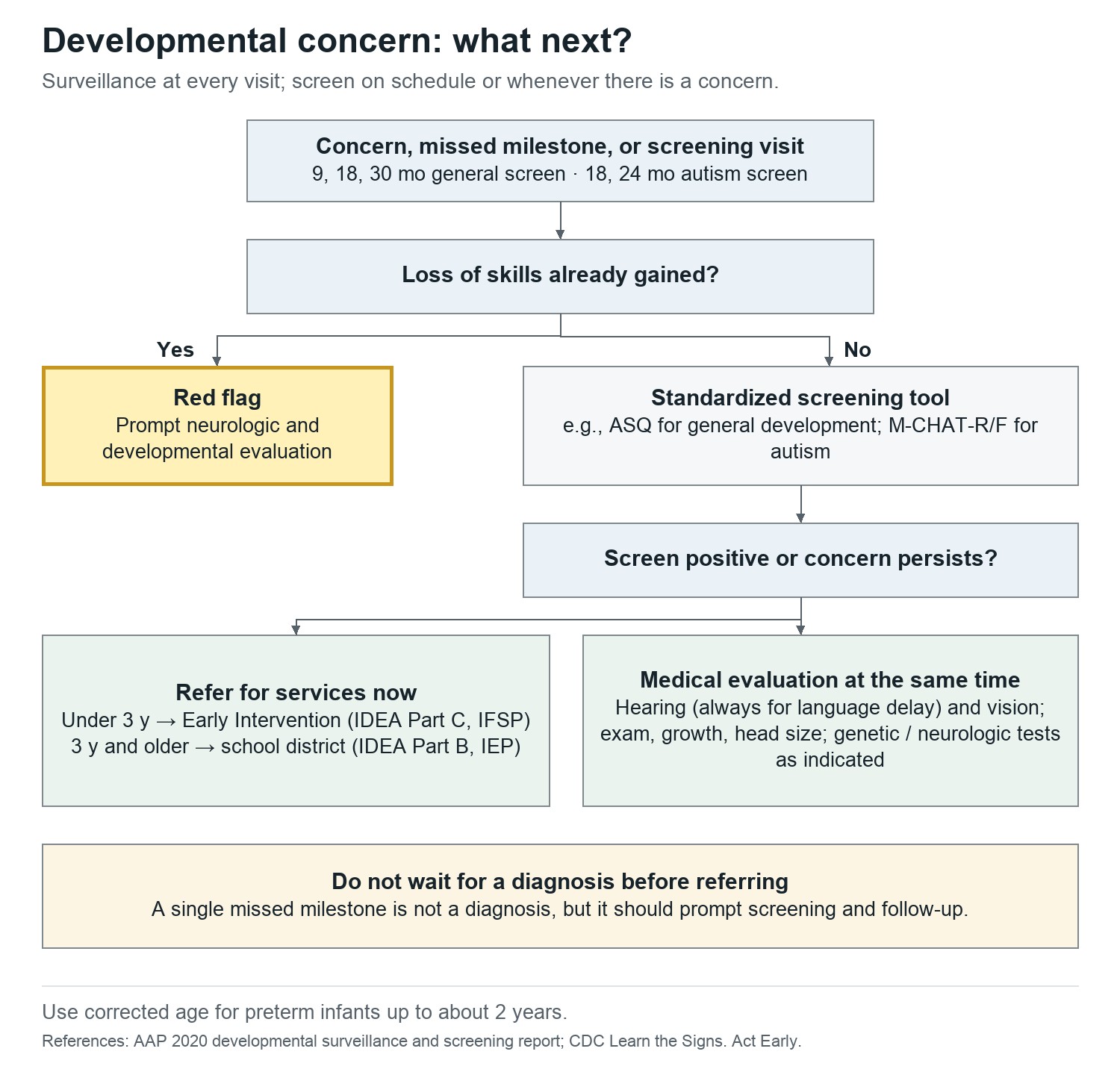
A child who loses words, social skills or motor skills he already had needs a prompt developmental and neurologic evaluation, at any age. Do not wait for the next scheduled screen.
Missed milestones that should prompt a screen
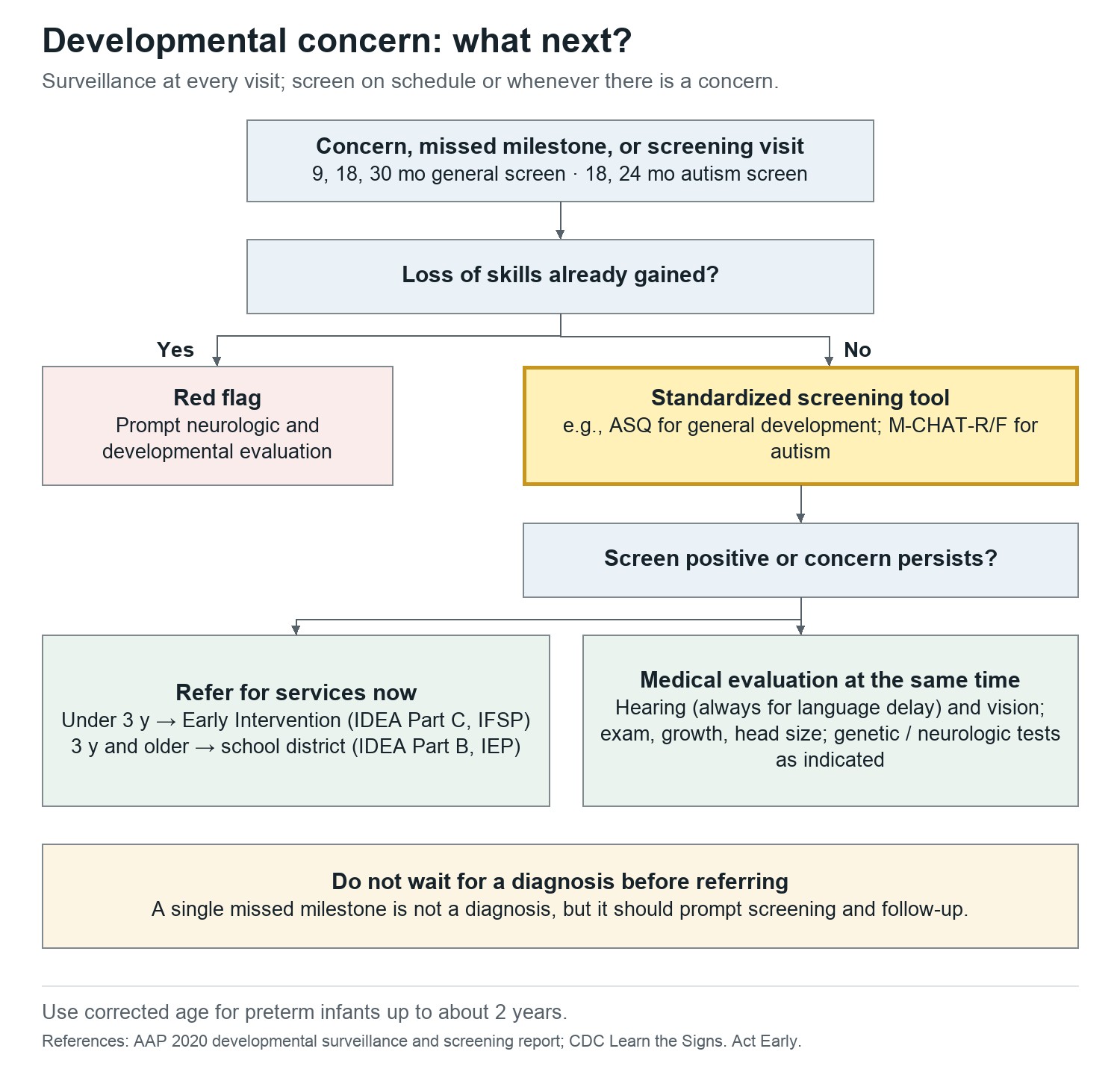
The CDC 2022 checklists list skills that most children (75% or more) show by each age, so a missing skill is a real reason to screen. When a skill is missing, give a standardized screen and evaluate the domain involved.
- Normal at 3 years: copies a circle, puts on loose clothing, says first name and plays with other children.
- Delayed speech alone does not diagnose autism; autism needs deficits in social communication plus restricted, repetitive behaviors.
| Age | Missing skill | Domain |
|---|---|---|
| 2 months | No social smile in response to faces or voices | Social-emotional |
| 9 months | Cannot sit without support | Motor: screen and do a motor evaluation |
| 9 months | No babbling (e.g., after meningitis) | Language: developmental and hearing assessment |
| 15 months | No affectionate gestures (hugs, cuddles) despite normal motor and language skills | Social-emotional |
| 18 months | Fewer than 3 words besides mama or dada | Expressive language |
| 2 years | Cannot point to named body parts or pictures in a book | Receptive language |
| Older toddler | No pointing to share interest | Social communication: think of autism |
| 3 years | Only about 25 words; speech hard for others to understand | Language and speech |
Refer for services now
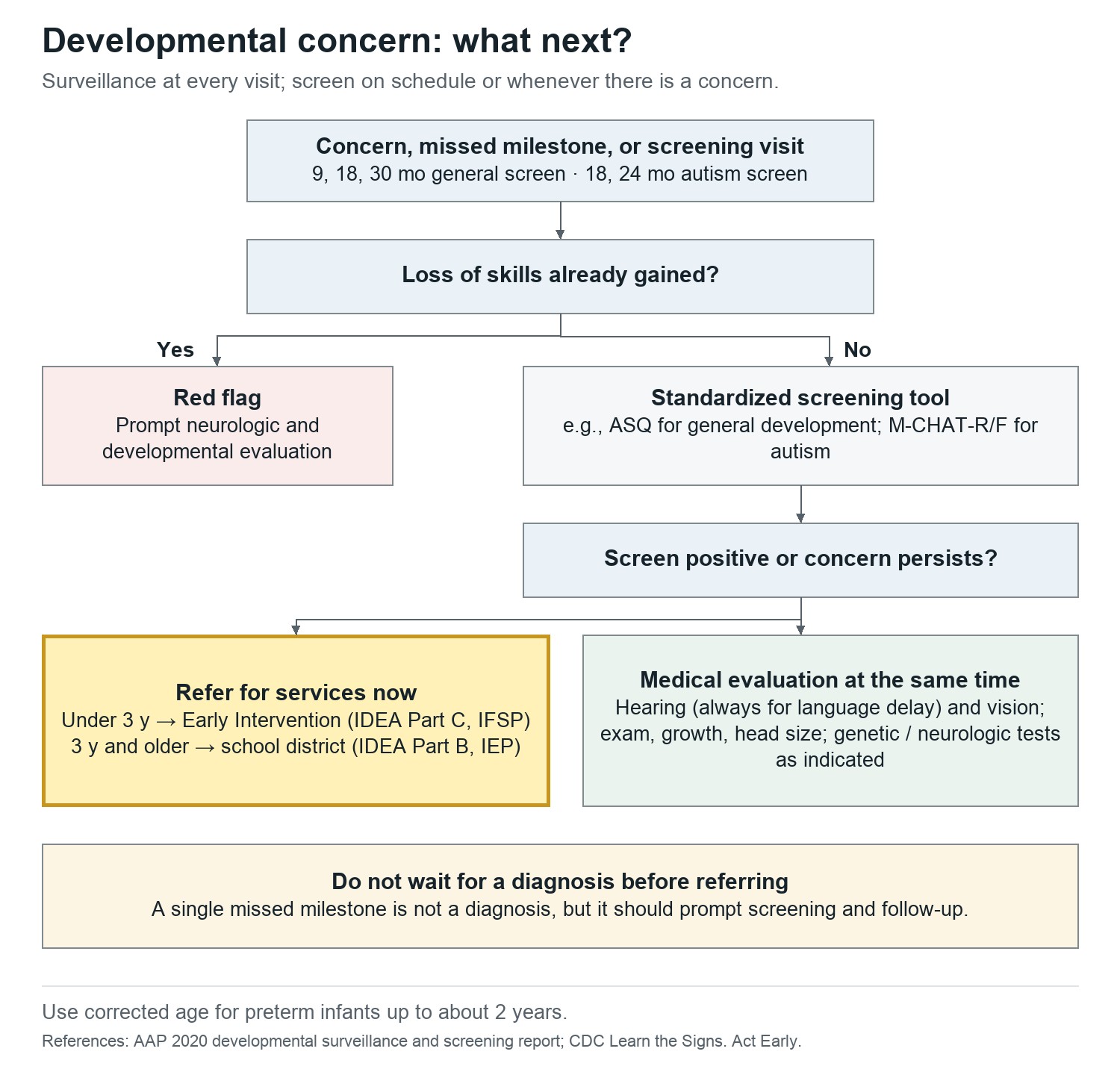
A positive screen or a persisting concern leads to referral right away, while the medical evaluation goes on. Services do not need a diagnosis.
- Under 3 years: Early Intervention under IDEA Part C, with an individualized family service plan (IFSP).
- 3 years and older: the local school district under IDEA Part B, with an individualized education program (IEP).
- A child of 24 months who does not combine 2 words: hearing and language evaluation, and refer to Early Intervention.
Medical evaluation at the same time
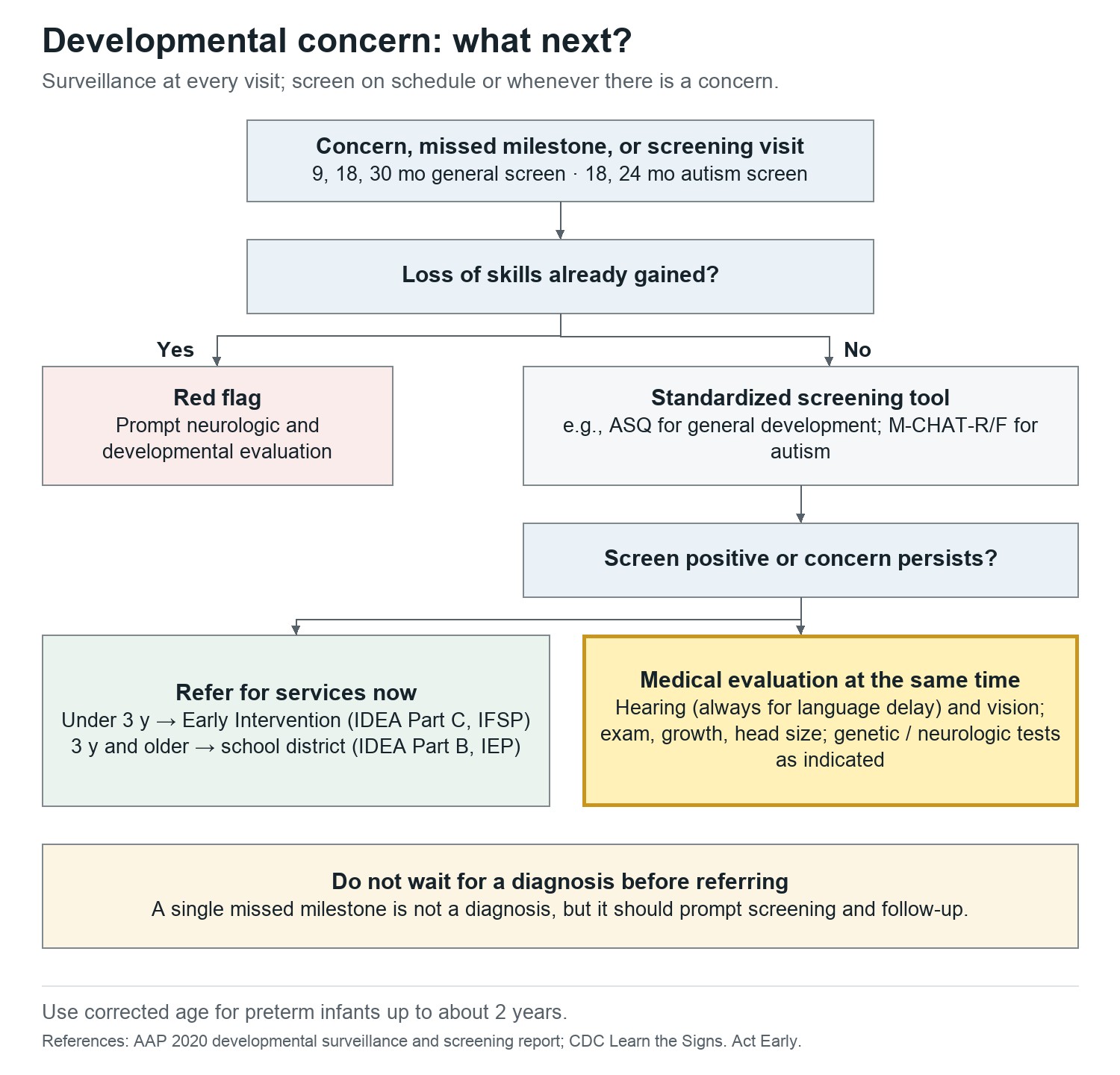
The medical evaluation looks for a cause and for problems that make development worse: hearing and vision, a full exam, growth and head size, and genetic or neurologic tests when they are indicated.
- Any language or speech delay: formal audiology testing, even if the newborn hearing screen was passed, because hearing loss can start later.
- An 18-month-old who says only one word but points and babbles: evaluate language and overall development, with a formal hearing test.
- A 3-year-old whom strangers barely understand: hearing evaluation and speech-language referral.
Language milestones to compare against
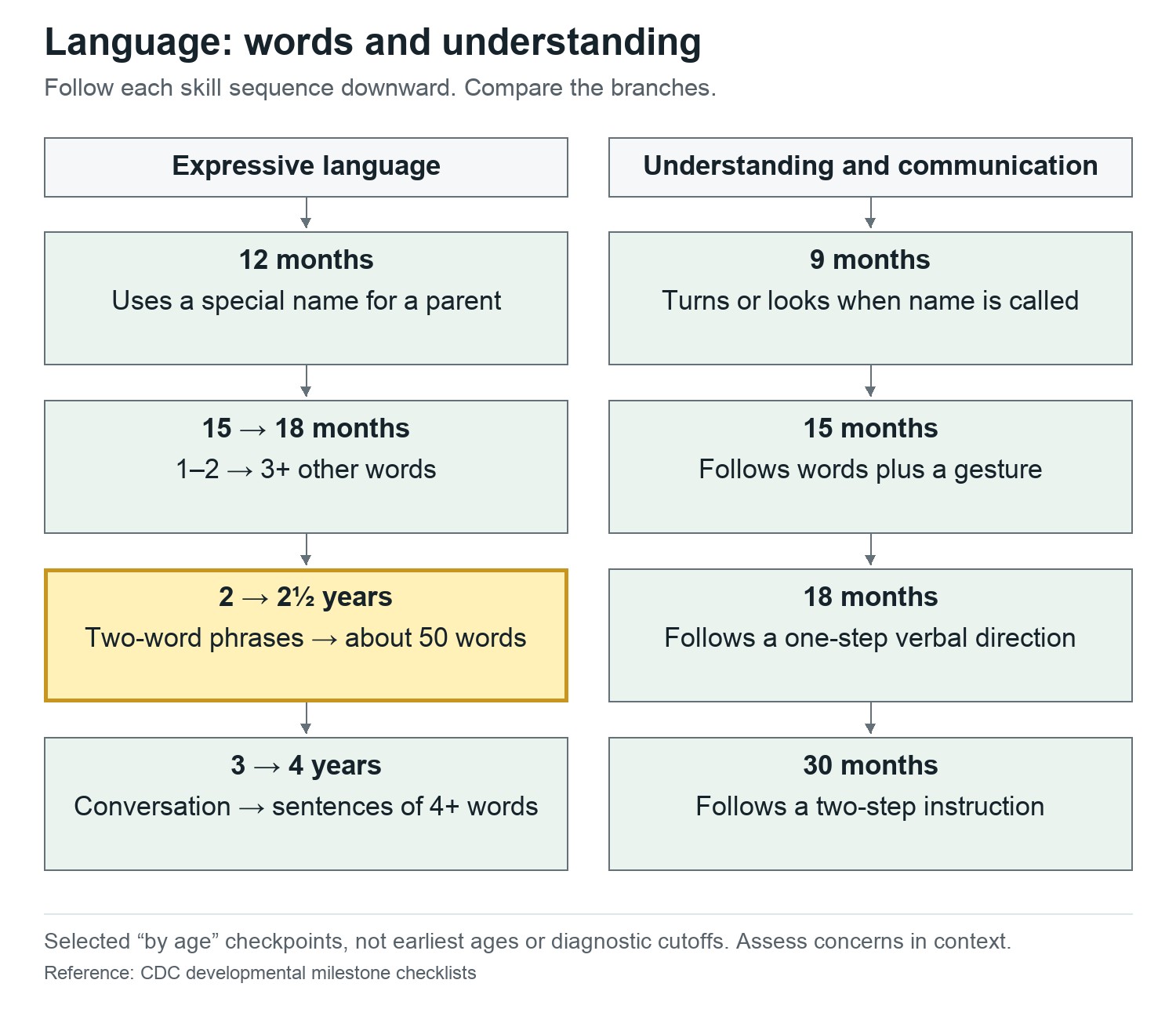
Expressive and receptive language develop on two parallel tracks. Compare a child against the expected skill on each track, not against one number alone.
| Age | Expressive | Understanding |
|---|---|---|
| 9 months | Babbles (mamama, bababa) | Turns or looks when name is called |
| 12 months | Uses a special name for a parent | — |
| 15 months | 1–2 other words | Follows words plus a gesture |
| 18 months | 3 or more other words | Follows a one-step verbal direction |
| 2 years | 2-word phrases | Points to named body parts and book pictures |
| 30 months | About 50 words | Follows a two-step instruction |
| 3–4 years | Conversation, then sentences of 4 or more words | — |
Stuttering and speech fluency
- Stuttering means repetitions of sounds or words, prolongations and blocks.
- Every child with a new speech or fluency concern needs a hearing screen.
- Refer to a speech-language pathologist when stuttering persists or causes anxiety, avoidance of speaking in class or other distress.
Global developmental delay and intellectual disability
Global developmental delay is a significant delay in 2 or more domains in a child under 5 years, when formal testing is not yet reliable. Intellectual disability is diagnosed when both intellectual (cognitive) function and adaptive function are measured and both are impaired, with onset in childhood.
- Adaptive behavior has 3 domains: conceptual, social and practical.
- Current practice grades severity by adaptive functioning and support needs, not by IQ. In older IQ-based systems, an IQ around 60 fell in the mild range.
- Adaptive skills can be taught and improve throughout life.
- Teaching a new daily skill: scaffold it in small steps, repeat often and fade help gradually.
- Weak self-care skills in mild intellectual disability: occupational therapy plus practice at home.
- IEP goals should include adaptive, school and community skills, not only academics.
- Many adults with mild intellectual disability work and live with limited support.
Common questions
At what ages should children have developmental screening?
The AAP recommends a standardized general developmental screen at 9, 18 and 30 months, and an autism-specific screen at 18 and 24 months, plus a screen whenever a concern comes up.
Does a child need a diagnosis before Early Intervention?
No. Refer a child under 3 years to Early Intervention as soon as a screen is positive or a concern persists; the medical evaluation runs at the same time.
Does a passed newborn hearing screen rule out hearing loss in a toddler with speech delay?
No. Hearing loss can begin or progress after birth, so every child with a language delay needs a formal hearing evaluation.
Study this topic
Sources
- AAP 2020: Developmental surveillance and screening (Pediatrics)
- AAP 2020: Identification, evaluation and management of autism spectrum disorder (Pediatrics)
- AAP/CDC 2022: Evidence-informed milestones for developmental surveillance (Pediatrics)
- AAP 2014: Evaluation of the child with intellectual disability or global developmental delay (Pediatrics)
Written for Pedemy in our own words from the sources above; checked November 2026. For education only, not medical advice; check doses and local protocols before treating a patient. Pedemy is independent and not affiliated with or endorsed by the organizations cited.