

Main decision tree
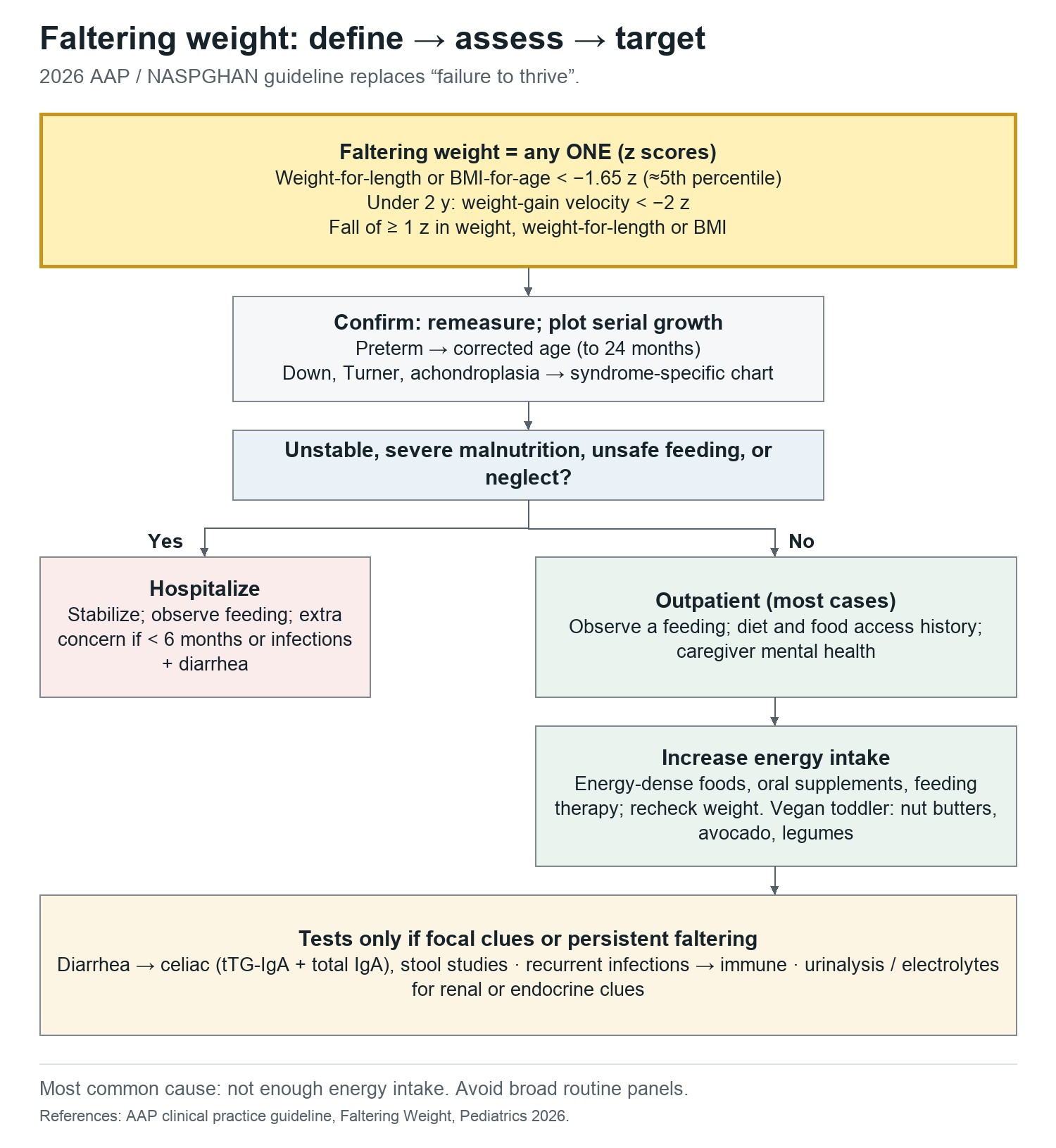
Faltering weight: define, assess, target
Key points
- Faltering weight = any one of: weight-for-length or BMI-for-age below −1.65 z (about the 5th percentile); under 2 years, weight-gain velocity below −2 z; or a fall of 1 z or more.
- The 2026 z-score criteria replace the old rules (below the 3rd or 5th percentile, or crossing 2 major percentile lines).
- The most common cause is not taking in enough suitable food.
- Remeasure and plot serial growth; use corrected age for preterm infants up to 24 months.
- Most children are managed as outpatients: observe a full feed and take a diet and food-access history.
- Admit for medical instability, severe malnutrition, unsafe feeding, or suspected abuse or neglect.
- Test only when there are focal clues or faltering persists; broad routine panels are not recommended.
Definition: the 2026 z-score criteria
The 2026 AAP and NASPGHAN guideline uses z scores instead of percentiles. One criterion is enough.
In the classic nutritional pattern, weight falls first while length and head circumference are spared at first. Length falls later if intake stays poor.
- Weight-for-length (under 2 years) or BMI-for-age (2 years and over) below −1.65 z, about the 5th percentile.
- Under 2 years: weight-gain velocity below −2 z for age, about the 2nd percentile.
- A fall of 1 z or more in weight, weight-for-length or BMI.
- Serial weight-for-length z scores track wasting in infants better than weight alone.
| Older teaching rule | 2026 criterion |
|---|---|
| Weight below the 3rd or 5th percentile | Weight-for-length or BMI-for-age below −1.65 z |
| Weight-for-height below the 5th percentile | Weight-for-length below −1.65 z |
| Crossing 2 major percentile lines after stable growth | A fall of 1 z or more |
Confirm the measurement and the right chart
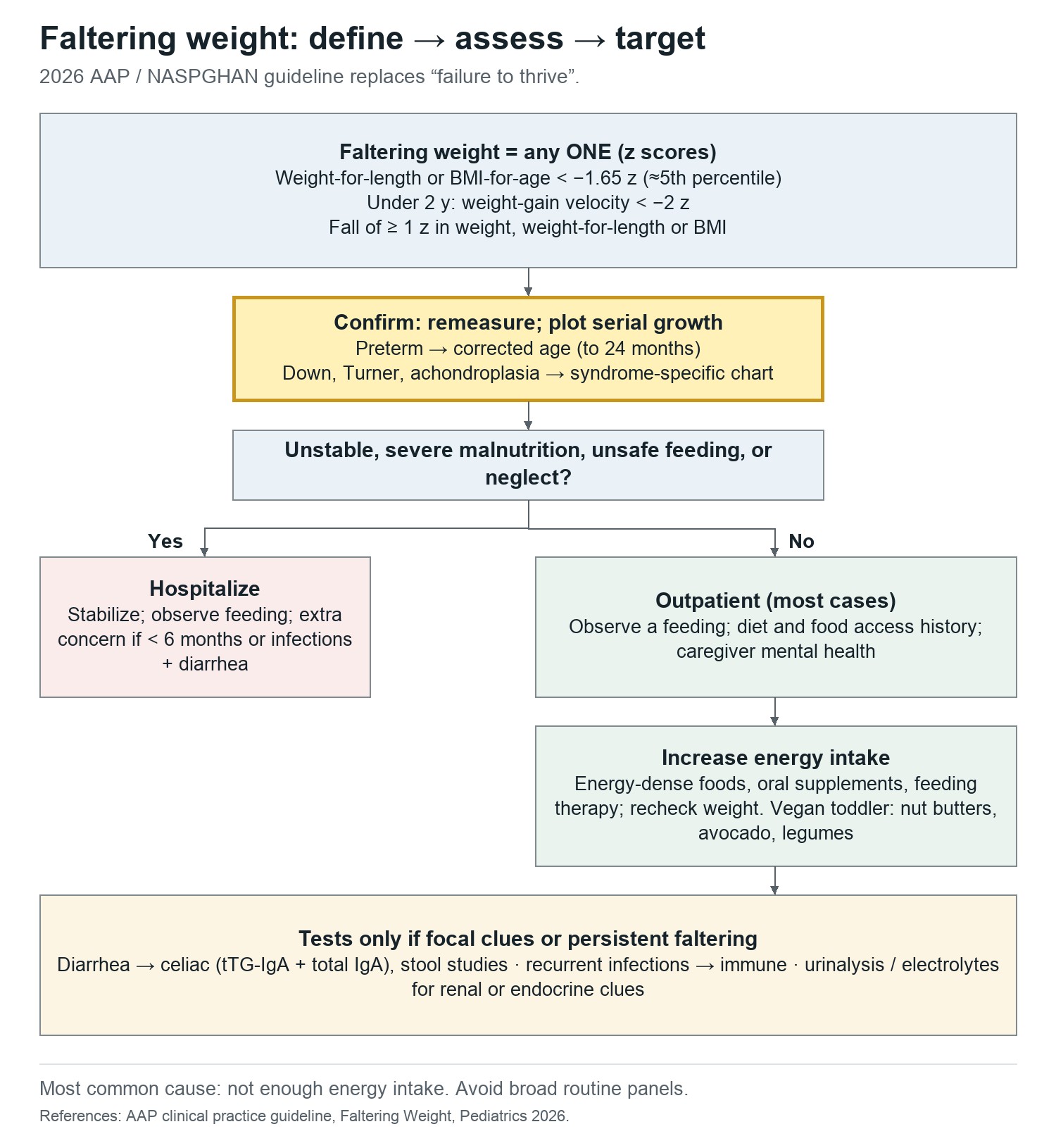
Many low readings are measuring errors. Weigh the infant undressed, measure length lying down on a length board, and plot every past value to see the trend.
- Preterm infants: plot by corrected age until 24 months.
- Prematurity raises the risk of faltering weight: energy needs are higher and feeding is often harder.
- Down syndrome, Turner syndrome and achondroplasia: use the syndrome-specific chart.
- One low point on a chart does not prove malnutrition; look at the trajectory and the whole child.
Outpatient assessment and treatment
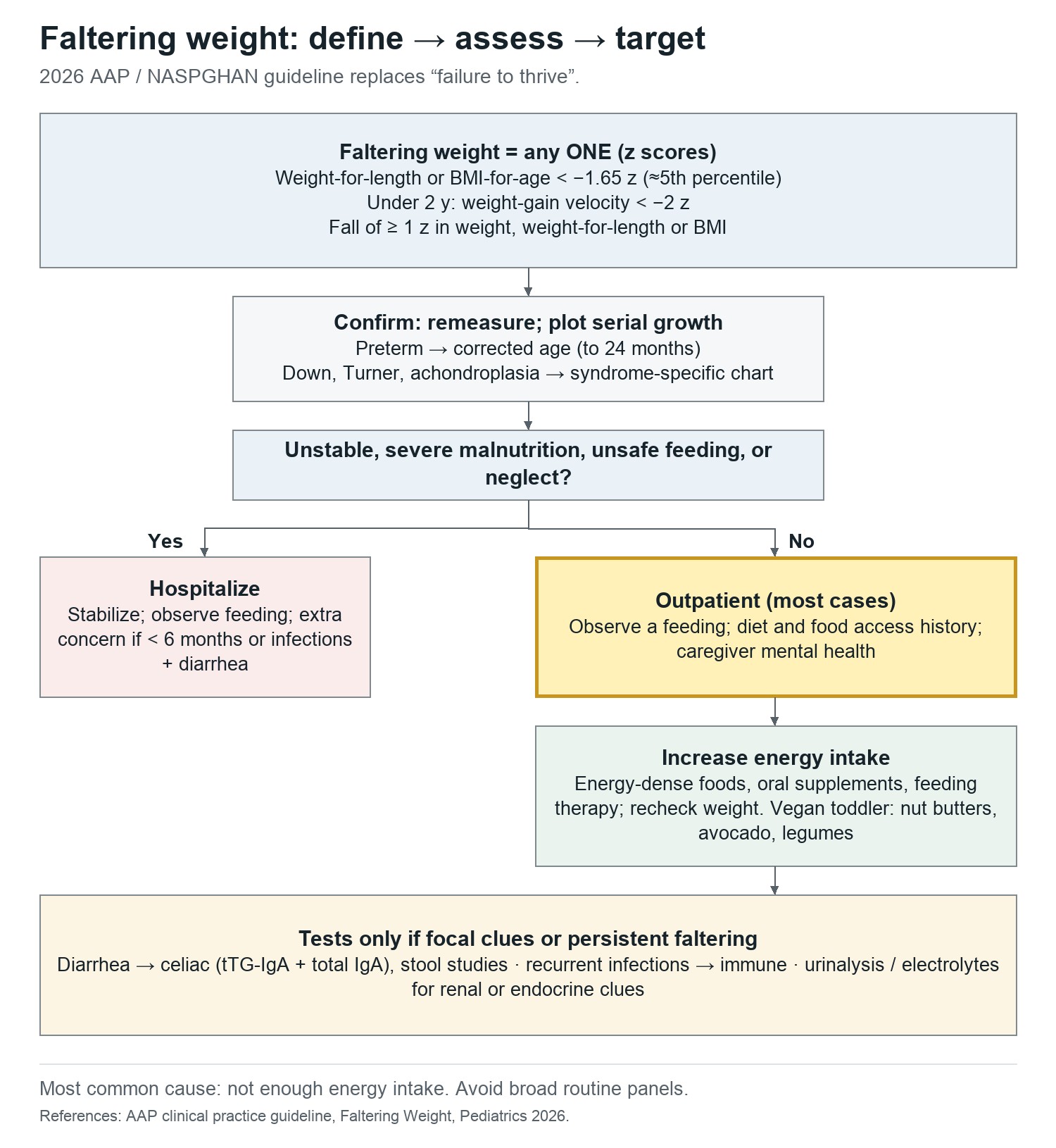
Most children with faltering weight can be cared for in clinic. Watching a whole breastfeed or bottle feed often shows the problem: poor latch, short feeds, weak suck, or a stressful mealtime.
A 6-month-old who is apathetic, has lost fat over the buttocks and thighs, and has weight far below length and head size most likely is not getting enough suitable food.
- History: what, how much and how often the child eats; formula mixing; juice and milk volume; vomiting and stools.
- Ask about food access, household stress and caregiver depression.
- Treat with energy-dense foods, oral nutritional supplements and feeding therapy for a pediatric feeding disorder.
- Vegan toddler: add energy-dense plant foods such as nut butters, avocado and legumes.
- Recheck weight regularly; reassess or escalate if gain stays poor.
When to admit
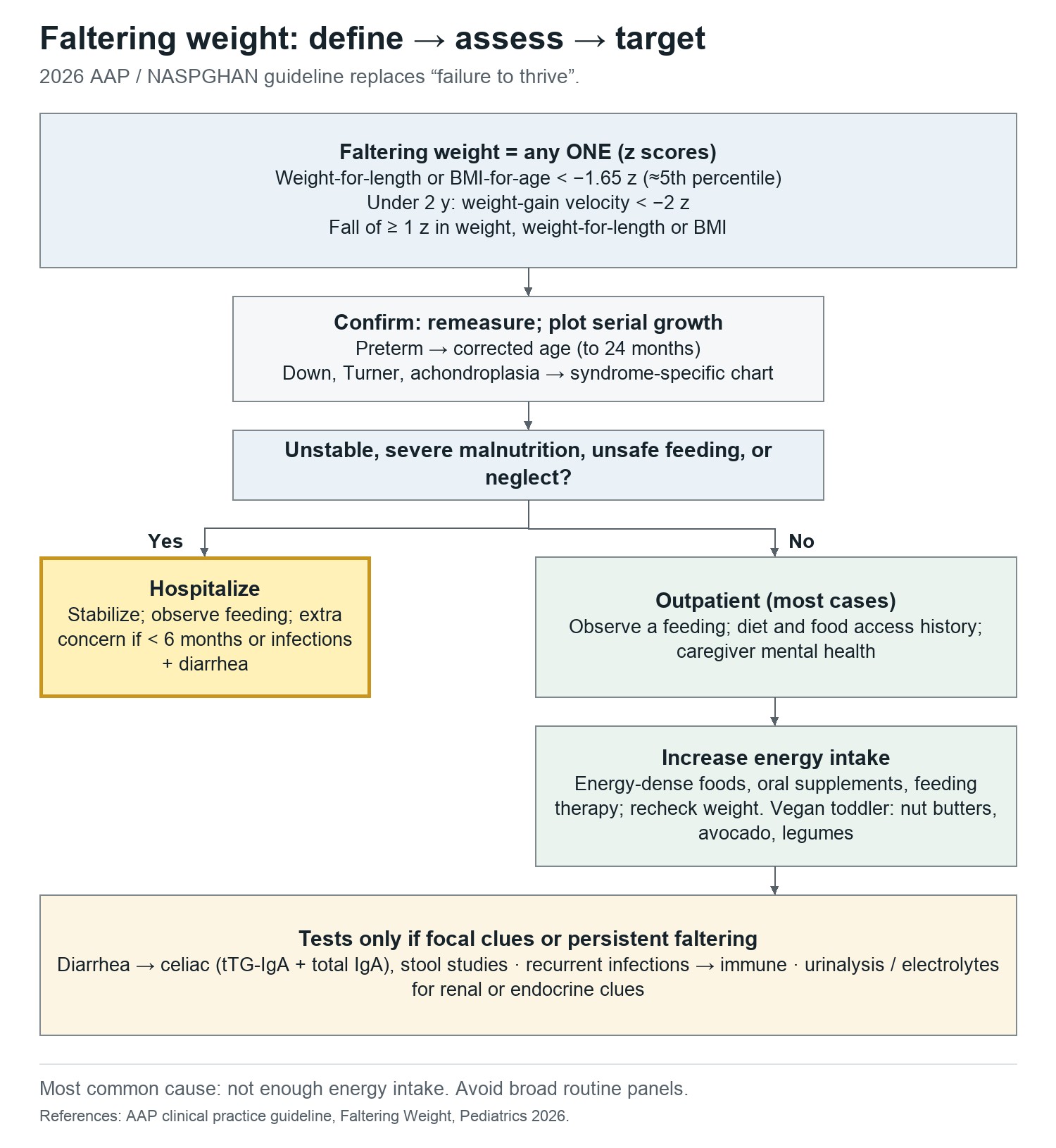
Refeed severely malnourished children slowly and watch phosphate, potassium and magnesium, because refeeding syndrome can cause dangerous drops in these salts.
- Medical instability: dehydration, low temperature, slow heart rate, electrolyte problems.
- Severe malnutrition.
- Unsafe feeding, or a need to watch feeding closely in hospital.
- Suspected abuse, neglect or serious psychosocial risk.
- Take extra care under 6 months of age, and in a severely wasted infant with chronic diarrhea and repeated serious infections.
Targeted tests, not broad panels
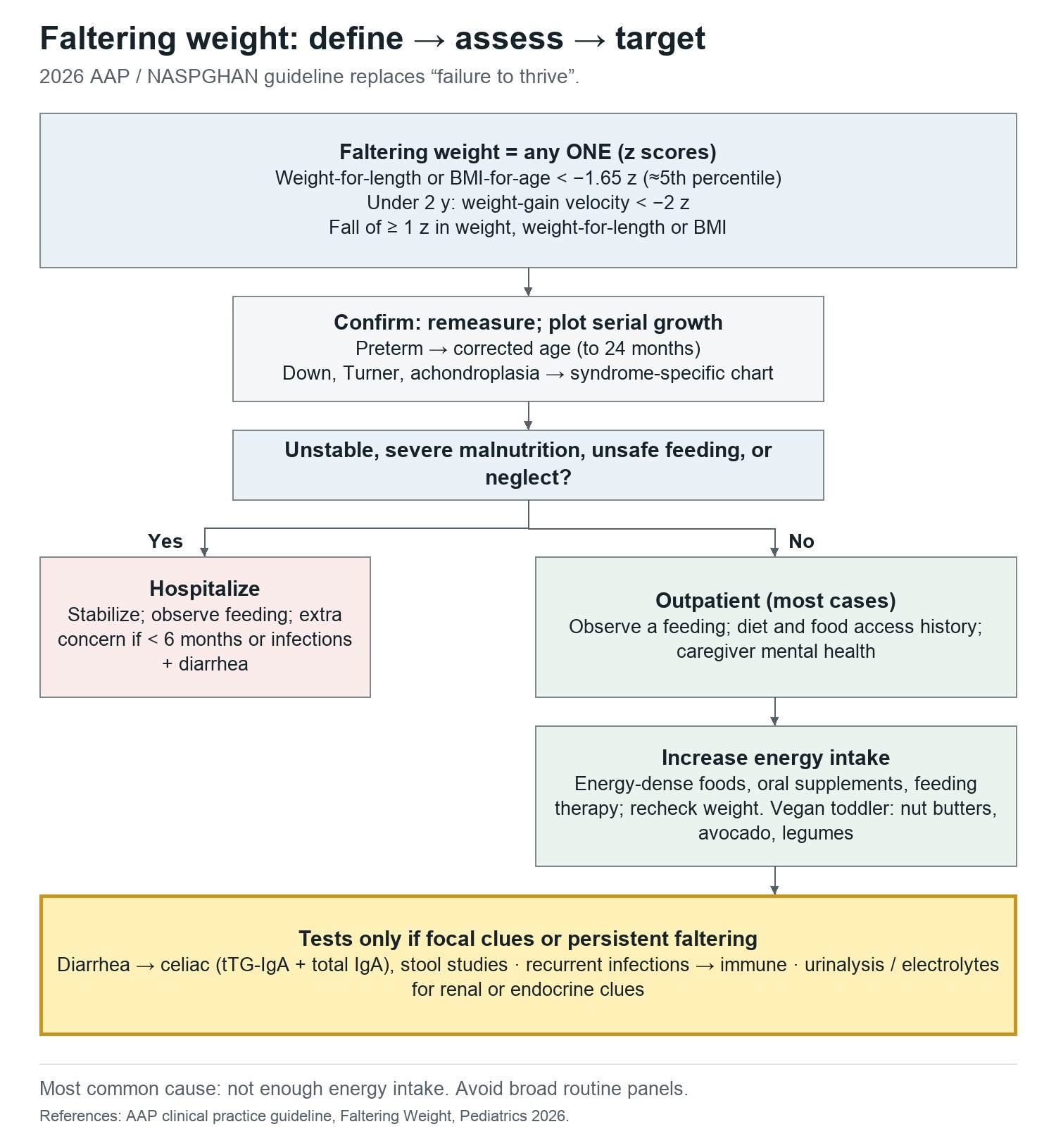
Routine screening panels rarely find a cause and are not recommended. Order tests only when the history or exam points to a system, or when weight keeps faltering despite good intake. Endoscopy with biopsy is suggested for persistent faltering or when a condition can only be found that way.
| Clue | Test or concern |
|---|---|
| Chronic diarrhea, malabsorption | Celiac screen (tTG-IgA plus total IgA), stool studies |
| Chronic diarrhea with recurrent infections | Immunodeficiency work-up |
| Poor gain despite apparently adequate intake | Urinalysis and electrolytes for renal or endocrine causes |
| Respiratory symptoms, oily stools | Sweat chloride: a normal newborn screen does not rule out cystic fibrosis |
| Cardiac or respiratory signs | Targeted cardiac or lung evaluation |
Severe malnutrition: wasting and nutritional edema
The WHO now uses the terms wasting and nutritional edema. Both are severe malnutrition and usually need hospital care.
| Form | Key features |
|---|---|
| Marasmus (severe wasting) | Marked loss of muscle and subcutaneous fat; no edema |
| Kwashiorkor (nutritional edema) | Pitting edema of the feet and legs, often with skin and hair changes; weight may hide the wasting |
Common questions
What replaced the term failure to thrive?
The 2026 AAP and NASPGHAN guideline uses the term faltering weight and defines it with z scores instead of percentiles.
What is the most common cause of faltering weight?
Not taking in enough suitable food. A feeding history and an observed feed usually show why.
Should every child with poor weight gain have blood tests?
No. Tests are for children with focal clues or weight that keeps faltering despite better intake.
Study this topic
Sources
- AAP and NASPGHAN 2026: Clinical practice guideline for diagnosis and management of faltering weight (Pediatrics)
- WHO 2023: Guideline on the prevention and management of wasting and nutritional oedema
- CDC: Growth charts
Written for Pedemy in our own words from the sources above; checked November 2026. For education only, not medical advice; check doses and local protocols before treating a patient. Pedemy is independent and not affiliated with or endorsed by the organizations cited.