

Main decision tree
Language: words and understanding
Key points
- 2 months: smiles back; 4 months: coos and chuckles; 6 months: laughs, squeals and blows raspberries.
- 9 months: babbles 'mamamama', looks when called by name, is wary of strangers and reacts when a parent leaves.
- 12 months: waves bye-bye, uses 'mama' or 'dada' for a parent and understands 'no'.
- 15 months: 1–2 words besides mama/dada and points to ask; 18 months: 3 or more words and points to share interest.
- 2 years: two-word phrases; 30 months: about 50 words; 4 years: sentences of 4 or more words.
- Play: beside other children at 30 months, joins them at 3 years, follows rules and takes turns at 5 years.
- No meaningful words at 18 months: do not wait; check hearing and refer for evaluation now.
Language: speaking and understanding
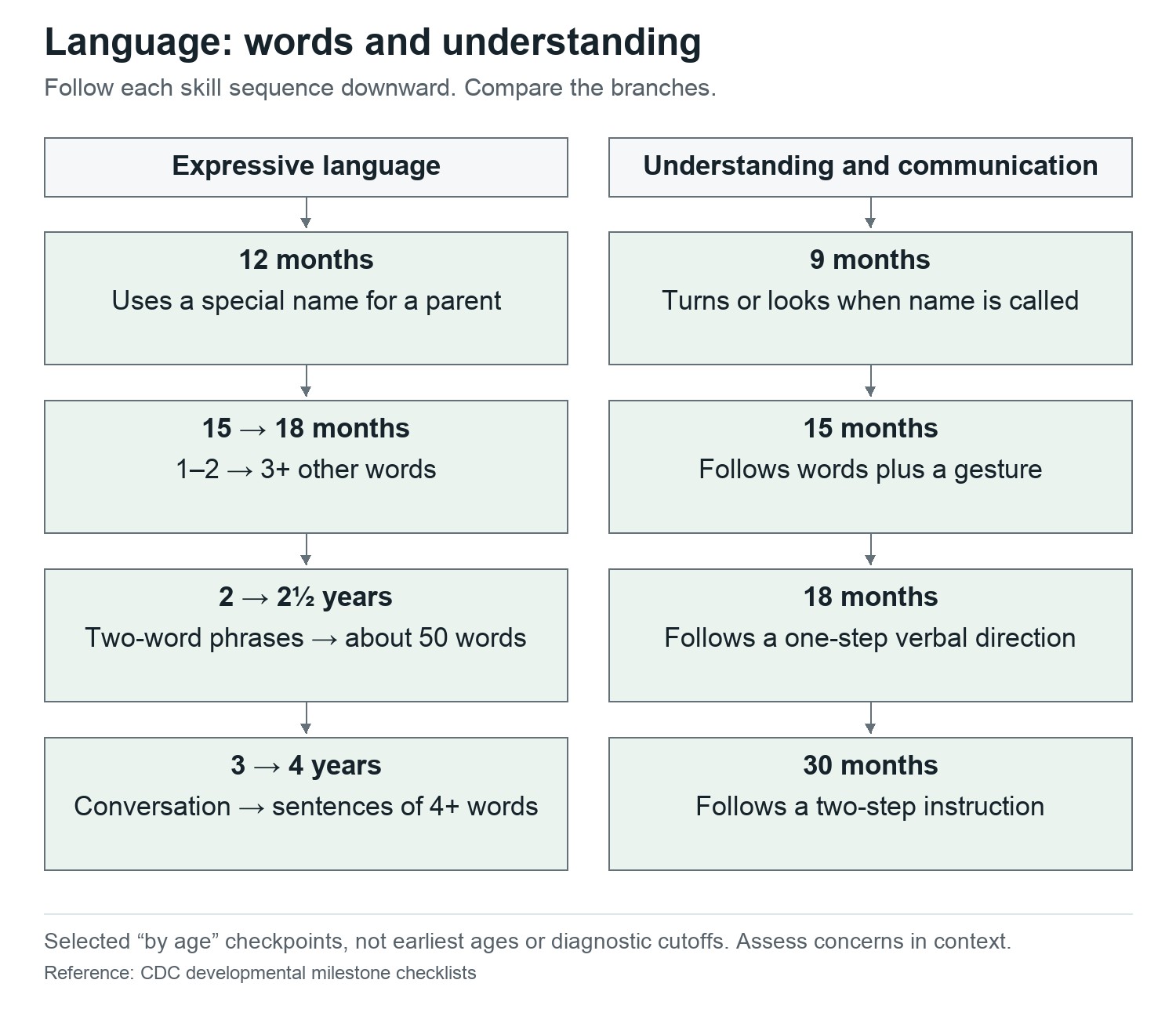
The tree follows two lines. Expressive language is what the child says: a special name for a parent at 12 months, a few words at 15–18 months, phrases at 2 years and conversation by 3 years.
Understanding comes first: turning to their name at 9 months, following directions with a gesture at 15 months, one-step directions without a gesture at 18 months and two-step directions at 30 months.
Birth to 12 months: smiles, sounds and babble
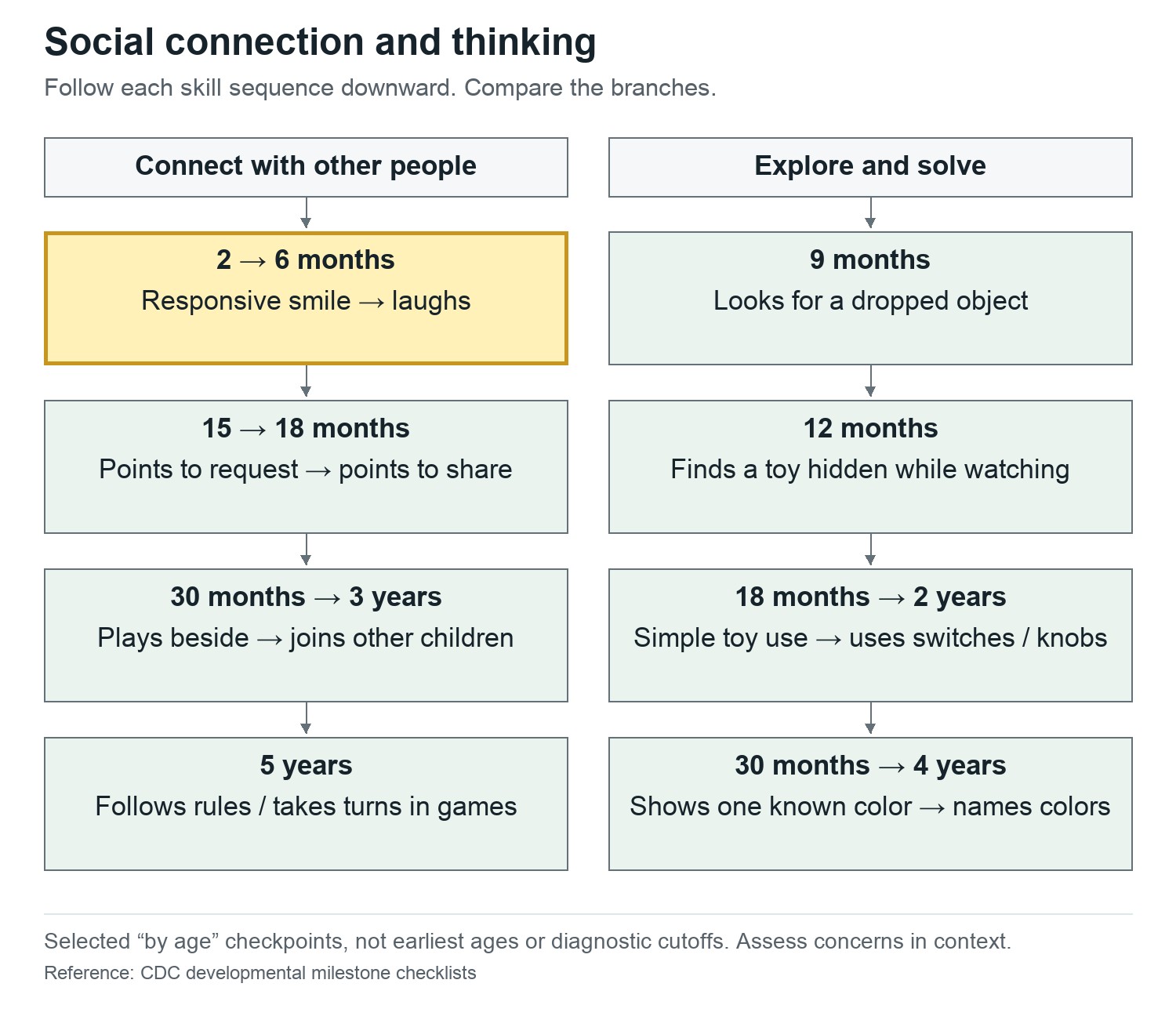
| Age | Language | Social-emotional |
|---|---|---|
| 2 months | Makes sounds other than crying; reacts to loud sounds | Smiles when spoken to or smiled at |
| 4 months | Coos ('oooo', 'aahh') | Smiles on their own to get attention; chuckles; uses looks, movement or sounds to keep an adult's attention |
| 6 months | Takes turns making sounds; blows raspberries; squeals | Laughs; knows familiar people; likes looking in a mirror |
| 9 months | Repeated syllables ('mamamama', 'babababa'); lifts arms to be picked up; looks when name is called | Shy, clingy or fearful with strangers; several facial expressions; reacts when a parent leaves; smiles or laughs at peek-a-boo |
| 12 months | Waves bye-bye; says 'mama', 'dada' or another special name for a parent; understands 'no' (pauses or stops) | Plays games such as pat-a-cake |
15 to 18 months: first words and pointing
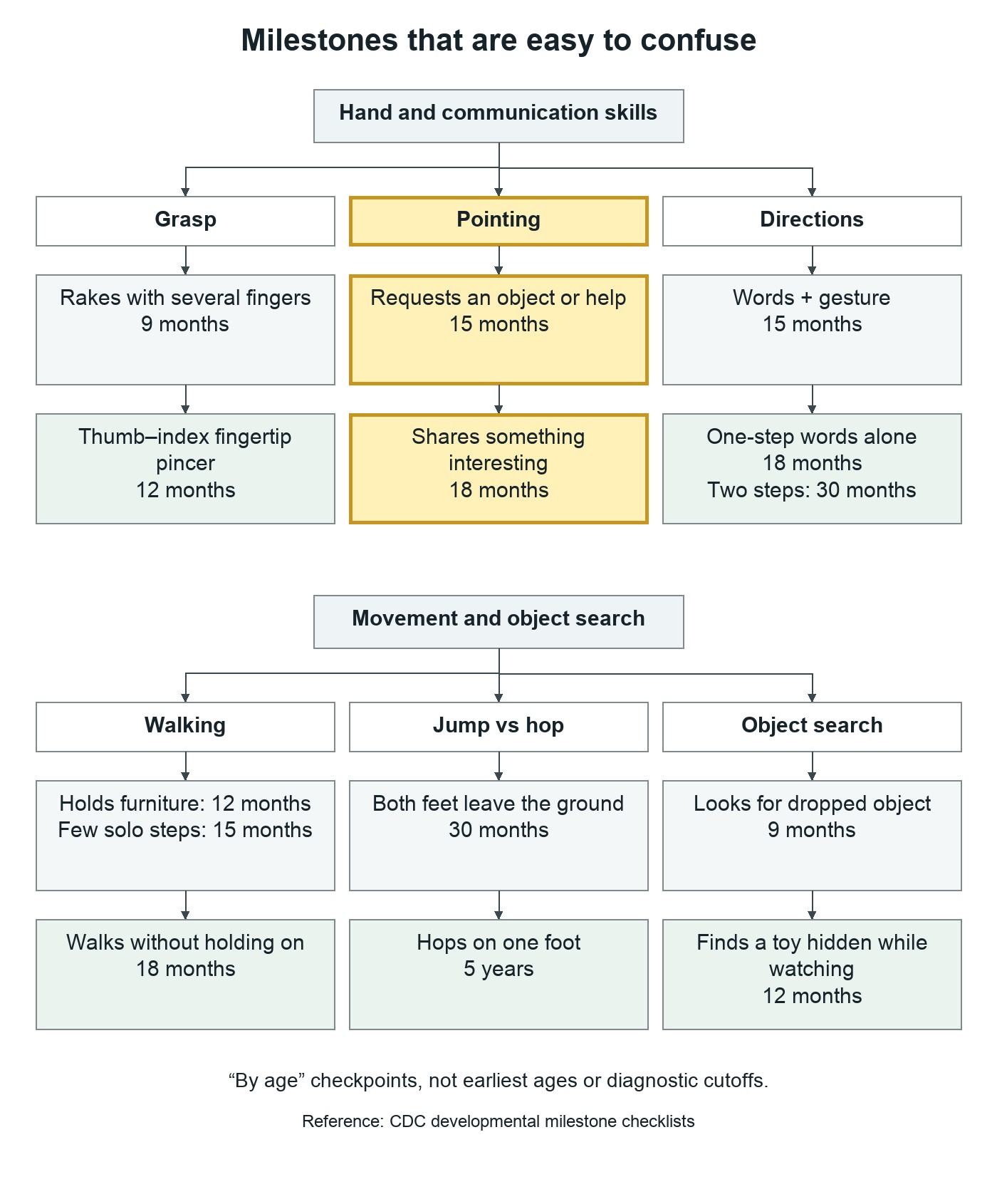
Pointing changes meaning. At 15 months a child points to request an object or help. At 18 months a child points to show you something interesting, to share attention. Pointing to share is a key social-communication skill, and its absence is an early autism clue.
| Age | Language | Social-emotional |
|---|---|---|
| 15 months | Tries 1–2 words besides mama/dada; looks at a familiar object when you name it; follows a direction with words plus a gesture; points to ask for something | Copies other children in play; shows you an object they like; claps when excited; hugs a doll; shows affection |
| 18 months | Tries 3 or more words besides mama/dada; follows a one-step direction without a gesture | Points to show something interesting; looks at a few book pages with you; helps with dressing by pushing an arm into a sleeve |
2 to 5 years: phrases, sentences and stories
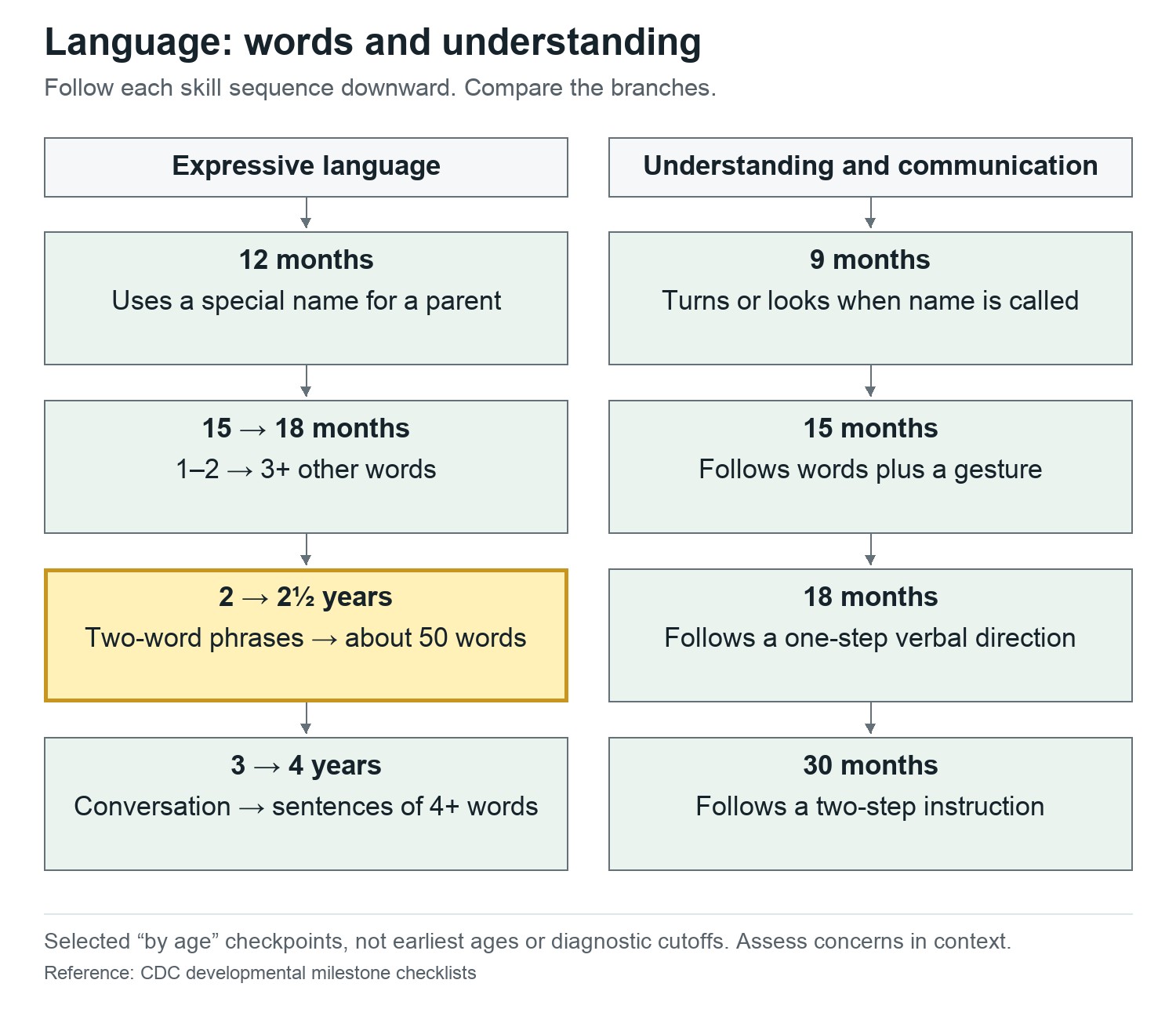
Intelligibility: on the CDC checklist a 3-year-old talks well enough for others to understand most of the time.
| Age | Most children by this age |
|---|---|
| 2 years | Say at least 2 words together ('more milk'); point to at least 2 body parts and to pictures in a book when asked; use gestures beyond waving and pointing, such as nodding yes |
| 30 months | Say about 50 words; say 2 or more words with an action word ('doggie run'); name an object in a book when asked; use 'I', 'me' or 'we' |
| 3 years | Hold a conversation with at least 2 back-and-forth exchanges; ask who, what, where or why questions; name an action in a picture; say their first name |
| 4 years | Speak in sentences of 4 or more words |
| 5 years | Tell a story with at least 2 events; answer simple questions about a story; keep a conversation going for more than 3 exchanges; use or recognize simple rhymes |
Following directions
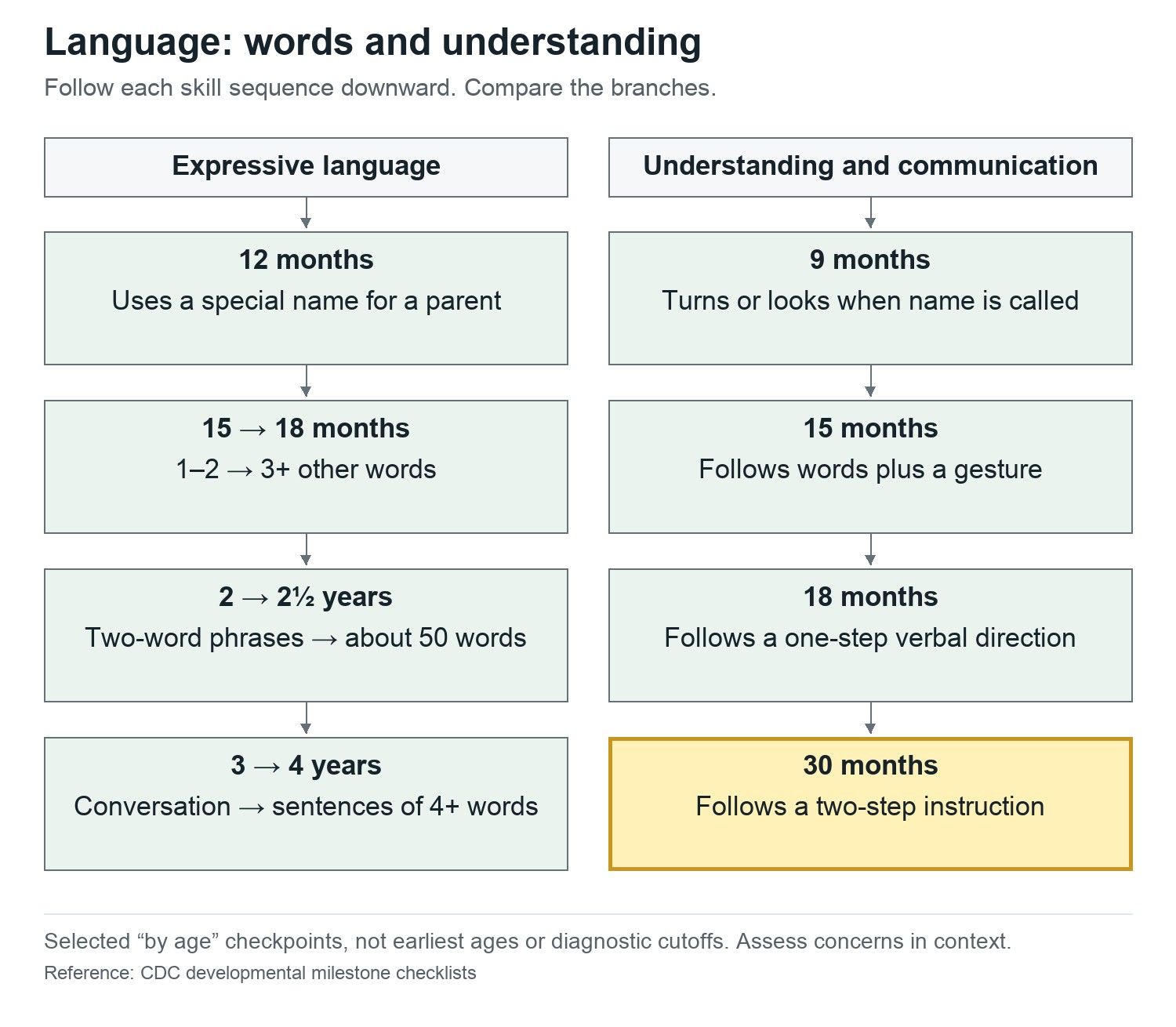
- 15 months: follows a direction given with words and a gesture.
- 18 months: follows a one-step direction with words alone.
- 30 months: follows a two-step instruction and a simple routine when told, such as helping clean up toys.
Social development and play
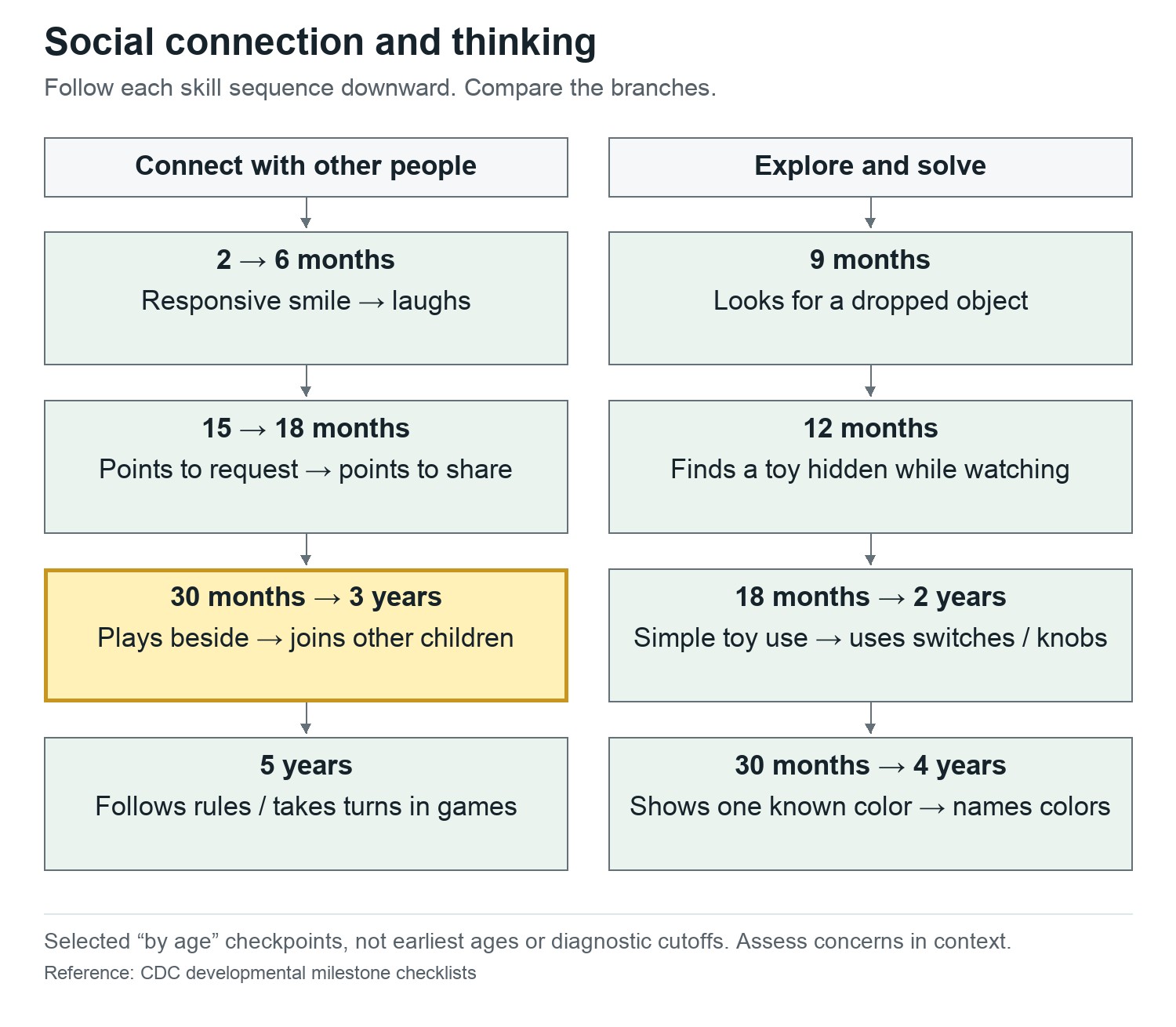
Parallel play is playing beside another child, not with them. Cooperative play has a shared activity or goal.
| Age | Most children by this age |
|---|---|
| 2 years | Notice when someone is hurt or upset; look at a parent's face to judge a new situation |
| 30 months | Play beside other children and sometimes with them (parallel play) |
| 3 years | Calm within about 10 minutes after a caregiver leaves at drop-off; notice other children and join them to play |
| 5 years | Follow rules or take turns in games; sing, dance or act for you; do simple chores such as matching socks or clearing the table |
When to act on a speech or social concern
- No meaningful words at 18 months: evaluate now; start with a formal hearing test and refer to early intervention at the same time.
- Any loss of words or social skills at any age needs prompt evaluation.
- Not pointing to share, not responding to name or poor eye contact: complete autism screening and refer.
- Milestones on the CDC checklists are skills at least 75% of children have by that age, so a missed milestone is a reason to act, not to wait.
- AAP: developmental surveillance at every well visit; standardized screening at 9, 18 and 30 months; autism screening at 18 and 24 months.
Common questions
How many words should an 18-month-old say?
On the CDC checklist most 18-month-olds try at least 3 words besides 'mama' and 'dada'. A toddler with no meaningful words at 18 months needs a hearing test and evaluation now.
When do toddlers start putting two words together?
By 2 years most children combine 2 words, such as 'more milk'. By 30 months they say about 50 words.
What is the difference between parallel and cooperative play?
Parallel play is playing beside another child without interacting, typical around 30 months. Cooperative play has a shared goal; by 3 years children join others, and by 5 years they follow rules and take turns.
Study this topic
Sources
- Zubler et al. 2022: Evidence-informed milestones for developmental surveillance tools (Pediatrics)
- CDC Learn the Signs. Act Early.: Milestones by age
- AAP 2020: Developmental surveillance and screening clinical report (Pediatrics)
Written for Pedemy in our own words from the sources above; checked November 2026. For education only, not medical advice; check doses and local protocols before treating a patient. Pedemy is independent and not affiliated with or endorsed by the organizations cited.