

Main decision tree
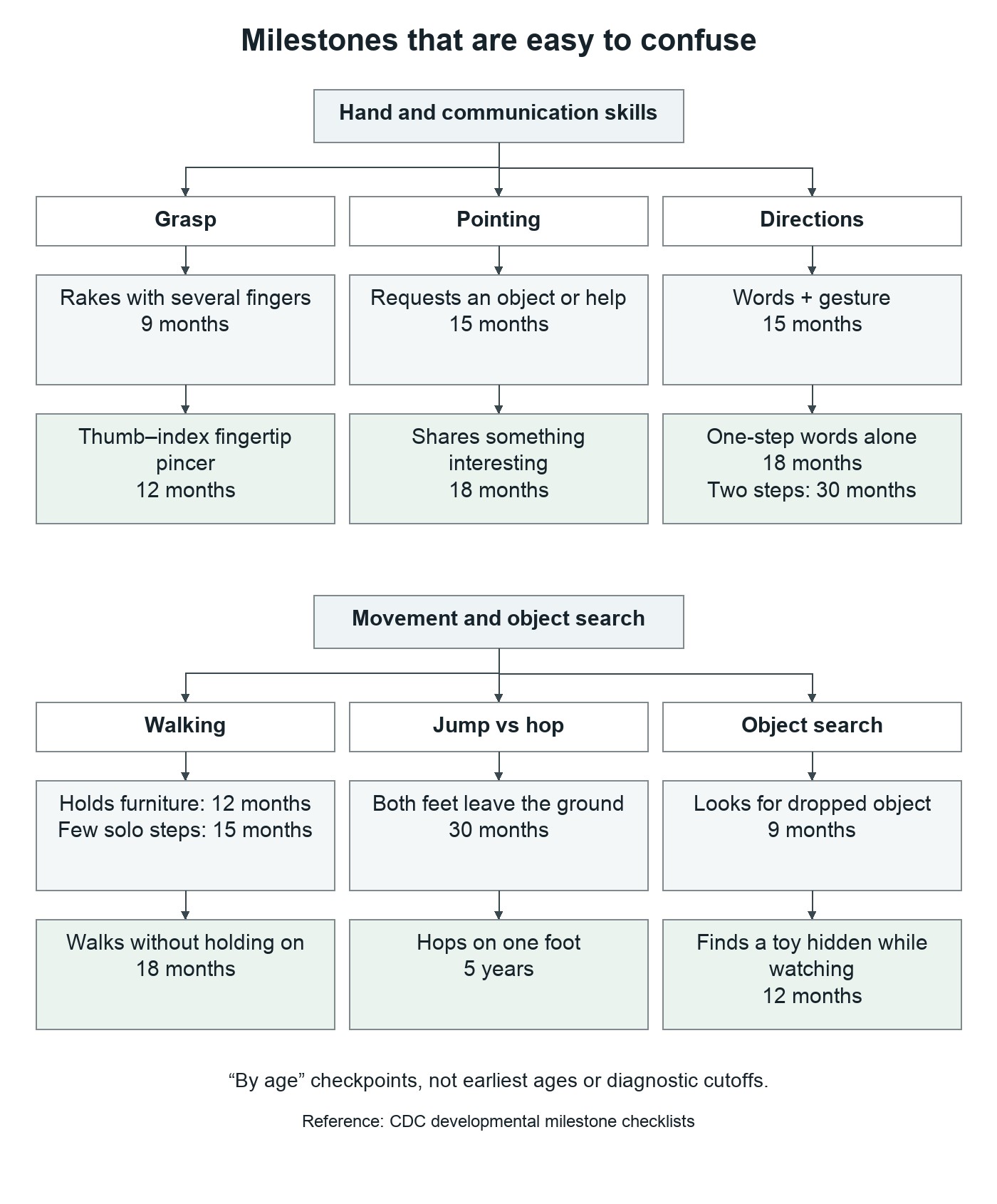
Milestones that are easy to confuse
Key points
- Four CDC domains: social-emotional, language/communication, cognitive (learning, thinking, problem-solving) and movement/physical.
- The domain with the missing skills is the delayed one; normal skills in other domains are the distractors.
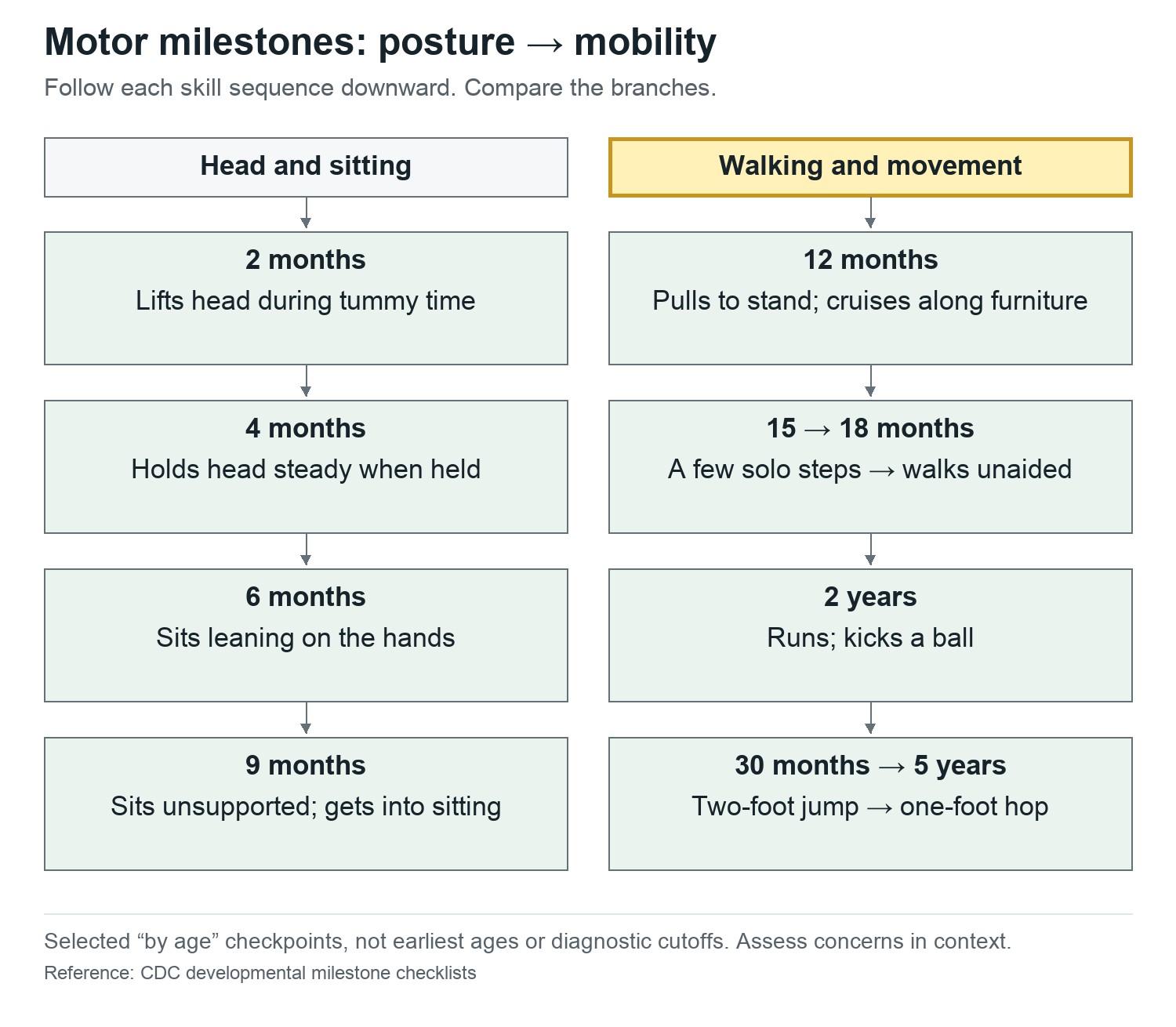
- 15 months: a few solo steps, 1–2 new words, shows liked toys, stacks 2 objects, finger-feeds.
- 30 months: jumps, turns single pages, about 50 words, uses 'me', follows 2-step directions, plays beside others.
- Pretend play, colors, counting and hidden-object search are cognitive skills; pointing to share is social.
- Any missed milestone → standardized screening or referral, not 'wait and see'.
How to read a milestone case
List each skill in the stem and place it in one domain. Then ask which domain holds all the missing skills. If every skill matches the age, the child is developing normally.
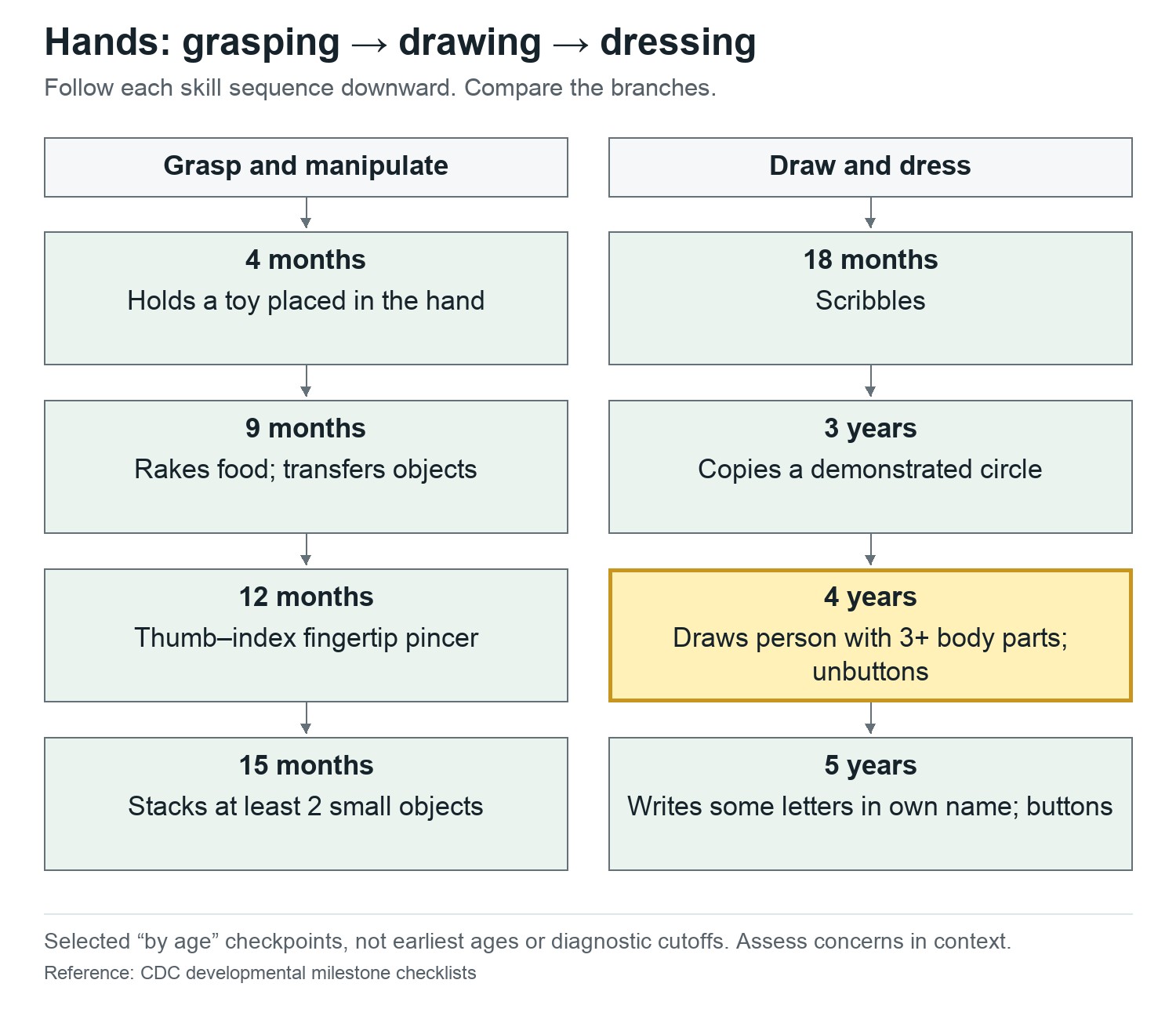
The tree pairs skills that are often mixed up: raking versus pincer grasp, pointing to request versus to share, directions with and without a gesture, cruising versus walking, jumping versus hopping, and the two steps of object search.
| Domain | Typical skills tested |
|---|---|
| Movement/physical | Head control, sitting, walking, running, stairs, grasp, drawing, buttons, fork and spoon |
| Language/communication | Sounds, babble, words, phrases, following directions, conversation, rhymes |
| Social-emotional | Smiling, stranger wariness, showing and sharing, empathy, play with others, routines |
| Cognitive | Mouthing and reaching, object search, functional toy use, pretend play, colors, counting, letters, attention span |
2 to 6 months
| Case | Delayed domain |
|---|---|
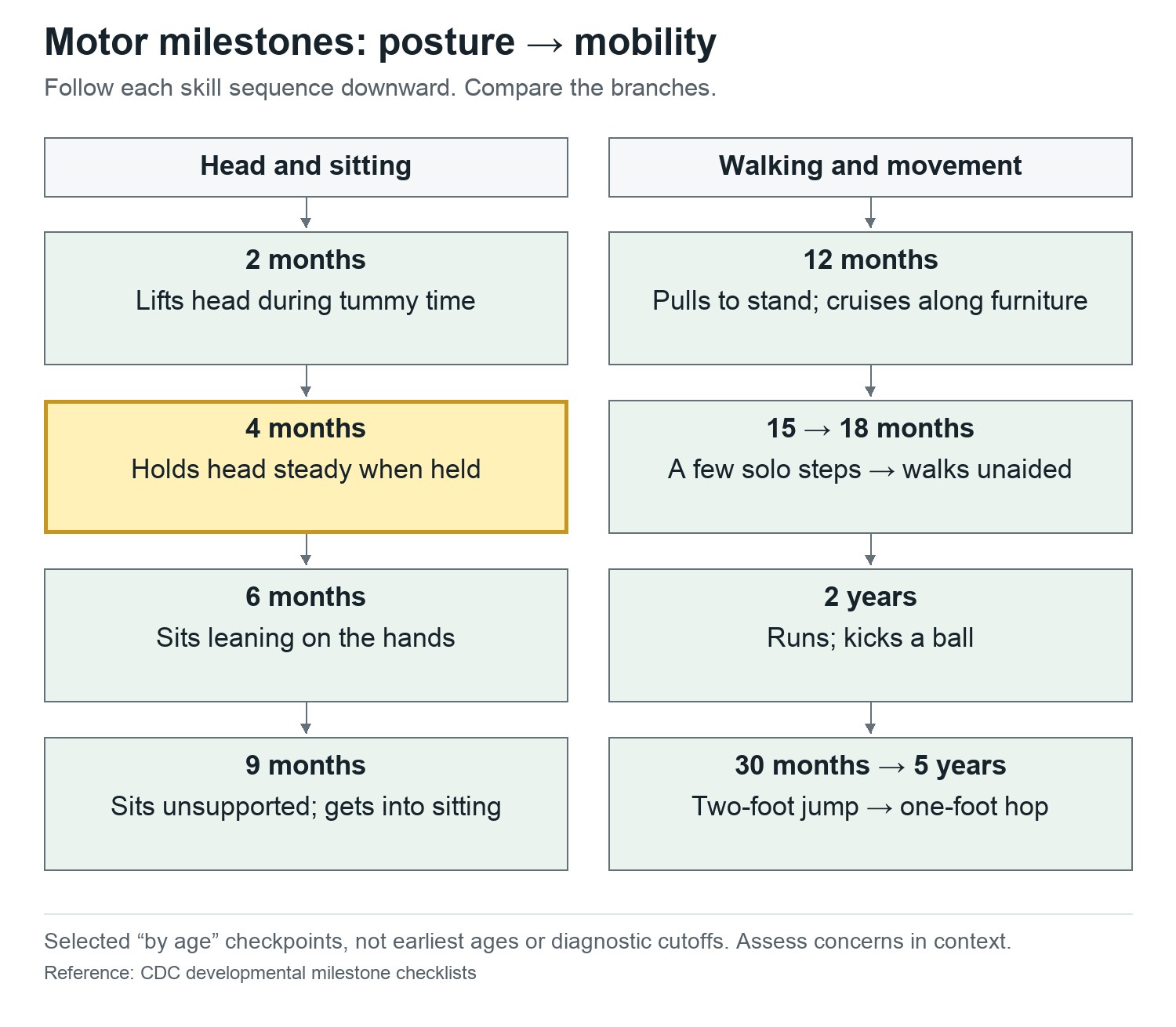
| 2 months: smiles back, coos, watches you; cannot lift head on tummy, hands always fisted | Movement/physical |
| 4 months: smiles, coos, looks at her hands; head lag, cannot hold a toy | Movement/physical |
| 4 months: steady head, pushes up, coos; does not smile on his own or chuckle | Social-emotional |
| 6 months: laughs, squeals, rolls; does not reach for toys or mouth objects | Cognitive |
| 6 months: rolls, reaches, mouths toys, laughs; no squeals, raspberries or turn-taking sounds | Language/communication |
9 and 12 months
| Case | Delayed domain |
|---|---|
| 9 months: babbles, lifts arms to be picked up, shy; cannot sit unsupported or pass a toy hand to hand | Movement/physical |
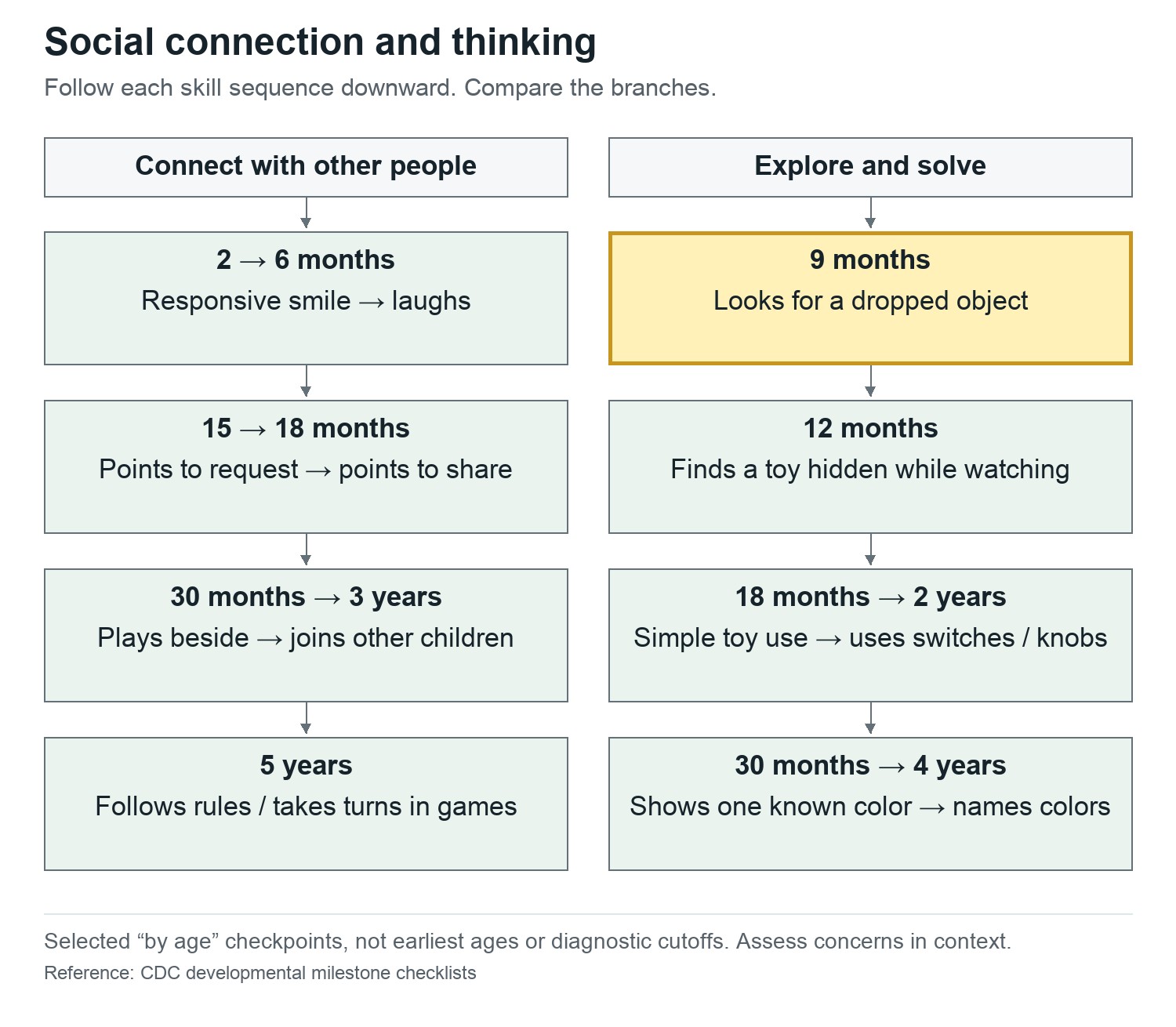
| 9 months: sits, transfers, babbles, laughs; does not bang 2 objects or look for a dropped toy | Cognitive |
| 9 months: sits, transfers, babbles, bangs blocks; no stranger wariness, few expressions, does not look when called | Social-emotional |
| 12 months: cruises, pincer grasp, waves, says 'dada'; does not find a hidden toy or put a block in a cup | Cognitive |
| 12 months: cruises, pincer grasp, finds hidden toys; does not wave, say mama/dada or respond to 'no' | Language/communication |
15 and 18 months
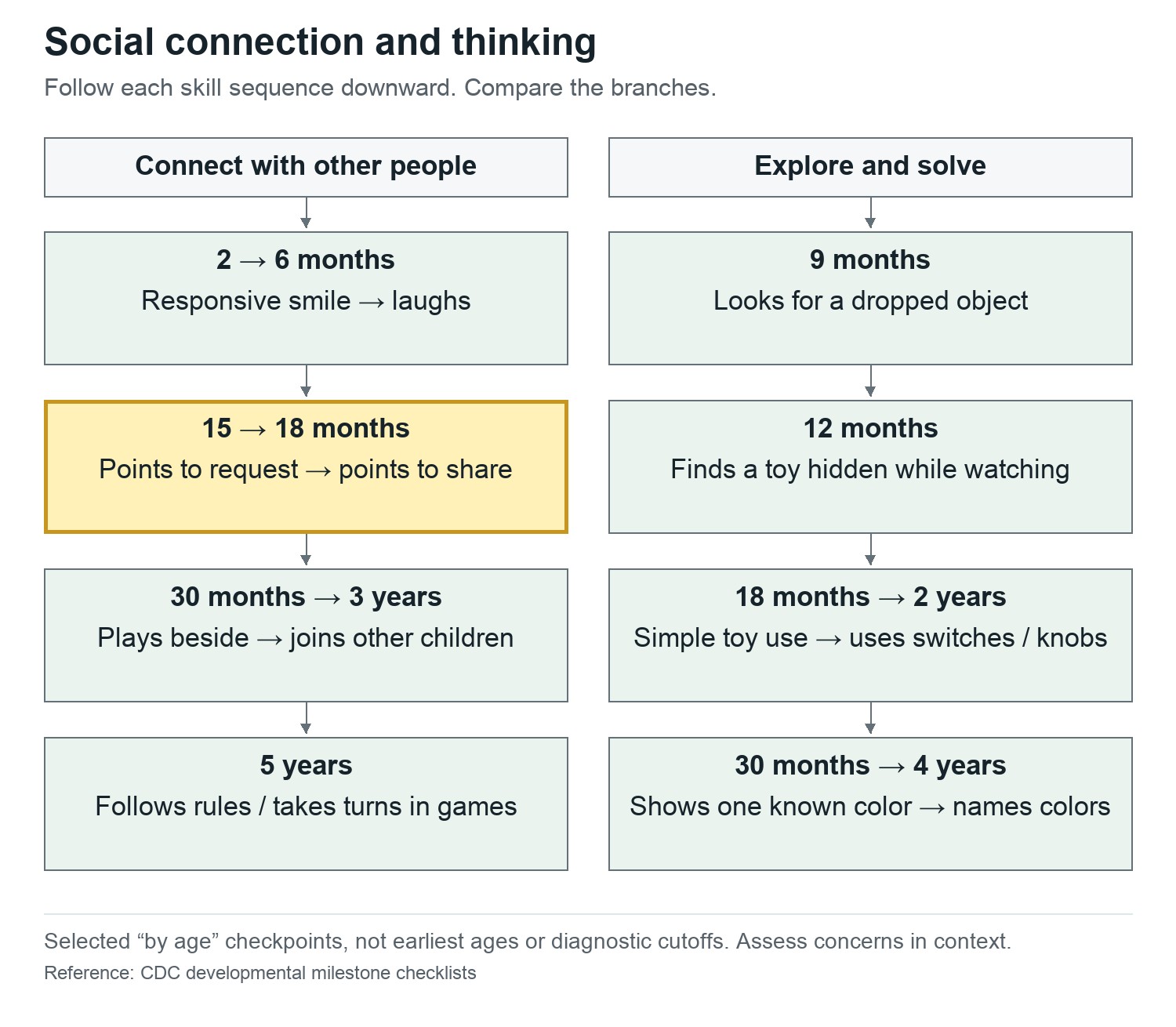
Expected at 15 months: a few steps alone, 1–2 words besides mama/dada, looks at a familiar object when you name it, shows you a liked object, hugs a toy, claps when excited, stacks 2 objects and feeds self with fingers.
| Case | Delayed domain |
|---|---|
| 15 months: says 2 words, points, hugs a doll, stacks 2 blocks; takes no steps alone | Movement/physical |
| 15 months: walks, stacks blocks, claps; no words but 'mama', no pointing, cannot follow a direction | Language/communication |
| 18 months: walks, says 3 words, points to show; does not copy chores or play with toys functionally | Cognitive |
| 18 months: walks, scribbles, copies sweeping, points; says only 'mama', cannot follow a 1-step command without a gesture | Language/communication |
| 18 months: walks, says 4 words, follows commands; does not point to show, share a book or check where you are | Social-emotional |
2 years and 30 months
| Case | Delayed domain |
|---|---|
| 2 years: says 'more milk', points to body parts; cannot run, kick a ball or walk up stairs | Movement/physical |
| 2 years: runs, kicks, uses 2-word phrases; does not notice others are hurt or check a parent's face | Social-emotional |
| 30 months: jumps, uses 'I' and 'me'; no pretend play, cannot follow 2-step directions | Cognitive |
| 30 months: jumps, about 50 words, follows 2-step directions; does not play near others or follow routines | Social-emotional |
| 30 months: jumps, turns single pages, about 50 words, uses 'me', 2-step directions, plays beside others | None: age appropriate |
3 to 5 years
| Case | Delayed domain |
|---|---|
| 3 years: asks 'why?', says his name, draws a circle; cannot use a fork, string beads or put on clothes | Movement/physical |
| 3 years: converses, uses a fork, joins other children; cannot copy a circle or avoid hot objects when warned | Cognitive |
| 3 years: uses a fork, dresses, draws a circle; single words only, no questions, strangers cannot understand | Language/communication |
| 4 years: sentences, names colors, pretends; cannot catch a ball, unbutton, or hold a crayon except in a fist | Movement/physical |
| 4 years: catches a ball, unbuttons, comforts friends; cannot name colors, draw a 3-part person or tell what comes next | Cognitive |
| 4 years: catches, unbuttons, talks, draws a person; does not comfort others, pretend or ask to play | Social-emotional |
| 5 years: hops, tells stories, rhymes; cannot count to 10, name letters or focus for 5 minutes | Cognitive |
| 5 years: hops, buttons, counts to 10; cannot tell a 2-event story, keep a conversation going or rhyme | Language/communication |
What to do after finding a delay
- Milestones on the CDC checklists are skills at least 75% of children have by that age, so a missed milestone is a reason to act, not to wait.
- Missing a milestone, losing a skill, or a parent concern at any visit → standardized developmental screening or direct referral.
- AAP: developmental surveillance at every well visit; standardized screening at 9, 18 and 30 months; autism screening at 18 and 24 months.
- Language delay: formal hearing test first, with early intervention referral at the same time.
- Motor delay: examine tone, strength, reflexes and symmetry; consider a neurology referral.
- Children under 3 years go to early intervention; children 3 and older go to the school district for evaluation.
Common questions
What are the four developmental domains on the CDC checklists?
Social-emotional, language/communication, cognitive (learning, thinking, problem-solving) and movement/physical development.
What milestones are expected at 15 months?
Most 15-month-olds take a few steps alone, say 1–2 words besides mama/dada, point to ask for things, show you a toy they like, stack 2 small objects and feed themselves with their fingers.
Study this topic
Sources
- Zubler et al. 2022: Evidence-informed milestones for developmental surveillance tools (Pediatrics)
- CDC Learn the Signs. Act Early.: Milestones by age
- AAP 2020: Developmental surveillance and screening clinical report (Pediatrics)
Written for Pedemy in our own words from the sources above; checked November 2026. For education only, not medical advice; check doses and local protocols before treating a patient. Pedemy is independent and not affiliated with or endorsed by the organizations cited.