

Main decision tree
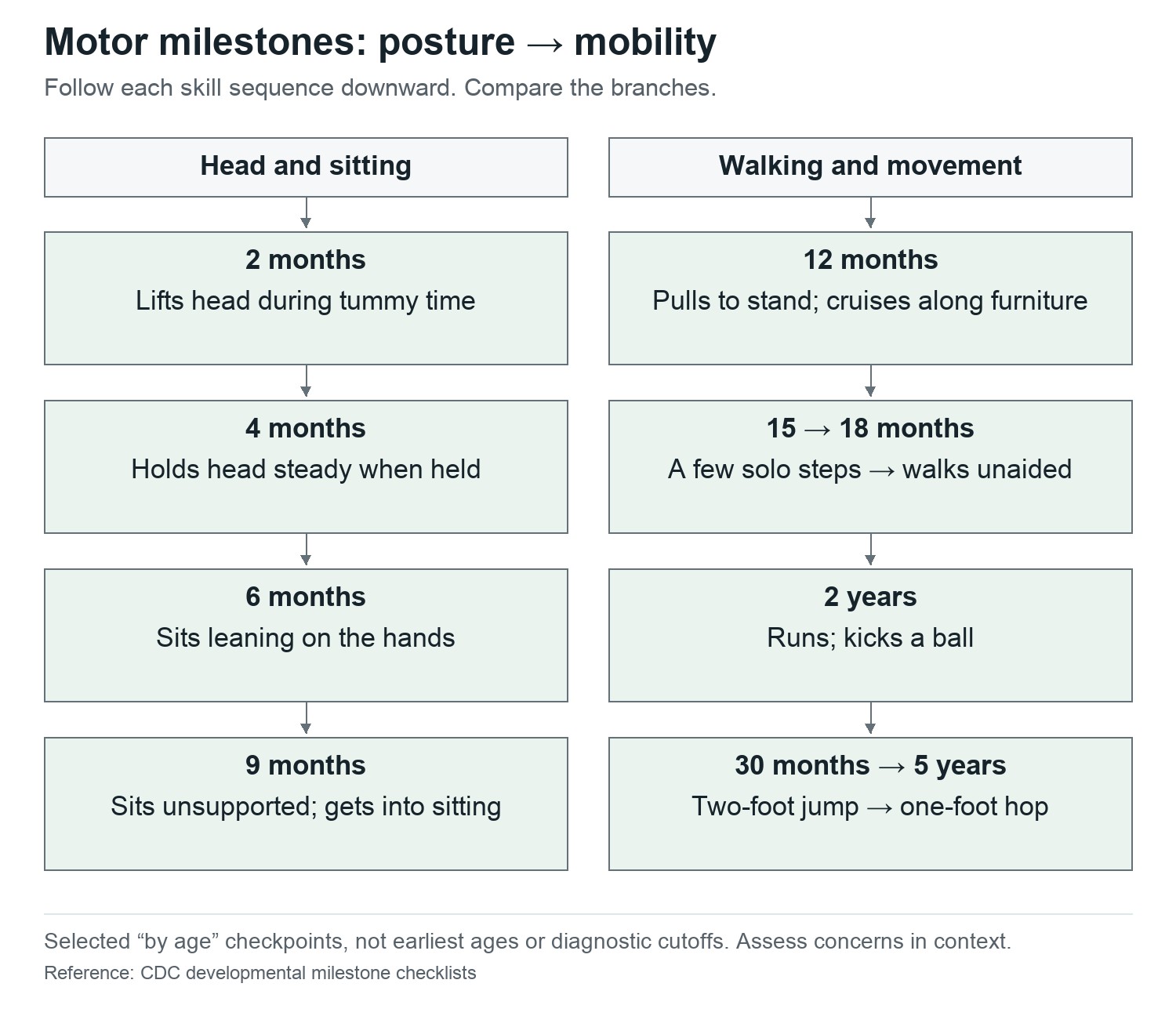
Motor milestones: posture to mobility
Key points
- Head: up on tummy at 2 months, steady when held at 4 months; head lag at 4 months needs assessment.
- Sitting: leans on hands at 6 months, sits without support and gets into sitting at 9 months.
- Walking: cruises at 12 months, a few steps alone at 15 months, walks without holding on at 18 months.
- 2 years: runs and kicks a ball; 30 months: jumps with both feet; 5 years: hops on one foot.
- Hand: rakes at 9 months, pincer at 12 months, copies a circle at 3 years, draws a 3-part person at 4 years.
- Moro and palmar grasp fade by 5–6 months; plantar grasp by 9–12 months; an upgoing toe can be normal to 2 years.
- Parachute response appears at 8–9 months and lasts for life.
Gross motor: from head control to hopping
The tree follows two lines: head control and sitting in the first year, then walking and movement into the preschool years. Each box is a CDC checkpoint that at least 75% of children have reached by that age.
| Age | Most children by this age |
|---|---|
| 2 months | Hold the head up on the tummy; move both arms and both legs |
| 4 months | Hold the head steady without support when held; push up onto elbows or forearms on the tummy |
| 6 months | Roll from tummy to back; push up with straight arms on the tummy; lean on the hands when sitting |
| 9 months | Get into a sitting position alone; sit without support |
| 12 months | Pull up to stand; walk holding on to furniture (cruise) |
| 15 months | Take a few steps alone |
| 18 months | Walk without holding on; climb onto and off a couch or chair without help |
| 2 years | Run; kick a ball; walk up a few stairs with or without help |
| 30 months | Jump so both feet leave the ground |
| 4 years | Catch a large ball most of the time |
| 5 years | Hop on one foot |
Head control and sitting
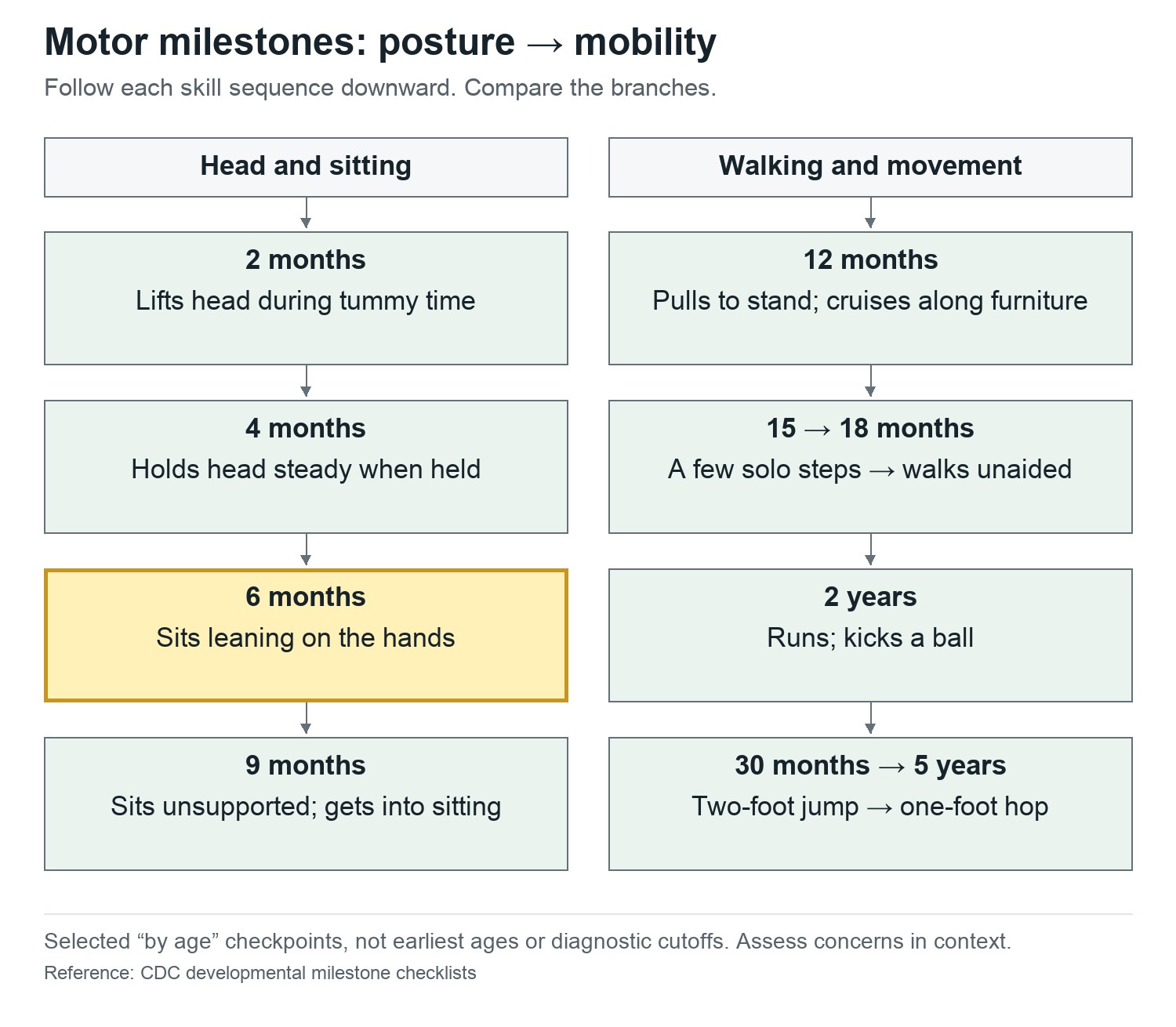
- Sitting follows a sequence: sits leaning on the hands by 6 months, sits without support by 9 months.
- Persistent head lag or poor head control at 4 months needs a neurologic and developmental assessment.
- Check that both arms and both legs move: asymmetry suggests a neurologic problem such as a brachial plexus injury or hemiparesis.
Walking, running and jumping
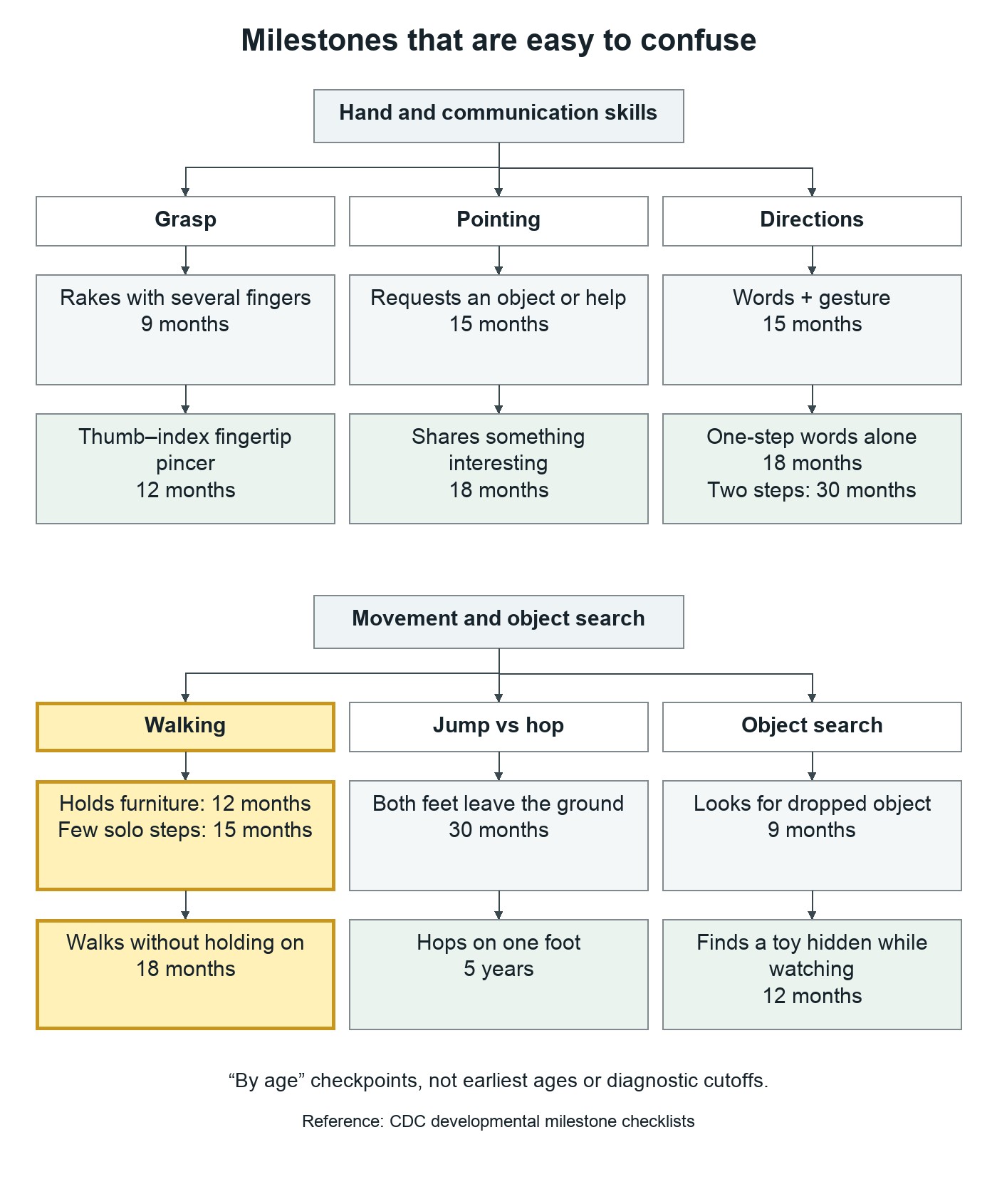
- Walking sequence: pulls up and cruises by 12 months, a few steps alone by 15 months, walks without holding on by 18 months.
- A 15-month-old who takes no independent steps needs a developmental evaluation.
- Jumping with both feet (30 months) is not hopping: hopping on one foot is a 5-year skill.
Fine motor: grasp to pincer
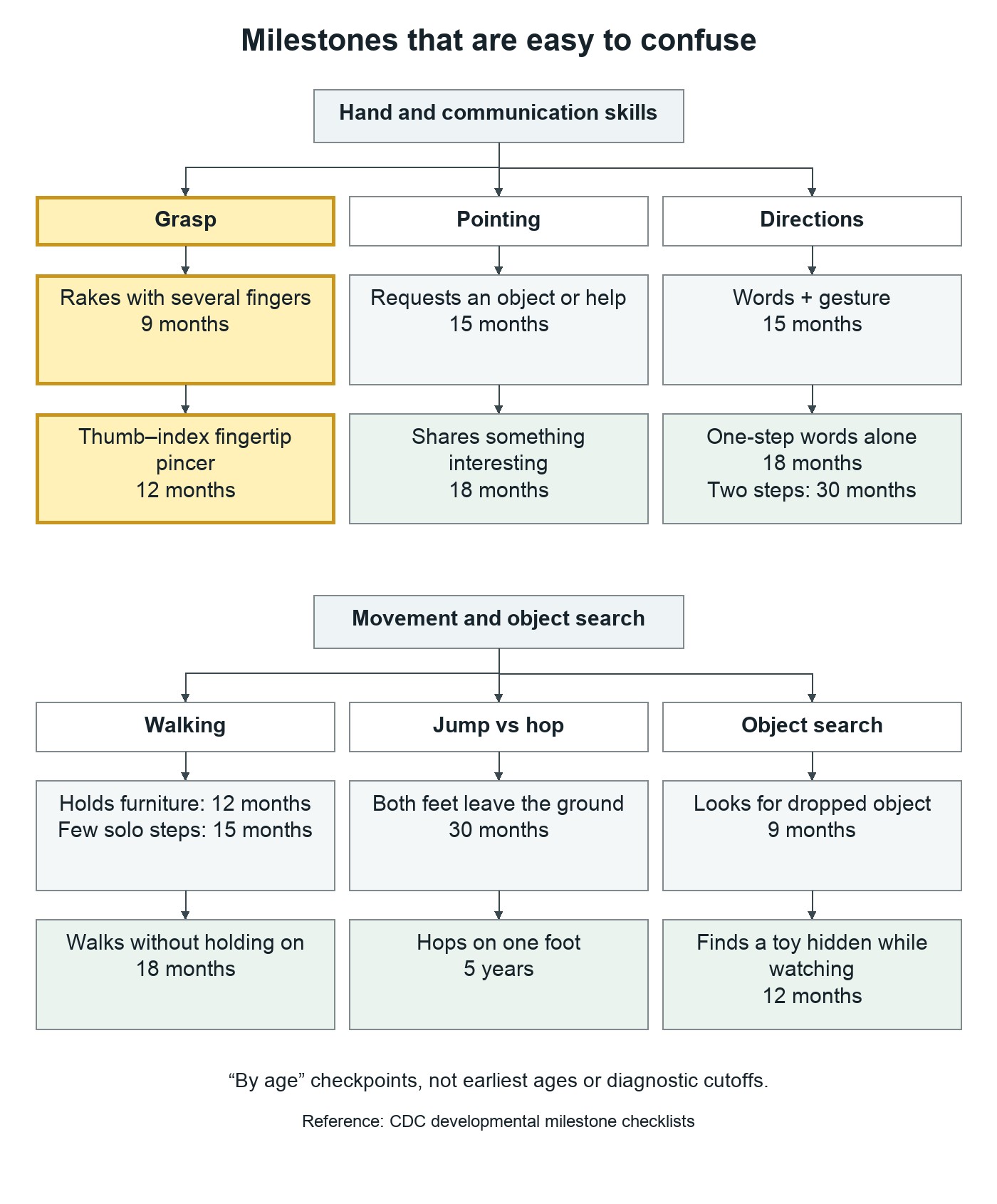
The pincer grasp brings a new safety risk: choking on small objects and food pieces.
A strong hand preference before about 12 months is a warning sign: it may mean weakness of the other arm.
| Age | Most children by this age |
|---|---|
| 2 months | Open the hands briefly |
| 4 months | Hold a toy placed in the hand; swing an arm at toys; bring hands to the mouth |
| 9 months | Move an object from one hand to the other; rake food toward themselves with the fingers |
| 12 months | Pincer grasp: pick up a small object between the thumb and index fingertip |
| 15 months | Stack at least 2 small objects; feed themselves with the fingers |
Drawing, dressing and self-feeding
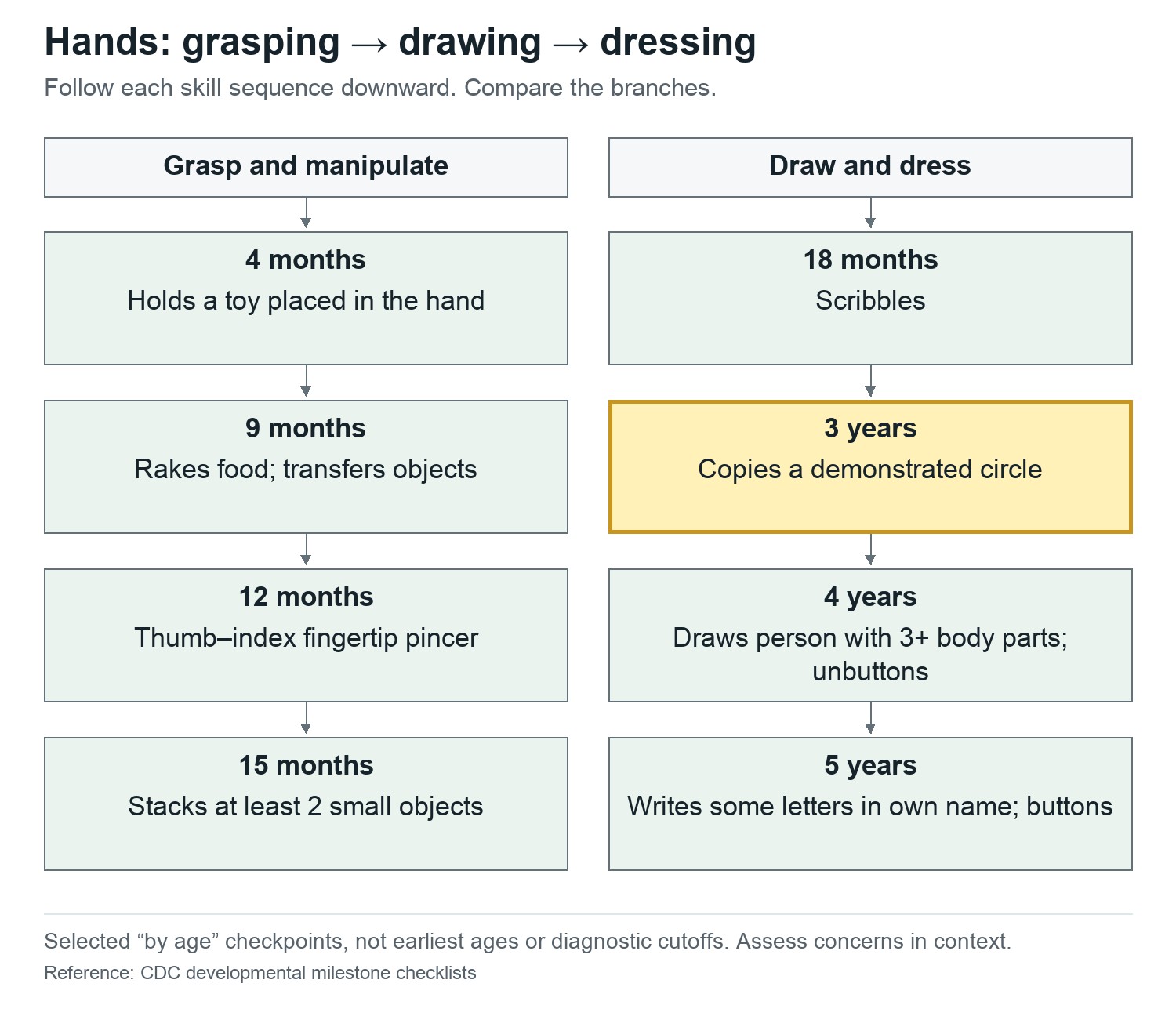
| Age | Drawing and dressing | Feeding |
|---|---|---|
| 12 months | Drinks from an open cup an adult holds | |
| 18 months | Scribbles | Drinks from an open cup alone, with some spills; tries to use a spoon |
| 2 years | Eats with a spoon | |
| 30 months | Turns book pages one at a time; takes off some loose clothing; twists lids and doorknobs | |
| 3 years | Copies a circle when shown; strings large beads; puts on some loose clothing | Uses a fork |
| 4 years | Draws a person with 3 or more body parts; holds a crayon with the fingers, not a fist; unbuttons some buttons | Serves food or pours water with supervision |
| 5 years | Writes some letters of their name; fastens some buttons |
Primitive reflexes and when they fade
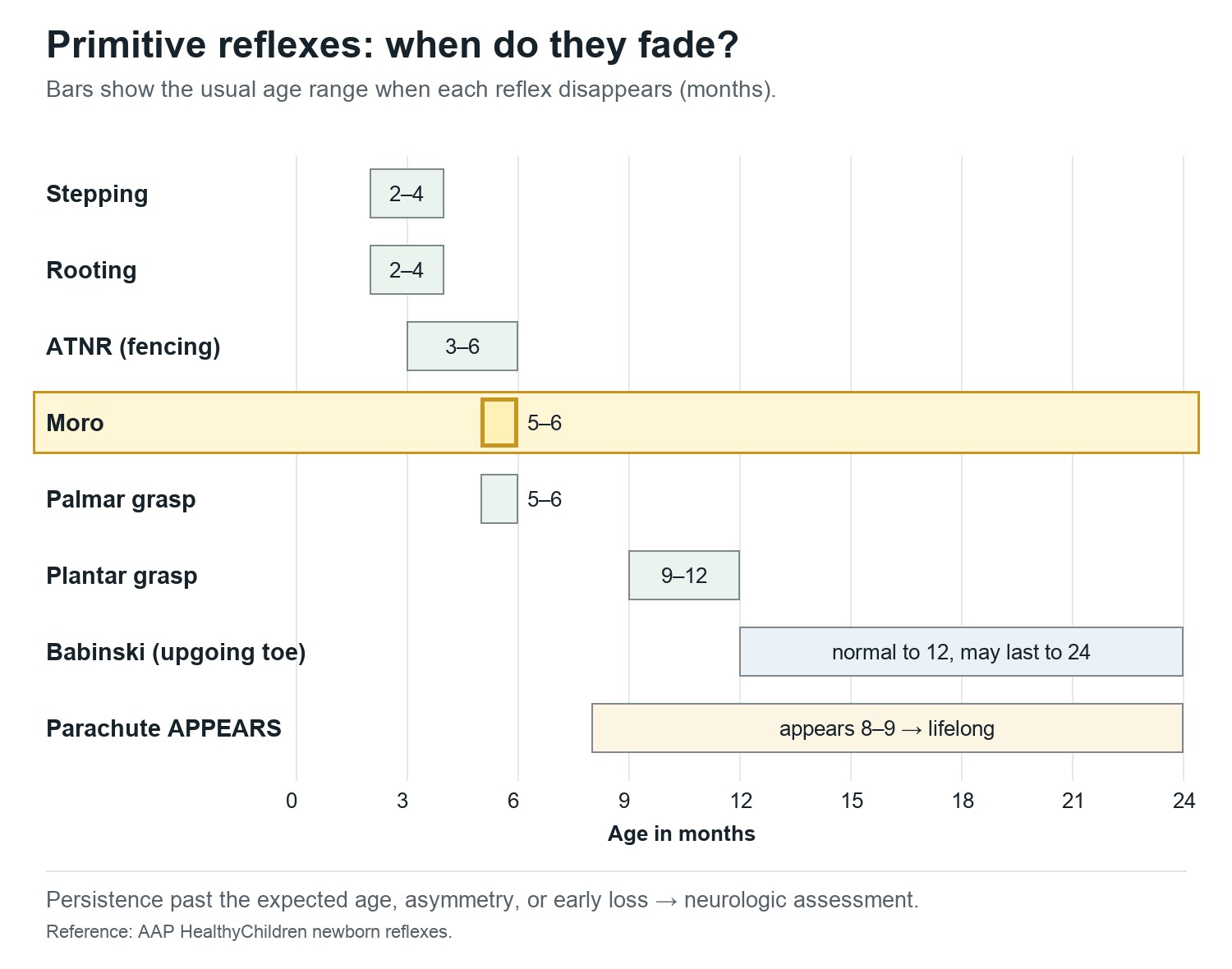
The graph shows the usual age each reflex disappears. Reflexes fade as the cortex matures and voluntary movement takes over.
- A 6-month-old has lost rooting, stepping and ATNR, with only a faint Moro and palmar grasp; both should be gone by 9 months.
- Plantar grasp outlasts Moro and palmar grasp.
- A healthy 1-year-old still shows the parachute response, not the Moro.
| Reflex | How it looks | Usually gone by |
|---|---|---|
| Stepping | Held upright with feet on a surface, the baby makes alternating steps | 2–4 months |
| Rooting | Stroke the cheek or mouth corner; the head turns toward it | About 4 months |
| ATNR (fencing) | Turn the head: the arm on the face side extends, the other arm flexes | 3–6 months |
| Moro | Sudden loss of support: arms open and extend, then come inward | 5–6 months |
| Palmar grasp | Object in the palm: fingers flex around it | 5–6 months |
| Plantar grasp | Pressure under the toes: toes curl down | 9–12 months |
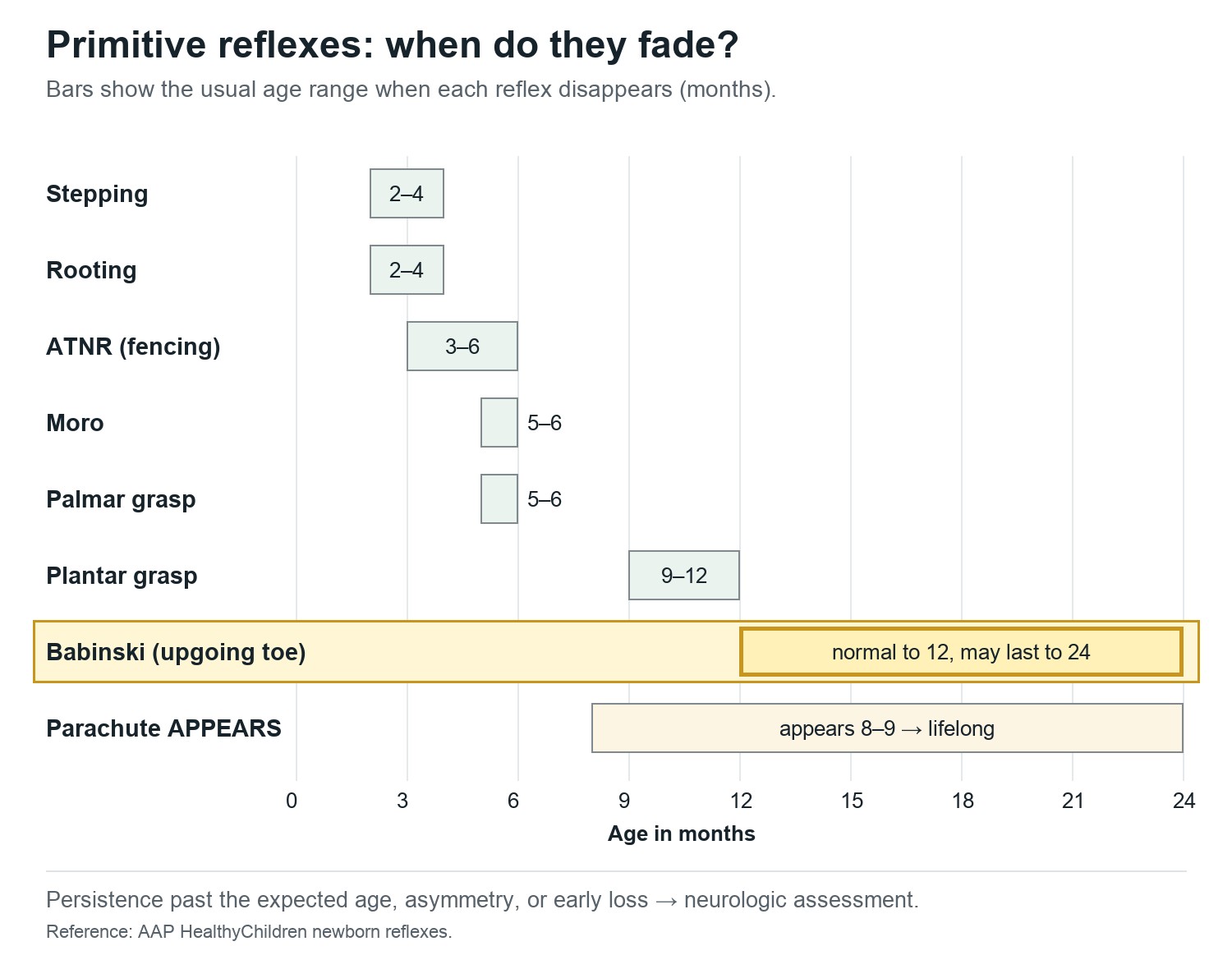
| Babinski | Stroke the outer sole: great toe extends, other toes fan | Normal to 12 months; may last to 24 months |
| Parachute | Tilted forward toward a surface: arms extend to catch | Appears at 8–9 months; lasts for life |
Reflex red flags
- A brief fencing posture in a normal 4-week-old is a normal ATNR: reassure.
- An obligatory ATNR (the baby cannot move out of it), or one present at any age beyond 6 months, needs evaluation.
- A clearly persistent Moro beyond 6 months needs a neurologic and developmental assessment, as in cerebral palsy.
- An asymmetric Moro suggests a brachial plexus injury or clavicle fracture.
- An upgoing plantar response is normal in a 9-month-old; after age 2 years it points to an upper motor neuron lesion.
- Early loss of a reflex or a missing parachute response after 9–10 months also needs assessment.
Common questions
When does the Moro reflex go away?
Usually by 5–6 months. A clearly persistent Moro after 6 months, or one that is asymmetric, needs a neurologic assessment.
Is a positive Babinski normal in babies?
Yes. An upgoing great toe is normal through the first year and can persist up to 2 years.
When should a baby walk?
On the CDC checklists most children take a few steps alone by 15 months and walk without holding on by 18 months. A child with no independent steps at 15 months needs evaluation.
Study this topic
Sources
- Zubler et al. 2022: Evidence-informed milestones for developmental surveillance tools (Pediatrics)
- CDC Learn the Signs. Act Early.: Milestones by age
- AAP HealthyChildren.org: Newborn reflexes
- AAP 2020: Developmental surveillance and screening clinical report (Pediatrics)
Written for Pedemy in our own words from the sources above; checked November 2026. For education only, not medical advice; check doses and local protocols before treating a patient. Pedemy is independent and not affiliated with or endorsed by the organizations cited.