

Main decision tree
School support: which plan?
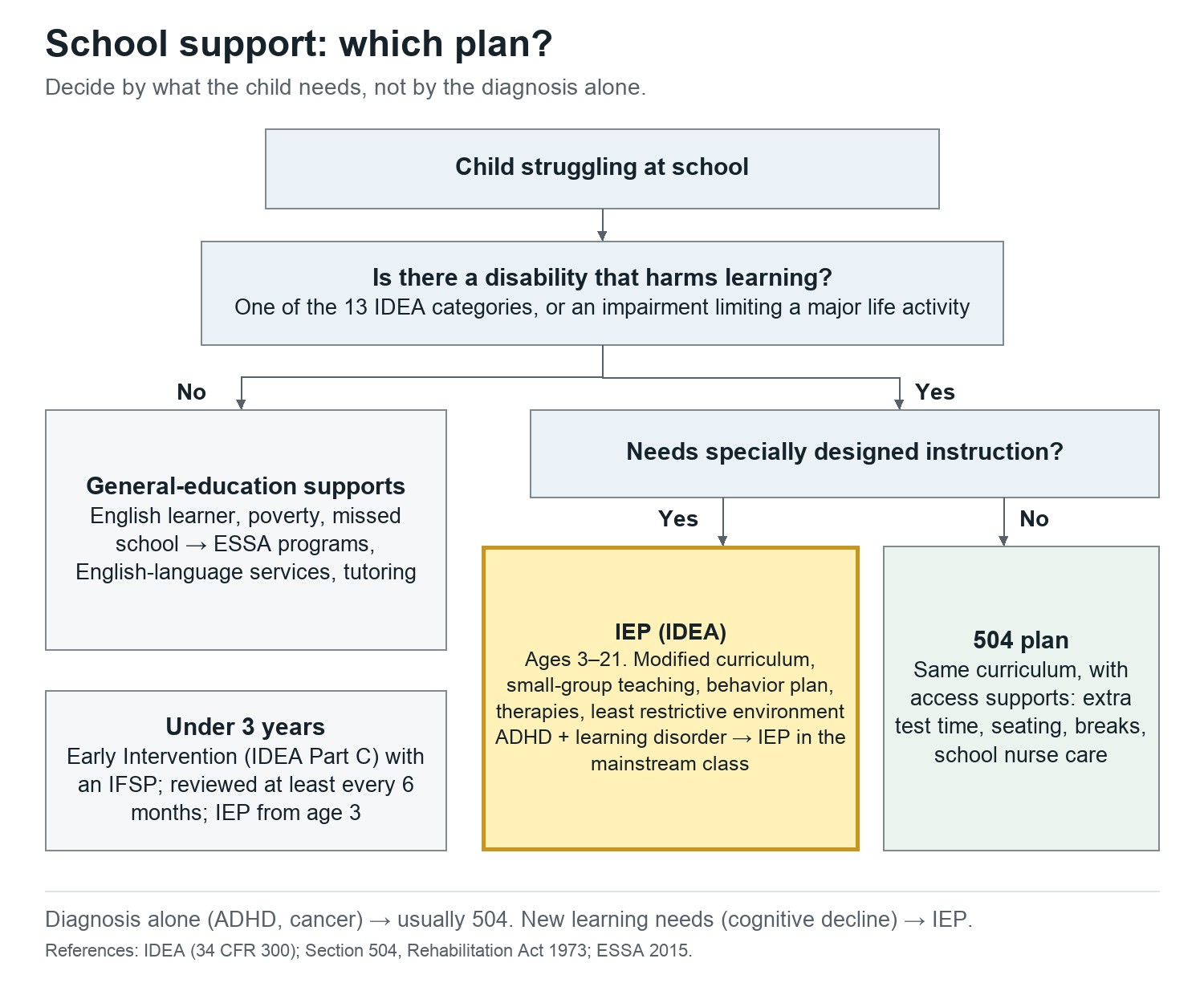
Key points
- IEP under IDEA Part B (ages 3–21): needs a qualifying disability AND a need for specially designed instruction.
- 504 plan (Section 504, Rehabilitation Act 1973): an impairment that limits a major life activity; same curriculum with access supports.
- Under 3 years: Early Intervention (IDEA Part C) with an IFSP, reviewed at least every 6 months.
- At age 3 the IFSP is replaced by an IEP under IDEA Part B.
- ADHD or leukemia can qualify for an IEP under 'other health impairment' when special instruction is needed.
- Limited English alone is not a disability: support comes through general education under ESSA.
- Students with disabilities are taught in the least restrictive environment, usually the general classroom with supports.
IEP: special education under IDEA
The Individuals with Disabilities Education Act (IDEA) gives children with disabilities a free appropriate public education. Part B covers ages 3 through 21 and is delivered through the individualized education program (IEP).
Two conditions are both needed: a disability in one of the 13 IDEA categories, and a need for specially designed instruction because of it.
- IEP services: modified curriculum, small-group teaching, a behavior plan, therapies, in the least restrictive environment.
- A diagnosed learning disorder that needs specially designed teaching → IEP.
- ADHD plus a learning disorder → IEP, usually in the mainstream class.
- ADHD or cancer can qualify under 'other health impairment' when the child needs special instruction.
- New learning needs, such as cognitive decline after cancer treatment → evaluate for an IEP.
- For intellectual disability, IEP goals include adaptive, school and community skills, not only academics.
504 plan: access supports without special teaching
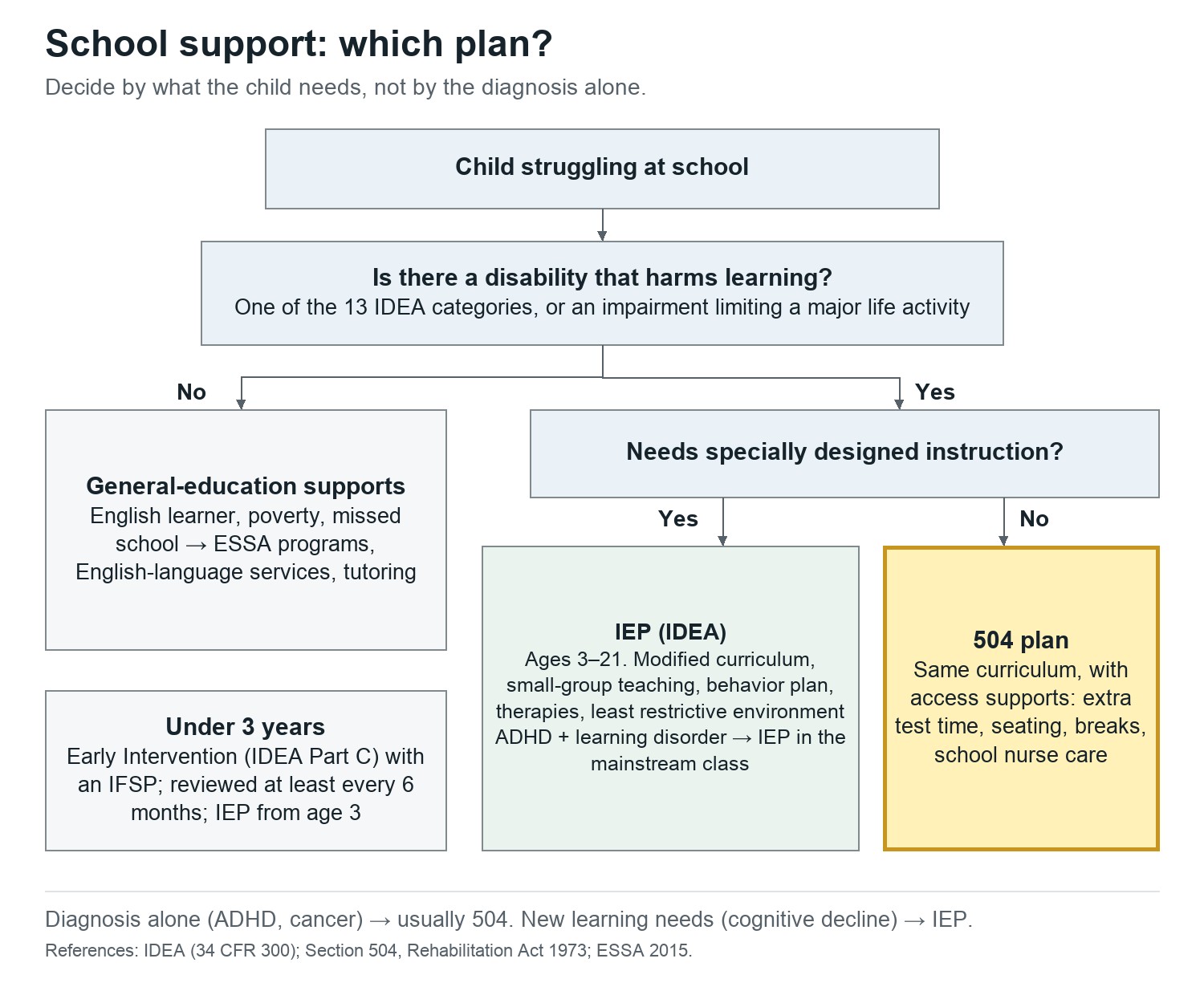
Section 504 of the Rehabilitation Act of 1973 protects any student with a physical or mental impairment that substantially limits a major life activity. The child stays in the same curriculum and gets accommodations so that he can take part.
- Typical supports: extra test time, preferential seating, breaks, medication or care from the school nurse.
- ADHD that slows task completion: extra time on tests.
- A diagnosis such as ADHD or cancer with only access needs → usually a 504 plan.
- Needing school nursing care does not by itself mean a child needs an IEP.
General-education supports: no disability
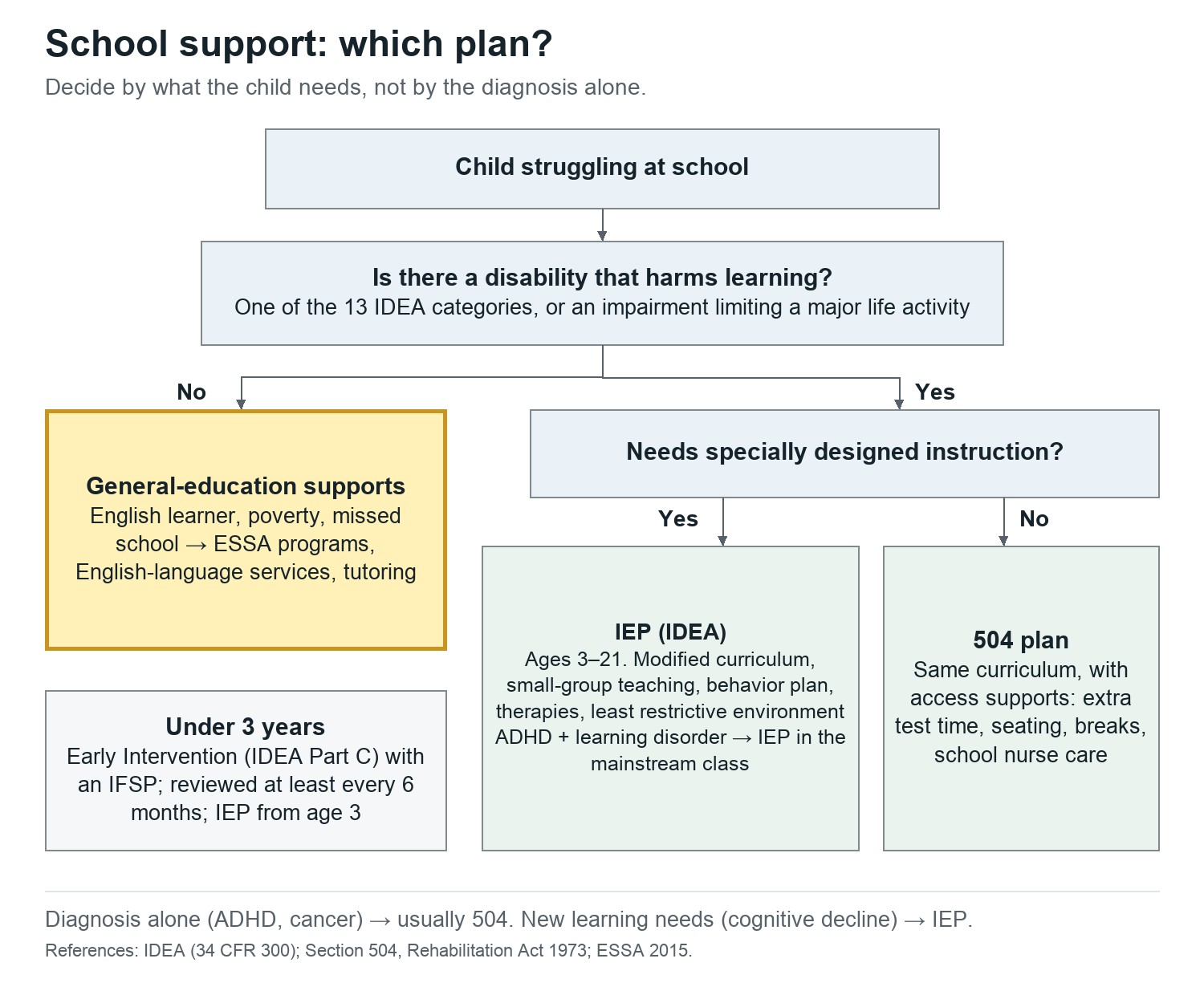
When there is no disability that harms learning, help comes from general education. English learners, children in poverty and children who have missed school get ESSA programs, English-language services and tutoring.
- The Every Student Succeeds Act (ESSA, 2015) replaced No Child Left Behind.
- A recent immigrant behind in class only because of English → ESSA English-language support, not special education.
- Limited English proficiency alone does not establish an IDEA disability.
- A gifted child who is bored with grade-level work: acceleration or advanced, appropriately leveled instruction.
Early Intervention under 3 years (IDEA Part C)
Children from birth to 3 years with a delay or a condition likely to cause one get Early Intervention under IDEA Part C. Services are written into an individualized family service plan (IFSP) and are often given at home or in child care.
- The IFSP is reviewed at least every 6 months.
- A 30-month-old in Early Intervention still has an IFSP; from age 3 the school district takes over with an IEP under Part B.
- Children living in poverty and children from minoritized groups face the greatest barriers to Early Intervention, so refer early and help families follow through.
Children with blindness or low vision
- The school team includes a teacher of students with visual impairments and an orientation and mobility specialist.
- Classroom adaptations: large print, screen readers and oral responses.
- A separate classroom is not the default; the least restrictive environment usually means the general classroom with supports.
Other school documents
| Document | Who it is for |
|---|---|
| Individualized family service plan (IFSP) | Child under 3 years in Early Intervention |
| Individualized education program (IEP) | Child 3–21 years who needs specially designed instruction |
| 504 plan | Impairment limiting a major life activity; access supports only |
| Individual health plan | Student whose medical needs are managed by school staff |
| Transition plan (part of the IEP) | Teen in special education preparing to move to adult services, work or further education |
Common questions
What is the difference between an IEP and a 504 plan?
An IEP (IDEA) gives specially designed instruction to a child with a qualifying disability. A 504 plan keeps the same curriculum and adds access supports, such as extra test time or seating, for an impairment that limits a major life activity.
Does ADHD qualify for an IEP?
It can, under 'other health impairment', when ADHD harms learning and the child needs special instruction. If the child needs only accommodations, a 504 plan fits.
What happens to Early Intervention at age 3?
The IFSP under IDEA Part C ends, and the school district evaluates the child for an IEP under IDEA Part B.
Study this topic
Sources
- AAP 2015: The Individuals with Disabilities Education Act for children with special educational needs (Pediatrics)
- AAP 2013: Early intervention, IDEA Part C services and the medical home (Pediatrics)
- US Department of Education: Individuals with Disabilities Education Act
Written for Pedemy in our own words from the sources above; checked November 2026. For education only, not medical advice; check doses and local protocols before treating a patient. Pedemy is independent and not affiliated with or endorsed by the organizations cited.