

Main decision tree
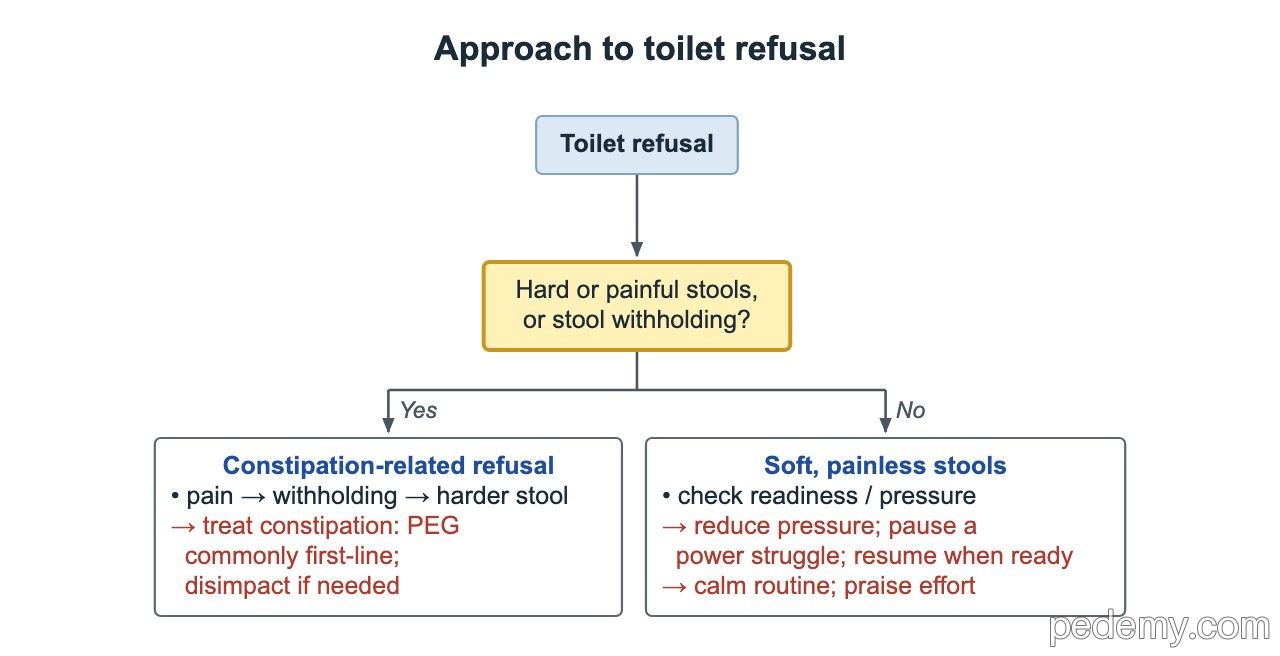
Approach to toilet refusal
Key points
- Many children gain daytime bladder control by about 3–4 years.
- Nighttime dryness comes after daytime control; bedwetting is not called enuresis before 5 years.
- Hard or painful stools with withholding point to constipation-related refusal, not a simple power struggle.
- Pain → withholding → harder stool keeps the cycle going; PEG is first-line, and fiber and fluids alone are not enough.
- Restart toilet training after 2–4 weeks of soft, painless stools.
- Power struggle with soft stools: pause training for a few months (often 2–3) with no reminders.
- A bedwetting alarm is not routine care for a toddler; active enuresis treatment starts from about 6 years.
Toilet refusal: start with the stools
The first question in a toddler who refuses the toilet is whether stools are hard or painful, or whether he holds them back. That one finding separates constipation-related refusal from a training power struggle.
Constipation-related refusal
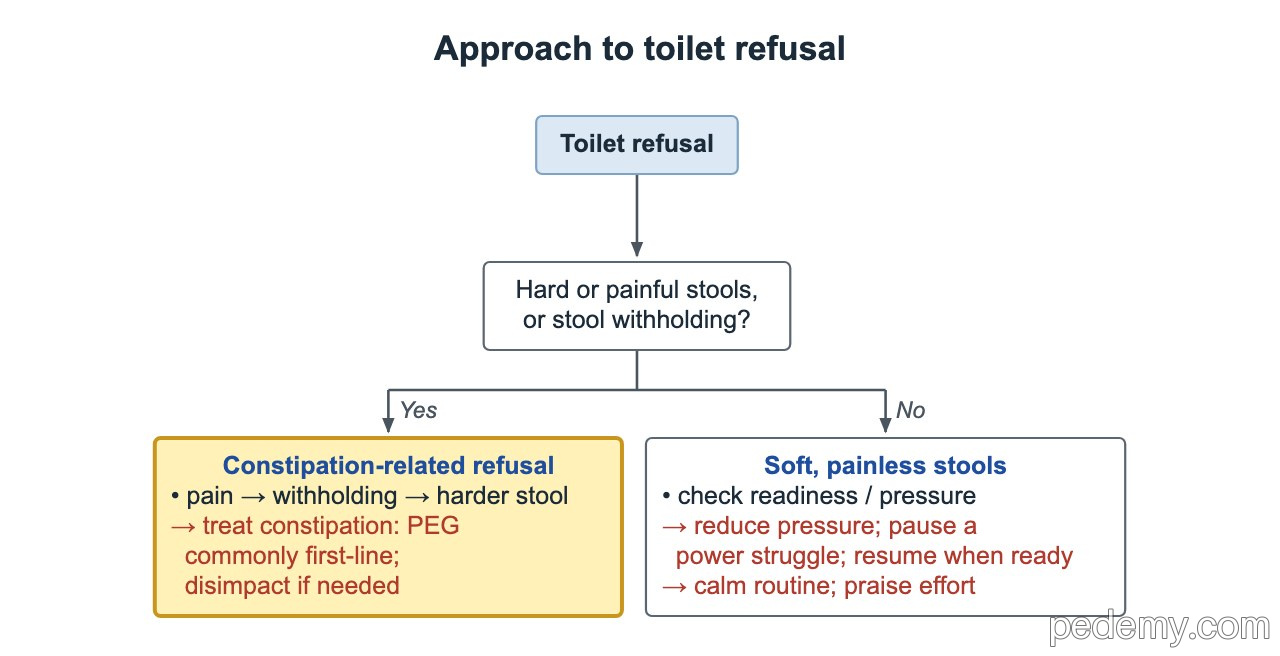
A painful stool makes the child hold the next one. The retained stool grows harder and hurts more, so the cycle repeats. Treat the constipation first.
- Polyethylene glycol (PEG) is commonly first-line; disimpact first if there is a fecal mass.
- Extra fiber and fluids alone are not enough for painful withholding; add a stool softener such as PEG.
- Restart toilet training only after 2–4 weeks of soft, painless stools.
Soft, painless stools: a power struggle
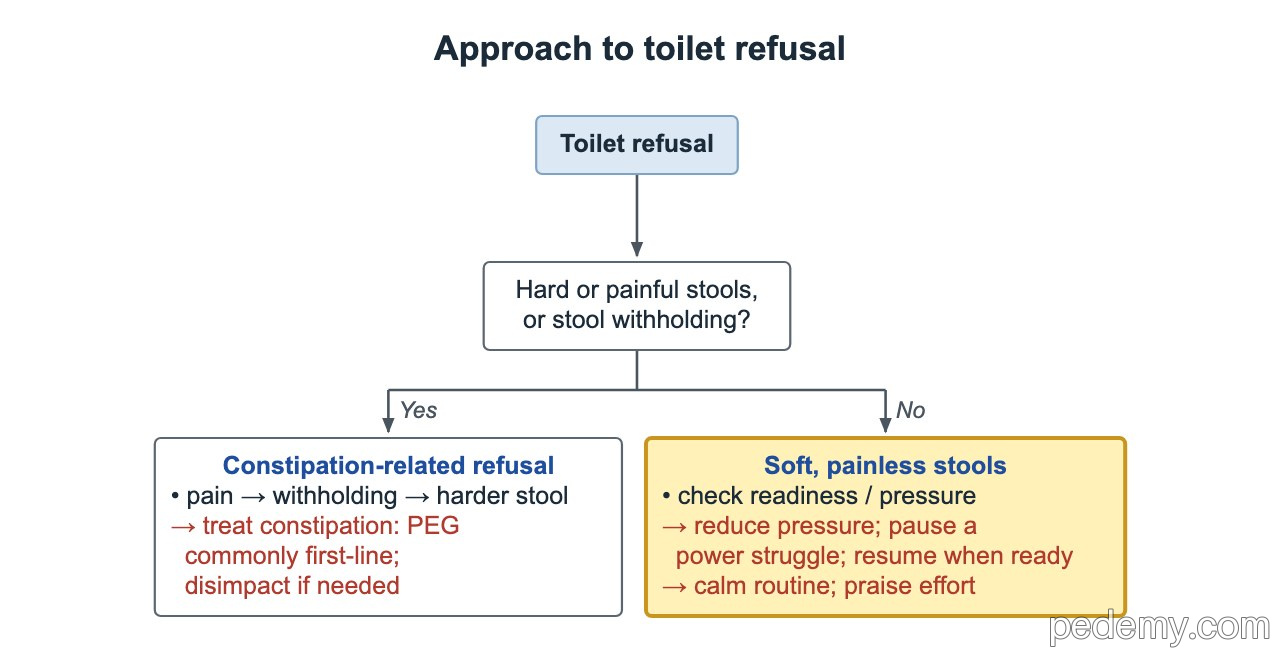
When stools are soft and painless, check readiness and how much pressure the family is using. Forceful training often turns into a power struggle.
- Reduce pressure and pause training; resume when the child is ready.
- A break of a few months, often 2–3, with no reminders, usually helps.
- Keep a calm routine and praise effort, not only success.
When to expect bladder control
Daytime control comes first and nighttime control later. In a toddler who is not yet dry by day, work on daytime continence before thinking about nights.
- A bedwetting alarm is not appropriate routine care for a 30-month-old.
- In a child with enuresis, look for and treat constipation and daytime wetting first.
| Skill | Usual timing | What it means |
|---|---|---|
| Daytime bladder control | About 3–4 years in many children | A 30-month-old wet by day and night: focus on daytime first |
| Nighttime dryness | After daytime control; often not until 5–7 years | Night wetting in a preschooler is normal |
| Nocturnal enuresis | Wetting at night at 5 years or older | Treatment (alarm or desmopressin) is usually offered from about 6 years |
Common questions
Why does my toddler refuse to poop on the toilet?
Most often because stools are hard or painful, so the child holds them back. Treat constipation, usually with PEG, and restart training after 2–4 weeks of painless stools.
When should a child be dry at night?
Nighttime dryness comes after daytime control and often not until 5–7 years. Bedwetting is not considered enuresis before age 5.
Should I stop toilet training if my child resists?
If stools are soft and painless and training has become a power struggle, take a break of a few months with no reminders, then try again calmly.
Study this topic
Sources
- ESPGHAN/NASPGHAN 2014: Evaluation and treatment of functional constipation in infants and children (JPGN)
- ICCS 2020: Management and treatment of nocturnal enuresis (J Pediatr Urol)
- AAP HealthyChildren.org: Toilet training
Written for Pedemy in our own words from the sources above; checked November 2026. For education only, not medical advice; check doses and local protocols before treating a patient. Pedemy is independent and not affiliated with or endorsed by the organizations cited.