

Main decision tree
Bronchiolitis: supportive care (RSV prevention)
Key points
- Maternal RSVpreF vaccine (Abrysvo): one dose at 32–36 weeks of pregnancy, given September through January in most of the US.
- The infant counts as protected only if the mother was vaccinated at least 14 days before delivery.
- Infants <8 months entering their first season whose mothers were not vaccinated, or vaccinated <14 days before birth: one dose of nirsevimab or clesrovimab.
- No product is preferred; choose by availability, timing and parent preference.
- One nirsevimab dose protects for about 5 months, about one RSV season.
- Second season (8–19 months): nirsevimab again only for high-risk children; clesrovimab is not used in the second season.
- Palivizumab has been largely replaced by nirsevimab and clesrovimab.
Mother or infant: choosing one product
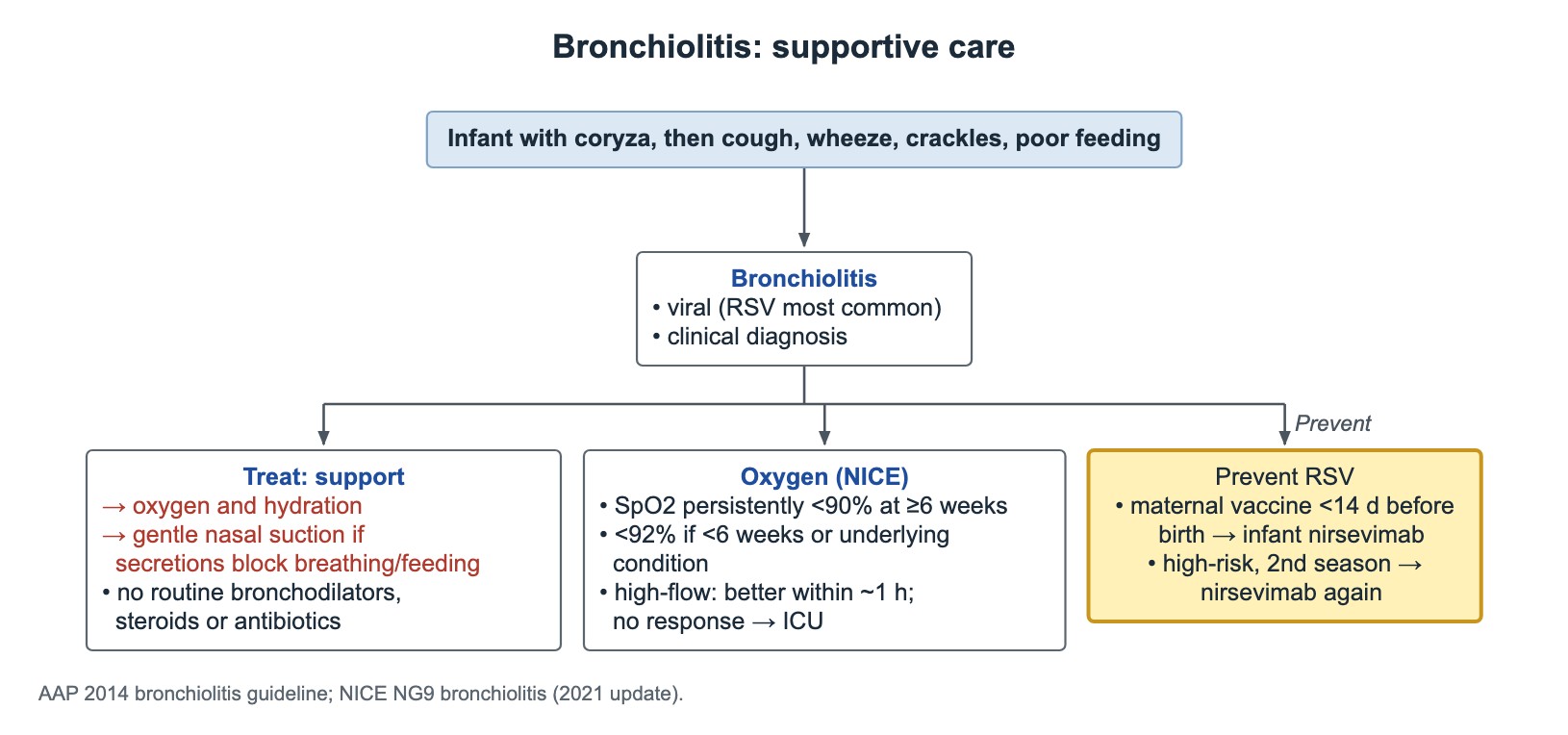
RSV is the most common cause of bronchiolitis and the leading cause of hospital admission in US infants. The tree shows bronchiolitis care with prevention as one branch: a mother vaccinated less than 14 days before birth means the infant still needs a monoclonal antibody, and a high-risk child gets nirsevimab again in the second season.
There are three products for the first season: the maternal vaccine, nirsevimab and clesrovimab. Each one alone protects the infant, so most infants need just one. The tree names nirsevimab; clesrovimab, licensed in 2025, is an equal alternative for the first season.
| Situation | What the infant needs |
|---|---|
| Mother vaccinated ≥14 days before delivery | Usually nothing more |
| Mother vaccinated <14 days before delivery | Nirsevimab or clesrovimab |
| Mother not vaccinated or status unknown | Nirsevimab or clesrovimab |
| High-risk child, 8–19 months, entering second season | Nirsevimab |
Maternal RSV vaccine
- Product: RSVpreF (Abrysvo), the only RSV vaccine used in pregnancy.
- Timing: one dose at 32 weeks 0 days through 36 weeks 6 days of gestation.
- Season: given from September through January in most of the continental US, so the baby is born shortly before or during RSV season.
- Antibodies cross the placenta. It takes at least 14 days after the dose for enough antibody to reach the baby.
- It is currently recommended in one pregnancy only; infants born after later pregnancies receive a monoclonal antibody.
Nirsevimab and clesrovimab for the first season
Both are long-acting monoclonal antibodies given as one intramuscular injection. They are recommended for infants younger than 8 months who are born during or entering their first RSV season and are not protected by maternal vaccination.
Give the dose shortly before the season (October through March in most of the continental US), or within the first week of life, ideally before discharge, for babies born during the season. They can be given with routine infant vaccines.
- Nirsevimab (Beyfortus): 50 mg if <5 kg, 100 mg if ≥5 kg in the first season.
- Clesrovimab (Enflonsia): 105 mg once, whatever the weight; first season only.
- A single nirsevimab dose protects for about 5 months, roughly one RSV season.
- A healthy term infant whose mother was not vaccinated needs one dose of either antibody.
Second season: high-risk children only
Most children need no RSV product in their second season. Children aged 8–19 months at increased risk of severe RSV disease get nirsevimab again (200 mg, as two 100 mg injections) before their second season.
- Chronic lung disease of prematurity that needed medical support (such as steroids, diuretics or oxygen) during the 6 months before the second season.
- Severe immunocompromise.
- Cystic fibrosis with severe disease, such as severe lung disease or weight-for-length below the 10th percentile.
- American Indian and Alaska Native children.
What does not replace infant protection
- Vaccinating household adults does not protect a newborn nearly as well as immunizing the mother in pregnancy or the infant directly.
- Palivizumab, a monthly injection, has been largely replaced by single-dose nirsevimab or clesrovimab.
- There is no RSV vaccine for infants or young children; prevention in this age group is passive antibody, from the mother or by injection.
Common questions
Does my baby need nirsevimab if I had the RSV vaccine in pregnancy?
Usually not, if the vaccine was given at least 14 days before delivery. If it was given less than 14 days before birth, the baby should get nirsevimab or clesrovimab.
When is the RSV vaccine given in pregnancy?
One dose at 32–36 weeks of pregnancy, from September through January in most of the US.
Which children get nirsevimab in their second RSV season?
Only high-risk children aged 8–19 months, such as those with chronic lung disease of prematurity needing support, severe immunocompromise, severe cystic fibrosis, or American Indian and Alaska Native children.
What is the difference between nirsevimab and clesrovimab?
Both are single-dose long-acting antibodies for infants under 8 months in their first season. Nirsevimab is dosed by weight and is also used for high-risk children in the second season; clesrovimab is one fixed dose and is used only in the first season.
Study this topic
Sources
- ACIP: Use of clesrovimab for prevention of RSV lower respiratory tract infection in infants (MMWR 2025)
- ACIP: Use of nirsevimab for prevention of RSV disease among infants and young children (MMWR 2023)
- ACIP: Use of the Pfizer RSV vaccine during pregnancy to prevent RSV in infants (MMWR 2023)
- CDC: RSV immunization guidance for infants and young children
Written for Pedemy in our own words from the sources above; checked November 2026. For education only, not medical advice; check doses and local protocols before treating a patient. Pedemy is independent and not affiliated with or endorsed by the organizations cited.