

Main decision tree
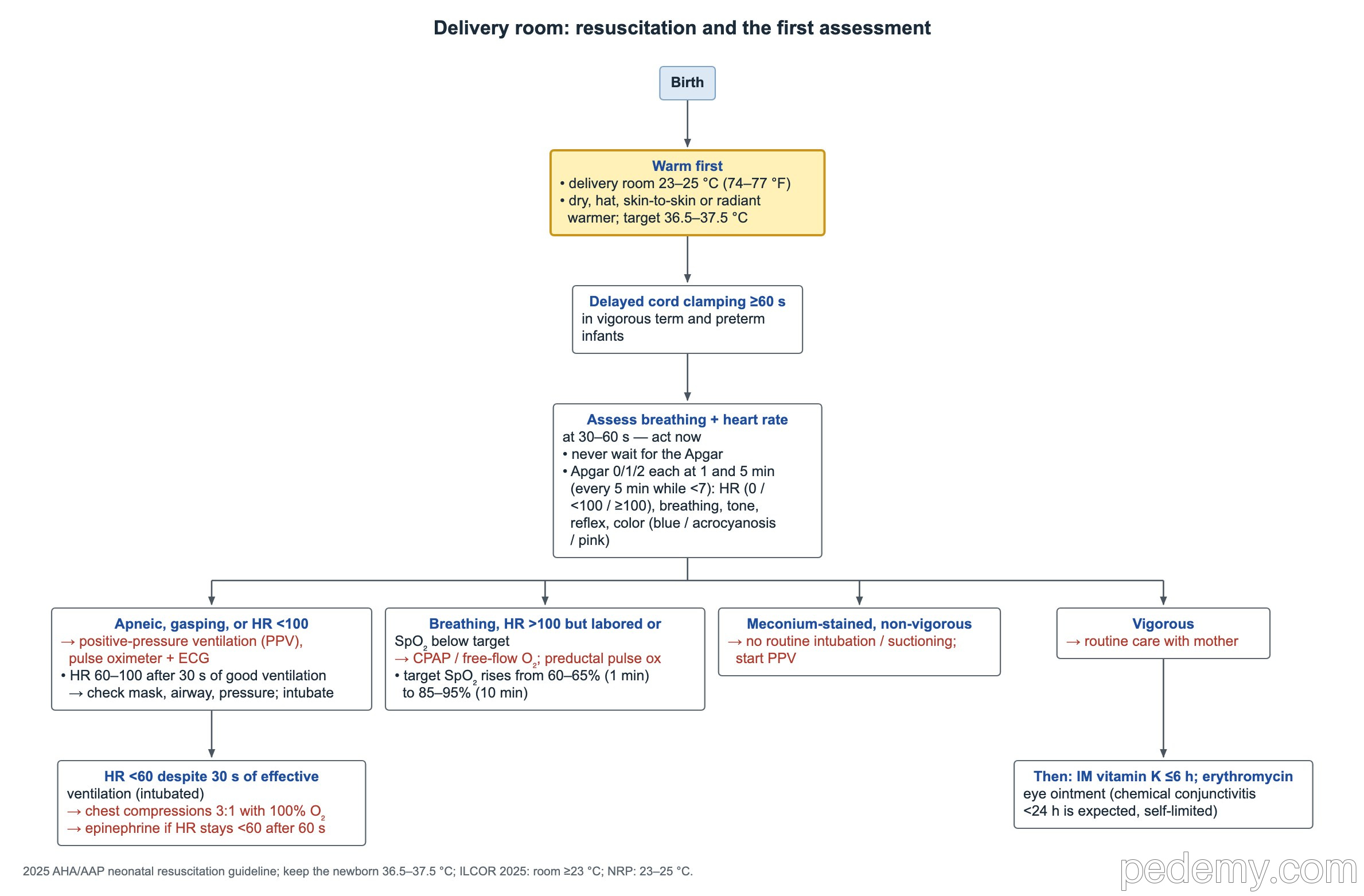
Delivery room: resuscitation and the first assessment
Key points
- Delivery room 23–25 °C (74–77 °F); keep the newborn at 36.5–37.5 °C.
- Apneic, gasping or heart rate below 100/min → positive-pressure ventilation within the first minute.
- Heart rate below 60/min despite 30 seconds of effective ventilation (ideally through an endotracheal tube) → chest compressions 3:1 with 100% oxygen.
- Heart rate still below 60/min after compressions and ventilation → IV or IO epinephrine.
- Never wait for the 1-minute Apgar to start resuscitation.
- Delay cord clamping for at least 60 seconds in vigorous term and preterm newborns; not with placental abruption or a baby who needs resuscitation.
- PPHN: right-to-left shunting with preductal (right hand) saturation above foot saturation; no difference does not exclude it.
Before birth and the first seconds
Preparation starts before the birth. The team asks four questions: gestational age, whether the amniotic fluid is clear, other risk factors, and the plan for umbilical cord management (added in NRP 8th edition).
- Warm first: room temperature 23–25 °C (74–77 °F), dry the baby, put on a hat, and use skin-to-skin care or a radiant warmer.
- Keep the baby's temperature at 36.5–37.5 °C; very preterm babies also need plastic wrap and a warm mattress.
- Delay cord clamping for at least 60 seconds in vigorous babies.
- Within 30–60 seconds, assess breathing and heart rate and act on what you find.
Ventilation and chest compressions
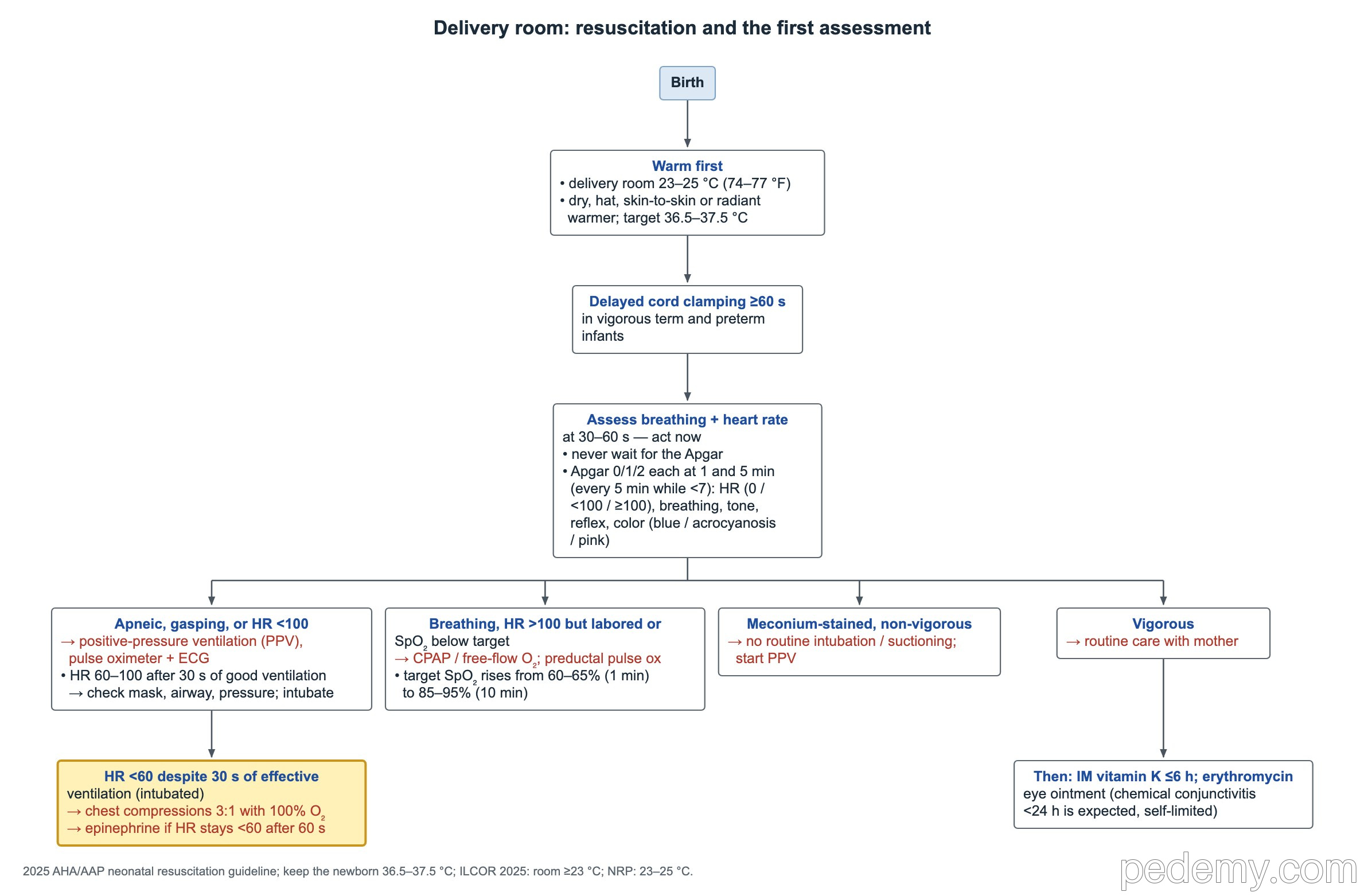
Effective ventilation fixes most newborn bradycardia. A breathing baby whose heart rate is still below 100/min after warming, drying and stimulation needs positive-pressure ventilation (PPV), not more stimulation.
- Apneic, gasping or heart rate below 100/min → PPV, a right-hand pulse oximeter and an ECG monitor.
- Start PPV with 21% oxygen at 35 weeks or later, and 21–30% oxygen before 35 weeks; adjust to preductal saturation targets.
- Heart rate not rising → check mask seal, airway position and pressure; then an endotracheal tube or laryngeal mask.
- Breathing, heart rate above 100/min but labored or low saturation → CPAP or free-flow oxygen.
- Preductal saturation targets rise from 60–65% at 1 minute to 85–95% at 10 minutes.
- Heart rate below 60/min after 30 seconds of effective ventilation, ideally through an endotracheal tube → chest compressions at 3 compressions to 1 breath, with 100% oxygen.
- Meconium-stained, non-vigorous baby: no routine intubation for suctioning; start PPV.
Epinephrine and volume
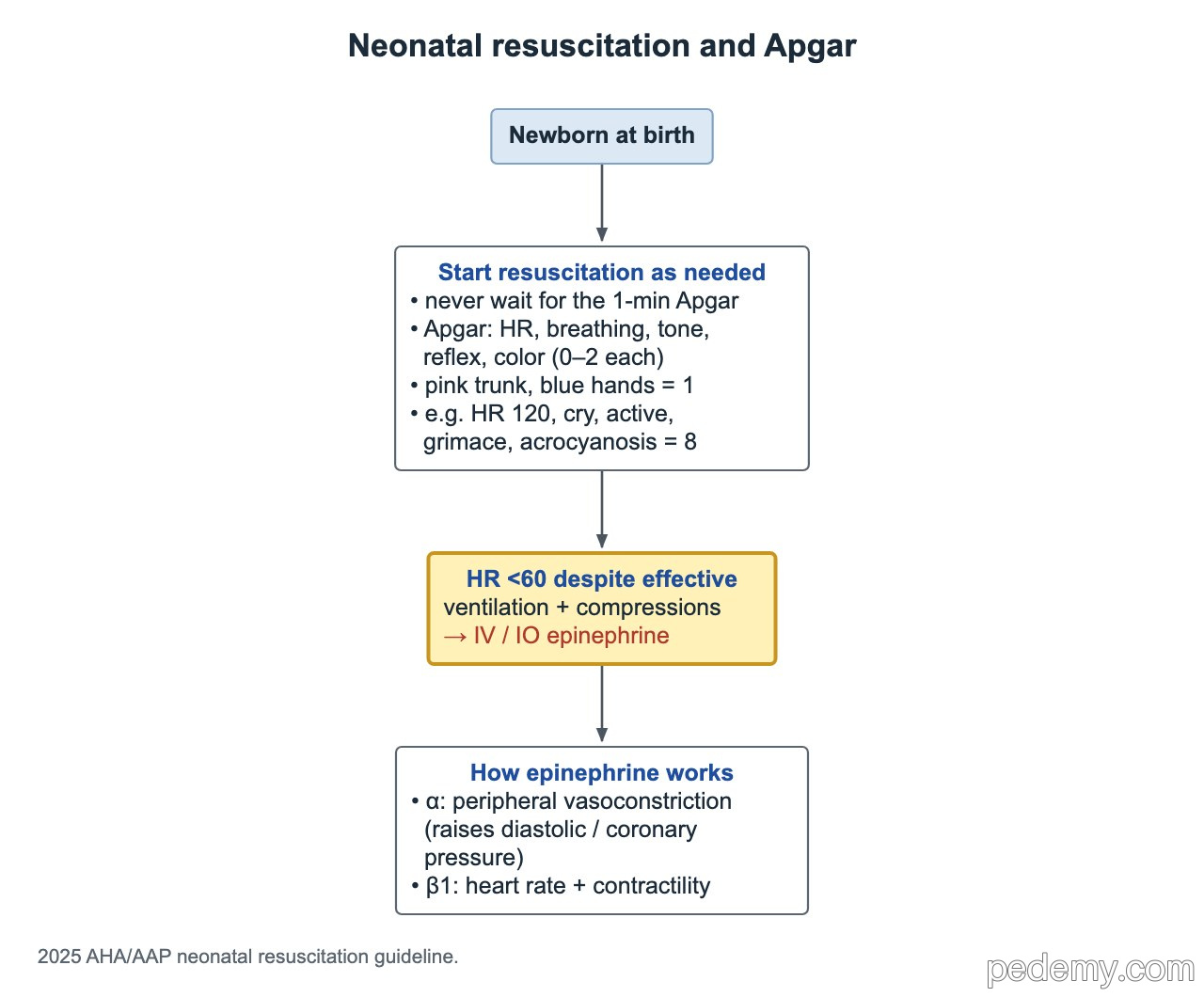
Epinephrine is given when the heart rate stays below 60/min despite effective ventilation and coordinated compressions. Its alpha effect constricts peripheral vessels, which raises diastolic and coronary perfusion pressure; its beta-1 effect raises heart rate and contractility.
- Preferred route: IV (umbilical venous catheter) or intraosseous, 0.01–0.03 mg/kg of 0.1 mg/mL epinephrine, repeated every 3–5 minutes if needed.
- Endotracheal epinephrine (0.05–0.1 mg/kg) is less reliable and is used only while IV or IO access is being placed.
- Suspected blood loss (pale baby, poor response, history of bleeding): volume 10 mL/kg of normal saline or O-negative blood over 5–10 minutes.
The Apgar score
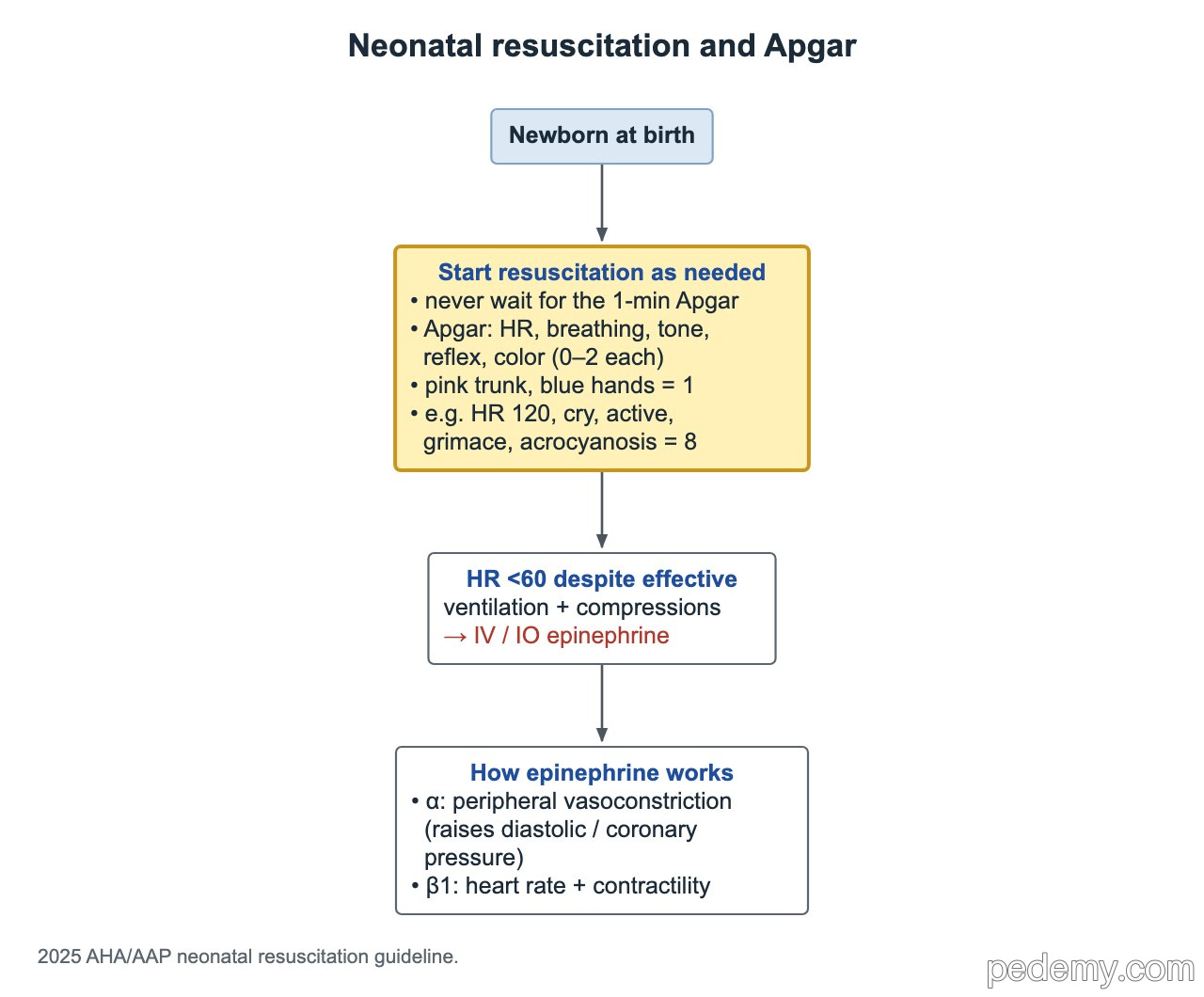
The Apgar score describes how the baby is doing and how it responds to resuscitation. It is recorded at 1 and 5 minutes, then every 5 minutes up to 20 minutes while it is below 7. It is never used to decide when to start resuscitation.
- Heart rate 120, strong cry, active motion, grimace, pink trunk with blue limbs → 2+2+2+1+1 = 8.
- Heart rate 70, weak breaths, limp, no response, blue hands and feet → 1+1+0+0+1 = 3.
- A low 5-minute score alone does not prove hypoxic-ischemic injury.
| Sign | 0 | 1 | 2 |
|---|---|---|---|
| Heart rate | Absent | Below 100/min | 100/min or more |
| Respiratory effort | Absent | Weak, irregular | Good, crying |
| Muscle tone | Limp | Some flexion | Active motion |
| Reflex irritability | No response | Grimace | Cry or cough |
| Color | Blue or pale | Pink trunk, blue hands and feet | Pink all over |
Birth transition and delayed cord clamping
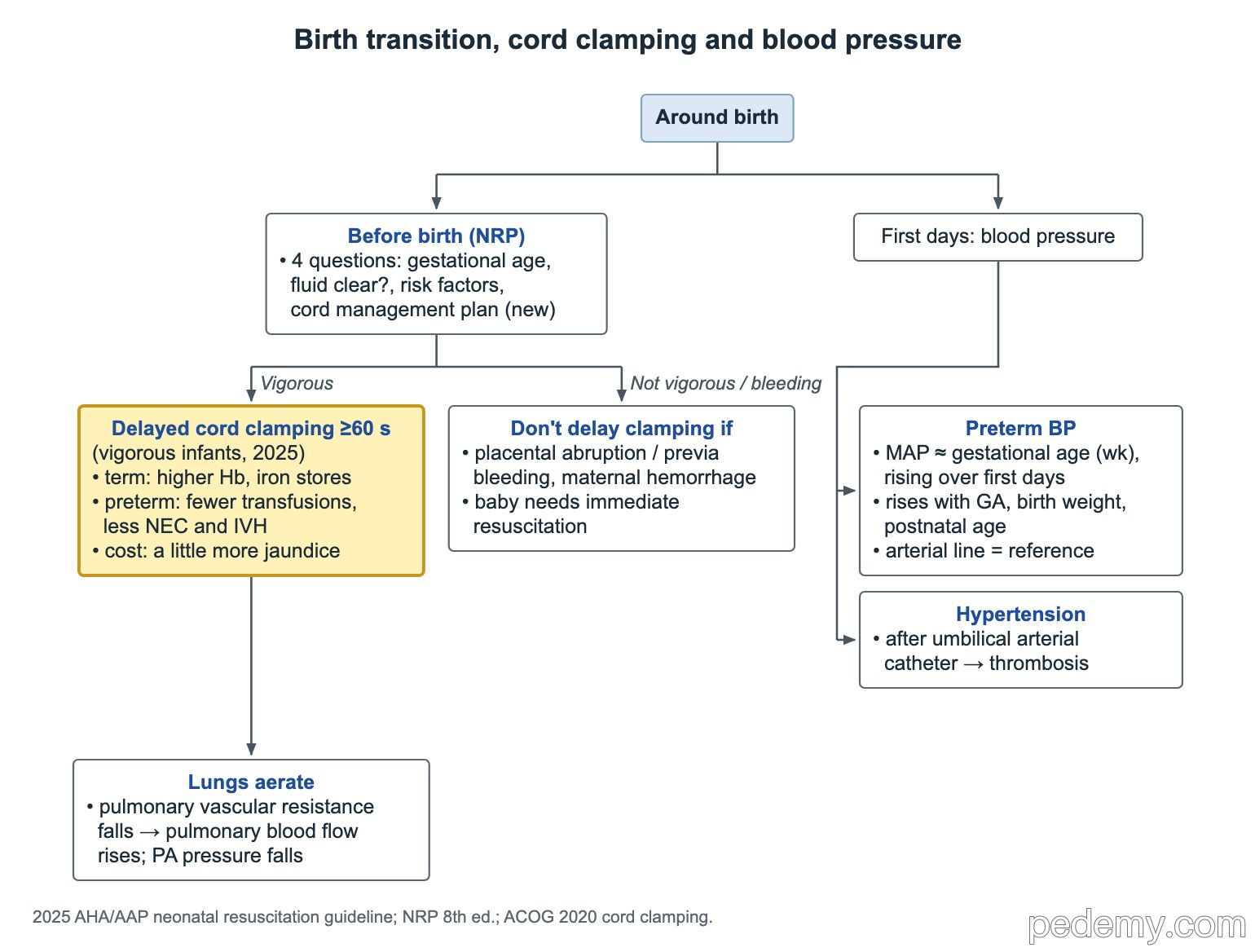
When the lungs fill with air, pulmonary vascular resistance falls, pulmonary blood flow rises and pulmonary artery pressure falls. Left atrial pressure rises and closes the foramen ovale, and the ductus arteriosus begins to close.
| Delayed cord clamping (at least 60 s) | Effect |
|---|---|
| Term babies | Higher hemoglobin and iron stores; small increase in jaundice needing phototherapy |
| Preterm babies | Lower mortality before discharge and fewer transfusions; possibly less NEC and IVH |
| Do not delay | Placental abruption, bleeding previa, maternal hemorrhage, or a baby who needs immediate resuscitation |
Newborn blood pressure and hypertension
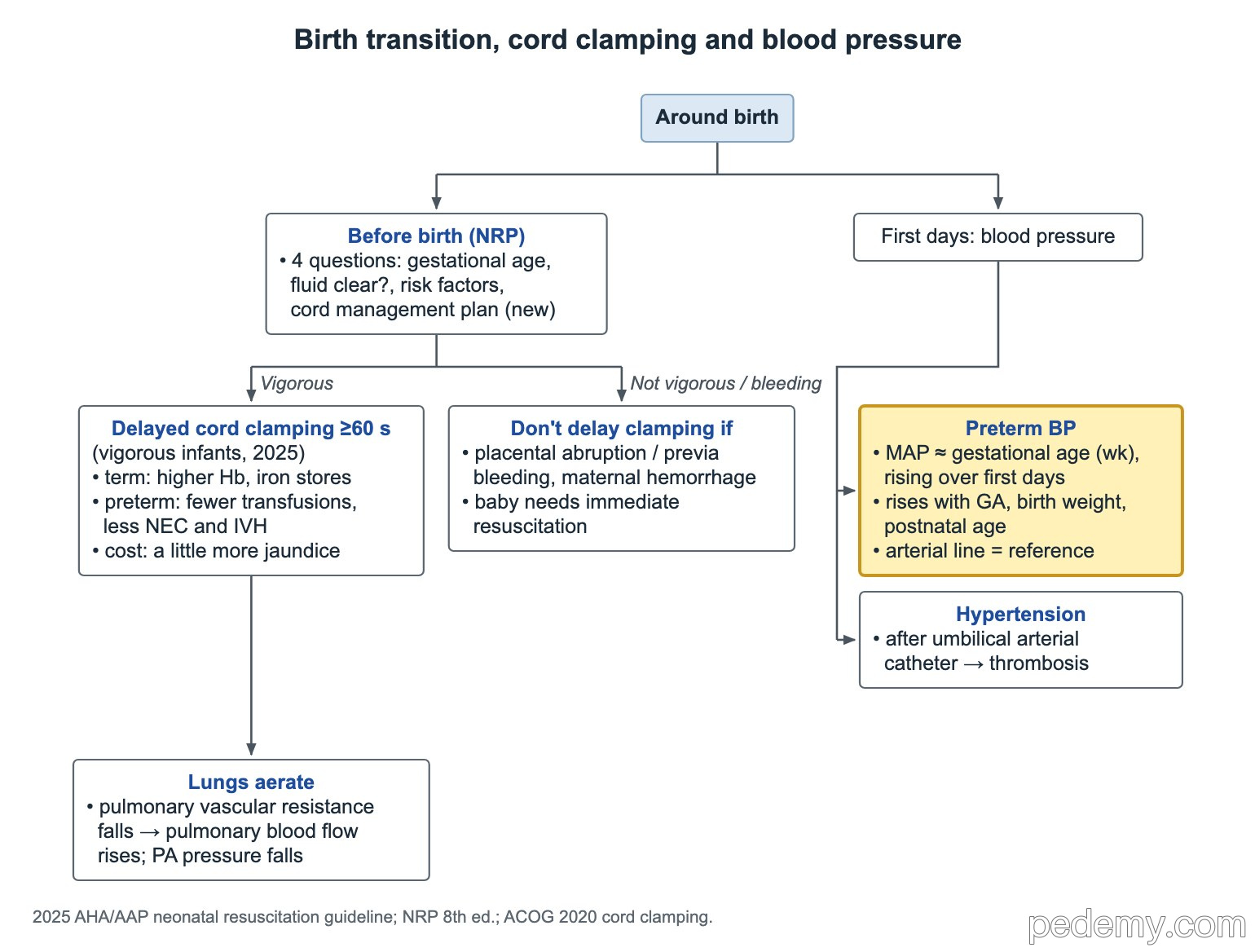
- Normal newborn blood pressure rises with gestational age, birth weight and postnatal age, so a healthy preterm baby's pressure at 2 weeks is higher than on day 1.
- Bedside estimate in the first days: mean arterial pressure (mm Hg) is about the gestational age in weeks; it is usually above 30 by day 3.
- Intra-arterial measurement is the gold standard; otherwise use an oscillometric cuff of the right size.
- Hypertension after an umbilical arterial catheter → think renal artery or aortic thrombosis, the most common cause.
- Gross hematuria, a flank mass, hypertension and low platelets in an infant of a diabetic mother → renal vein thrombosis; Doppler ultrasound of the renal veins and IVC. Prematurity is the top risk factor.
PPHN and patent ductus arteriosus
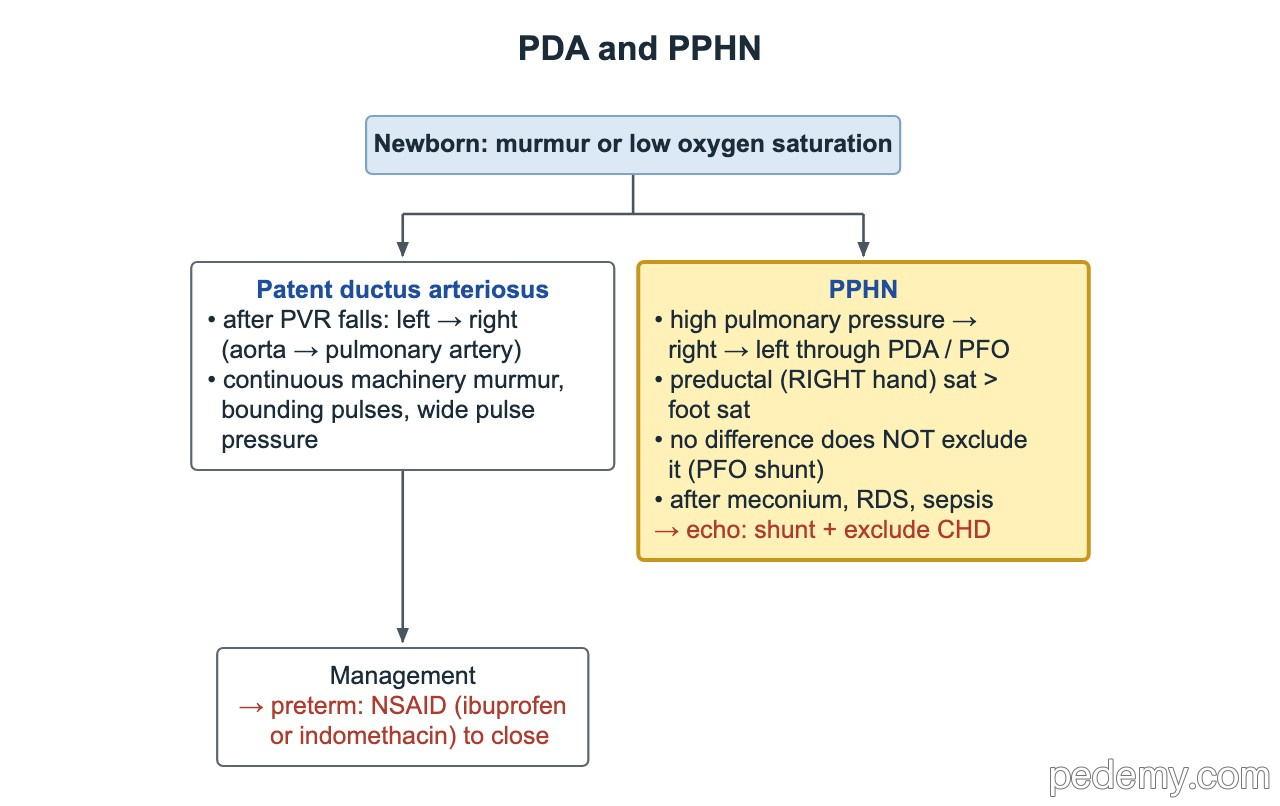
The same fetal channels shunt in opposite directions depending on pulmonary pressure. With high pulmonary pressure (PPHN) blood goes right to left; once pulmonary resistance falls, a patent ductus shunts left to right, from the aorta to the pulmonary artery.
- PPHN: hypoxemia with preductal (right hand) saturation higher than the foot, often after meconium aspiration, RDS, sepsis or diaphragmatic hernia.
- No pre- and postductal difference does not exclude PPHN: the shunt may be only at the foramen ovale.
- Echocardiography confirms the shunt and pulmonary pressure and excludes structural heart disease.
- Preterm PDA: continuous (machinery) murmur, bounding pulses and wide pulse pressure.
- When a preterm PDA is treated with medicine, an NSAID (ibuprofen or indomethacin) is the classic choice; acetaminophen is an alternative. Many PDAs close without treatment (AAP 2016).
Common questions
When do you start chest compressions in a newborn?
When the heart rate stays below 60/min after 30 seconds of effective ventilation, ideally through an endotracheal tube. Use 3 compressions to 1 breath with 100% oxygen.
Do you wait for the Apgar score before resuscitating?
No. Resuscitation starts from breathing and heart rate in the first minute. The Apgar score is recorded at 1 and 5 minutes but never guides when to start.
How long should cord clamping be delayed?
At least 60 seconds in vigorous term and preterm babies. Clamp promptly for placental abruption, maternal hemorrhage or a baby who needs immediate resuscitation.
Study this topic
Sources
- AHA/AAP 2025: Part 5, Neonatal Resuscitation (Circulation)
- ACOG Committee Opinion 814: Delayed umbilical cord clamping after birth (2020)
- AAP and ACOG 2015: The Apgar score (Pediatrics)
- AAP 2016: Patent ductus arteriosus in preterm infants (Pediatrics)
- Dionne et al. 2012: Hypertension in infancy, diagnosis, management and outcome (Pediatr Nephrol)
Written for Pedemy in our own words from the sources above; checked November 2026. For education only, not medical advice; check doses and local protocols before treating a patient. Pedemy is independent and not affiliated with or endorsed by the organizations cited.