

Main decision tree
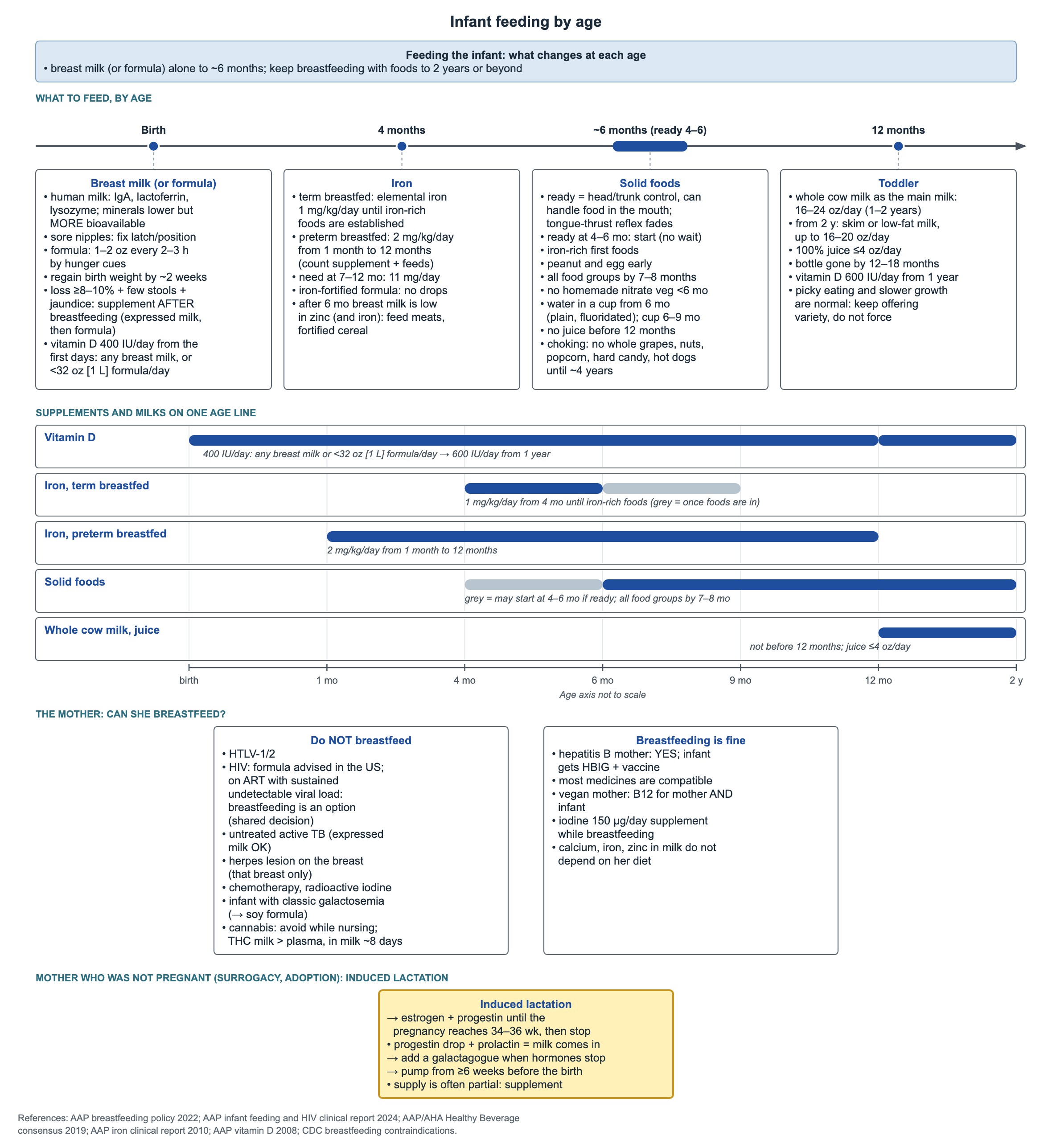
Infant feeding by age
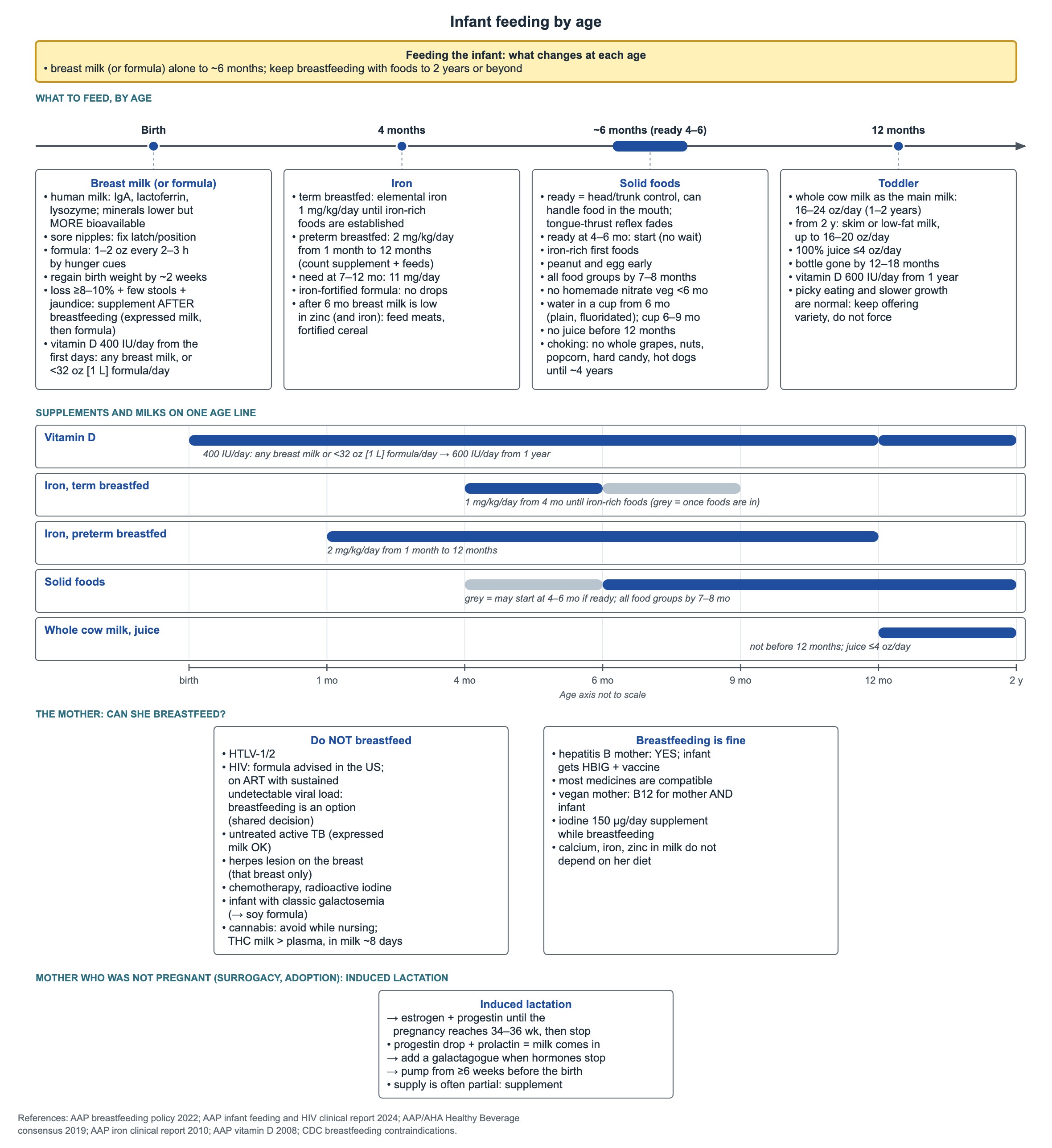
Key points
- Vitamin D 400 IU daily from the first days for any infant who gets breast milk or less than about 32 oz (1 L) of formula a day.
- Term breastfed infants: elemental iron 1 mg/kg/day from 4 months until iron-rich foods are established.
- Breastfed preterm infants: iron 2 mg/kg/day from 1 month to 12 months.
- Most term babies are back to birth weight by 10–14 days; a loss of 8–10% or more needs a feeding check.
- Lactating parent: iodine supplement 150 mcg/day; a vegan parent and her baby both need vitamin B12.
- Do not breastfeed with HTLV-1/2, untreated active TB, a herpes lesion on the breast, chemotherapy or radioactive iodine, or an infant with classic galactosemia.
- Fresh expressed milk keeps up to 4 days in the fridge; frozen milk is best used within 6 months.
The two supplements: vitamin D and iron
Human milk is low in vitamin D and its iron stores run down by mid-infancy. So an exclusively breastfed baby needs both vitamin D and iron, at different ages.
The age line on the tree shows when each one starts and stops.
- Vitamin D: 400 IU once a day, starting in the first days of life.
- Partly breastfed babies need it too, unless they drink about 32 oz (1 L) or more of formula a day.
- Vitamin D need rises to 600 IU/day from 1 year.
- Iron, term breastfed: 1 mg/kg/day of elemental iron from 4 months until iron-rich foods are in the diet.
- Iron, preterm breastfed: 2 mg/kg/day from 1 month to 12 months.
Human milk and the first weeks
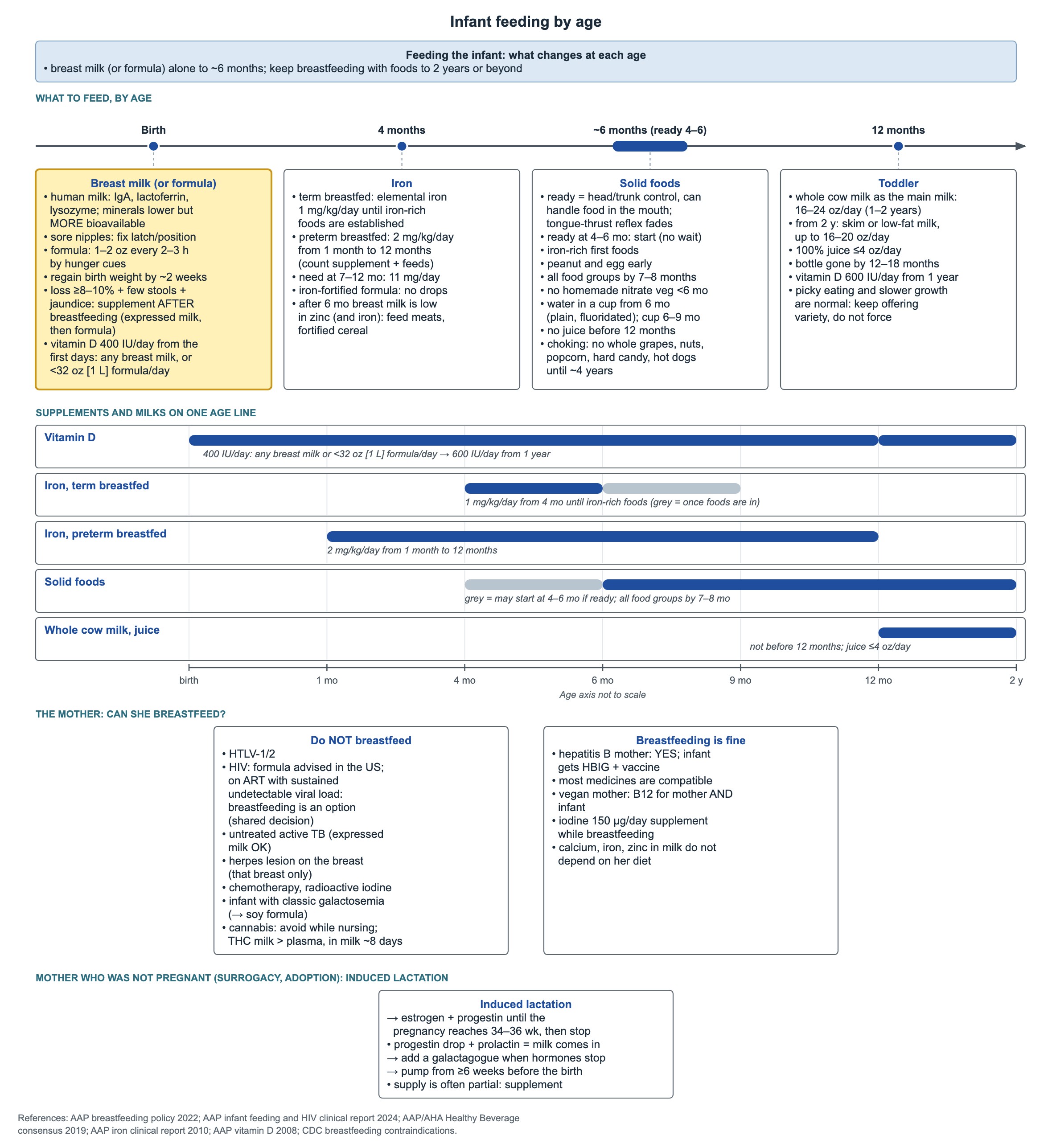
Colostrum and mature milk protect the gut. Secretory IgA coats the gut lining; lactoferrin and lysozyme add more defense.
Human milk has lower mineral levels than formula, but they are better absorbed, so lower content does not mean poorer nutrition.
- Stools change from meconium to green-brown transitional stools to yellow, seedy stools by about day 4–5.
- Most term babies regain birth weight by 10–14 days.
- Weight loss of 8–10% or more, few stools and jaundice: watch a feed, then give expressed milk after breastfeeding; use infant formula if expressed milk is not enough.
- Sore nipples usually mean a poor latch or position; fix the latch first.
- Tight frenulum with poor latch: start with skilled lactation help; frenotomy only if feeding problems continue.
Iron for breastfed infants
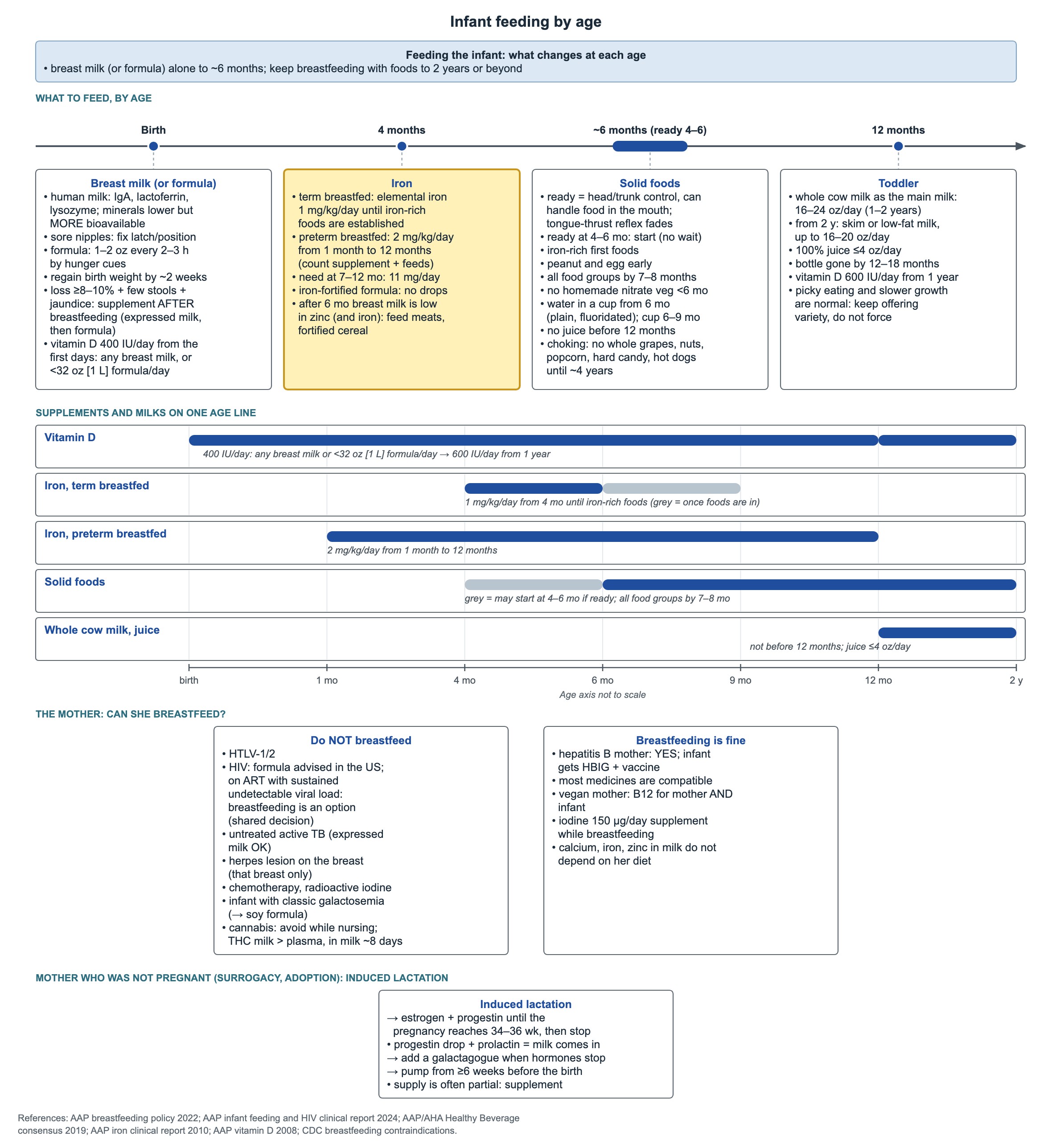
A term baby is born with iron stores that last about 4 months. Breast milk iron is well absorbed but the amount is small, so stores fall after that.
| Infant | Iron supplement |
|---|---|
| Term, exclusively or mostly breastfed | 1 mg/kg/day elemental iron from 4 months until iron-rich foods are established |
| Preterm, breastfed | 2 mg/kg/day from 1 month to 12 months (count iron from fortifier and foods) |
| Term, iron-fortified formula | No drops needed |
| Any infant 7–12 months | Needs about 11 mg/day of iron from all sources |
When not to breastfeed, and the parent's diet
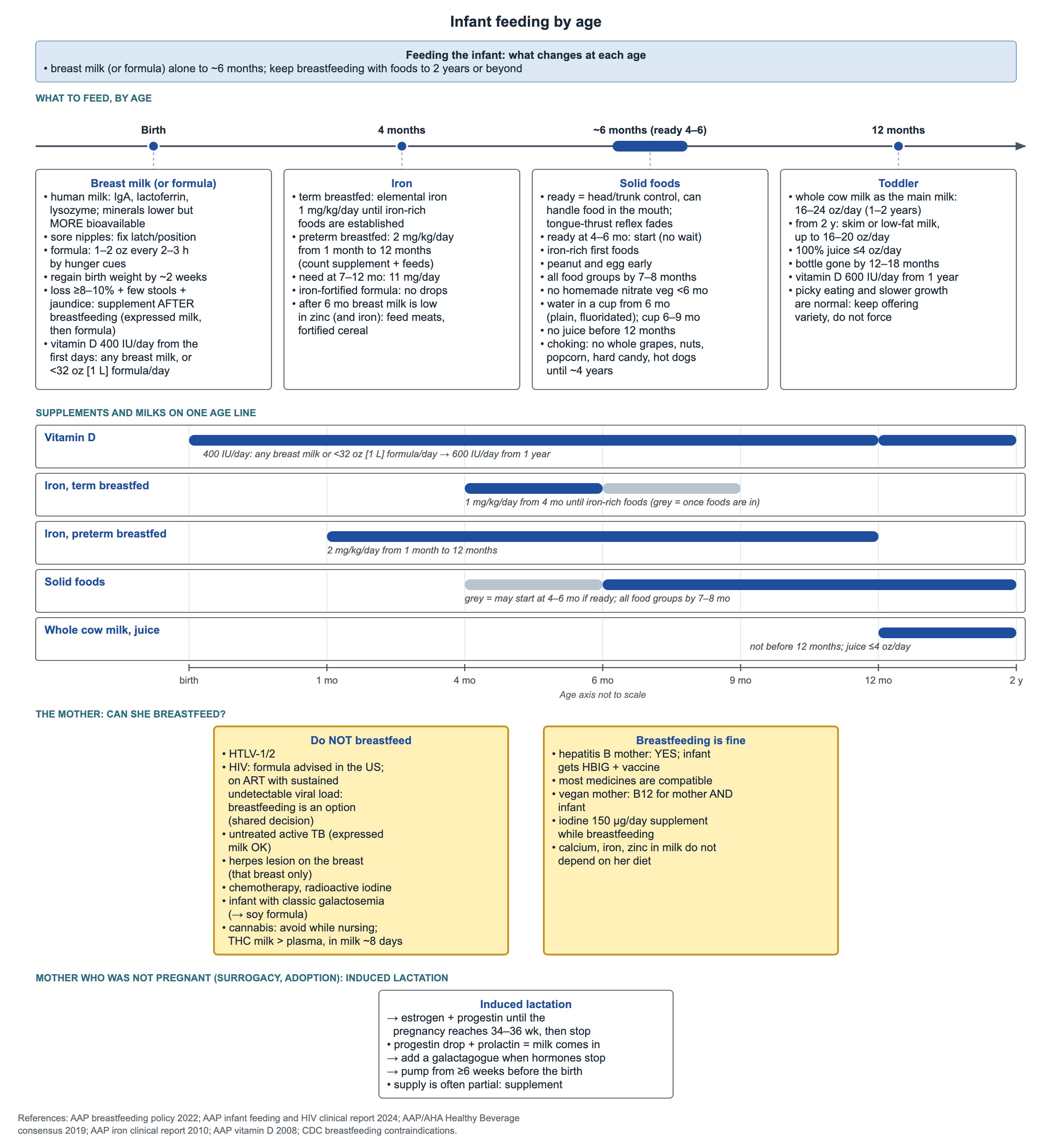
True contraindications are rare. Most medicines are compatible; check each drug in the NIH LactMed database.
- Iodine: milk iodine does depend on the parent's intake. A parent who avoids dairy and seafood and takes no supplement puts the baby at risk. Iodine makes thyroid hormone, which drives brain development.
- Give lactating parents a daily supplement with 150 mcg iodine as potassium iodide.
- A single spot urine iodine describes a population, not one person's long-term status.
- Cannabis: advise not to use it while breastfeeding. THC is fat-soluble, reaches higher levels in milk than in plasma, and can stay in milk for about a week, so pumping and dumping for 24–48 hours does not work.
| Do not breastfeed | Breastfeeding is fine |
|---|---|
| HTLV-1 or HTLV-2 | Hepatitis B: the baby gets HBIG and vaccine at birth |
| HIV: formula is advised in the US; with sustained undetectable viral load on ART, breastfeeding is a shared decision | Most medicines |
| Untreated active TB (expressed milk is OK) | Vegan parent: give B12 to parent and infant |
| Herpes lesion on the breast (that breast only) | Iodine 150 mcg/day supplement while breastfeeding |
| Cytotoxic chemotherapy, radioactive iodine | Calcium, iron and zinc in milk do not depend on the parent's diet |
| Infant with classic galactosemia (use soy formula) |
Storing expressed milk
- Thaw in the fridge or in warm water, never in a microwave: it heats unevenly and can burn the baby.
| Where | Fresh expressed milk |
|---|---|
| Room temperature (77 °F / 25 °C or cooler) | Up to 4 hours |
| Refrigerator | Up to 4 days |
| Freezer | Best within 6 months; up to 12 months is acceptable |
| Thawed milk | Use within 24 hours once fully thawed in the fridge; do not refreeze |
Induced lactation (surrogacy, adoption)
Milk comes in after birth when progesterone and estrogen fall sharply while prolactin stays high (lactogenesis II, secretory activation). Induced lactation copies this in a parent who was not pregnant.
- Give estrogen plus progestin until the carrier's pregnancy reaches about 34–36 weeks, then stop.
- When the hormones stop, add a galactagogue (a dopamine antagonist such as domperidone or metoclopramide).
- Start regular hospital-grade pumping at least 6 weeks before the expected birth.
- Supply is often partial, so plan for formula or donor milk as well.
Common questions
Does a breastfed baby need vitamin D drops?
Yes. Give 400 IU daily from the first days of life, unless the baby drinks about 32 oz (1 L) or more of formula a day.
When should a breastfed baby start iron drops?
A term baby who is mostly breastfed starts 1 mg/kg/day of elemental iron at 4 months and continues until iron-rich foods are eaten regularly. Preterm babies start 2 mg/kg/day at 1 month.
How long does breast milk last in the fridge?
Fresh expressed milk keeps up to 4 days in the fridge. In the freezer it is best used within 6 months.
Can a mother with hepatitis B breastfeed?
Yes. The baby gets hepatitis B vaccine and HBIG at birth, and breastfeeding can start right away.
Study this topic
Sources
- AAP 2022 policy statement: Breastfeeding and the use of human milk (Pediatrics)
- AAP: Prevention of rickets and vitamin D deficiency in infants, children and adolescents (Pediatrics 2008)
- AAP: Diagnosis and prevention of iron deficiency in infants and young children (Pediatrics 2010)
- AAP: Iodine deficiency, pollutant chemicals and the thyroid (Pediatrics 2014)
- CDC: Breast milk storage and preparation
Written for Pedemy in our own words from the sources above; checked November 2026. For education only, not medical advice; check doses and local protocols before treating a patient. Pedemy is independent and not affiliated with or endorsed by the organizations cited.