

Main decision tree
Undernutrition and the nutrition math
Key points
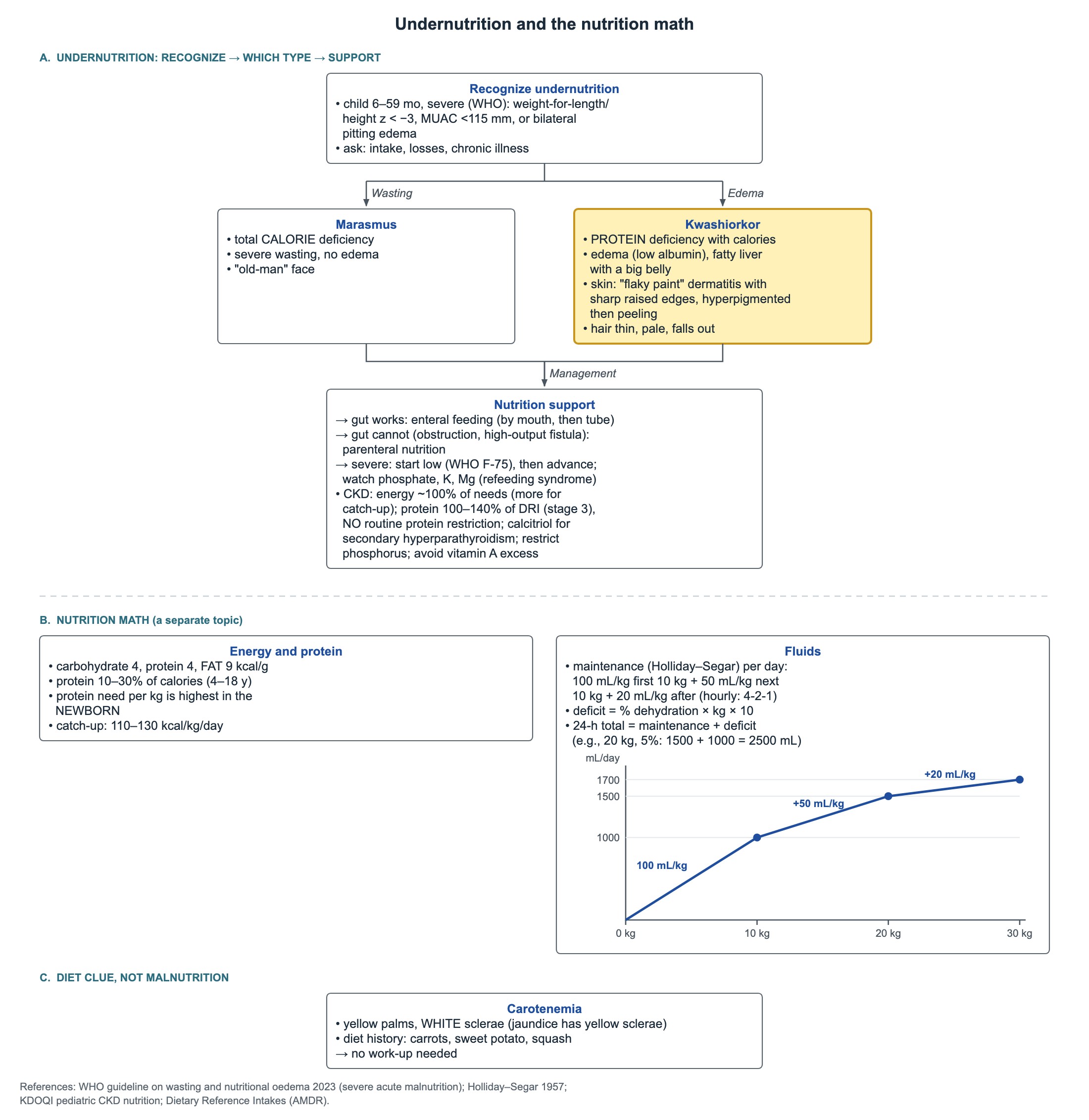
- Marasmus: total calorie deficit, severe wasting, no edema. Kwashiorkor: edema, fatty liver, flaky-paint dermatitis.
- Usable gut: enteral feeding (mouth, then tube). Parenteral nutrition only when the gut cannot meet needs.
- Holliday–Segar: 100 mL/kg/day for the first 10 kg, 50 mL/kg for the next 10 kg, 20 mL/kg after that (4-2-1 mL/kg/h).
- Deficit (mL) = % dehydration × weight (kg) × 10; 15 kg at 7%: 1,250 + 1,050 = 2,300 mL in 24 hours.
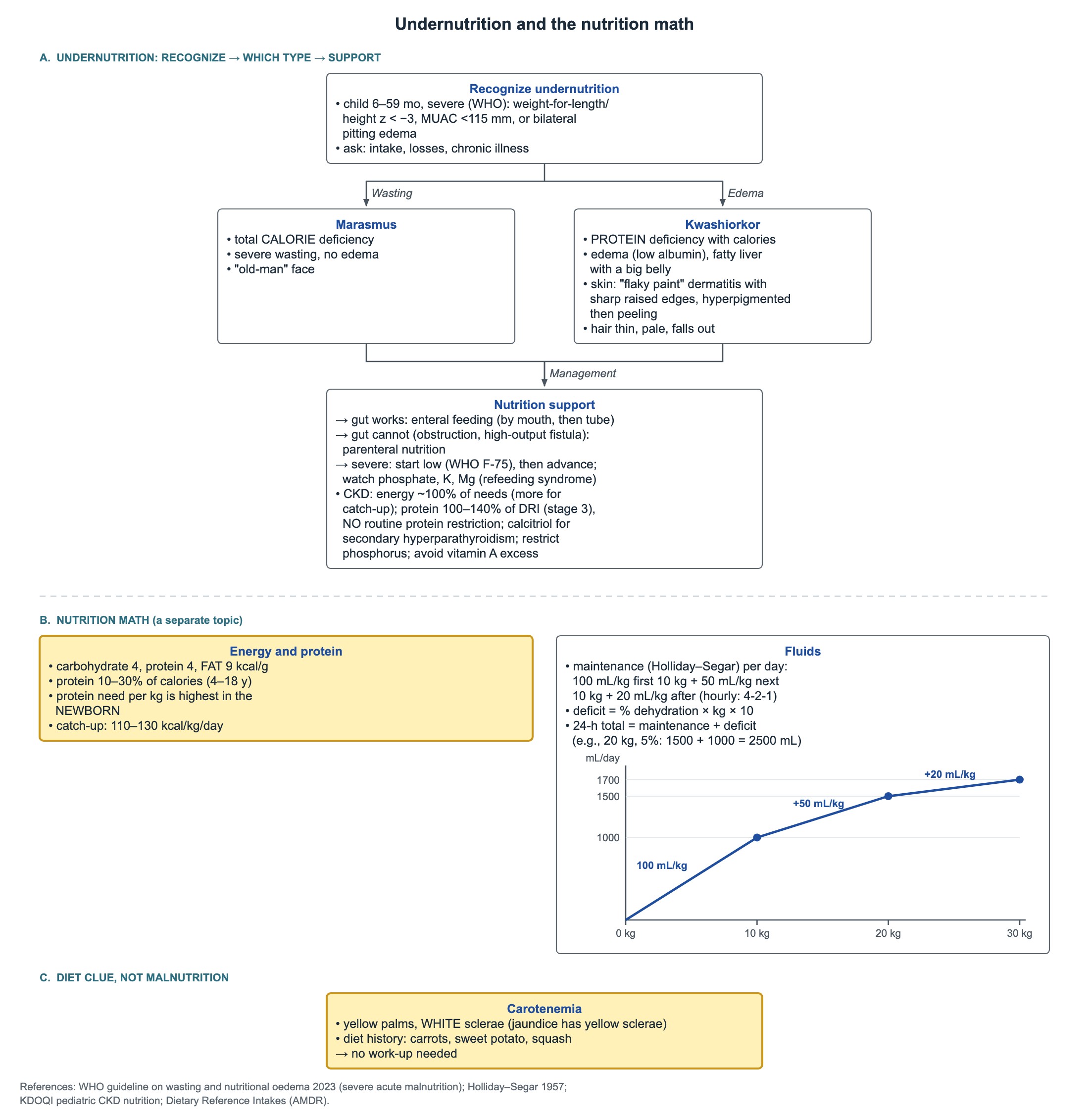
- Carbohydrate and protein give 4 kcal/g; fat gives 9 kcal/g.
- Protein need per kg is highest in the newborn; protein is 10–30% of calories at 4–18 years.
- Catch-up growth needs about 110–130 kcal/kg/day, versus 100–110 for a healthy term infant.
Recognizing undernutrition: marasmus and kwashiorkor
In children 6–59 months, severe acute malnutrition means weight-for-length z score below −3, mid-upper arm circumference under 115 mm, or bilateral pitting edema. Always ask about intake, losses and chronic illness.
| Marasmus | Kwashiorkor | |
|---|---|---|
| Main deficit | Total calories | Protein, with relatively adequate calories |
| Edema | None; severe wasting | Yes, from low albumin |
| Other signs | Old-man face | Fatty liver with a big belly; thin, pale hair that falls out |
| Skin | Loose, thin | Flaky-paint dermatitis: red-brown scaling patches with sharp raised edges, darkening then peeling |
Choosing the feeding route
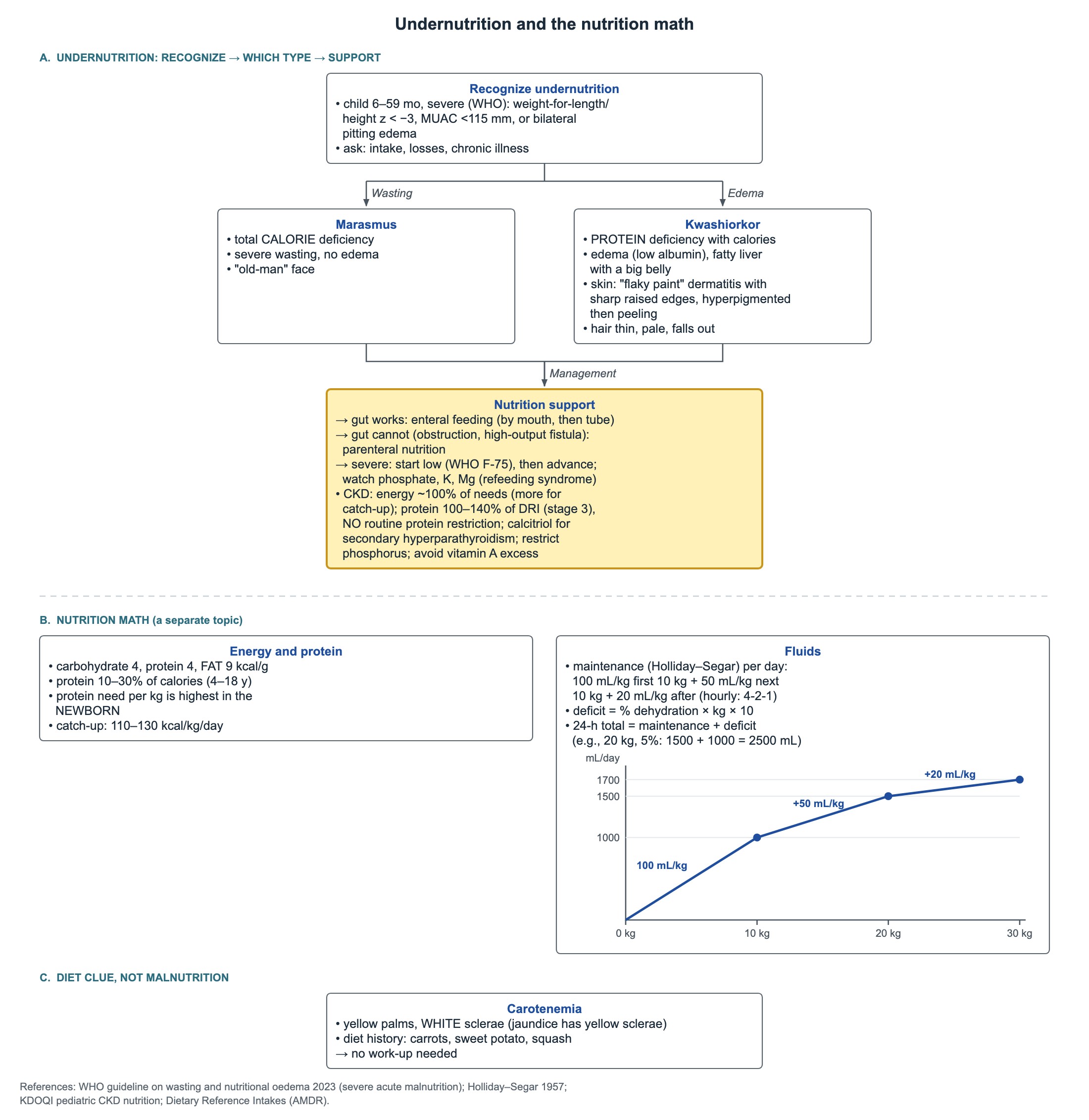
- If the gut works, use it: oral feeds first, then tube feeds if the child cannot eat enough.
- Parenteral nutrition delivers nutrients into a vein. Use it when the gut cannot meet needs, such as bowel obstruction or a high-output fistula.
- Severe malnutrition: start low (WHO F-75) and advance slowly.
- Watch phosphate, potassium and magnesium in the first days: refeeding syndrome.
Nutrition in chronic kidney disease
Growth failure is common in children with CKD, and poor intake is a major cause.
- Energy: start at 100% of the estimated energy requirement for age; raise it if growth lags.
- If oral intake cannot meet needs, use enteral tube feeding.
- Protein: no routine restriction in infants and young children; aim for 100–140% of the DRI in stage 3.
- Phosphorus: do not supplement; control high levels with dietary restriction and binders.
- Calcitriol (active vitamin D) treats secondary hyperparathyroidism.
- Avoid extra vitamin A: the kidneys clear its metabolites poorly, so toxicity is more likely.
Energy and protein
| Fact | Value |
|---|---|
| Carbohydrate | 4 kcal/g |
| Protein | 4 kcal/g |
| Fat | 9 kcal/g |
| Protein share of calories, 4–18 years | 10–30% |
| Highest protein need per kg | Newborn |
| Healthy term infant | About 100–110 kcal/kg/day |
| Catch-up growth (preterm, SGA, heart disease) | About 110–130 kcal/kg/day |
Maintenance fluids and dehydration deficit
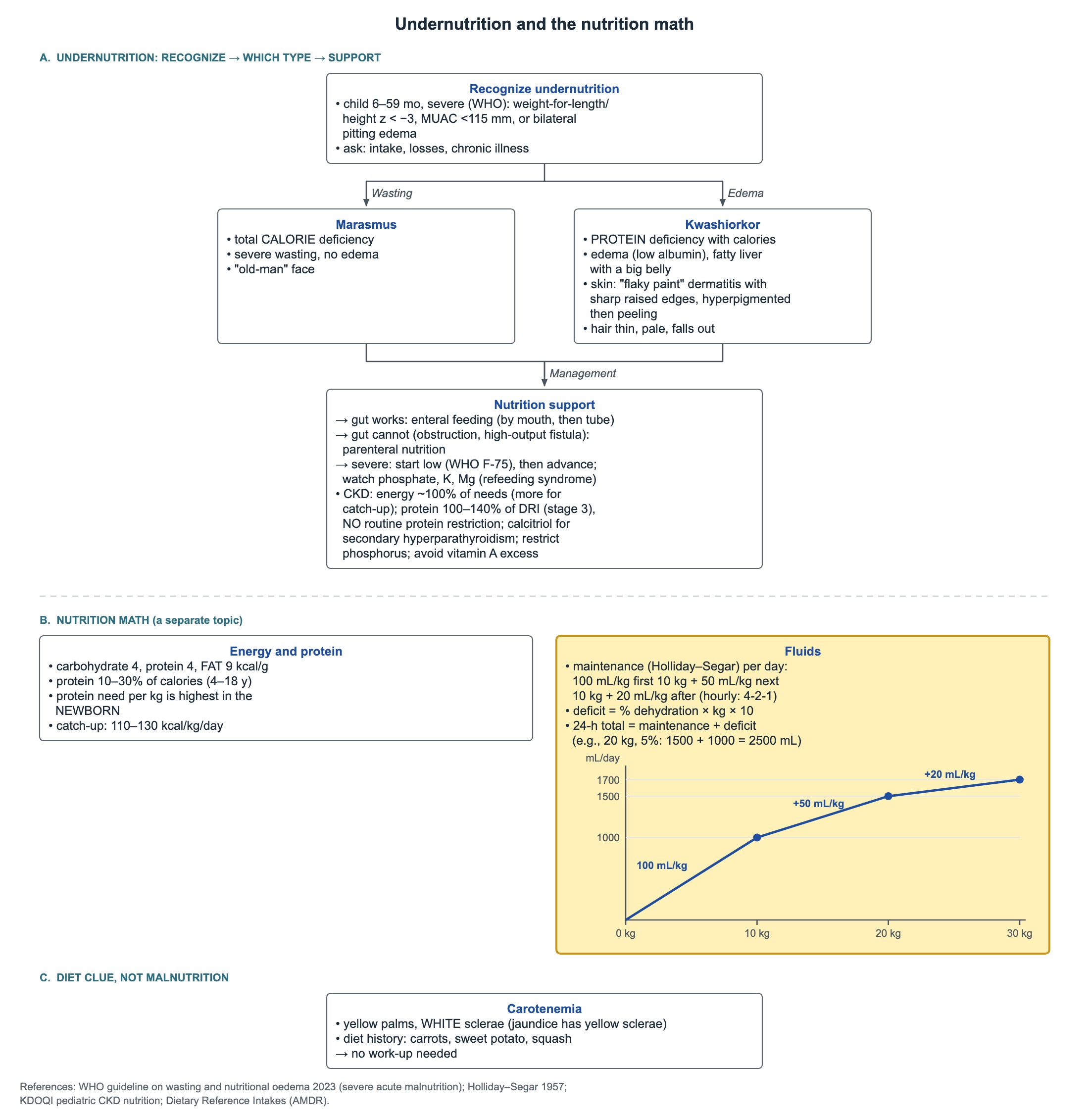
- Daily maintenance (Holliday–Segar): 100 mL/kg for the first 10 kg, plus 50 mL/kg for the next 10 kg, plus 20 mL/kg for each kg above 20.
- Hourly version (4-2-1): 4 mL/kg/h for the first 10 kg, 2 mL/kg/h for the next 10 kg, 1 mL/kg/h after.
- Deficit in mL = % dehydration × weight in kg × 10.
- 24-hour total = maintenance + deficit.
- Example: 15 kg, 7% dehydrated. Maintenance 1,000 + 250 = 1,250 mL; deficit 7 × 15 × 10 = 1,050 mL; total 2,300 mL.
- Example: 20 kg, 5% dehydrated. Maintenance 1,500 mL; deficit 1,000 mL; total 2,500 mL.
- For IV maintenance, the AAP advises isotonic fluid with potassium chloride and dextrose for most children.
Carotenemia: a diet clue, not malnutrition
- Yellow-orange palms and soles with white sclerae; jaundice turns the sclerae yellow.
- Comes from many carrots, sweet potatoes or squash: take a diet history, no work-up needed.
- In a thin teenager with carotenemia, screen for an eating disorder.
Common questions
How do you calculate maintenance fluids in children?
Use Holliday–Segar: 100 mL/kg/day for the first 10 kg, 50 mL/kg/day for the next 10 kg and 20 mL/kg/day for each kg after. Hourly, that is 4-2-1 mL/kg/h.
What is the difference between marasmus and kwashiorkor?
Marasmus is a total calorie deficit with severe wasting and no edema. Kwashiorkor shows edema, a fatty liver and flaky-paint skin; WHO calls it edematous malnutrition, and protein lack alone does not explain it.
How do you calculate a fluid deficit?
Multiply the percent dehydration by the weight in kg and by 10 to get mL. A 15-kg child who is 7% dehydrated has a deficit of 1,050 mL.
Study this topic
Sources
- Holliday MA, Segar WE: The maintenance need for water in parenteral fluid therapy (Pediatrics 1957)
- AAP 2018 clinical practice guideline: Maintenance intravenous fluids in children (Pediatrics)
- KDOQI clinical practice guideline for nutrition in children with CKD: 2008 update (Am J Kidney Dis)
- WHO 2023 guideline on the prevention and management of wasting and nutritional oedema
Written for Pedemy in our own words from the sources above; checked November 2026. For education only, not medical advice; check doses and local protocols before treating a patient. Pedemy is independent and not affiliated with or endorsed by the organizations cited.