

Main decision tree
Primary teeth and the dental home
Key points
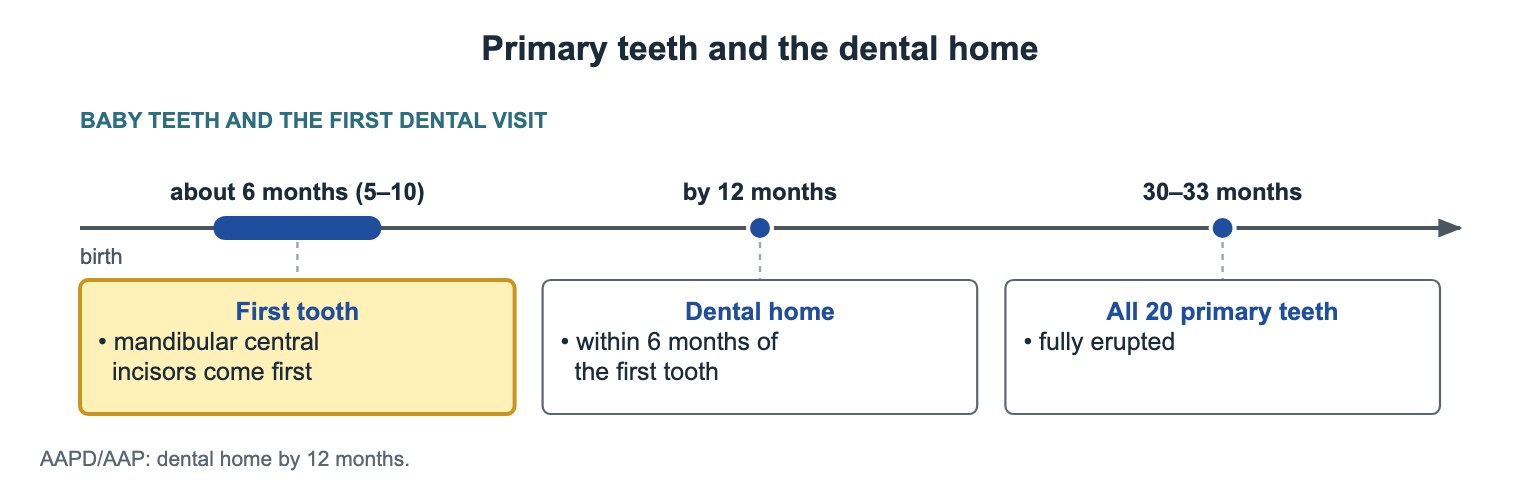
- First tooth at about 6 months (range 5–10 months); the mandibular central incisors come first.
- 20 primary teeth, all erupted by about 30–33 months.
- Dental home within 6 months of the first tooth and no later than 12 months of age.
- Fluoride varnish in the office every 3–6 months from the first tooth.
- Fluoride toothpaste: rice-grain smear from the first tooth to 3 years; pea-sized amount at 3–6 years.
- Dental abscess: drainage or extraction plus amoxicillin; clindamycin only for penicillin allergy.
- Fever, facial swelling with trismus or breathing difficulty → admit for IV antibiotics and drainage.
Tooth eruption
The first tooth appears at about 6 months, with a normal range of 5–10 months. A rough rule of thumb puts the first tooth near 7 months, give or take about 4 months.
By about 30–33 months all 20 primary teeth are in.
- Usual order: mandibular central incisors, then maxillary central incisors, lateral incisors, first molars, canines and second molars.
- Hypothyroidism is the classic endocrine cause of delayed eruption.
The dental home
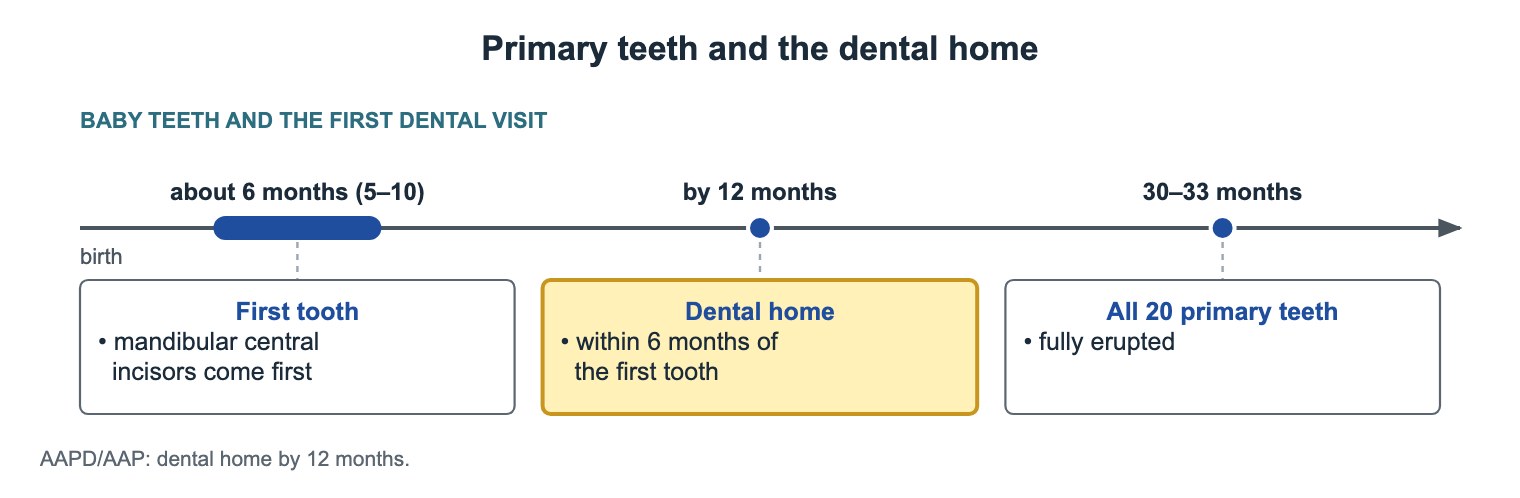
Every child should have a dental home within 6 months of the first tooth and no later than 12 months of age. Until then, and between dental visits, the pediatrician does oral health risk assessment, applies fluoride varnish and counsels the family.
Fluoride
- Fluoride varnish: apply in the office every 3–6 months to all children from the first tooth (USPSTF grade B for children up to 5 years).
- Toothpaste from the first tooth to 3 years: a smear the size of a grain of rice, twice a day.
- Toothpaste at 3–6 years: a pea-sized amount, twice a day; an adult helps with brushing.
- Oral fluoride supplements: only for children 6 months and older whose main water source is low in fluoride; check the water level before prescribing.
- Fluorosis: white flecks or streaks that can progress to brown pitting of enamel, from too much fluoride while teeth are forming.
| Stain | Cause |
|---|---|
| White flecks to brown pitting | Fluorosis (excess fluoride during tooth development) |
| Gray-brown bands | Tetracycline taken while teeth were forming |
How caries develop
Oral bacteria, especially Streptococcus mutans, ferment sugars into acid. The acid lowers plaque pH and demineralizes the enamel. Frequent sugar exposure gives the enamel no time to recover.
- No bottle or cup of milk or juice in bed.
- Breastfeeding beyond 12 months, especially frequent night-time feeding once other foods have started, raises the risk of early childhood caries; wipe or brush the teeth after the last feed.
- Limit juice and sugary drinks; water between meals.
Dental abscess
Caries with tooth pain and facial swelling suggests a dental abscess. Antibiotics alone do not cure it: the source must be treated by drainage, pulp treatment or extraction. An abscessed primary tooth is usually extracted.
- Clindamycin is not first-line in a child without allergy because of a higher risk of C. difficile infection.
- Fever, spreading facial swelling, trismus or breathing or swallowing difficulty: admit for IV antibiotics and urgent drainage.
| Situation | Antibiotic |
|---|---|
| No allergy | Amoxicillin, with drainage or extraction |
| Severe or not improving on amoxicillin | Amoxicillin-clavulanate; IV ampicillin-sulbactam if severe |
| Penicillin allergy | Clindamycin |
| Anaerobic coverage needed | Metronidazole as an add-on, never alone |
Common questions
When should a child first see a dentist?
Within 6 months of the first tooth and no later than the first birthday.
How much toothpaste should a toddler use?
A rice-grain smear of fluoride toothpaste from the first tooth until 3 years, then a pea-sized amount from 3 to 6 years.
What antibiotic is used for a tooth abscess in a child?
Amoxicillin, together with drainage or extraction. Amoxicillin-clavulanate is used if it is severe or not improving, and clindamycin for penicillin allergy.
Study this topic
Sources
- AAP 2020: Fluoride use in caries prevention in the primary care setting (Pediatrics)
- USPSTF 2021: Prevention of dental caries in children younger than 5 years
- AAP Bright Futures: Oral health
Written for Pedemy in our own words from the sources above; checked November 2026. For education only, not medical advice; check doses and local protocols before treating a patient. Pedemy is independent and not affiliated with or endorsed by the organizations cited.