

Main decision tree
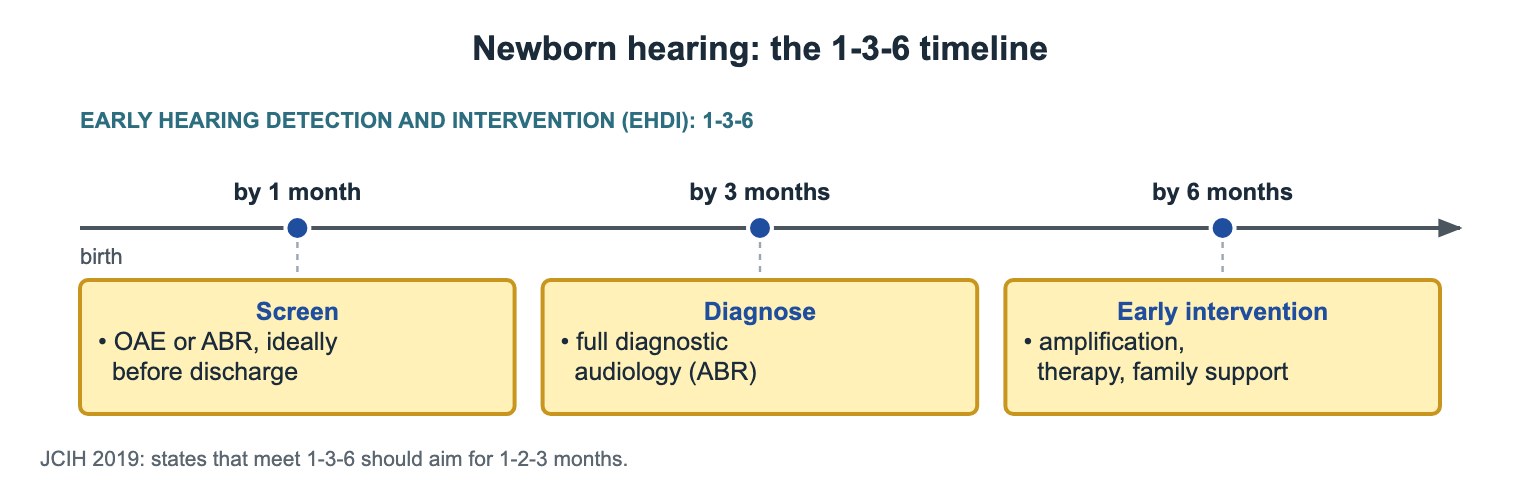
Newborn hearing: the 1-3-6 timeline
Key points
- Newborn hearing 1-3-6: screen by 1 month, diagnose by 3 months, early intervention by 6 months.
- OAE can miss neural hearing loss (auditory neuropathy); ABR does not.
- After bacterial meningitis, test hearing with ABR or audiology before discharge or soon after.
- Conventional screening audiometry in the office is reliable from about 4 years.
- Instrument-based vision screening from 12 months to 3 years; chart acuity from 4–5 years.
- At 4 years, refer if the child cannot read the 20/40 line with each eye.
- Strabismus check: corneal light reflex and unilateral cover test; abnormal → pediatric ophthalmology.
Newborn hearing: the 1-3-6 timeline
Every newborn has a hearing screen. The Early Hearing Detection and Intervention (EHDI) goals are a screen by 1 month, a full diagnostic audiology evaluation by 3 months for any baby who does not pass, and enrollment in early intervention by 6 months.
States that already meet 1-3-6 are encouraged to aim for 1-2-3 months.
- Screen: OAE or automated ABR, ideally before discharge from the birth hospital.
- Diagnose: full diagnostic audiology, including ABR, by 3 months.
- Intervene: hearing aids or other amplification, therapy and family support by 6 months.
- Babies in the NICU for more than 5 days are screened with ABR, because they are at higher risk of auditory neuropathy.
Which hearing test, and at what age
Otoacoustic emissions (OAE) test the outer hair cells of the cochlea. They can be normal when the auditory nerve does not work, so OAE misses neural hearing loss (auditory neuropathy). Auditory brainstem response (ABR) tests the pathway up to the brainstem and finds both.
Bacterial meningitis is a leading cause of acquired hearing loss. A child recovering from it needs ABR or a full audiology evaluation before discharge or as soon as possible, because early cochlear ossification can limit cochlear implant options.
- Bright Futures: audiometry at 4, 5, 6, 8 and 10 years, and a risk assessment at other visits.
- Adolescents: one hearing screen in each of the 11–14, 15–17 and 18–21 year age bands, including high frequencies (noise-induced loss).
- Refer at any age if parents are worried about hearing or speech, whatever earlier screens showed.
| Age | Usual test |
|---|---|
| Newborn | OAE or automated ABR |
| About 6 months to 2 years | Visual reinforcement audiometry (audiologist) |
| About 2–4 years | Play audiometry |
| From about 4 years | Conventional screening audiometry in the office |
| Any age, cannot cooperate | ABR |
Vision screening by age
From birth, every visit includes a red reflex test, an eye inspection and a check of fixation and following. An absent, dull or white reflex (leukocoria) needs urgent ophthalmology referral.
Instrument-based screening (photoscreening or autorefraction) can be done from 12 months and is preferred from 1 to 3 years. It looks for risk factors for amblyopia, such as high refractive error, unequal refraction between the eyes and strabismus. Chart-based visual acuity starts at 4–5 years, when most children can cooperate; instrument screening is an alternative until then.
Visual acuity keeps improving through early childhood and reaches the adult level of 20/20 by about 5–7 years.
- Use age-appropriate optotypes such as LEA symbols or HOTV letters, with one eye covered at a time.
- Also refer for a 2-line difference between the eyes, even if both pass.
| Age | Refer if the child cannot read (each eye) |
|---|---|
| 3 years | 20/50 line |
| 4 years | 20/40 line |
| 5 years and older | 20/32 line (or 20/30 on some charts) |
Corneal light reflex (Hirschberg test)
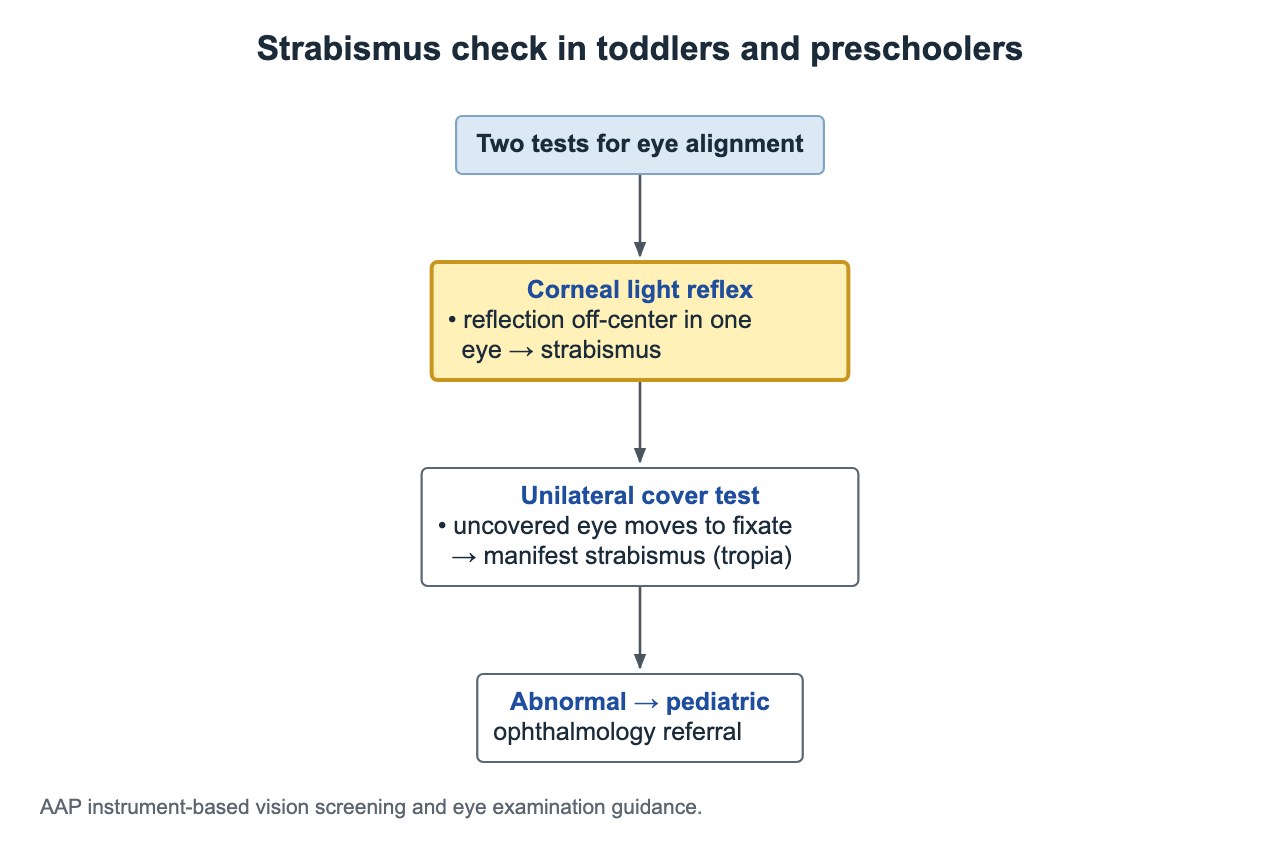
The child looks at a penlight held in front of the face. The light reflection should sit in the same spot on both corneas.
A reflection that is off-center in one eye suggests strabismus. Wide nasal bridges and epicanthal folds can make the eyes look crossed (pseudostrabismus), but the light reflex is symmetric.
Unilateral cover test
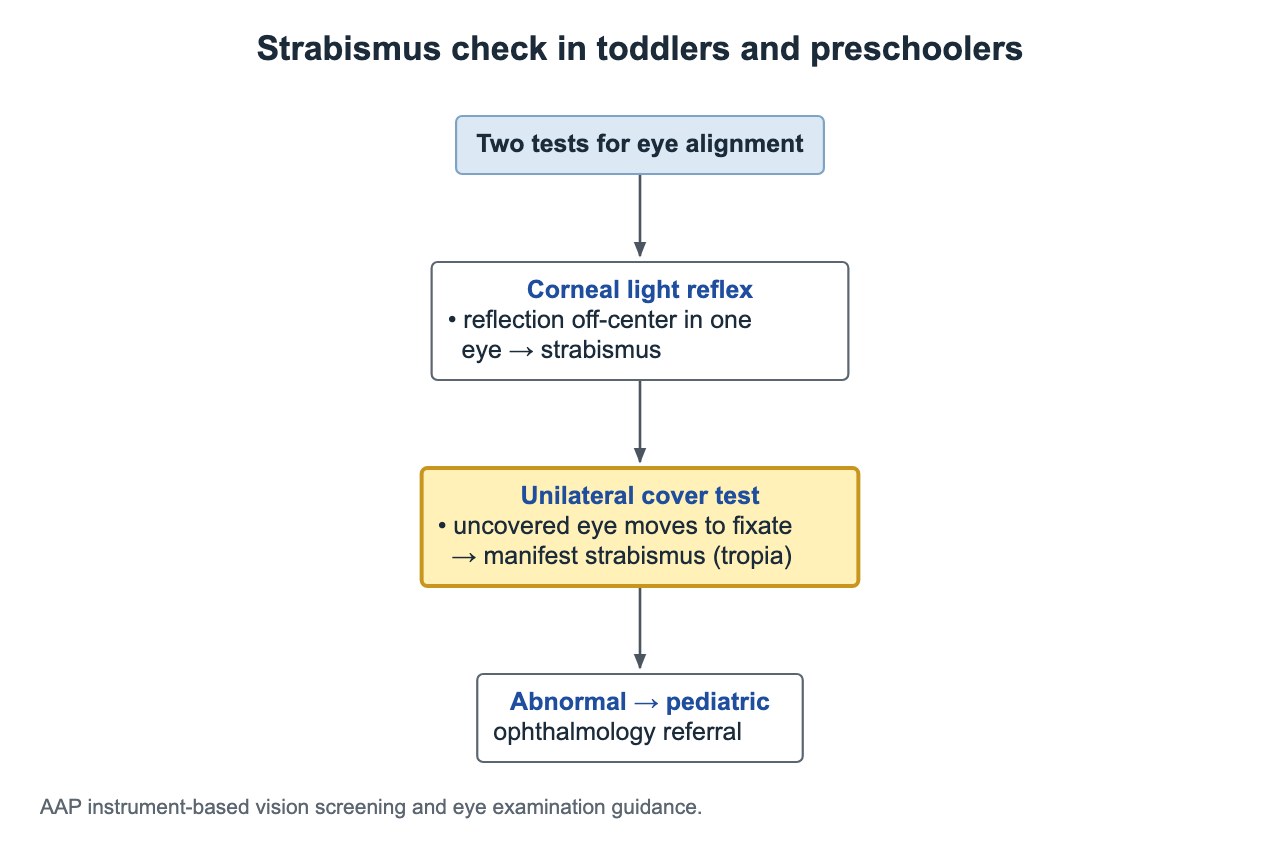
The child fixes on a target while one eye is covered. Watch the uncovered eye.
If the uncovered eye moves to take up fixation, it was not aligned before: this is manifest strabismus (a tropia). Repeat on the other side.
The corneal light reflex and the unilateral cover test are the two tests used to check eye alignment in toddlers and preschoolers. Any abnormal result needs referral to pediatric ophthalmology, because untreated strabismus can cause amblyopia.
Common questions
What is the 1-3-6 rule for newborn hearing?
Screen hearing by 1 month, confirm hearing loss with diagnostic audiology by 3 months, and start early intervention by 6 months.
What is the difference between OAE and ABR?
OAE tests the cochlea's outer hair cells and can miss auditory neuropathy. ABR measures the nerve pathway to the brainstem, so it detects both cochlear and neural hearing loss.
At what age should a child have an eye chart test?
Chart-based visual acuity usually starts at 4–5 years. From 1 to 3 years, instrument-based screening is used instead.
Study this topic
Sources
- Joint Committee on Infant Hearing: Year 2019 Position Statement
- AAP: Hearing Assessment in Infants, Children, and Adolescents: Recommendations Beyond Neonatal Screening (Pediatrics 2023)
- AAP/AAPOS/AAO: Visual System Assessment in Infants, Children, and Young Adults by Pediatricians (Pediatrics 2016)
- AAP/Bright Futures: Recommendations for Preventive Pediatric Health Care (periodicity schedule)
Written for Pedemy in our own words from the sources above; checked November 2026. For education only, not medical advice; check doses and local protocols before treating a patient. Pedemy is independent and not affiliated with or endorsed by the organizations cited.