

Main decision tree
Four principles of medical ethics
Key points
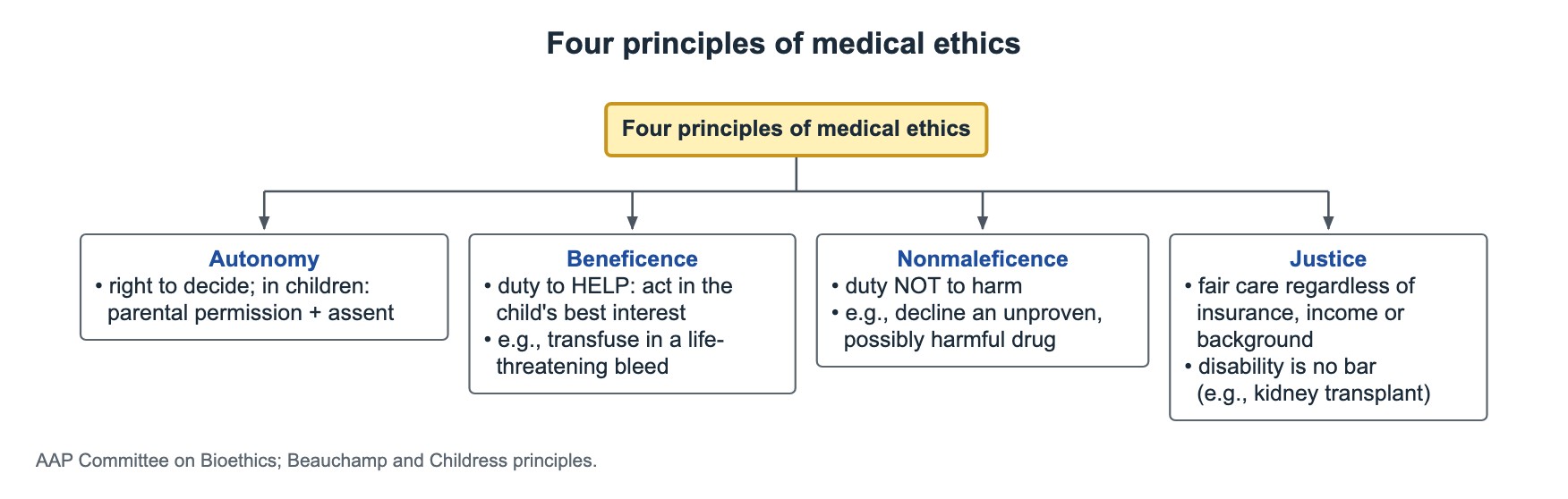
- Four principles: autonomy, beneficence (duty to help), nonmaleficence (duty not to harm) and justice (fair care for all).
- Children who cannot consent: decide by the child's best interests, with parental permission plus the child's assent.
- Adolescent confidentiality has limits: explain them up front (safety risk, mandated reporting).
- There is no universal age at which a minor can consent to all care; it depends on state law, the service and the minor's legal status.
- Refusal that risks serious harm (e.g., DKA, shock from bleeding): treat the emergency and escalate to ethics, legal and child protection.
- Predictive testing for adult-onset disease (e.g., BRCA1): defer to adulthood unless a beneficial intervention starts in childhood.
- Limited English proficiency: use a professional medical interpreter (in person, then video, then phone), not family members.
The four principles of medical ethics
For a teen on dialysis with severe intellectual disability, disability is not a reason to deny transplant listing; the team uses shared decision-making with the family.
Artificial fluids and nutrition are medical treatments. When life support is withdrawn because recovery is impossible, they may be stopped on the same basis as any other treatment: they offer no net benefit.
| Principle | Meaning | Board example |
|---|---|---|
| Autonomy | The right to decide; in children, parental permission plus assent | A teen helps choose among reasonable options |
| Beneficence | Duty to help: act in the child's best interest | Transfuse a child in shock from bleeding despite parental refusal |
| Nonmaleficence | Duty not to harm | Decline an unproven, possibly harmful drug for a dying teen |
| Justice | Fair care regardless of insurance, income or background | Intellectual disability alone does not bar a kidney transplant |
Parental permission and the child's assent
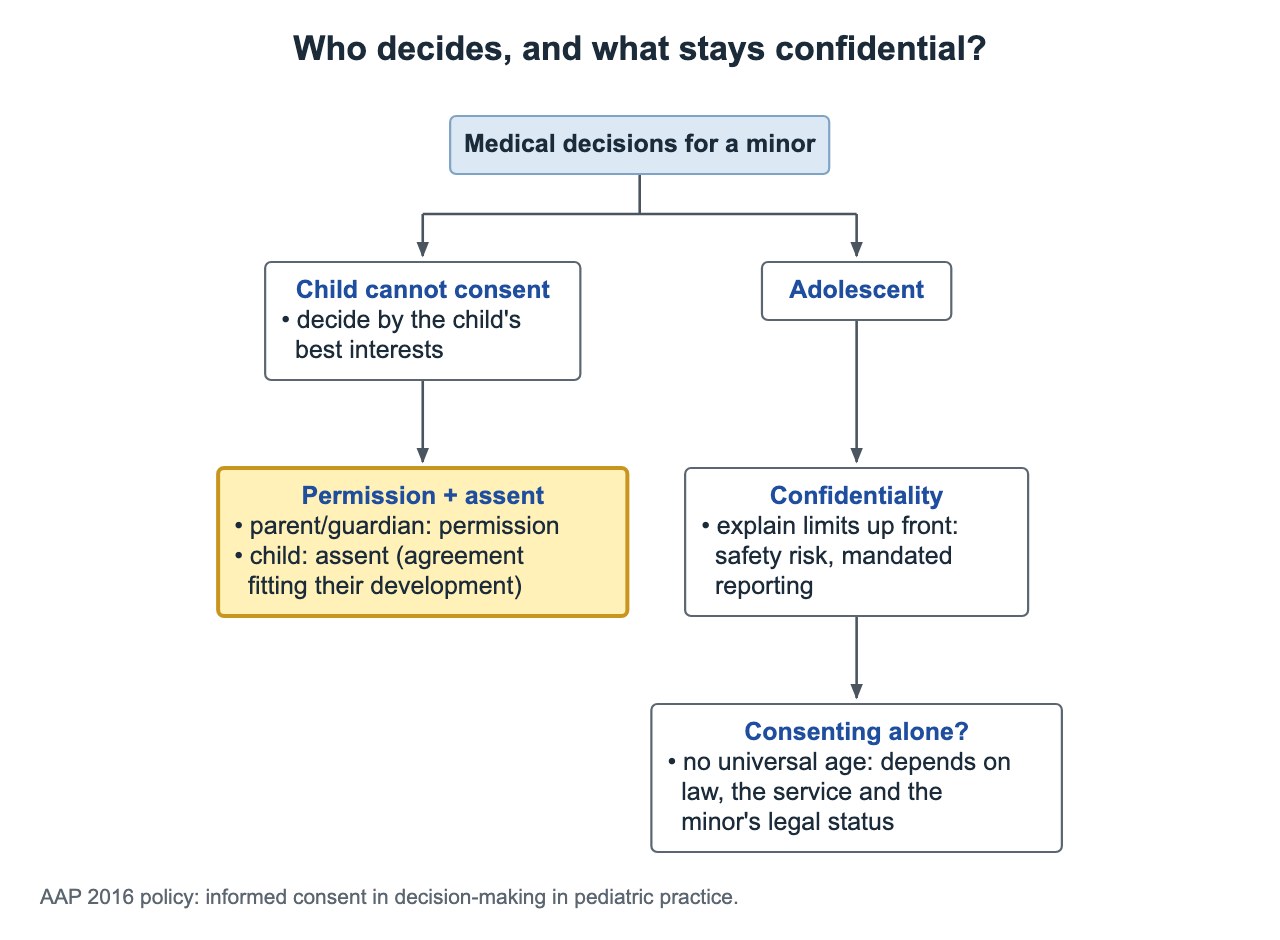
- Most children cannot give legal informed consent. Decisions follow the child's best interests.
- Parental permission: the parent or guardian authorizes care.
- Assent: the child's agreement, sought in a way that fits the child's development.
- Involve the child more as maturity grows; an older child's dissent carries weight, especially for non-urgent or research interventions.
Adolescent confidentiality and minor consent
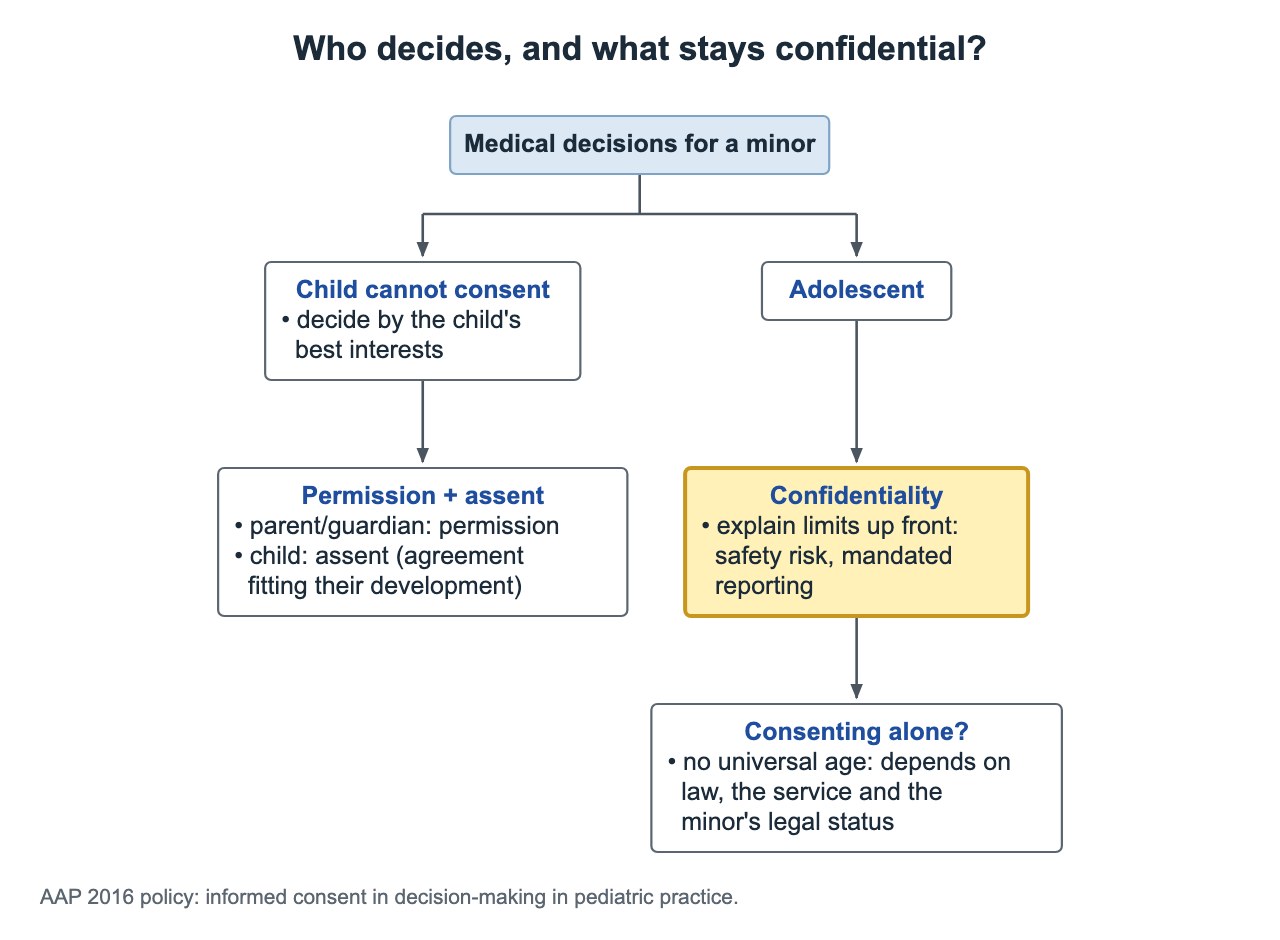
Time alone with the adolescent is routine. Before the conversation, explain what stays private and what does not.
- Confidentiality is not absolute. Limits include serious risk to the teen or others and legally required reporting such as abuse.
- Consenting alone: there is no single age, such as 14, at which a minor can consent to all care.
- Authority depends on state law, the type of service (for example, sexual health, substance use or mental health care) and the minor's legal status, such as emancipation.
When parents decline recommended care
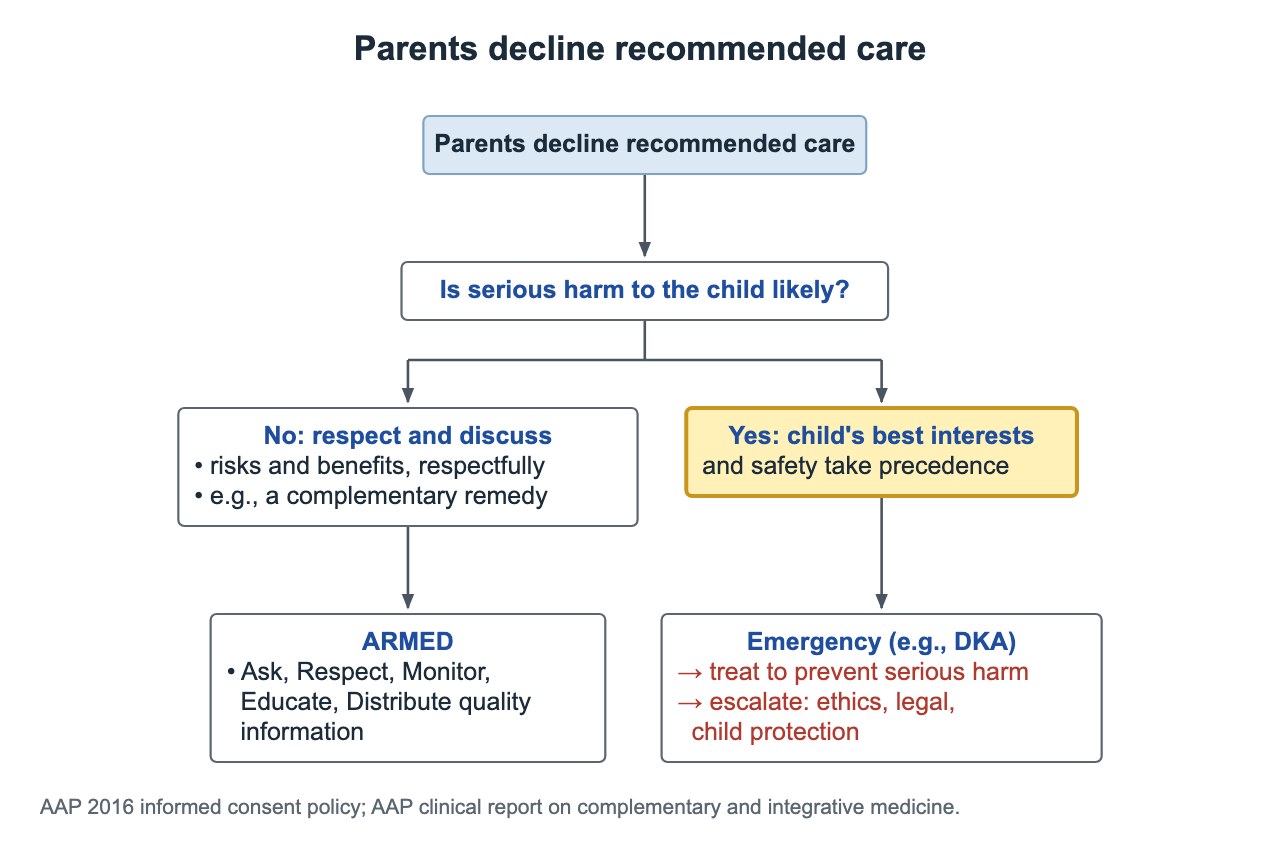
First ask: is serious harm to the child likely? If not, respect the family and discuss risks and benefits. If yes, the child's best interests and safety take precedence.
- Complementary or alternative remedy with no neglect concern: discuss risks and benefits respectfully and keep the relationship.
- ARMED approach: Ask about all remedies, Respect the family's beliefs, Monitor the child, Educate, Distribute quality information.
- Look for interactions between supplements and prescribed medicines.
Refusal in an emergency
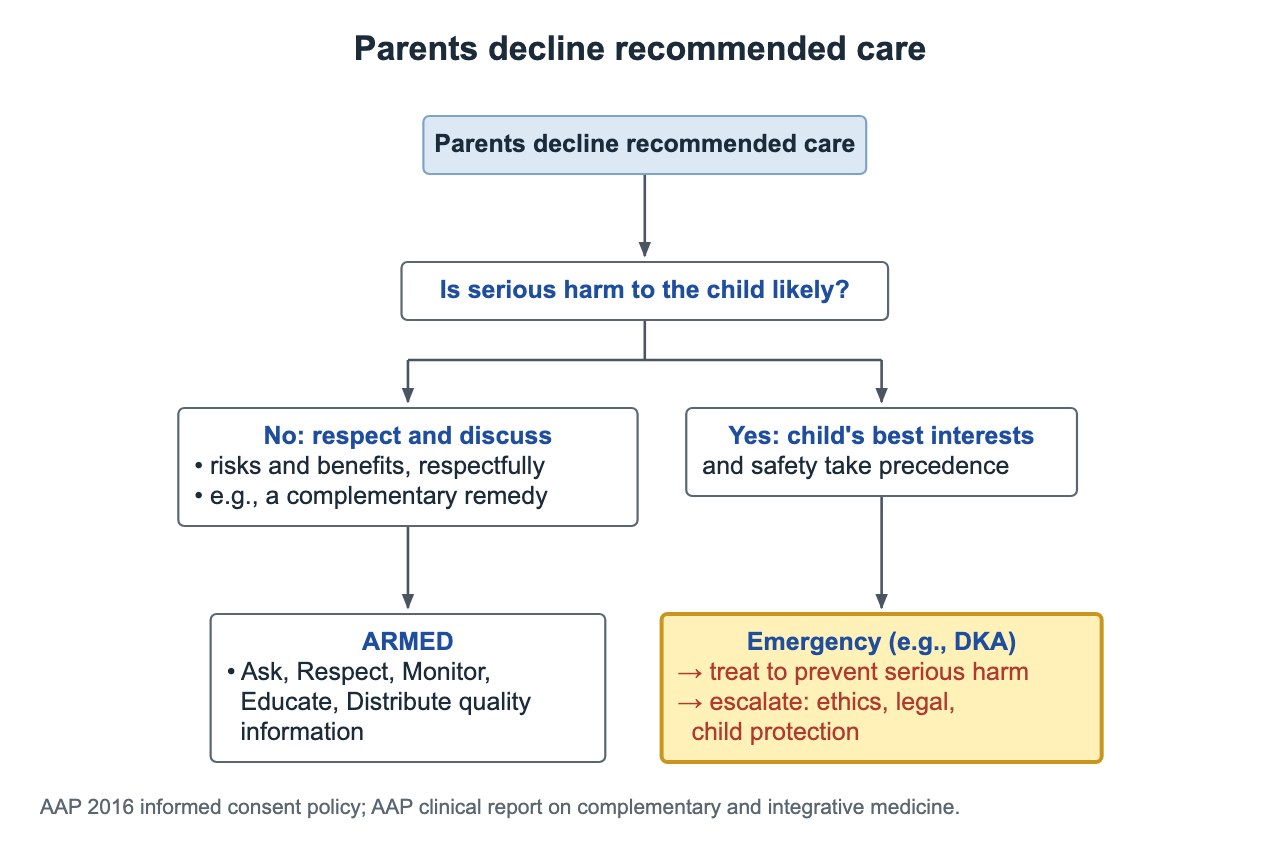
- Parents refuse urgent treatment for a young child with life-threatening DKA on religious grounds: the team does not accept the refusal. Give emergency care to prevent serious harm.
- Parents refuse a blood transfusion for a child in shock from bleeding: transfuse (beneficence).
- Escalate at once through ethics, legal and child protection pathways; a court order may be sought, but do not delay life-saving care.
Predictive genetic testing in minors
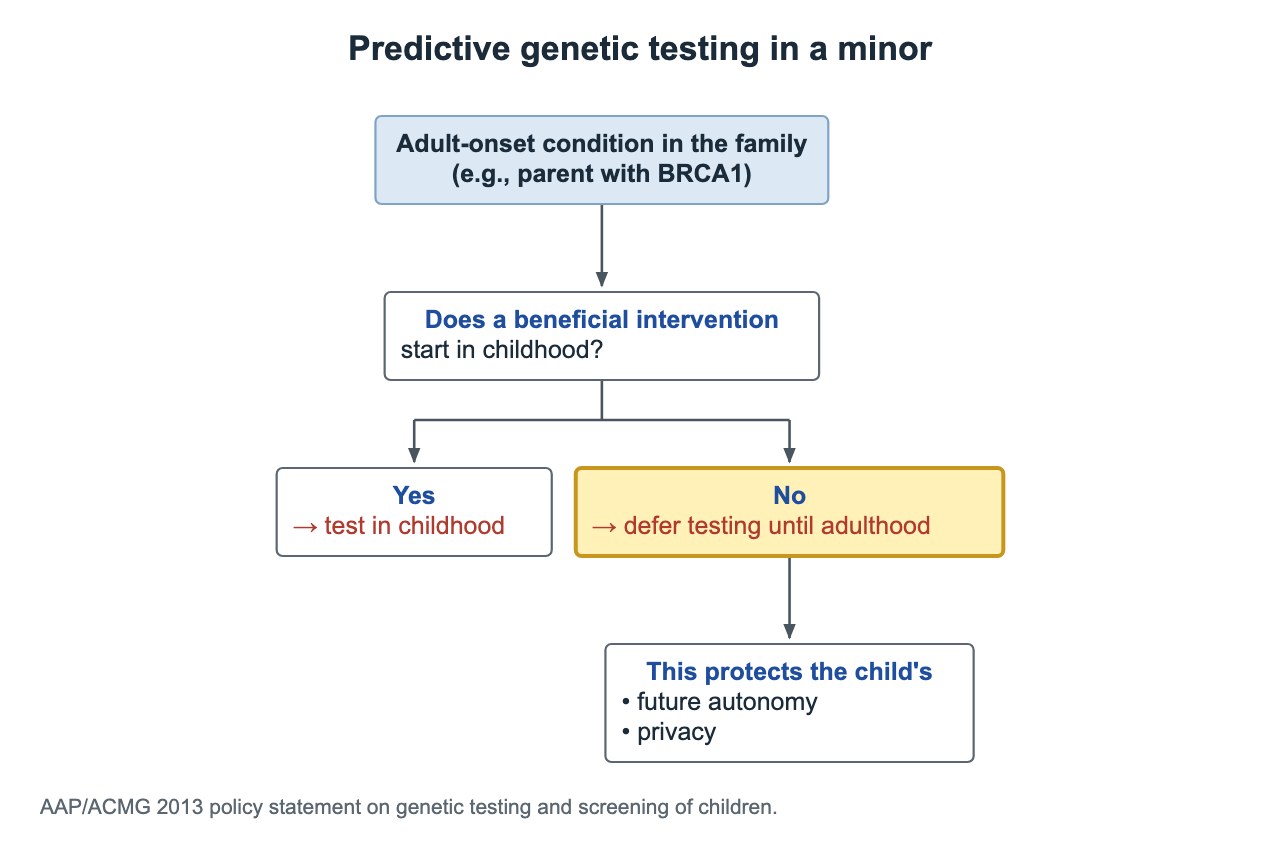
For an adult-onset condition in the family, ask whether a beneficial intervention starts in childhood.
- Yes (for example, familial adenomatous polyposis, where colon screening starts in childhood): test in childhood.
- No (for example, a healthy 14-year-old whose parent carries BRCA1): defer testing until adulthood, age 18.
- Deferring protects the child's future autonomy (the right to decide for themselves) and privacy.
Families with limited English proficiency
Limited English proficiency means self-reported English ability less than very well. Offer a professional medical interpreter whenever this applies, even if the family seems to understand some English.
- Best: an in-person professional medical interpreter, especially for consent to procedures such as bone marrow aspiration.
- No in-person interpreter: professional video interpreting is better than telephone.
- On a telehealth visit, add a professional interpreter now rather than waiting for an English-speaking relative.
- Do not use family members, including a bilingual adult sibling, unless the family declines a professional interpreter. Family interpreters make errors, breach confidentiality and can block disclosure of abuse or intimate partner violence.
- Speak to and look at the patient and family, not the interpreter.
- Confirm understanding with teach-back: the family repeats the key points.
- Document the interpreter's name or ID number, the service used and the language.
Common questions
What is the difference between assent and consent in pediatrics?
Consent (permission) comes from the parent or guardian. Assent is the child's own agreement, sought in a way that fits the child's development.
At what age can a minor consent to medical care?
There is no single age. It depends on state law, the type of service and the minor's legal status, such as emancipation.
Can parents refuse life-saving treatment for their child?
No. When refusal risks serious harm, clinicians give emergency care and involve ethics, legal and child protection services.
Can a family member interpret for a medical visit?
Use a professional medical interpreter. Family members, especially children, should not interpret unless the family declines professional help.
Study this topic
Sources
- AAP: Informed consent in decision-making in pediatric practice (Pediatrics 2016)
- AAP/ACMG: Ethical and policy issues in genetic testing and screening of children (Pediatrics 2013)
- AAP: Pediatric integrative medicine (Pediatrics 2017)
- AAP: Providing care for children in immigrant families (Pediatrics 2019)
Written for Pedemy in our own words from the sources above; checked November 2026. For education only, not medical advice; check doses and local protocols before treating a patient. Pedemy is independent and not affiliated with or endorsed by the organizations cited.