

Main decision tree
Pharmacokinetics: interactions
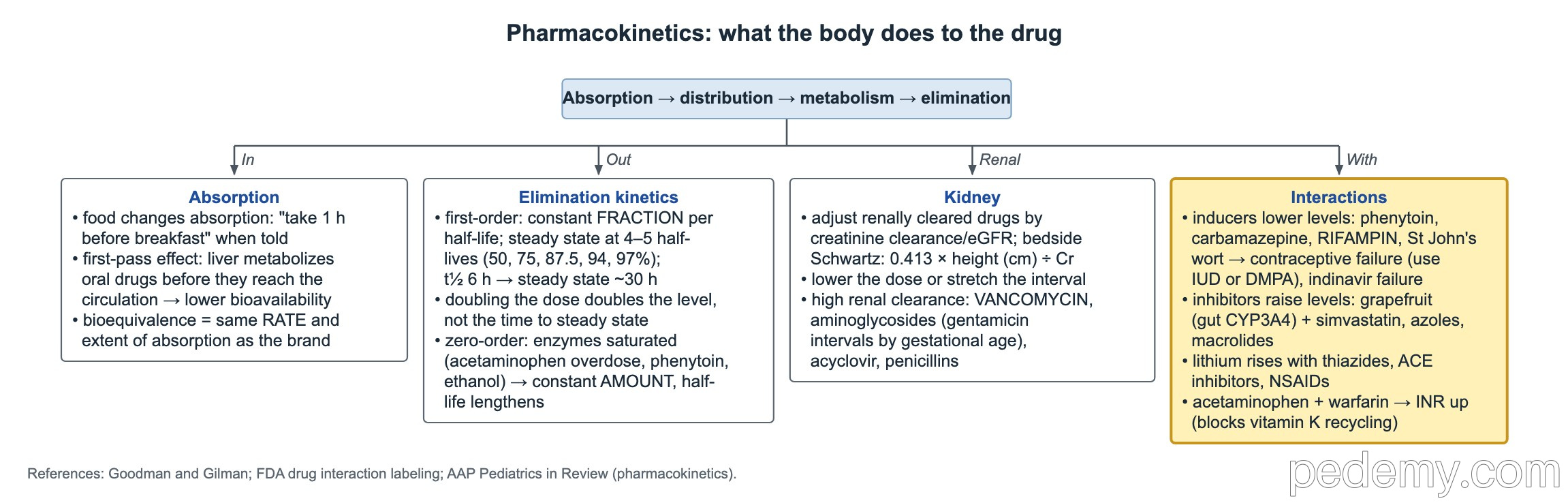
Key points
- Inducers lower levels: phenytoin, carbamazepine, rifampin, St John's wort.
- Inhibitors raise levels: grapefruit (gut CYP3A4), azole antifungals, macrolides.
- Grapefruit with simvastatin: higher statin exposure; avoid grapefruit and its juice.
- St John's wort lowers indinavir and can make hormonal contraception fail.
- Regular acetaminophen raises the INR on warfarin by interfering with vitamin K recycling.
- Thiazides, ACE inhibitors and NSAIDs raise lithium levels; aspirin does not.
Inducers and inhibitors
Drug levels that fall despite reported adherence and no new prescriptions point to a missed history: ask about OTC medicines, herbal products, supplements and recent food or drink changes.
| Type | Effect | Examples |
|---|---|---|
| Enzyme or transporter inducers | Lower levels of other drugs | Phenytoin, carbamazepine, rifampin, St John's wort |
| Enzyme inhibitors | Raise levels of other drugs | Grapefruit (gut CYP3A4), azole antifungals, macrolides |
| Renal handling | Raise lithium levels | Thiazides, ACE inhibitors, NSAIDs |
| Vitamin K cycle | Raises INR on warfarin | Regular acetaminophen |
Grapefruit and simvastatin
- Grapefruit inhibits CYP3A4 in the gut wall, so less drug is broken down on the first pass.
- More of a susceptible oral drug, such as simvastatin, reaches the blood; myopathy risk rises.
- Patients on simvastatin should avoid grapefruit and grapefruit juice.
- Intravenous drugs are not affected in the same way, because the effect is in the gut.
St John's wort
- St John's wort induces drug-metabolizing enzymes and transporters, lowering exposure to many drugs.
- Indinavir levels fall, which risks HIV treatment failure and resistance.
- Next step: stop the supplement and promptly review the antiretroviral regimen with the HIV team.
- It can also cause hormonal contraceptive failure; an IUD or DMPA avoids this.
Acetaminophen and warfarin
Regular acetaminophen use (not a single dose) can raise the INR in a patient on warfarin. It interrupts vitamin K recycling, which lowers the active clotting factors II, VII, IX and X. Check the INR more often when regular acetaminophen starts or stops.
Lithium
- Hydrochlorothiazide and other thiazides raise lithium levels.
- ACE inhibitors and most NSAIDs also raise lithium levels.
- Aspirin does not raise lithium levels.
- Lithium has a narrow therapeutic range: check levels after any of these changes.
Common questions
Why is grapefruit dangerous with some medicines?
It blocks CYP3A4 in the gut, so more of the drug is absorbed. Simvastatin levels rise and so does the risk of muscle injury.
Which drugs raise lithium levels?
Thiazide diuretics, ACE inhibitors and NSAIDs. Aspirin does not.
Does acetaminophen interact with warfarin?
Yes. Regular use can raise the INR, so monitor more closely.
Study this topic
Sources
- FDA: Grapefruit juice and some drugs don't mix
- NIH NCCIH: St. John's wort
- Piscitelli SC et al. Indinavir concentrations and St John's wort (Lancet 2000)
Written for Pedemy in our own words from the sources above; checked November 2026. For education only, not medical advice; check doses and local protocols before treating a patient. Pedemy is independent and not affiliated with or endorsed by the organizations cited.