

Main decision tree
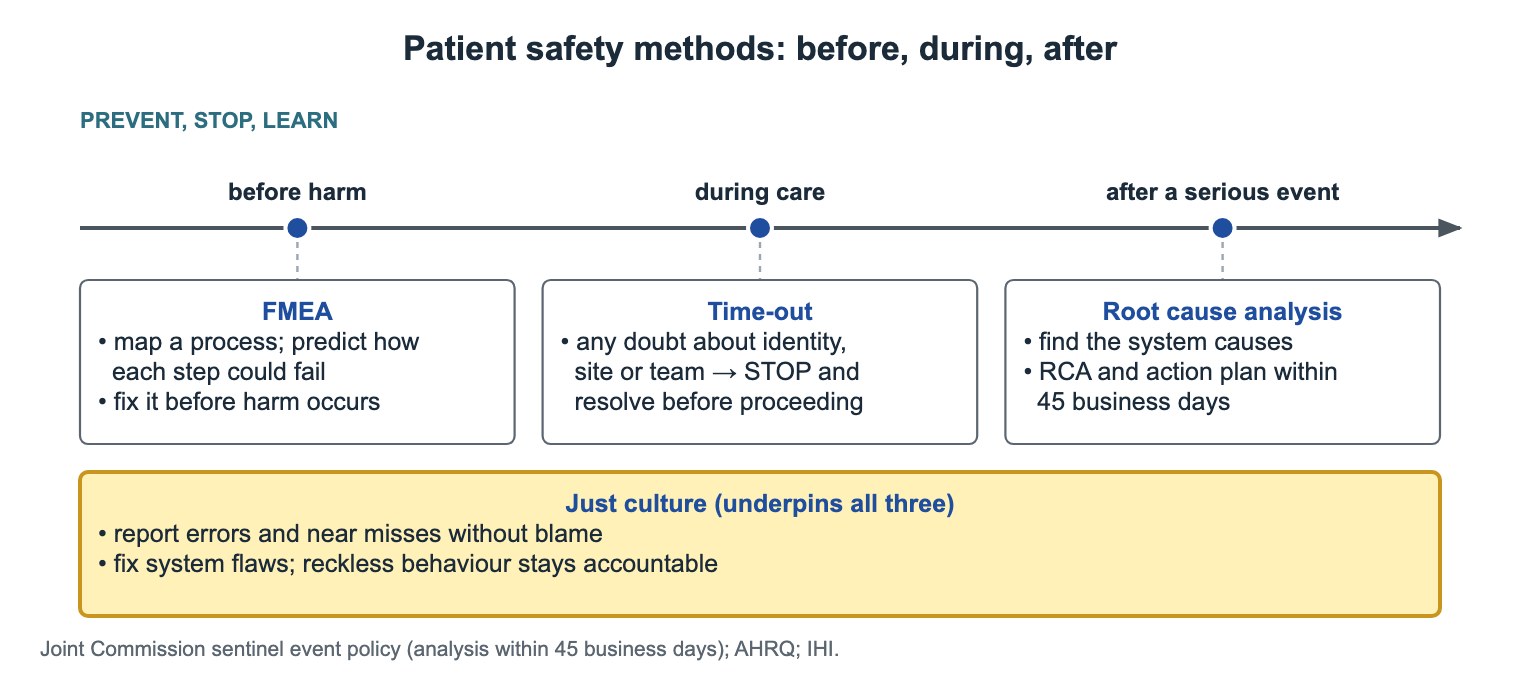
Patient safety methods: before, during, after
Key points
- Just culture: report errors and near misses without blame and fix system flaws; reckless behavior stays accountable.
- FMEA maps a process and predicts how each step could fail, before harm occurs.
- Time-out: any doubt about identity, site or team → stop and resolve before proceeding.
- Joint Commission: root cause analysis and action plan within 45 business days of a sentinel event or of learning about it.
- Near miss: an error caught before it reaches the child.
- From January 1, 2027 the Joint Commission sentinel event list aligns with the NQF Serious Reportable Events list.
- Reporting an adverse drug reaction to FDA MedWatch is voluntary for clinicians.
Just culture
Most serious errors come from flawed systems, not careless people. When a process failed and nobody acted recklessly, the right response is to encourage reporting without blame and fix the system flaw.
Just culture is not a no-blame culture: reckless behavior, such as knowingly skipping a safety step without reason, stays accountable.
Before harm: failure modes and effects analysis
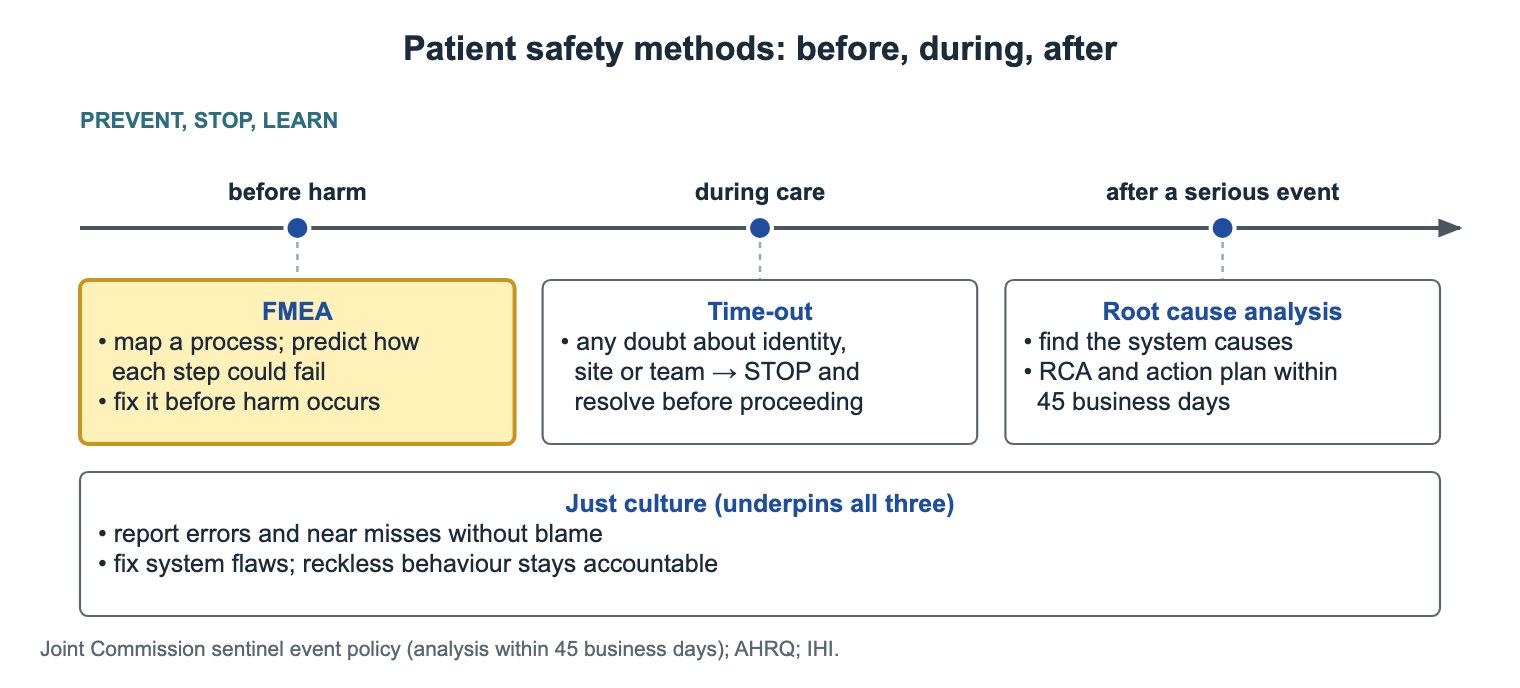
- FMEA is prospective: the team maps each step of a process and predicts how each step could fail.
- It ranks the failures by how likely and how harmful they are, then fixes the riskiest steps before an event occurs.
- Contrast: root cause analysis looks back after an event has happened.
During care: the time-out
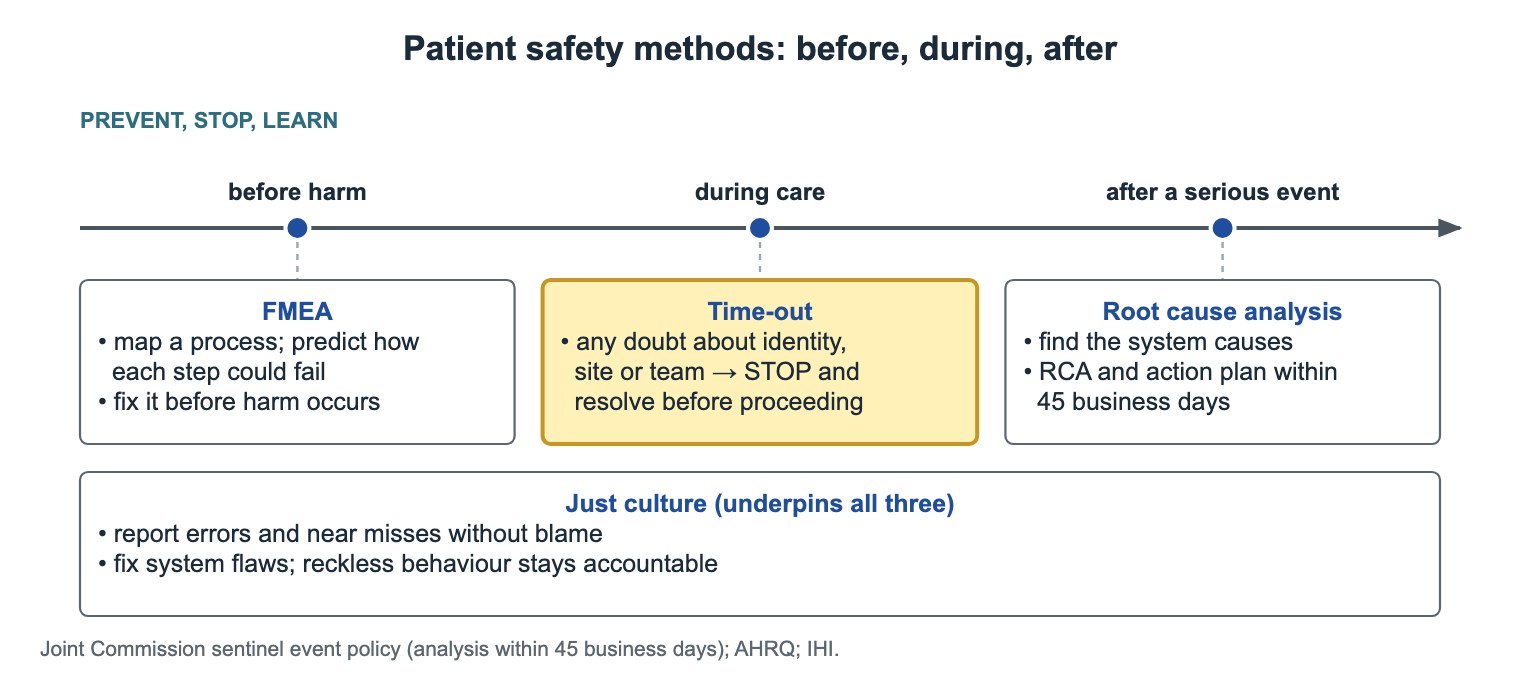
The Universal Protocol requires a time-out immediately before a procedure to confirm the right patient, the right procedure and the right site, with the whole required team present.
- If patient identity is uncertain or the operating clinician is absent, stop.
- Resolve the discrepancy with the required team before anyone proceeds.
- Any team member can and should speak up.
After a serious event: root cause analysis
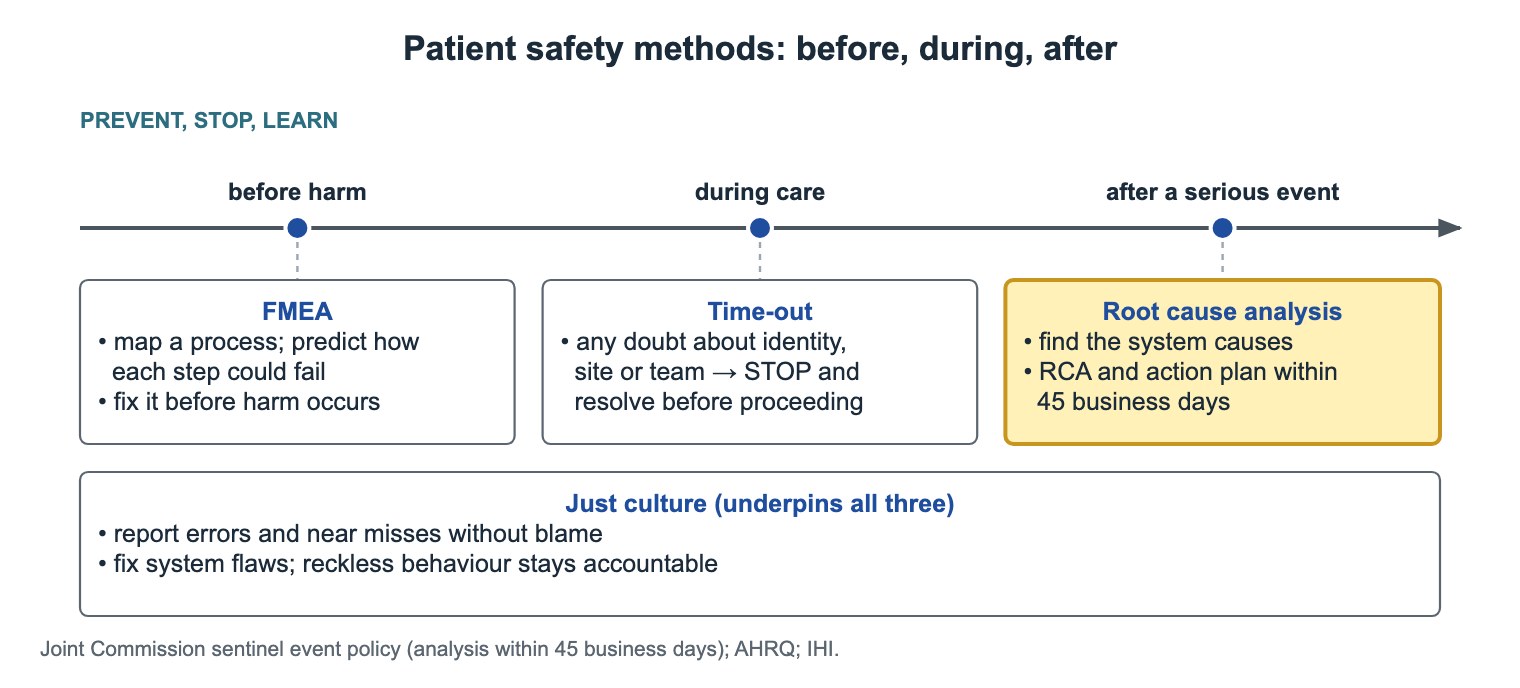
- RCA is retrospective: review records, interview staff and identify the system causes of an event, for example repeated vaccine mix-ups.
- It asks why the system allowed the error, not who made it.
- Joint Commission: complete the RCA and action plan within 45 business days of the sentinel event or of learning about it.
Classify the safety event
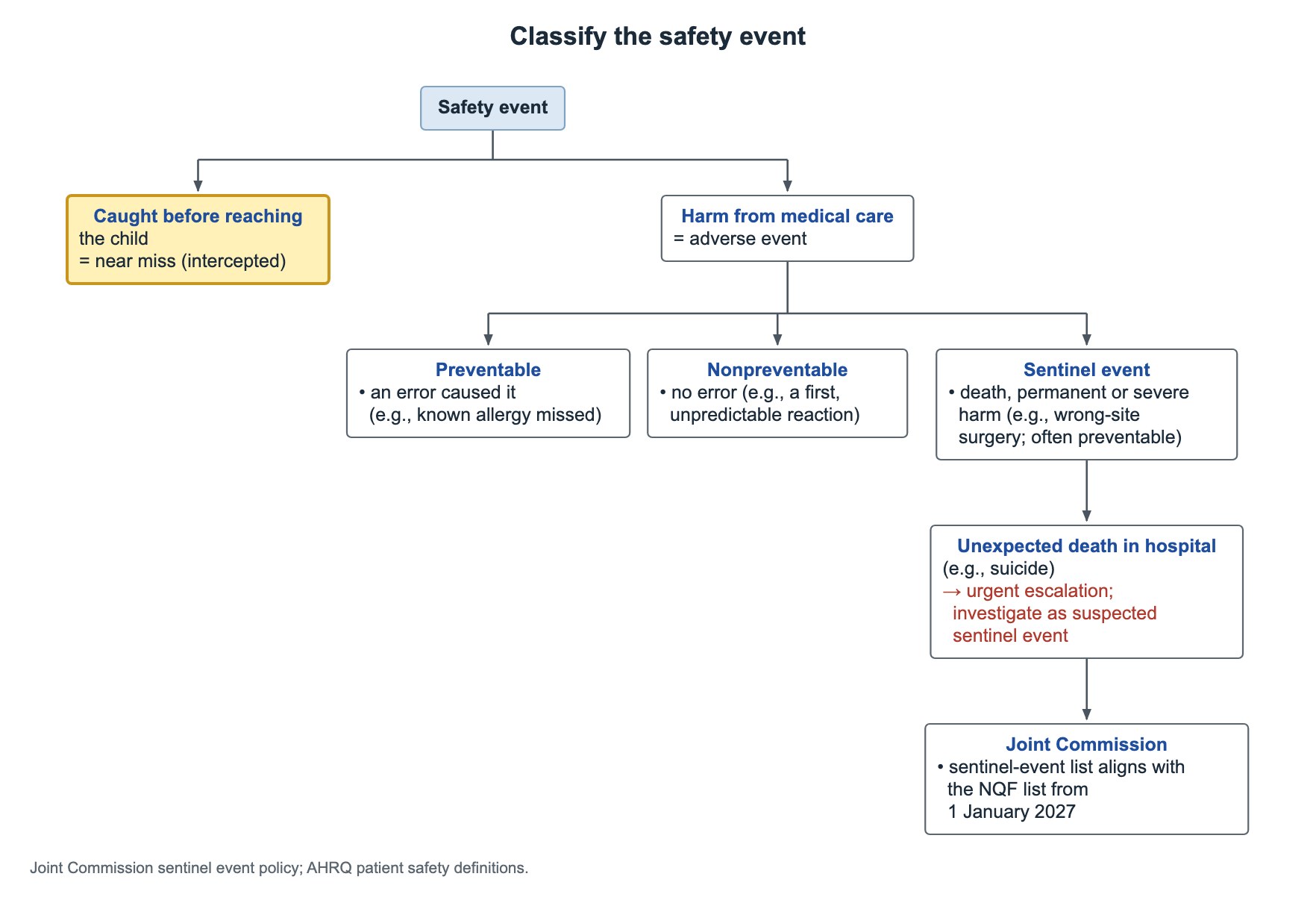
| Event | Definition | Example |
|---|---|---|
| Near miss (intercepted error) | An error caught before it reaches the child | Penicillin order stopped after the allergy is noticed, before any dose |
| Preventable adverse event | Harm caused by an error | A known serious penicillin allergy is missed; ampicillin causes anaphylaxis |
| Nonpreventable adverse event | Harm from care with no error | A first, unpredictable allergic reaction to cefazolin given after a proper allergy review |
| Sentinel event | Death, permanent harm or severe temporary harm from care; often preventable | Wrong-leg amputation after a mislabeled image |
Sentinel events and urgent escalation
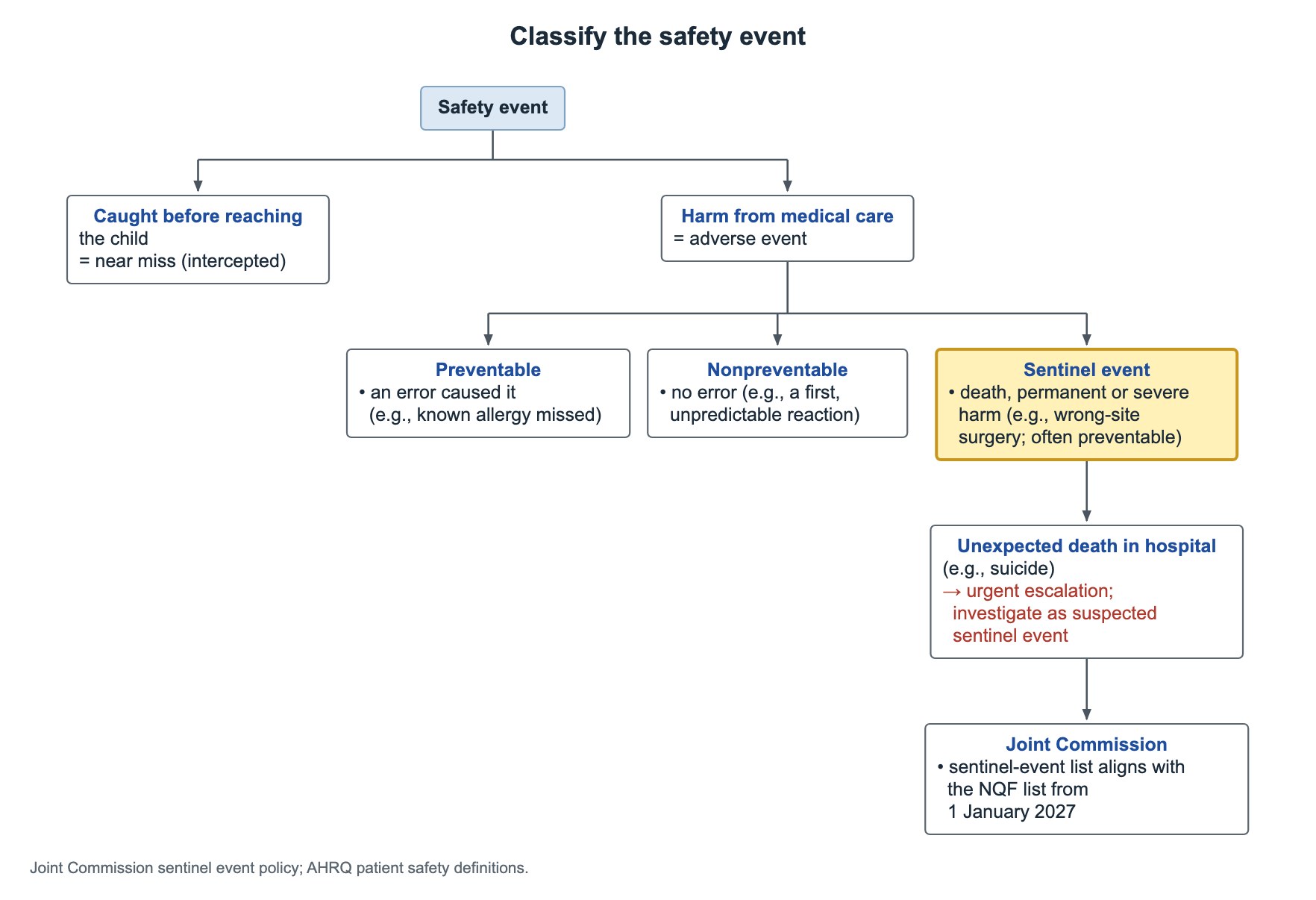
- Wrong-site surgery, such as amputation of the wrong leg after a mislabeled image, is both a sentinel event and a preventable adverse event.
- An unexpected death in hospital, such as an adolescent admitted after self-poisoning found dead with a syringe nearby, needs urgent safety escalation and investigation as a suspected sentinel event.
- From January 1, 2027, the Joint Commission sentinel event list is aligned with the National Quality Forum Serious Reportable Events list.
- Staff safety matters too: if a parent keeps threatening or stays aggressive despite de-escalation, call for help (security) and follow the office safety policy.
Medication safety and adverse drug reactions
- Look-alike, sound-alike (LASA) error: clonidine ordered, clonazepam dispensed.
- Safeguard: tall man lettering in the EHR and on labels (cloniDINE vs clonazePAM).
- Using only generic names does not prevent LASA errors; generic names can also look or sound alike.
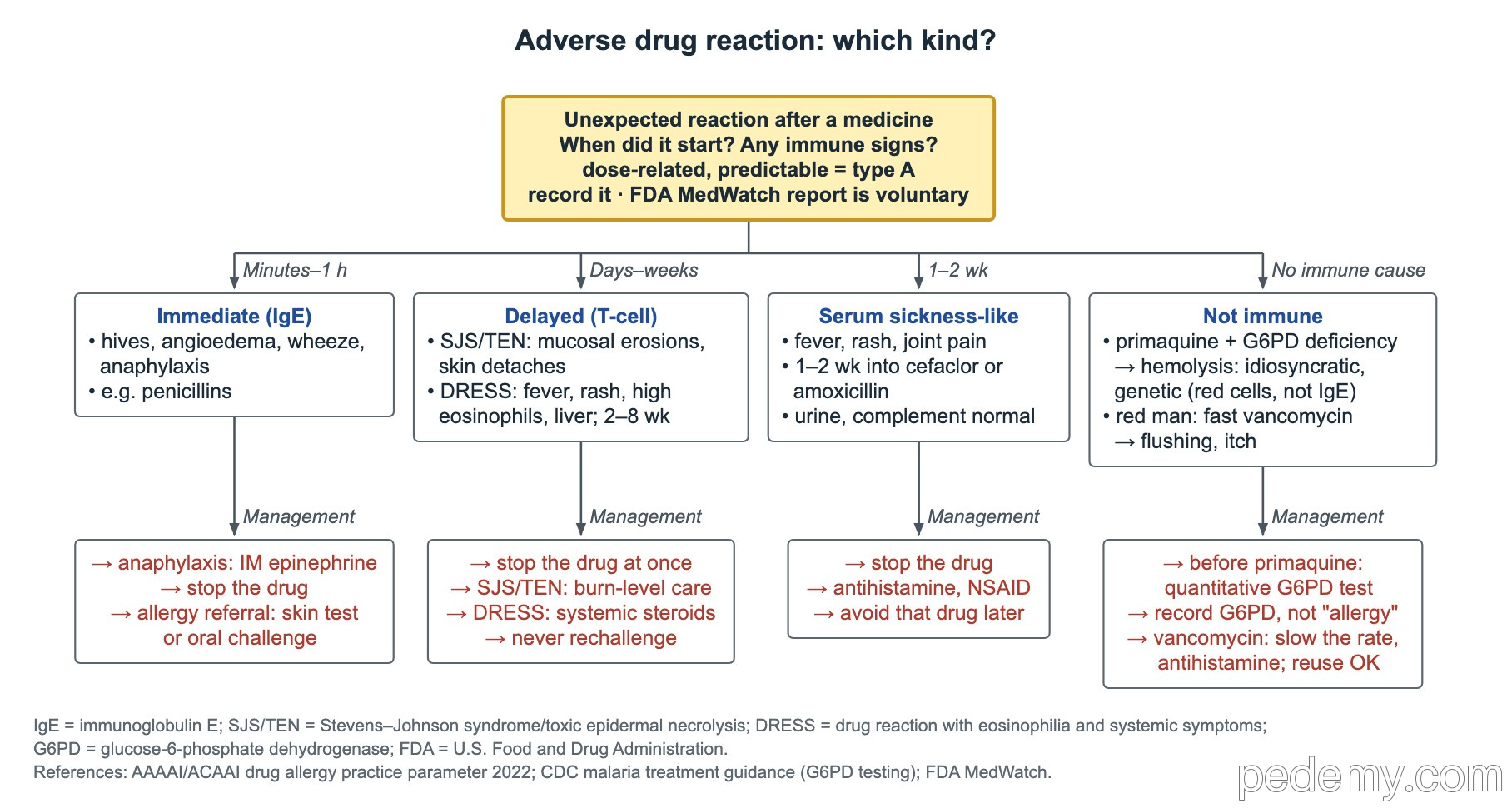
- Record every unexpected drug reaction. Reporting to FDA MedWatch is voluntary for clinicians, but encouraged.
- A treatment that seems to fail may not be taken as planned. A caregiver who stops a medicine because she misunderstood the plan is a family-related adherence factor; give a clear plan in the family's language and use teach-back.
Common questions
What is the difference between a near miss and an adverse event?
A near miss is an error caught before it reaches the patient. An adverse event is harm caused by medical care, with or without an error.
What is the difference between RCA and FMEA?
RCA looks back after an event to find system causes. FMEA looks ahead at a process to predict and fix failures before harm occurs.
How long does a hospital have to complete a root cause analysis?
The Joint Commission expects the RCA and action plan within 45 business days of the sentinel event or of learning about it.
Study this topic
Sources
- AAP: Principles of pediatric patient safety: reducing harm due to medical care (Pediatrics 2019)
- The Joint Commission: Sentinel event policy and procedures
- AHRQ PSNet: Root cause analysis primer
- ISMP: List of look-alike drug names with recommended tall man letters
- FDA: MedWatch safety information and adverse event reporting program
Written for Pedemy in our own words from the sources above; checked November 2026. For education only, not medical advice; check doses and local protocols before treating a patient. Pedemy is independent and not affiliated with or endorsed by the organizations cited.