

Main decision tree
Pharmacokinetics: elimination kinetics
Key points
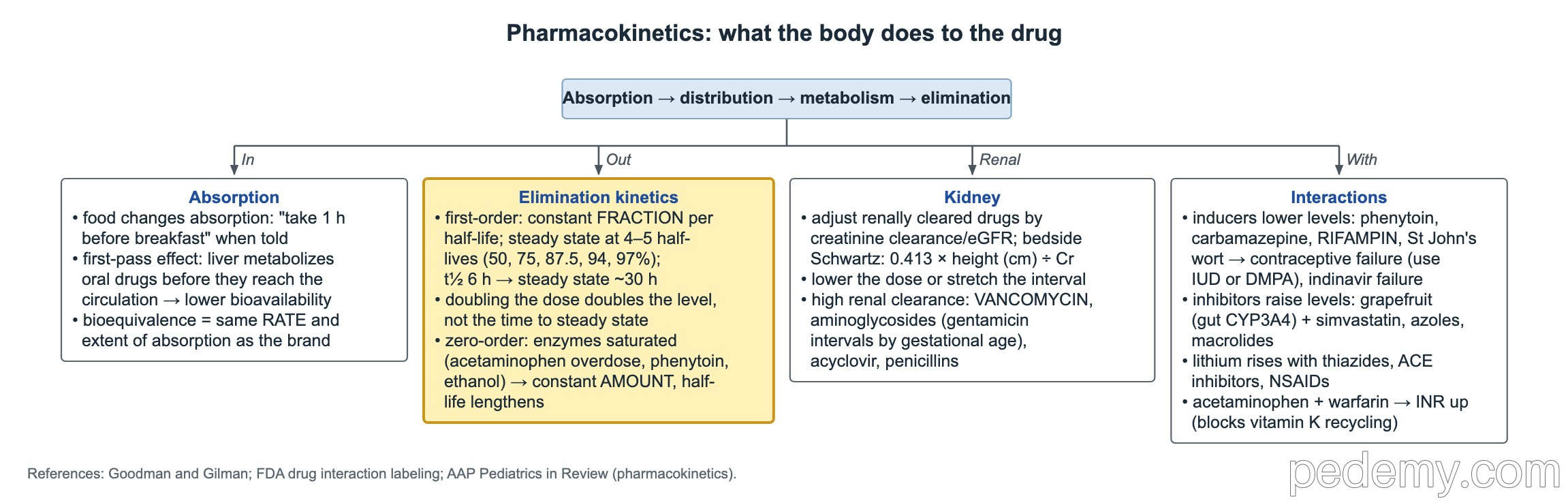
- First-order: a constant fraction (half the remaining drug) is eliminated each half-life.
- Steady state after 4–5 half-lives: 50%, 75%, 87.5%, about 94% and about 97% after 1–5 half-lives.
- After stopping, about 3% remains after 5 half-lives.
- Doubling the dose doubles the steady-state level, not the time to reach it.
- Zero-order: enzymes saturated, a constant amount is eliminated and the half-life lengthens (acetaminophen overdose, phenytoin, ethanol).
- Renal dosing uses eGFR or creatinine clearance: lower the dose or lengthen the interval.
- Bioequivalence = the same rate and extent of absorption as the reference product.
First-order elimination and half-life
Most drugs at usual doses follow first-order kinetics: the amount eliminated is proportional to the amount present. Each half-life removes half of what is left.
| Half-lives | Fraction of plateau reached (accumulating) | Fraction left after stopping |
|---|---|---|
| 1 | 50% | 50% |
| 2 | 75% | 25% |
| 3 | 87.5% | 12.5% |
| 4 | About 94% | About 6% |
| 5 | About 97% | About 3% |
Steady state and dose changes
- With regular dosing and no loading dose, steady state is reached after about 4–5 half-lives.
- Example: a drug with a half-life of 6 hours reaches steady state in about 30 hours.
- Doubling the maintenance dose of a linear drug doubles the steady-state concentration.
- The time to steady state is still set by the half-life alone.
- A loading dose reaches the target level quickly when waiting 4–5 half-lives is too slow.
Zero-order kinetics
When the eliminating enzymes are saturated, the body removes a constant amount per hour, not a constant fraction. The half-life is no longer fixed: it lengthens as the dose rises.
- Acetaminophen overdose: the usual pathways saturate, so elimination shifts to zero-order and the half-life lengthens.
- Phenytoin and ethanol show saturable elimination at usual doses.
- Small dose increases can cause large, unpredictable rises in level.
Absorption, first-pass effect and bioequivalence
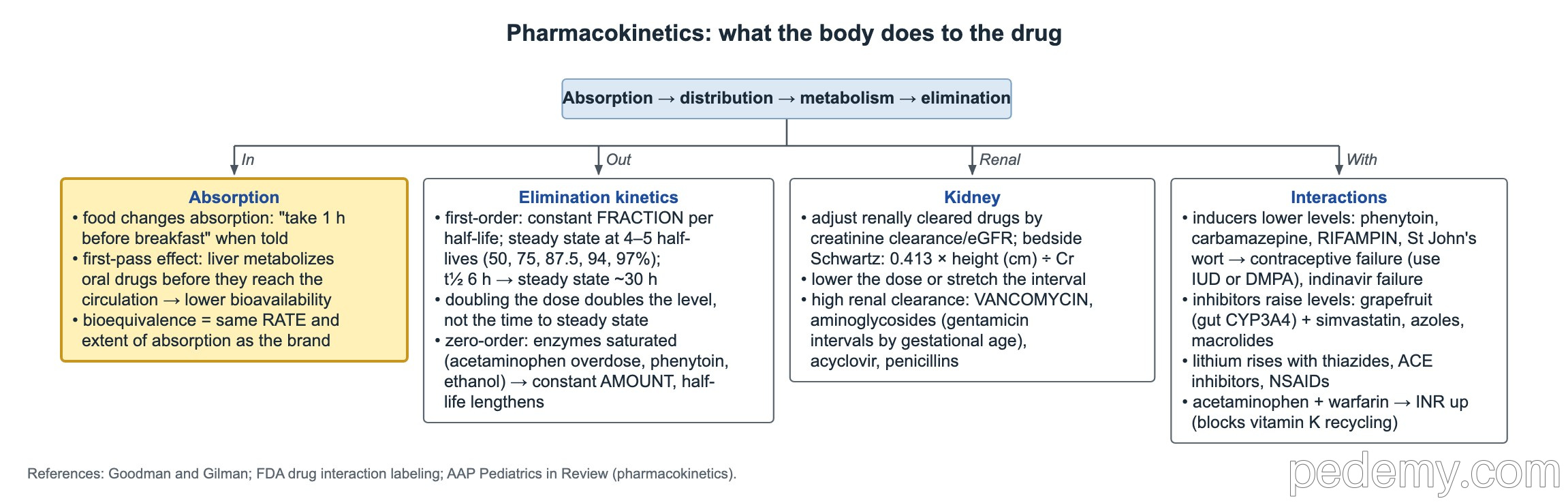
- First-pass effect: the liver (and gut wall) metabolizes an oral drug before it reaches the circulation, so an oral dose gives a lower level than the same IV dose.
- Bioavailability is the fraction of a dose that reaches the circulation unchanged; it is 100% for IV dosing.
- Food can reduce absorption: if the label says so, take the drug on an empty stomach, about 1 hour before breakfast.
- Two products are bioequivalent when they match in the rate and extent of absorption.
Dosing in kidney impairment
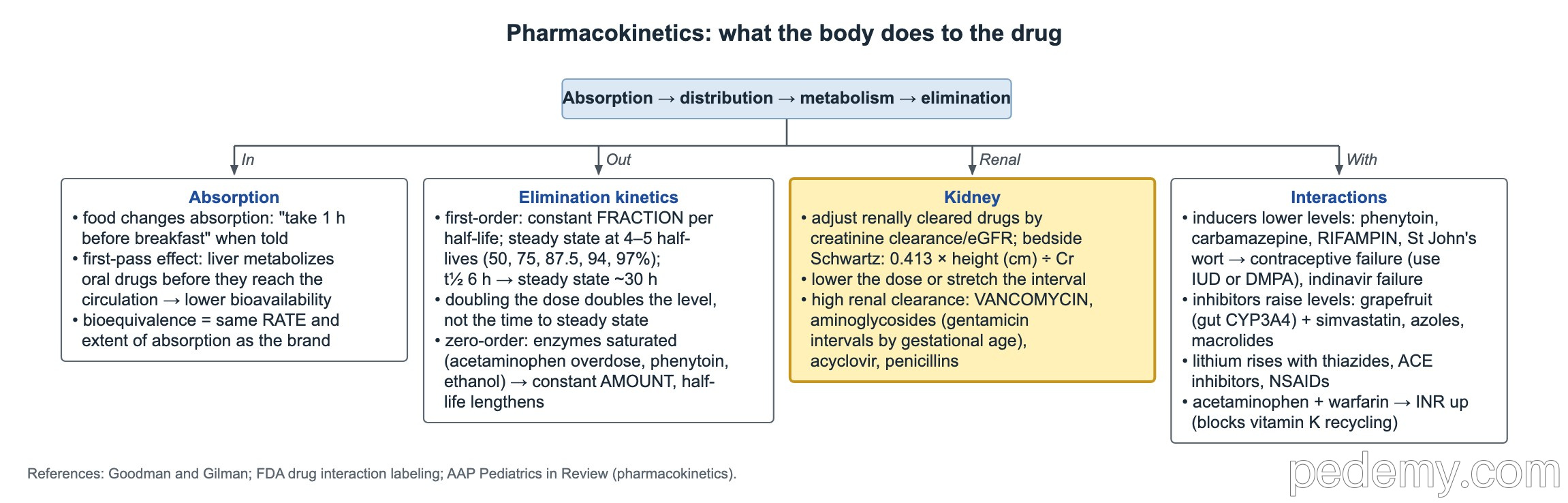
- Guide renal dosing by estimated GFR or creatinine clearance. In children, the bedside Schwartz equation: eGFR = 0.413 × height (cm) ÷ serum creatinine (mg/dL).
- Two ways to adjust: lower the dose, or lengthen the interval.
- Example: twice-daily amoxicillin for otitis with GFR 10–30 mL/min/1.73 m²: give a smaller dose at the same 12-hour interval.
- Drugs with high renal clearance need adjustment in CKD: vancomycin, aminoglycosides such as gentamicin, acyclovir and many penicillins.
- A renally cleared drug given unadjusted in kidney failure accumulates and causes toxicity.
Common questions
How many half-lives to reach steady state?
About 4–5 half-lives; about 97% of the plateau is reached after 5.
Does increasing the dose shorten the time to steady state?
No. A higher dose raises the steady-state level, but the time to reach it depends only on the half-life.
What is the difference between first-order and zero-order kinetics?
First-order removes a constant fraction per unit time; zero-order removes a constant amount because the enzymes are saturated.
Study this topic
Sources
- Kearns GL et al. Developmental pharmacology: drug disposition, action, and therapy in infants and children (N Engl J Med 2003)
- Schwartz GJ et al. New equations to estimate GFR in children with CKD (J Am Soc Nephrol 2009)
- FDA: Pharmacokinetics in patients with impaired renal function, guidance for industry
Written for Pedemy in our own words from the sources above; checked November 2026. For education only, not medical advice; check doses and local protocols before treating a patient. Pedemy is independent and not affiliated with or endorsed by the organizations cited.