

Main decision tree
Organizing care for children
Key points
- PDSA (Plan–Do–Study–Act): test a small change, study the result, adjust and test again.
- Lean removes waste (waiting, unnecessary steps); Six Sigma reduces variation and defects.
- Measures: outcome (length of stay), process (checklist completion), balancing (unplanned readmission).
- Calling a project QI does not by itself exempt it from IRB review; ask the institutional review office.
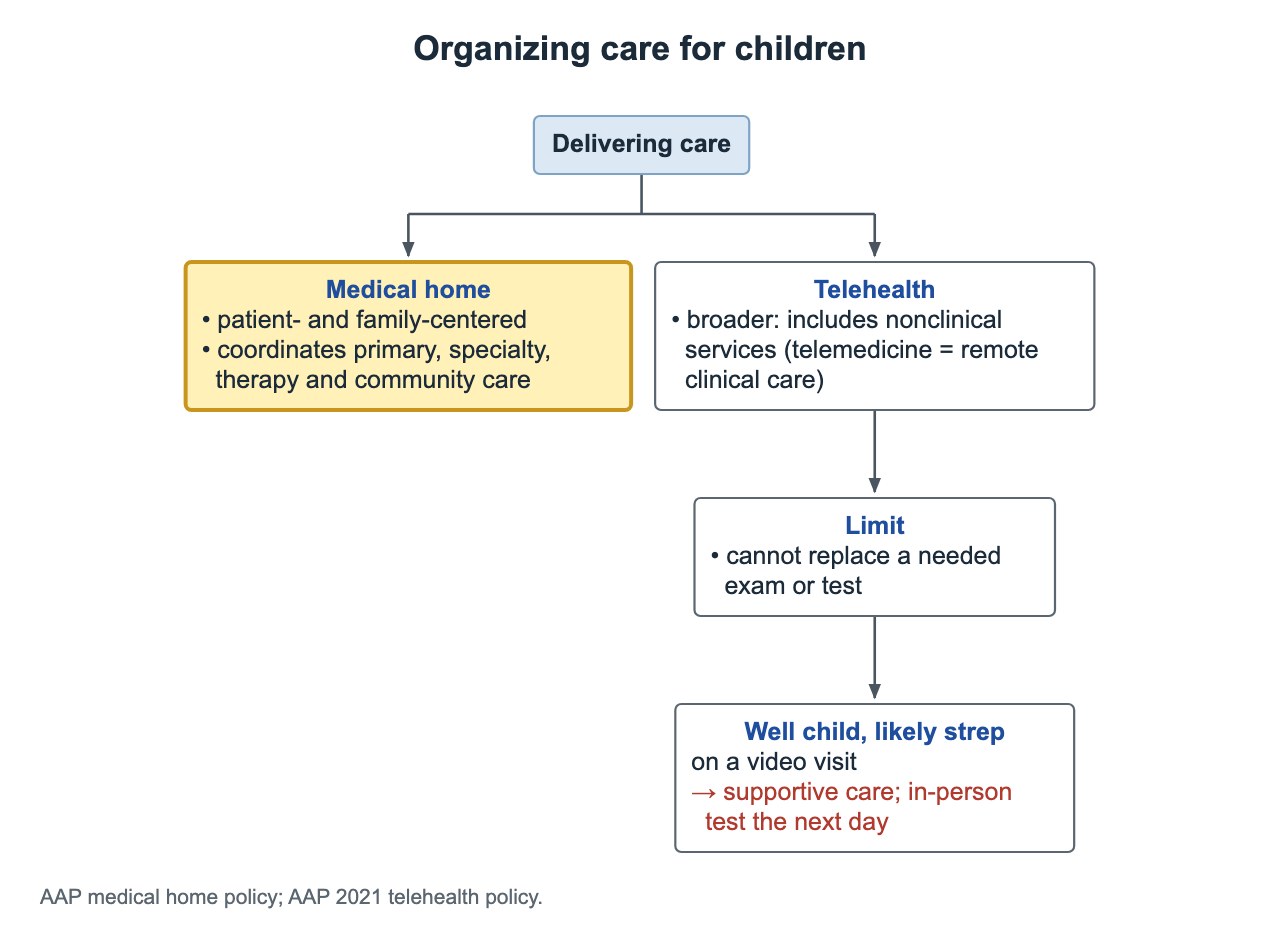
- The patient- and family-centered medical home coordinates primary, specialty, therapy and community care.
- Telehealth is broader than telemedicine and cannot replace a needed in-person exam or test.
- Angry parent: sit down, apologize and validate; do not lead with excuses.
Organizing care: medical home and telehealth
A child who needs primary care, specialty care, therapies and community support is best served by a patient- and family-centered medical home. It is accessible, continuous, comprehensive, coordinated and culturally effective care, led by the primary care clinician with the family as a partner.
Telehealth vs telemedicine
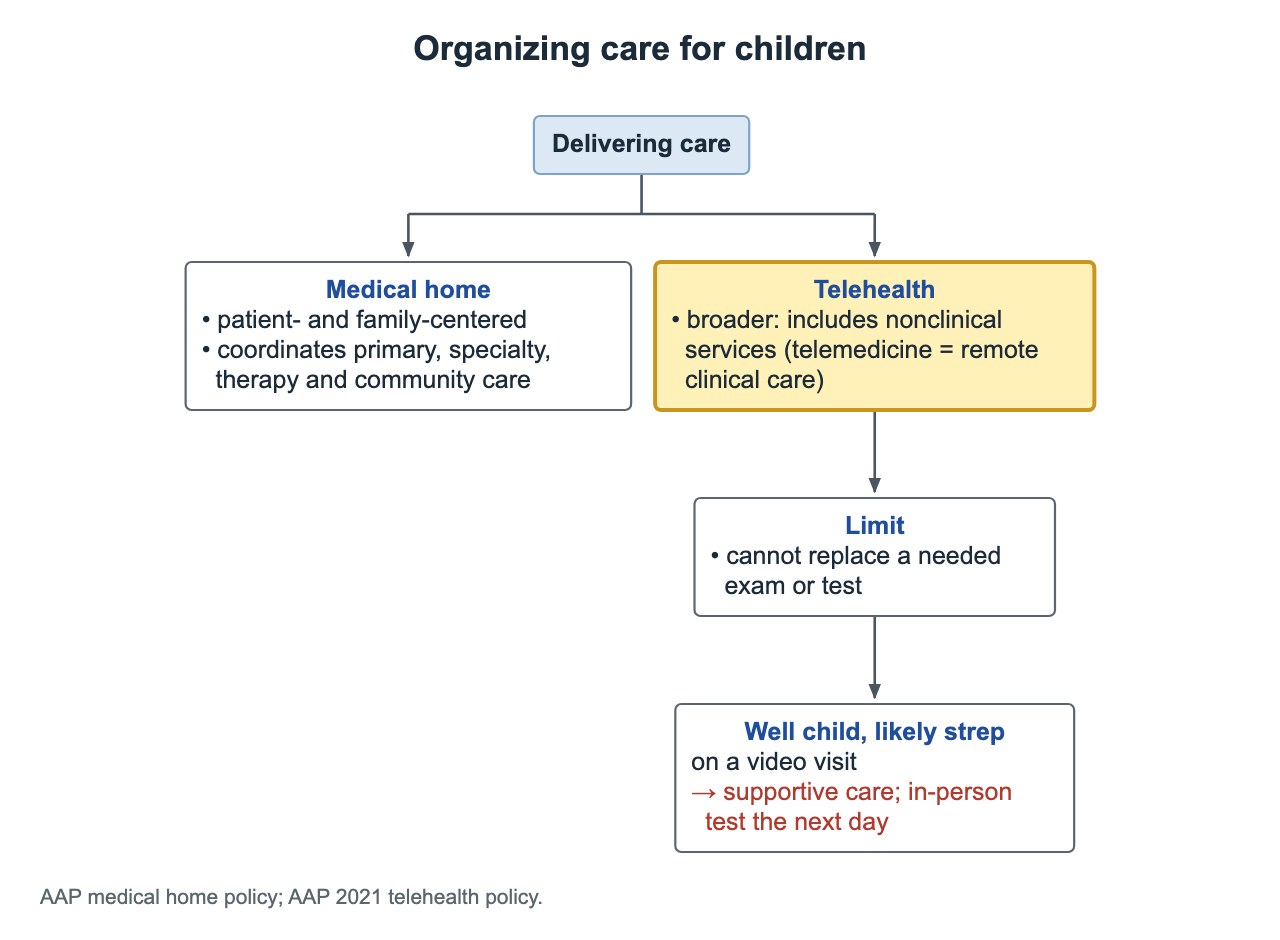
- Telemedicine: remote clinical care, such as a video visit.
- Telehealth: the broader term; it also includes nonclinical services such as education, training and administrative meetings.
- Its key limit: a video visit cannot replace an exam or test the child needs in person.
Telehealth and possible strep throat
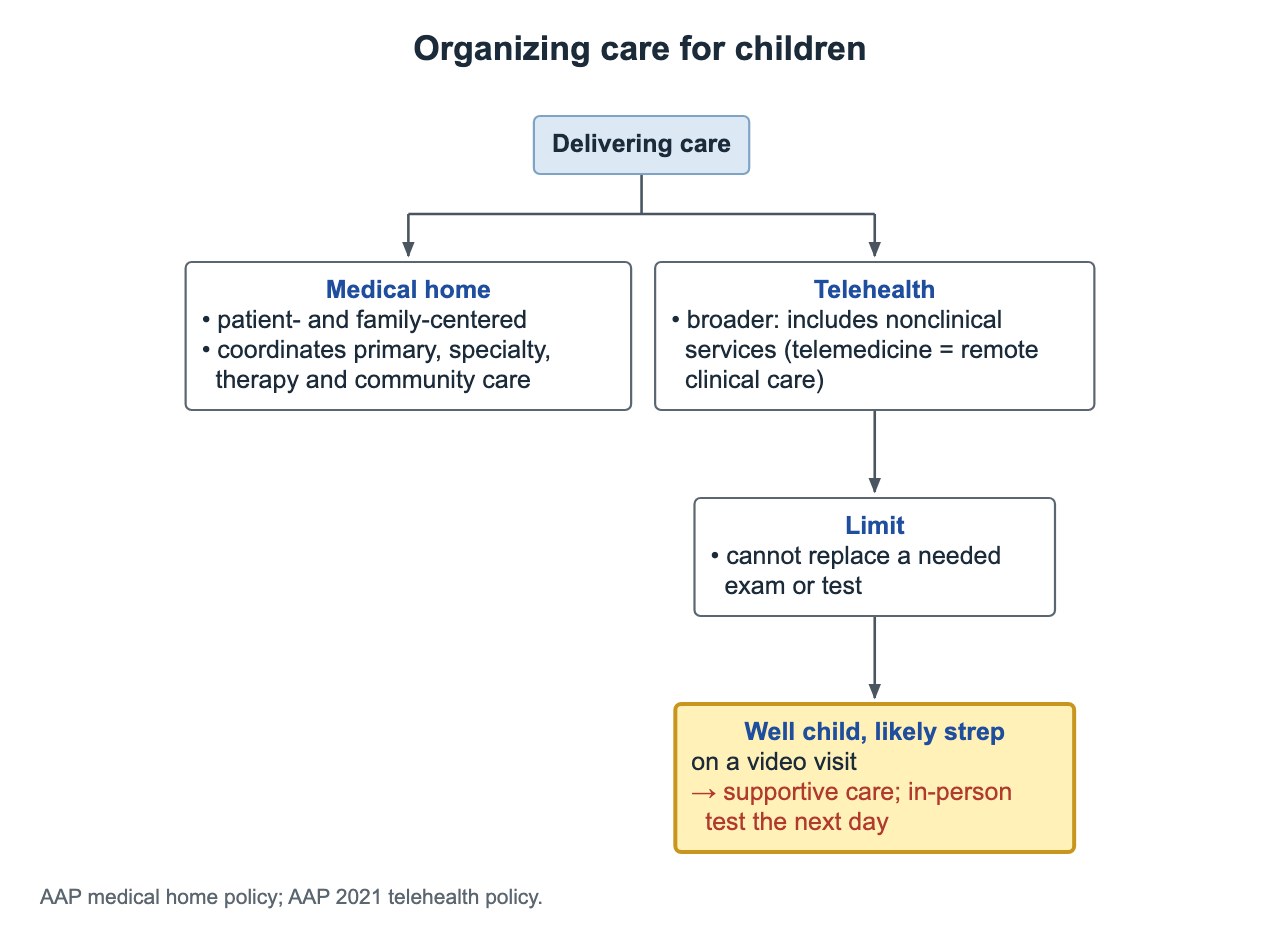
Group A strep pharyngitis is diagnosed with a rapid antigen test or throat culture, not by appearance alone. A video visit cannot provide that test.
- Well-appearing child with likely strep on a video visit: supportive care now and an in-person test the next day.
- Treat with antibiotics only after a positive test.
- A short delay is safe: antibiotics started within 9 days of symptom onset still prevent rheumatic fever.
- An ill-appearing child, drooling, trouble breathing or poor fluid intake needs prompt in-person care.
QI methods: PDSA, Lean and Six Sigma
A clinic that repeatedly measures inappropriate strep testing and changes its workflow to improve practice is doing QI: it aims to improve local care, not to create generalizable knowledge.
| Method | Focus | Board example |
|---|---|---|
| PDSA (Model for Improvement) | Small, rapid tests of change | A clinic tries a new registration step with a few families, reviews feedback and modifies the next test |
| Lean | Removing waste: waiting and unnecessary steps | Cutting steps between an IV-fluid order and its delivery |
| Six Sigma | Reducing process variation and defects | Making a lab process give the same result every time |
Outcome, process and balancing measures
- Outcome measure: the result you want to change (for a faster-discharge project, length of stay).
- Process measure: whether the steps are done (discharge checklist completion).
- Balancing measure: an unintended harm elsewhere in the system (unplanned readmission).
- Plot measures over time on a run chart to see whether a change is an improvement.
QI or research: does it need IRB review?
Labeling a project quality improvement does not automatically mean that IRB review is unnecessary. Projects that test new interventions, randomize patients or aim to produce generalizable knowledge may count as human subjects research.
Ask the institutional review office to decide which requirements apply before you start.
Upset families, de-escalation and implicit bias
- A parent angry about a long wait: sit down, apologize and validate the frustration.
- Explaining why you were late usually does not help; it can sound defensive.
- Avoid body language that escalates: crossed arms or hands on hips.
- Do not leave and hand the visit to a colleague; try de-escalation first.
- HEARD framework: Hear, Empathize, Apologize (acknowledge), Resolve, Diagnose the cause.
- When the clinic runs late, update waiting families about the delay at set intervals.
- If threats or aggression continue despite de-escalation, call for help and follow the office safety policy.
- Implicit bias: unconscious attitudes from societal stereotypes that affect clinical decisions; recognize it and use standardized approaches to reduce it.
Common questions
What is a balancing measure in quality improvement?
A measure that checks whether a change causes harm elsewhere, for example unplanned readmissions when a project shortens length of stay.
What is the difference between Lean and Six Sigma?
Lean removes waste such as waiting and unnecessary steps. Six Sigma reduces variation and defects in a process.
Does a quality improvement project need IRB approval?
Not always, but the label alone does not decide it. Ask the institutional review office to determine the requirements.
Study this topic
Sources
- AAP: Telehealth: improving access to and quality of pediatric health care (Pediatrics 2021)
- IDSA: Clinical practice guideline for group A streptococcal pharyngitis (Clin Infect Dis 2012)
- AAP: The impact of racism on child and adolescent health (Pediatrics 2019)
- HHS OHRP: Quality improvement activities FAQs
- IHI: Model for Improvement
Written for Pedemy in our own words from the sources above; checked November 2026. For education only, not medical advice; check doses and local protocols before treating a patient. Pedemy is independent and not affiliated with or endorsed by the organizations cited.