

Main decision tree
Juvenile idiopathic arthritis and its relatives
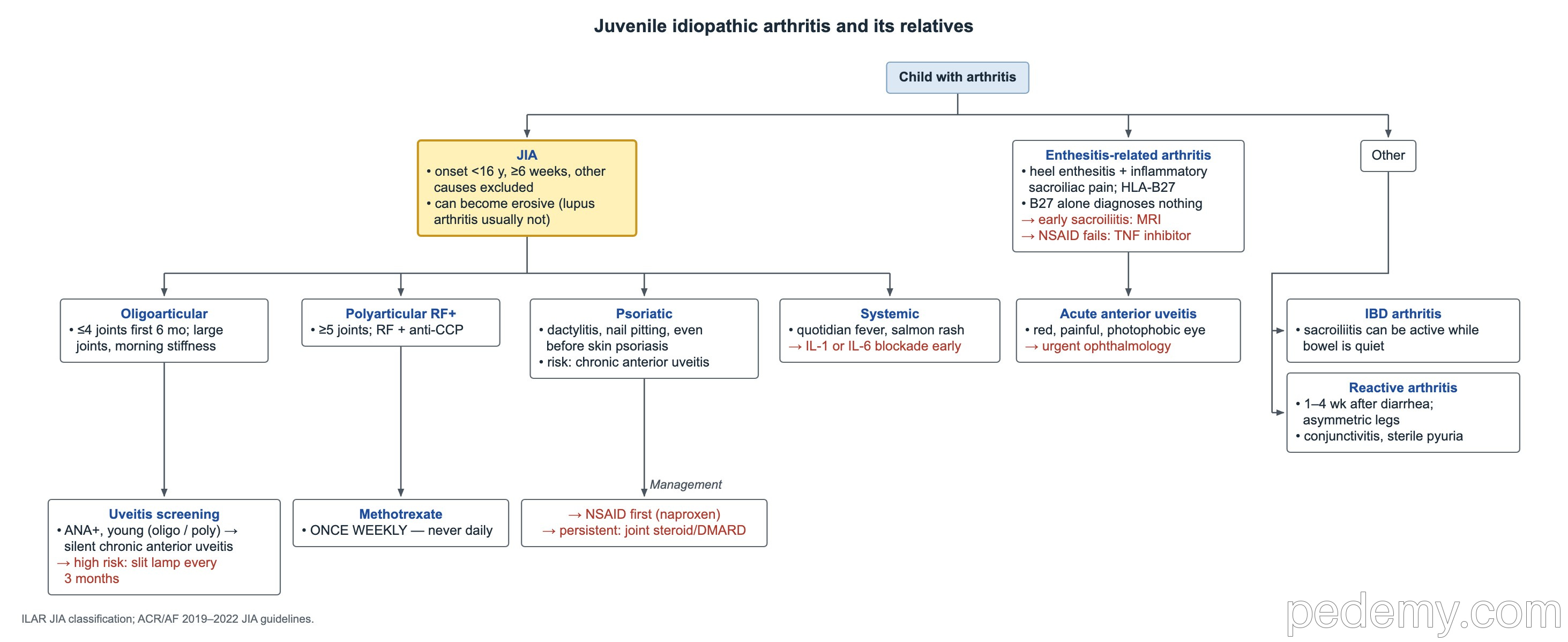
Key points
- JIA: onset before age 16, arthritis for ≥6 weeks, other causes excluded; JIA can become erosive, lupus arthritis usually does not.
- Oligoarticular JIA: ≤4 joints in the first 6 months; a young ANA-positive girl has the highest risk of silent uveitis.
- High-risk children with JIA need slit-lamp eye screening every 3 months.
- RF-positive polyarticular JIA (≥5 joints, RF and anti-CCP positive) behaves like adult RA: early methotrexate and a biologic.
- Methotrexate for JIA is given ONCE WEEKLY, never daily.
- Systemic JIA: quotidian fever and an evanescent salmon rash; IL-1 or IL-6 blockade early; watch for MAS.
- On a biologic: give inactivated vaccines; avoid live vaccines (MMR, varicella, LAIV, yellow fever, oral polio).
What counts as JIA
JIA is a diagnosis of exclusion: arthritis beginning before age 16 and lasting at least 6 weeks, after infection, malignancy, trauma and other rheumatic diseases are ruled out. An isolated positive ANA does not make the diagnosis.
JIA can erode cartilage and bone. Lupus arthritis is usually nonerosive.
| Category | Key features |
|---|---|
| Oligoarticular | ≤4 joints in the first 6 months; large joints; young ANA-positive girls |
| Polyarticular RF-negative | ≥5 joints in the first 6 months; RF negative |
| Polyarticular RF-positive | ≥5 joints; RF positive twice ≥3 months apart; teen girls; RA-like |
| Systemic | Quotidian fever, salmon rash, serositis, then arthritis |
| Psoriatic | Arthritis with psoriasis, or dactylitis, nail pitting or family history |
| Enthesitis-related | Enthesitis, sacroiliac pain, HLA-B27, often boys over 6 |
Oligoarticular JIA and silent uveitis
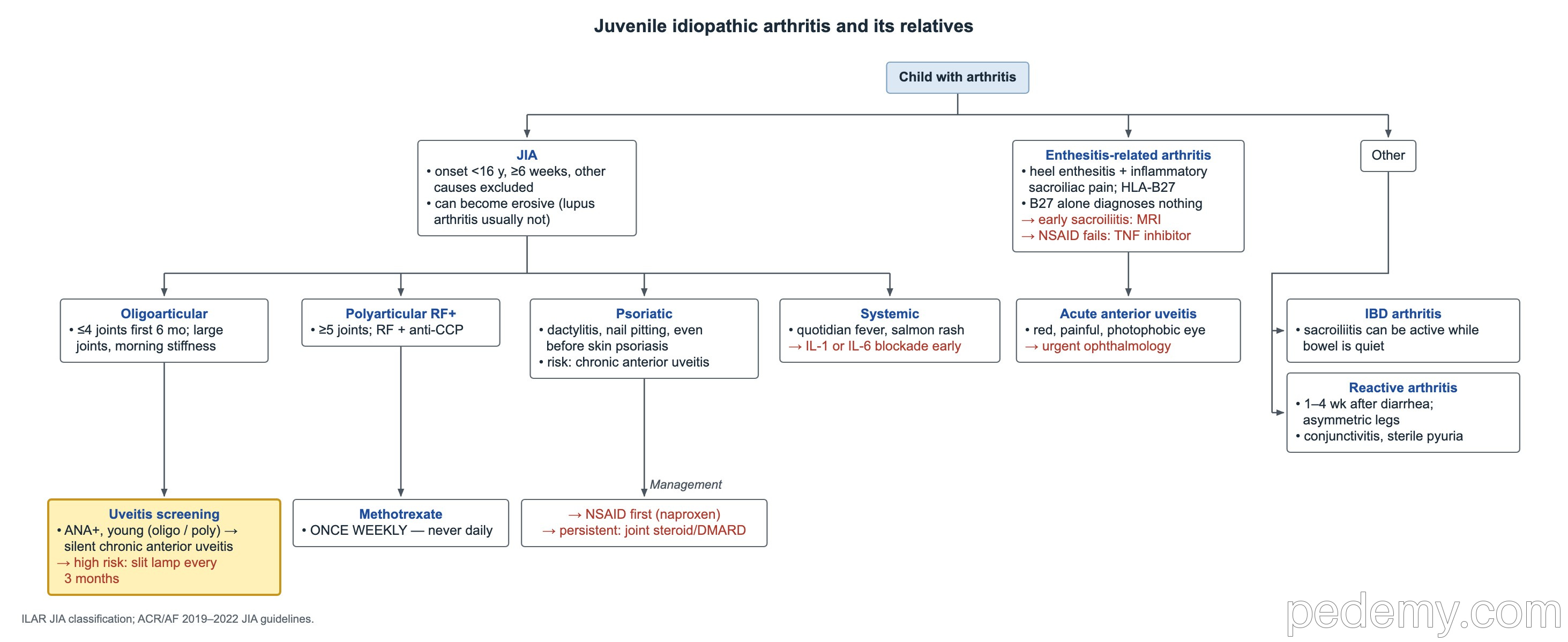
A typical child is a preschool girl with a swollen knee, morning stiffness and a mild limp but little pain. The main danger is chronic anterior uveitis, which causes no red eye or pain and can lead to vision loss if missed.
- Highest uveitis risk: ANA positive, young age at onset and the first years of disease; seen in oligoarticular, RF-negative polyarticular and psoriatic JIA.
- High-risk children: slit-lamp examination every 3 months (ACR/Arthritis Foundation 2019).
- Treatment of oligoarthritis: intra-articular glucocorticoid injection is central; NSAIDs help symptoms; methotrexate if arthritis persists or recurs.
Polyarticular RF-positive JIA
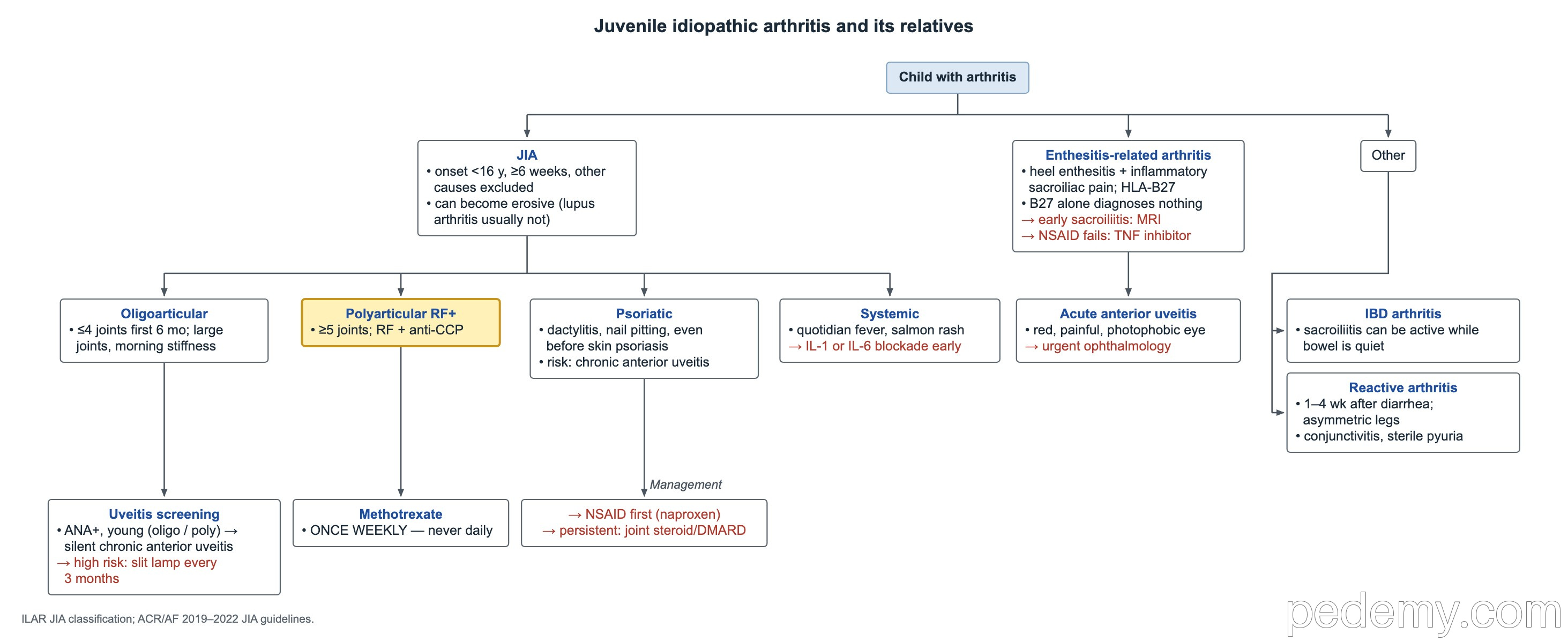
An adolescent girl with symmetric small-joint arthritis of the hands and feet, positive RF and anti-CCP has the childhood form of rheumatoid arthritis. It is aggressive and erosive.
- Start a DMARD (methotrexate) early; RF, anti-CCP or early joint damage favor adding a biologic early.
- Methotrexate is given once weekly, by mouth or subcutaneously, with folic acid. A daily-dosing error can be fatal.
- Treat to target: escalate until disease activity is low.
Systemic JIA
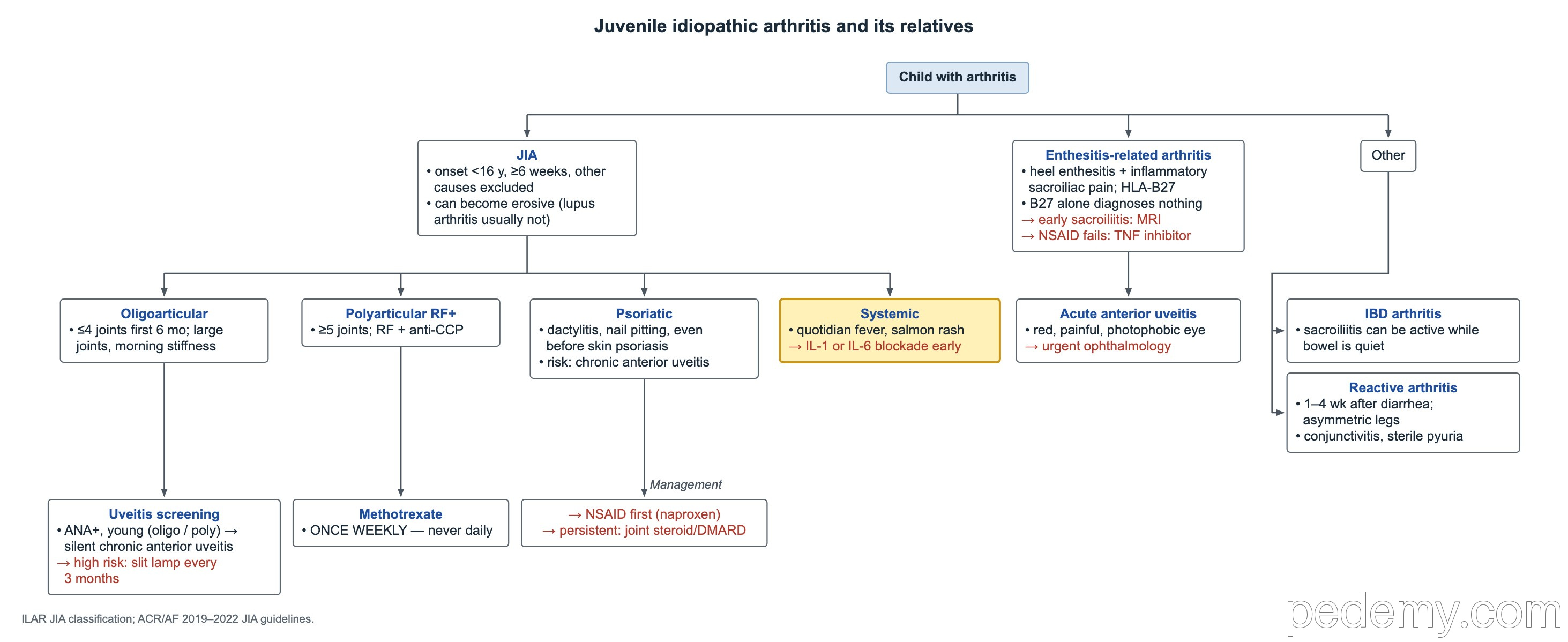
Systemic JIA (childhood-onset Still disease) starts with fever, not joints. Arthritis may appear weeks later, so the early picture looks like infection or malignancy.
- Quotidian fever: one or two daily spikes, back to normal or below between spikes.
- Evanescent salmon-pink rash that comes with the fever.
- Serositis, lymphadenopathy, hepatosplenomegaly; very high CRP, ferritin and platelets.
- Treatment: early IL-1 (anakinra, canakinumab) or IL-6 (tocilizumab) blockade, guided by rheumatology.
- Danger: macrophage activation syndrome, with falling platelets and ESR and rapidly rising ferritin.
Juvenile psoriatic arthritis
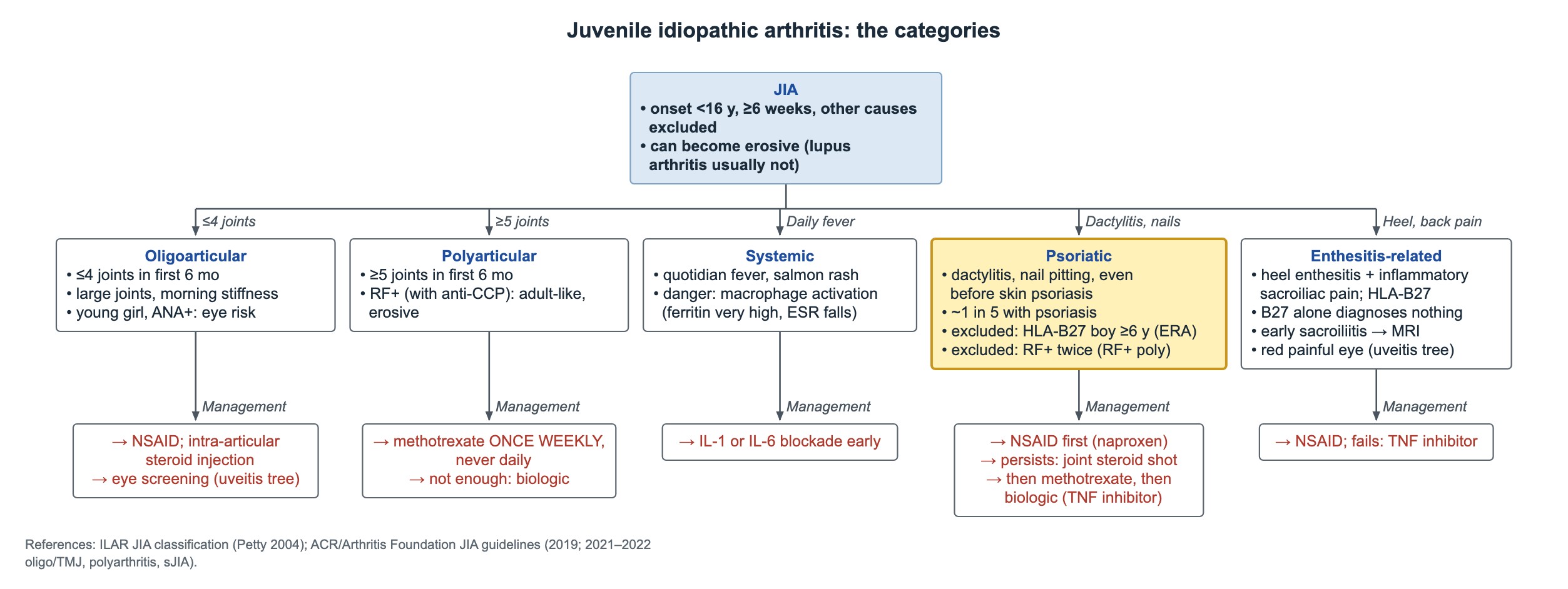
Dactylitis (a sausage digit), nail pitting or onycholysis can point to psoriatic arthritis before any skin psoriasis appears. About 1 in 5 people with psoriasis develop psoriatic arthritis.
- Excluded from the psoriatic category: an HLA-B27-positive boy with onset at age 6 or older (fits enthesitis-related arthritis), and RF positive twice 3 months apart (RF-positive polyarthritis).
- Eye risk: chronic anterior uveitis, so screen like other high-risk JIA.
- Treatment: NSAID (for example naproxen) first; intra-articular steroid for persistent joints; then methotrexate, then a biologic such as a TNF inhibitor.
Enthesitis-related, IBD-related and reactive arthritis
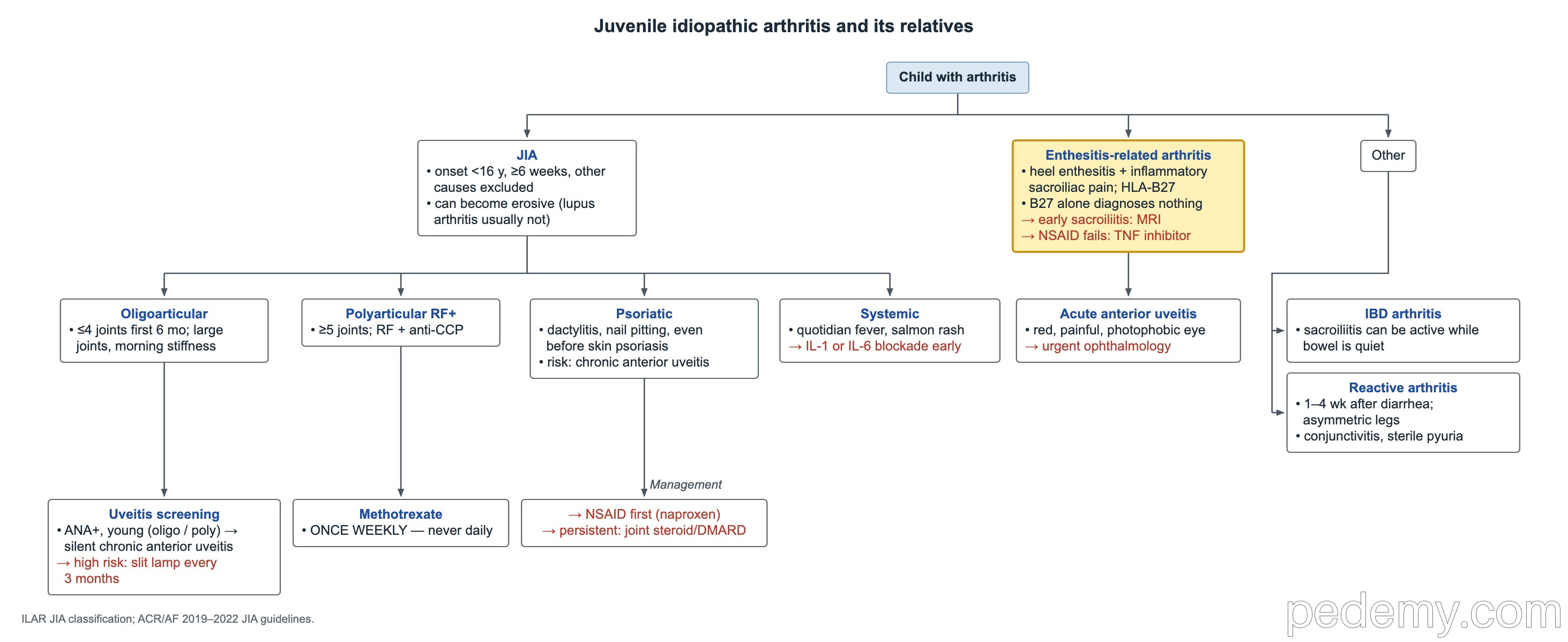
Enthesitis-related arthritis is the childhood spondyloarthritis pattern: heel (Achilles or plantar fascia) enthesitis, inflammatory back or buttock pain, often an HLA-B27-positive boy over 6.
- HLA-B27 supports the diagnosis but does not diagnose ankylosing spondylitis by itself.
- Suspected early sacroiliitis with a normal pelvic X-ray: MRI of the sacroiliac joints.
- Treatment: NSAIDs first; active sacroiliitis despite NSAIDs → TNF inhibitor.
- A red, painful, photophobic eye means acute anterior uveitis: urgent ophthalmology.
- IBD-associated sacroiliitis can stay active while the bowel is quiet.
- Reactive arthritis: asymmetric leg arthritis 1–4 weeks after enteric (Shigella, Salmonella, Yersinia, Campylobacter) or genital Chlamydia infection; may add conjunctivitis, urethritis or sterile pyuria, oral ulcers, enthesitis, dactylitis or circinate balanitis.
- Reactive arthritis treatment: NSAIDs (for example naproxen), joint injection if needed, sulfasalazine if chronic; antibiotics only for active Chlamydia.
Vaccines on biologics
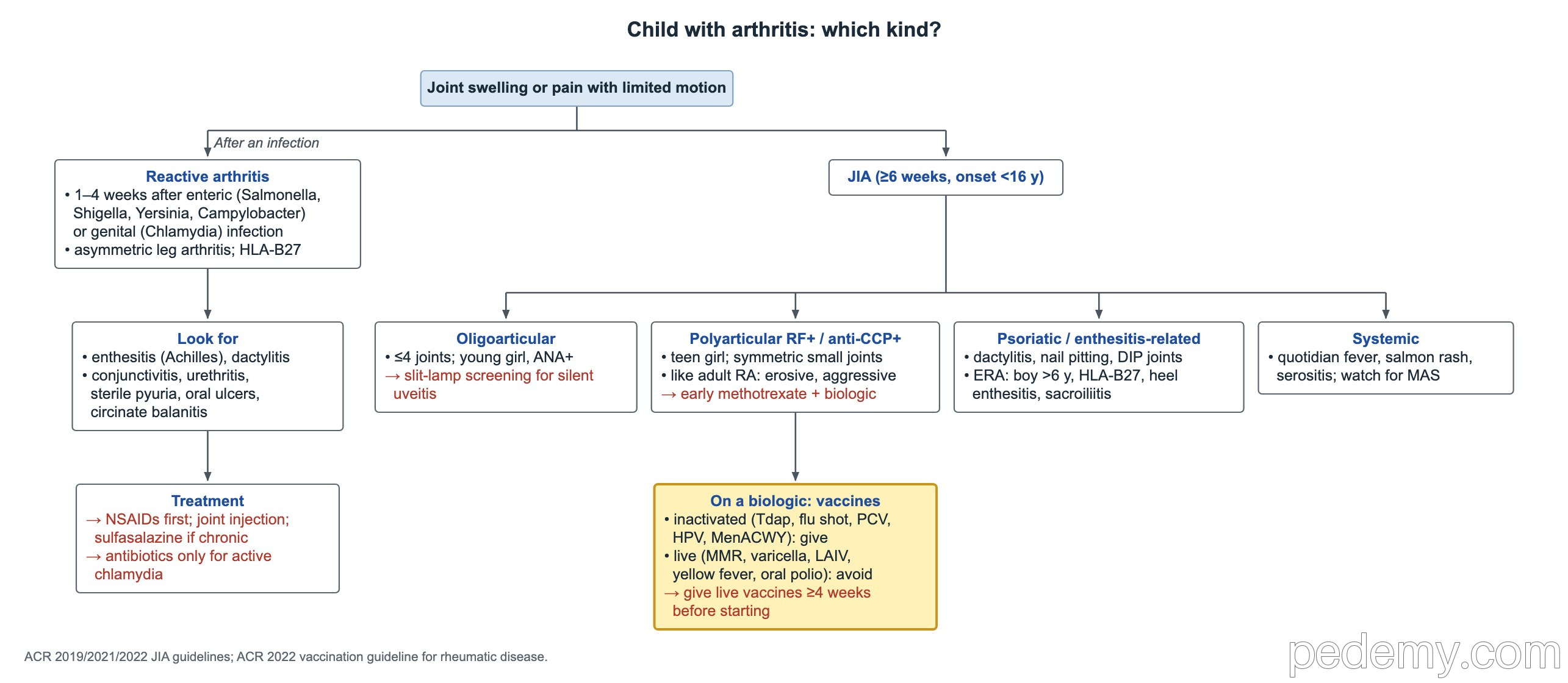
- Inactivated vaccines are safe and should be given: Tdap, yearly inactivated flu vaccine, pneumococcal, HPV, MenACWY.
- Live vaccines are generally avoided on biologics such as etanercept: MMR, varicella, live nasal flu vaccine, yellow fever, oral polio.
- Give needed live vaccines at least 4 weeks before starting immunosuppression when possible (ACR 2022).
Common questions
How often should children with JIA have eye exams?
It depends on risk. High-risk children (ANA positive, young at onset, early years of oligoarticular, RF-negative polyarticular or psoriatic JIA) need a slit-lamp exam every 3 months.
Does a positive ANA mean a child has JIA or lupus?
No. A positive ANA alone diagnoses neither. In a child who already has JIA, it marks a higher risk of silent uveitis.
How is methotrexate dosed in JIA?
Once a week, by mouth or by subcutaneous injection, usually with folic acid. It is never taken daily.
Study this topic
Sources
- 2019 ACR/Arthritis Foundation guideline: JIA polyarthritis, sacroiliitis and enthesitis (Arthritis Rheumatol)
- 2021 ACR guideline: JIA oligoarthritis, TMJ arthritis and systemic JIA (Arthritis Rheumatol 2022)
- 2019 ACR/Arthritis Foundation guideline for JIA-associated uveitis (Arthritis Care Res)
- 2022 ACR guideline for vaccinations in rheumatic and musculoskeletal diseases (Arthritis Care Res)
Written for Pedemy in our own words from the sources above; checked November 2026. For education only, not medical advice; check doses and local protocols before treating a patient. Pedemy is independent and not affiliated with or endorsed by the organizations cited.