

Main decision tree
Contraception: pick the safe method
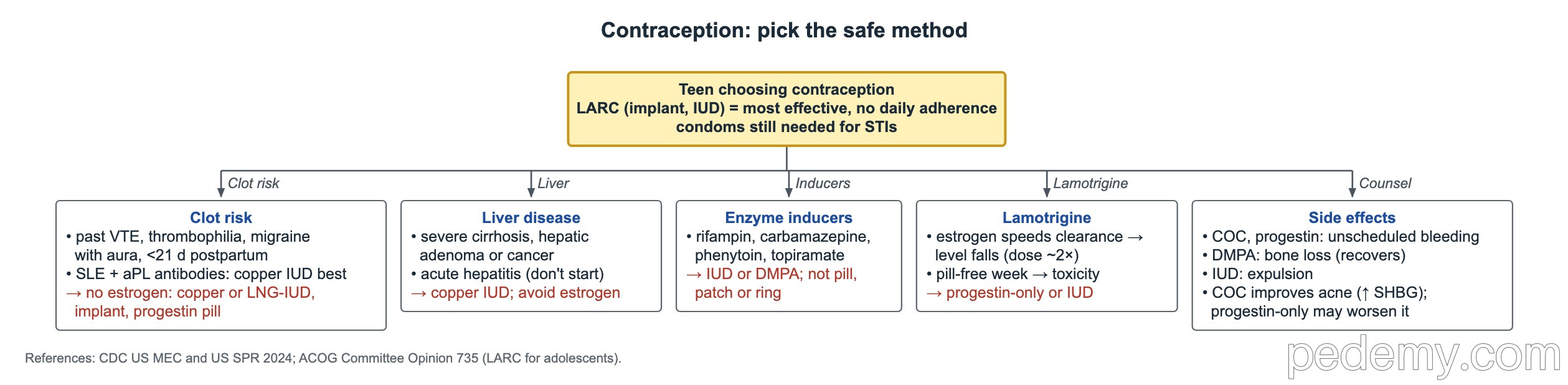
Key points
- LARC (subdermal implant, IUDs) is the most effective reversible contraception and avoids daily adherence; add condoms for STI protection.
- No estrogen with past VTE, thrombophilia, migraine with aura, SLE with antiphospholipid antibodies, or under 21 days postpartum.
- Rifampin, carbamazepine, phenytoin and topiramate lower hormone levels: use an IUD or DMPA, not the pill, patch or ring.
- Estrogen lowers lamotrigine levels; the dose may need to be about doubled.
- Emergency contraception works up to 120 hours (5 days); the most effective method is a copper IUD or LNG 52-mg IUD.
- Levonorgestrel 1.5 mg once (over the counter) or ulipristal 30 mg; ulipristal works better with obesity and on days 3–5.
- Testosterone-related amenorrhea is not contraception; testosterone is teratogenic.
Choosing a method: LARC first
The tree starts with the adolescent choosing a method. The two long-acting reversible contraception (LARC) options, the subdermal implant and intrauterine devices, are the most effective and do not depend on remembering a daily pill.
Then it branches by the question that decides safety: clot risk, liver disease, enzyme-inducing drugs, lamotrigine and expected side effects. Use the CDC US Medical Eligibility Criteria (US MEC 2024) for each condition.
- Offer every method, starting with LARC, and let the teen choose.
- Pelvic exam and Pap test are not needed before starting most methods.
- Teens with an IUD or implant should still use condoms to reduce STI risk.
- Teens who have sex only with partners of the same sex may still need contraception counseling: their pregnancy rates are not low.
Who should not take estrogen
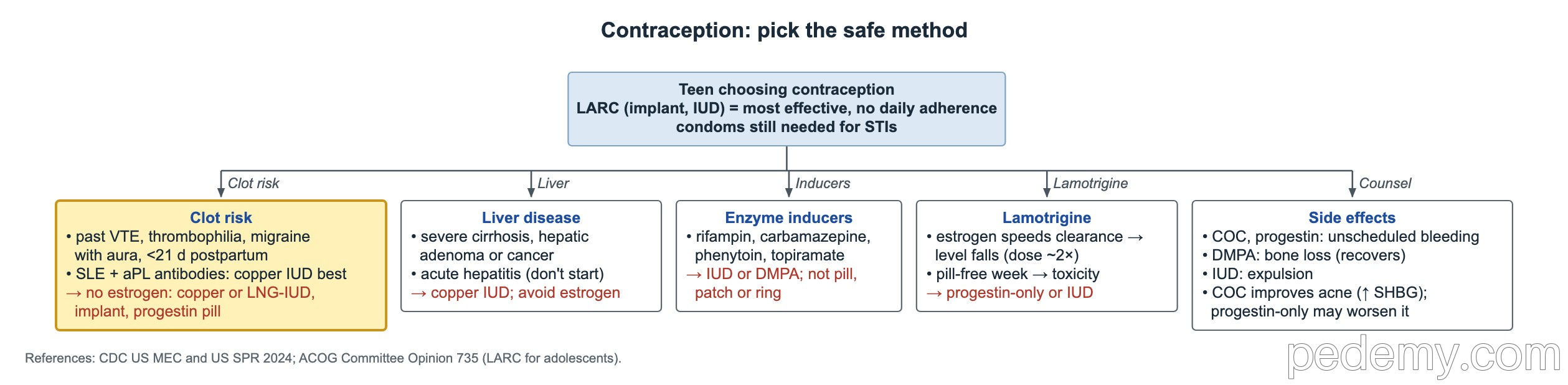
Estrogen raises clot risk. Combined pills, patches and rings are unacceptable (US MEC category 4) for these teens; estrogen-free methods are safe.
| Condition | Why | Good choice |
|---|---|---|
| Past DVT or PE, known thrombophilia | Venous clot risk | Copper or LNG IUD, implant, progestin-only pill |
| Migraine with aura | Ischemic stroke risk | Any estrogen-free method |
| SLE with positive antiphospholipid antibodies | Arterial and venous clots | Copper IUD (estrogen contraindicated) |
| Under 21 days postpartum | Postpartum clot risk is highest | Wait until at least 21 days for a combined method; progestin-only methods can start sooner |
| Severe (decompensated) cirrhosis, hepatocellular adenoma or liver cancer | Liver metabolizes estrogen; tumors are hormone sensitive | Copper IUD; avoid estrogen. Do not start estrogen during acute hepatitis |
Drug interactions
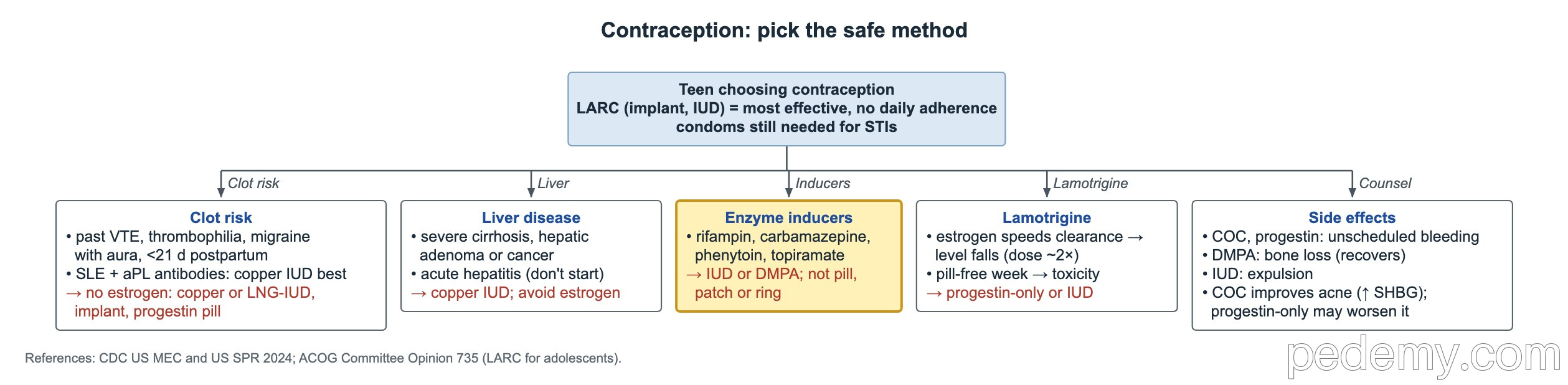
Enzyme-inducing drugs speed the breakdown of contraceptive hormones, so pills, patches and rings can fail. Rifampin is the classic antibiotic that does this; most other antibiotics do not.
- Inducers: rifampin, carbamazepine, phenytoin and topiramate.
- With an inducer: choose a copper or LNG IUD or DMPA, not a pill, patch or ring.
- Lamotrigine works the other way: estrogen speeds its clearance, so its level falls and the dose may need to be about doubled. Levels can rise in the pill-free week, causing toxicity.
- For a teen on lamotrigine, a progestin-only method or an IUD avoids this problem.
Side effects to counsel about
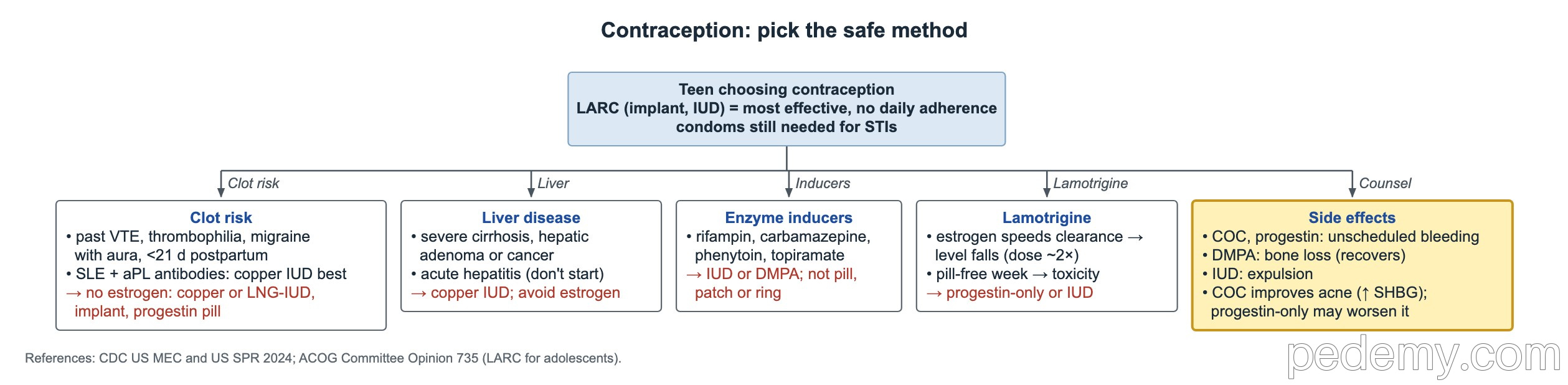
| Method | Main issue | What to say |
|---|---|---|
| Combined pill | Breakthrough bleeding in the first months | Usually settles within 3 months |
| Progestin-only pill, implant | Unscheduled, irregular bleeding | The most common reason to stop; treatable |
| DMPA (Depo-Provera) | Lower bone mineral density | Largely recovers after stopping; not a reason to deny DMPA |
| IUD | Expulsion | The most common IUD complication in teens |
| Combined pill and acne | Improves acne | Estrogen raises SHBG, which lowers free androgen |
| Progestin-only methods and acne | Can worsen acne | Consider a combined method if acne matters |
Emergency contraception
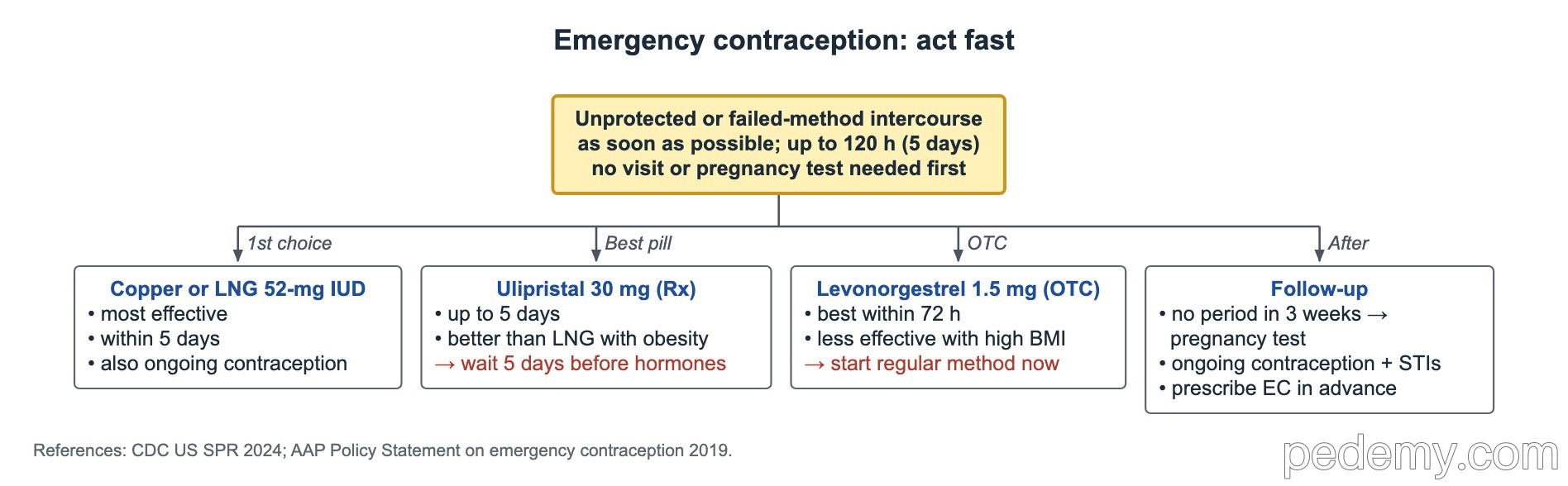
Give emergency contraception as soon as possible after unprotected sex or a failed method. It works up to 120 hours (5 days). No office visit or pregnancy test is needed first.
- Most effective: a copper IUD or an LNG 52-mg IUD placed within 5 days; it also gives ongoing contraception.
- Levonorgestrel 1.5 mg orally once: over the counter, best within 72 hours, less effective with a high BMI. Start a regular hormonal method right away.
- Ulipristal 30 mg (prescription): works up to 5 days and better than levonorgestrel with obesity (BMI 30 or more). Wait 5 days before starting hormonal contraception.
- No period within 3 weeks: do a pregnancy test.
- Follow up on ongoing contraception and STI testing.
- Prescribe emergency contraception in advance for sexually active teens.
Contraception with testosterone therapy
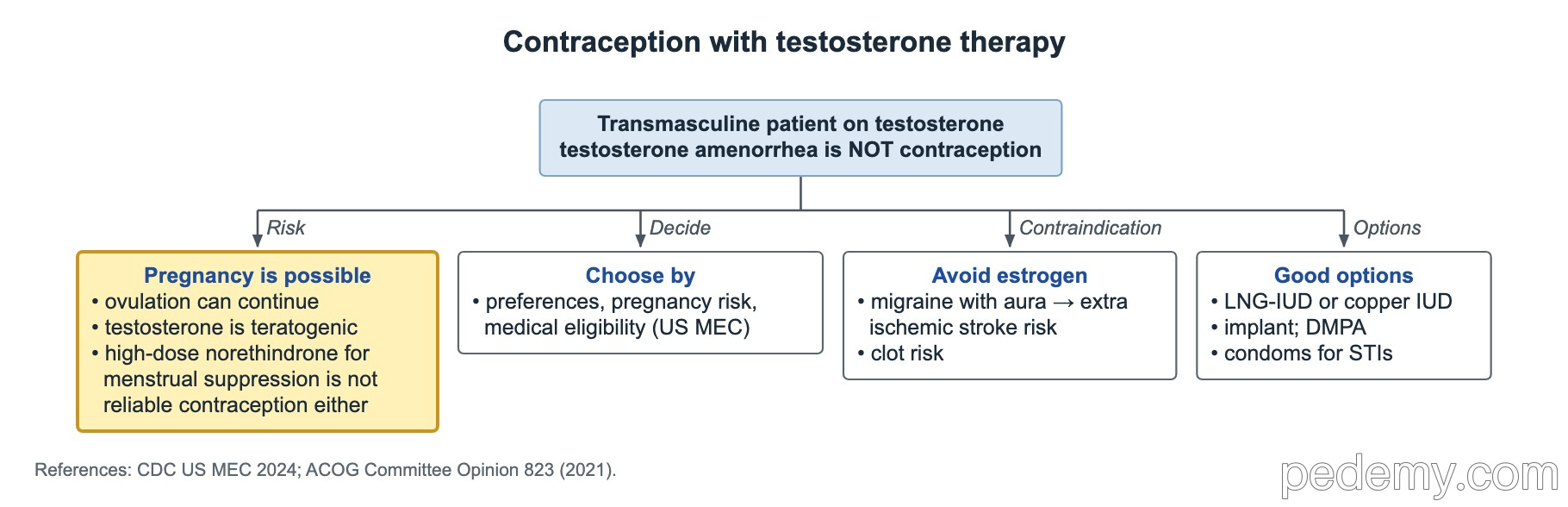
A transmasculine teen on testosterone can still ovulate and become pregnant, even with no periods. Testosterone is teratogenic, so effective contraception matters.
- High-dose norethindrone acetate used to stop menses is not reliable contraception.
- Choose by the patient's preferences, pregnancy risk and US MEC eligibility.
- Avoid estrogen when there is migraine with aura or clot risk.
- Good options: LNG or copper IUD, implant, DMPA; condoms for STIs.
Common questions
What is the most effective birth control for teenagers?
The implant and IUDs. They are more than 99% effective and need no daily action.
How long after sex does emergency contraception work?
Up to 5 days (120 hours), but it works best the sooner it is used. An IUD is the most effective option.
Does Depo-Provera hurt bones in teens?
It lowers bone density while in use, but density largely recovers after stopping. This is not a reason to withhold it.
Study this topic
Sources
- CDC: U.S. Medical Eligibility Criteria for Contraceptive Use, 2024 (MMWR Recomm Rep)
- CDC: U.S. Selected Practice Recommendations for Contraceptive Use, 2024 (MMWR Recomm Rep)
- AAP 2025: Contraception for Adolescents, policy statement (Pediatrics)
- AAP 2025: Contraceptive Counseling and Methods for Adolescents, clinical report (Pediatrics)
- AAP 2019: Emergency Contraception, policy statement (Pediatrics)
Written for Pedemy in our own words from the sources above; checked November 2026. For education only, not medical advice; check doses and local protocols before treating a patient. Pedemy is independent and not affiliated with or endorsed by the organizations cited.