

Main decision tree
Adolescent development and risk
Key points
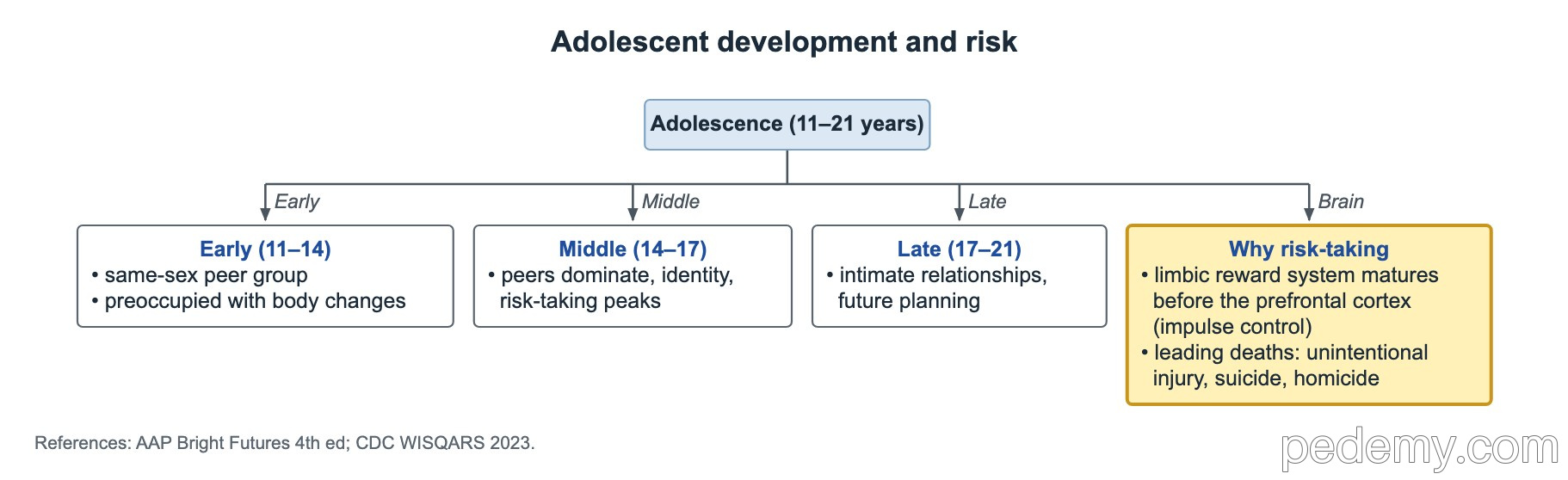
- Early adolescence (11–14 years): same-sex peer group and preoccupation with body changes.
- Risk-taking: the limbic reward system matures before the prefrontal cortex that controls impulses.
- Leading causes of death in US adolescents: unintentional injury, then suicide and homicide.
- Emancipated minors (marriage, military service, self-supporting, court order) consent to all their own care.
- Break confidentiality for a suicide plan, homicidal risk or abuse; not for sex, contraception, pregnancy or STIs alone.
- Start planning the move to adult care at about age 12.
- After sexual assault: HIV PEP as soon as possible and no later than 72 hours; repeat HIV and syphilis tests at 4–6 weeks and 3 months.
Stages of adolescence and risk-taking
Adolescence runs from about 11 to 21 years. The reward and emotion (limbic) systems mature before the prefrontal cortex, which controls impulses and planning. This gap explains the peak in risk-taking, especially with peers present.
- Leading causes of death in US adolescents: unintentional injury first, then suicide and homicide (their order varies by year).
- Firearms and motor vehicle crashes drive most of these deaths, so counsel on both.
| Stage | Typical features |
|---|---|
| Early (11–14 years) | Same-sex peer group; preoccupied with pubertal body changes; concrete thinking |
| Middle (14–17 years) | Peers dominate; identity questions; risk-taking peaks |
| Late (17–21 years) | Intimate relationships; future planning; more abstract thinking |
Who can consent
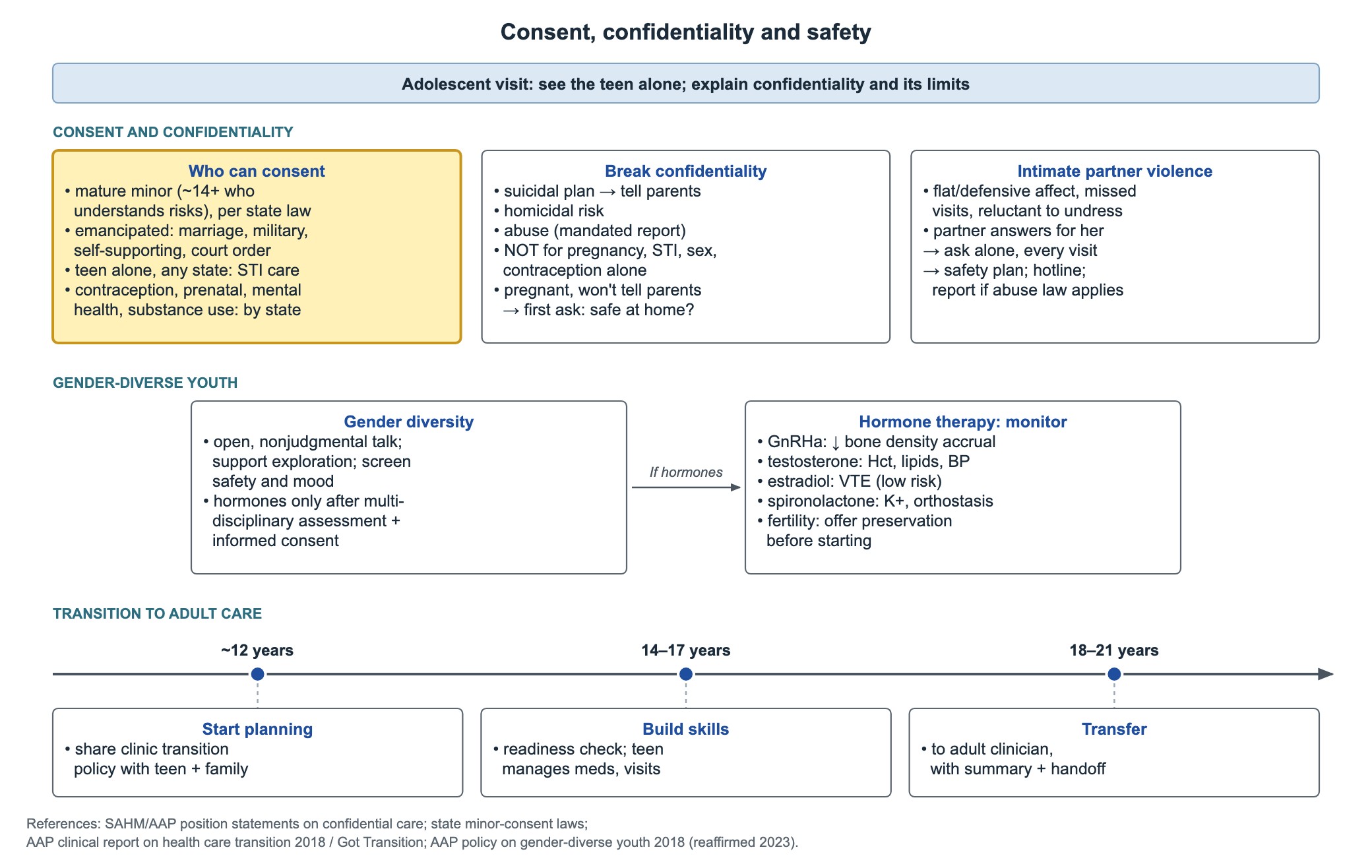
See every teen alone for part of the visit and explain confidentiality and its limits. Minor-consent rules come from state law, so the details vary.
- Emancipated minors can consent to all of their own care. Routes: marriage, military service, living independently and self-supporting, or a court order.
- Mature minor doctrine: an older adolescent (often about 14 or older) who understands the risks may consent to specific treatments, depending on state law.
- Every state lets minors consent to STI testing and treatment.
- Consent for contraception, prenatal care, mental health care and substance use treatment depends on the state.
When to break confidentiality
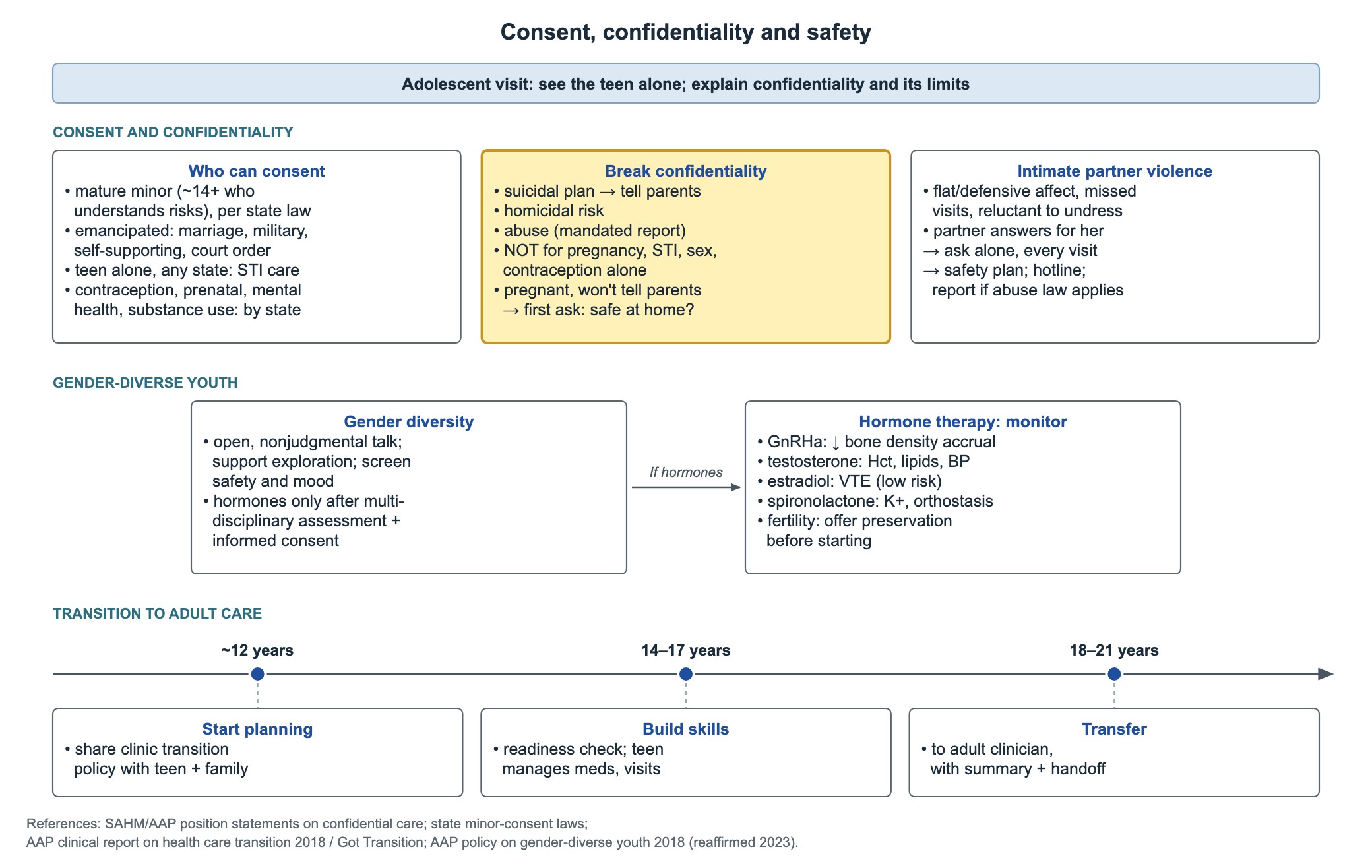
Confidentiality protects teens who would otherwise skip care. It has limits, and the teen should hear them before sensitive questions.
- Break it for a suicidal plan: tell the parents, even if the teen asks you not to.
- Break it for risk of harm to others, and report abuse as the law requires.
- Do not break it for sexual activity, contraception, pregnancy or STIs alone.
- A pregnant teen who will not tell her parents: first ask whether she is safe at home, then encourage disclosure.
- A teen who is skipping treatment for a chronic illness (for example, cystic fibrosis): explain the limits and help them tell the parents.
- A teen who discloses being gay: keep it confidential, respond with support and screen for depression, bullying, substance use and sexual risk. Still offer contraception counseling.
| Intimate partner violence clue | What to do |
|---|---|
| Flat or defensive affect, missed visits, reluctance to undress | Ask about relationship safety with the teen alone, at every visit |
| Partner answers for her or will not leave the room | Offer a safety plan and a hotline; report if abuse laws apply |
Gender-diverse youth
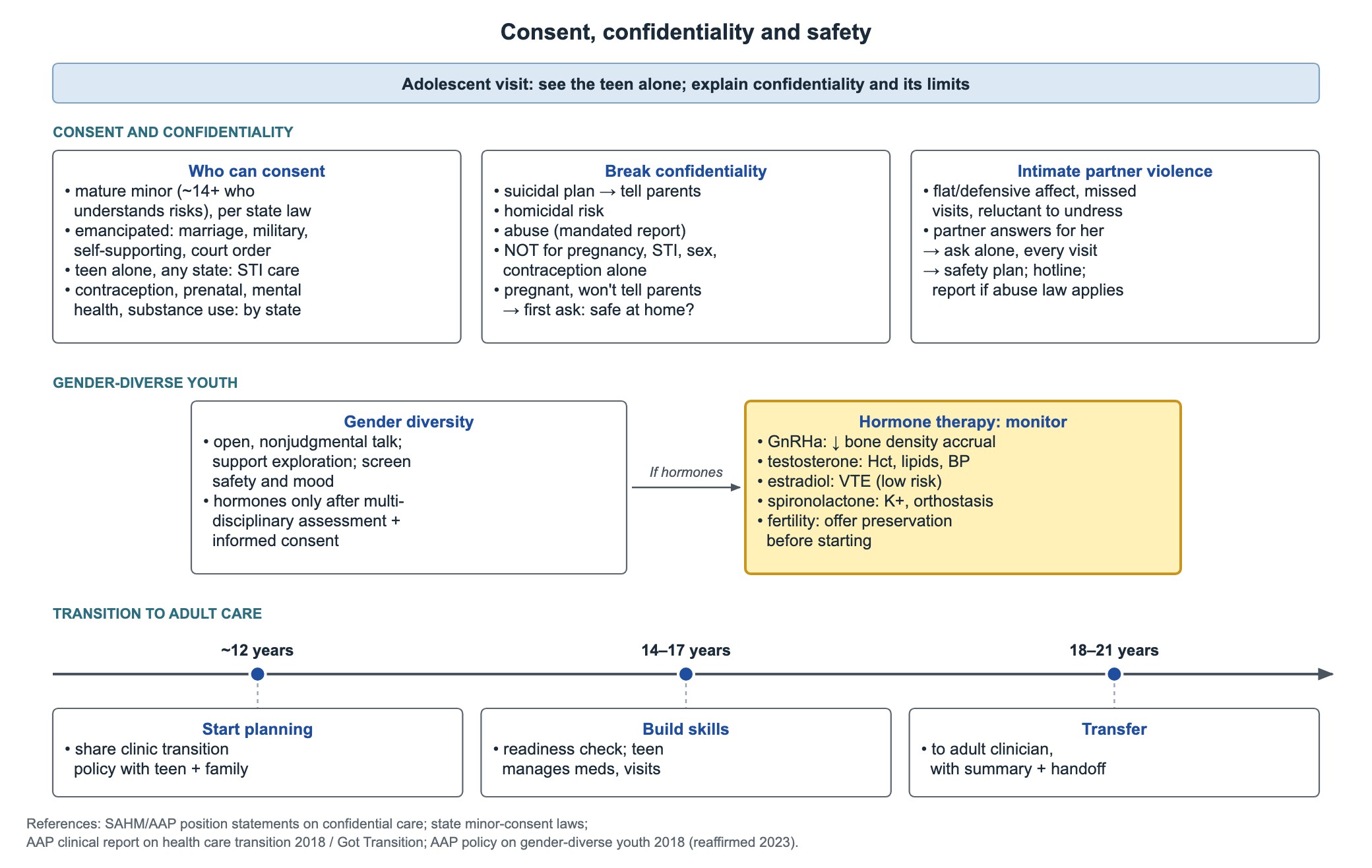
Start with an open, nonjudgmental conversation, support the young person's exploration, and screen for safety, mood and suicide risk. Conversion therapy is never appropriate. Affirming psychotherapy is the first step for a distressed early-pubertal teen.
Hormones are considered only after a comprehensive assessment by a multidisciplinary medical and mental health team, with informed consent from the teen and parents.
| Treatment | Main risk or monitoring |
|---|---|
| GnRH agonist (pubertal suppression) | Reduced bone mineral density accrual; lumbar BMD often stays below baseline even after estradiol |
| Testosterone | Monitor hemoglobin and hematocrit, lipids and blood pressure |
| Estradiol | Venous thromboembolism (low risk in healthy teens) |
| Spironolactone | Orthostatic hypotension; hyperkalemia is rare |
| GnRH agonist early in puberty, then sex steroids | Possible permanent infertility: offer fertility preservation first |
Transition to adult care
- About 12 years: share the practice's transition policy with the teen and family.
- 14–17 years: check readiness; the teen learns to manage medicines and appointments.
- 18–21 years: transfer to an adult clinician with a medical summary and a direct handoff.
After sexual assault: the first visit
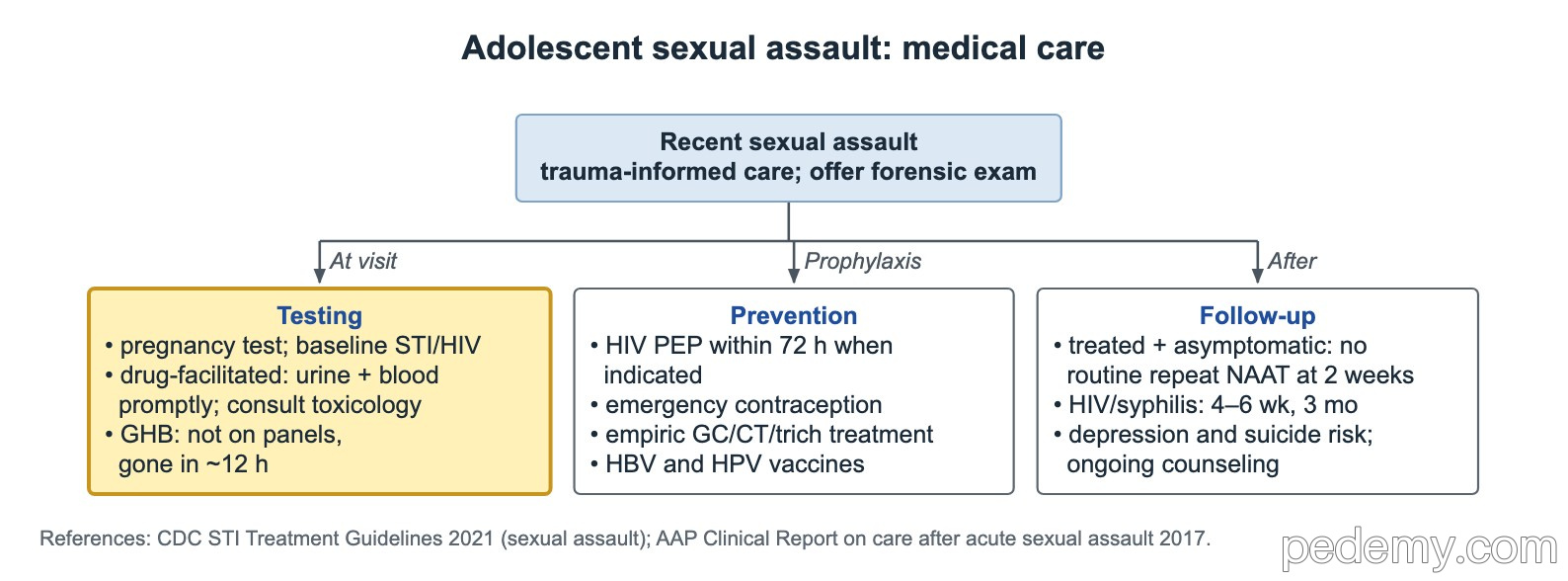
Use a trauma-informed approach and offer a forensic exam. Get a pregnancy test and baseline STI, HIV, syphilis and hepatitis B tests as indicated.
- Suspected drug-facilitated assault: collect urine and blood as early as possible and involve toxicology.
- Genital injury with amnesia after a party suggests GHB. Routine urine drug screens do not detect it, and it clears in about 12 hours.
Prophylaxis and follow-up after assault
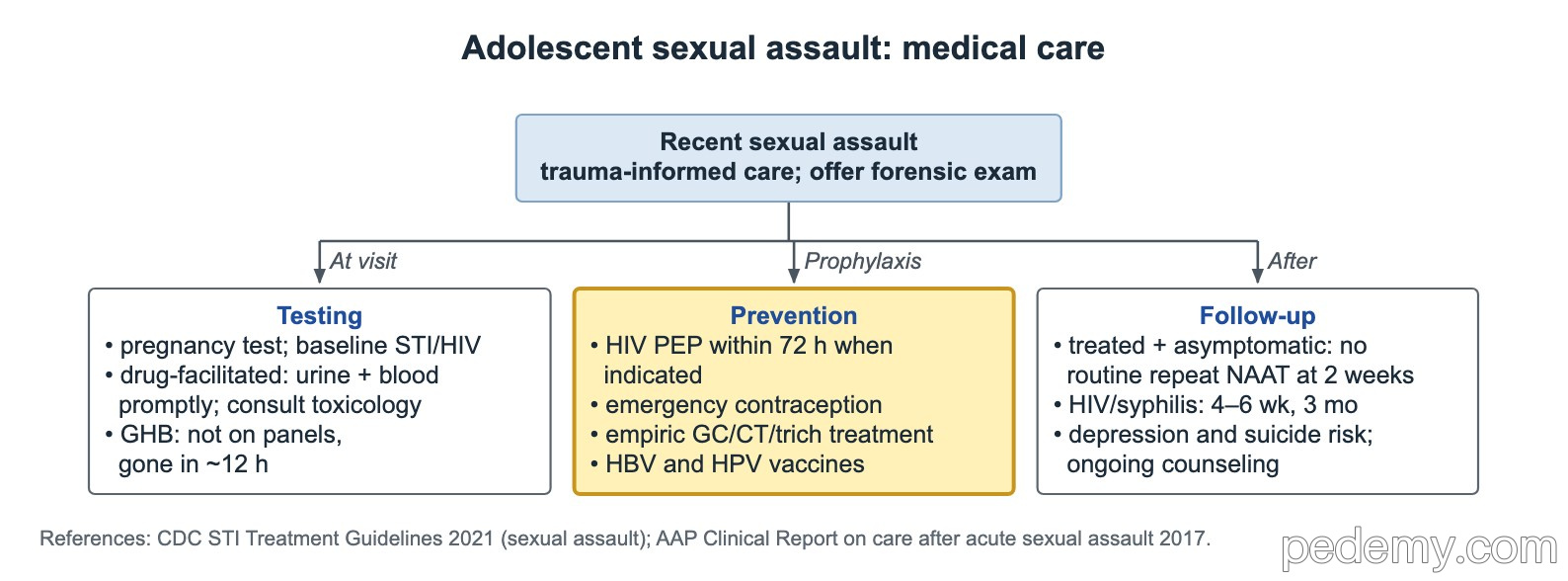
- HIV nPEP when the exposure carries real HIV risk: start as soon as possible, ideally within 24 hours and no later than 72 hours; the course is 28 days.
- Emergency contraception.
- Empiric treatment for gonorrhea, chlamydia and trichomonas.
- Hepatitis B and HPV vaccination if not complete.
- Treated and without symptoms: no routine repeat NAAT at 2 weeks.
- Repeat HIV and syphilis testing at 4–6 weeks and 3 months.
- Screen for depression and suicide risk and arrange ongoing counseling.
Common questions
Can a teenager get STI treatment without parental consent?
Yes. Every US state allows minors to consent to STI testing and treatment. Rules for other services vary by state.
When can a doctor break a teen's confidentiality?
When there is a risk of suicide or of harming others, or when abuse must be reported. Sexual activity, contraception, pregnancy or STIs alone are not reasons.
How soon must HIV PEP start after sexual assault?
As soon as possible, ideally within 24 hours, and no later than 72 hours after the exposure.
Study this topic
Sources
- AAP 2024: Confidentiality in the Care of Adolescents, policy statement (Pediatrics)
- AAP 2017: Care of the Adolescent After an Acute Sexual Assault (Pediatrics)
- CDC 2025: Antiretroviral postexposure prophylaxis after nonoccupational exposure to HIV (MMWR Recomm Rep)
- AAP/AAFP/ACP 2018: Supporting the health care transition from adolescence to adulthood (Pediatrics)
- CDC: Sexually Transmitted Infections Treatment Guidelines, 2021 (MMWR Recomm Rep)
Written for Pedemy in our own words from the sources above; checked November 2026. For education only, not medical advice; check doses and local protocols before treating a patient. Pedemy is independent and not affiliated with or endorsed by the organizations cited.