

Main decision tree
Inattention or hyperactivity: ADHD or a look-alike?
Key points
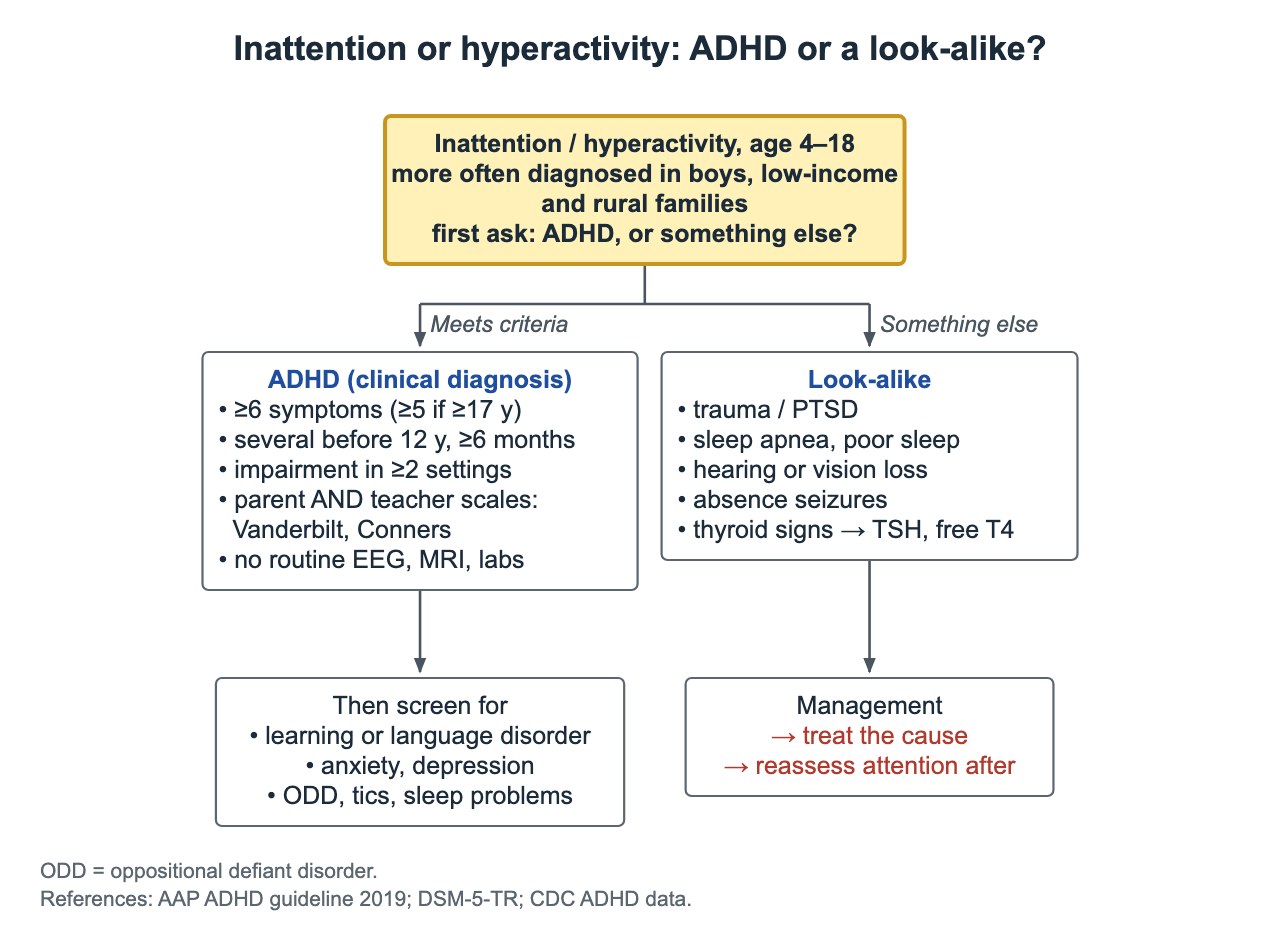
- About 1 in 9 US children aged 3–17 years have ever had an ADHD diagnosis (2022 survey); more often boys, lower-income and rural families.
- Diagnosis: ≥6 symptoms (≥5 at age 17 or older) for ≥6 months, several before age 12, impairing in ≥2 settings.
- Use parent and teacher rating scales (Vanderbilt, Conners); EEG, brain MRI and routine labs are not needed.
- Age 4–5 years: parent training in behavior management first; methylphenidate only if still moderate–severe.
- Age 6–18 years: FDA-approved medicine plus behavioral and school supports; teens need their assent.
- Before a stimulant: targeted cardiac history and exam; ECG only if something is positive.
- Most common stimulant side effect: decreased appetite; check BP, heart rate, height and weight at every visit.
ADHD or a look-alike?
Any child aged 4–18 years with inattention, hyperactivity or impulsivity that affects school or behavior should be evaluated. The first question is always whether the picture is ADHD or something else that looks like it.
In the 2022 National Survey of Children's Health, about 11% of US children had ever been diagnosed with ADHD. Diagnosis is reported more often in boys, in lower-income families and in rural (nonmetropolitan) areas.
Making the diagnosis
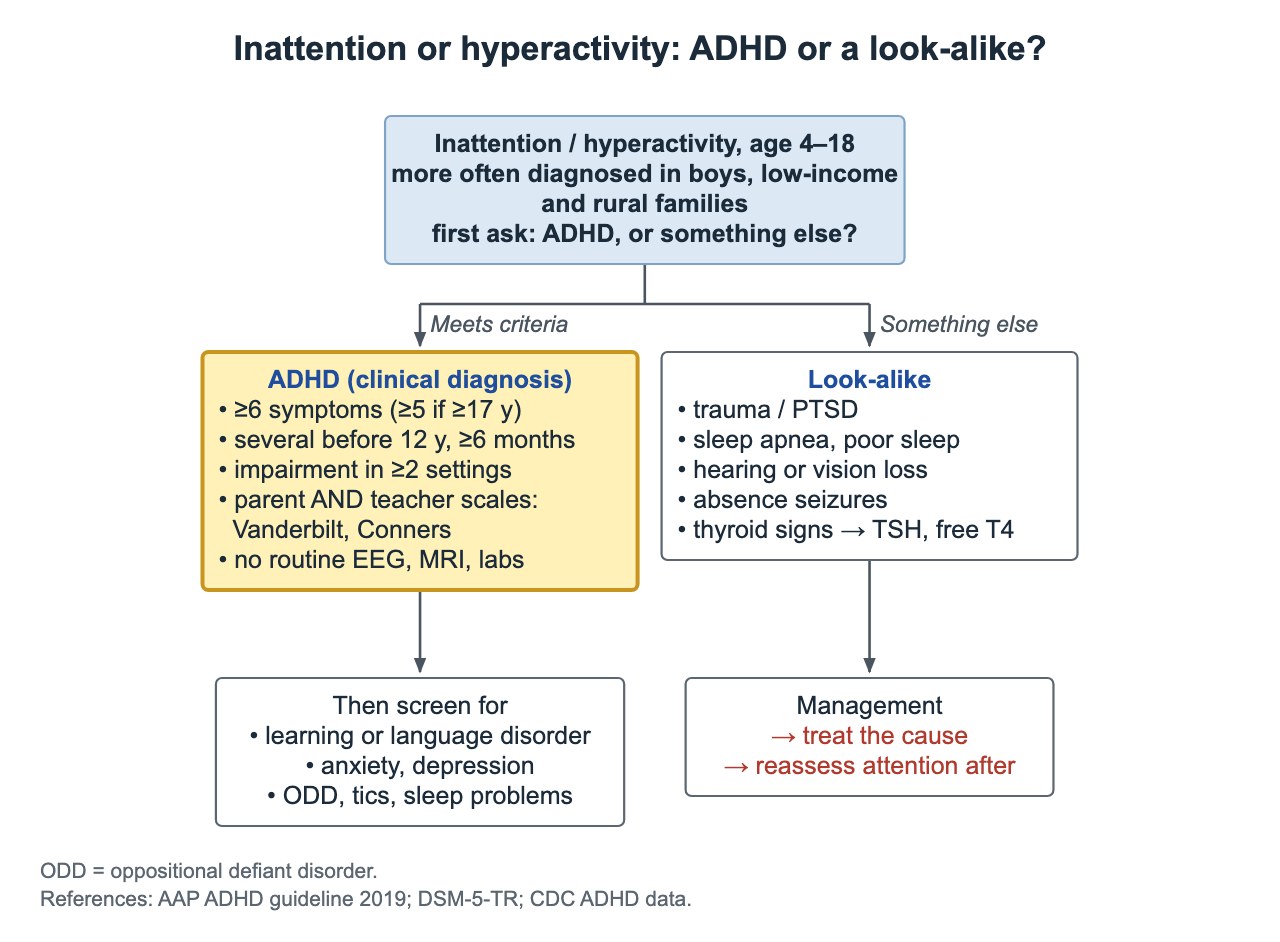
Presentations are predominantly inattentive, predominantly hyperactive-impulsive, or combined. Children who were maltreated have higher rates of ADHD; if a maltreated child is inattentive at home and school and has no trauma symptoms, ADHD can still be diagnosed.
- Symptoms: at least 6 inattentive and/or 6 hyperactive-impulsive symptoms; 5 are enough from age 17.
- Duration: at least 6 months, with several symptoms present before age 12.
- Settings: symptoms and impairment in 2 or more settings (home, school, activities). A positive teacher scale alone, with no symptoms at home or sport, is not enough.
- Rating scales: collect parent AND teacher ratings, for example Vanderbilt or Conners.
- Tests: no routine EEG, brain MRI or blood tests in a child with a normal history and exam.
Look-alikes and coexisting conditions
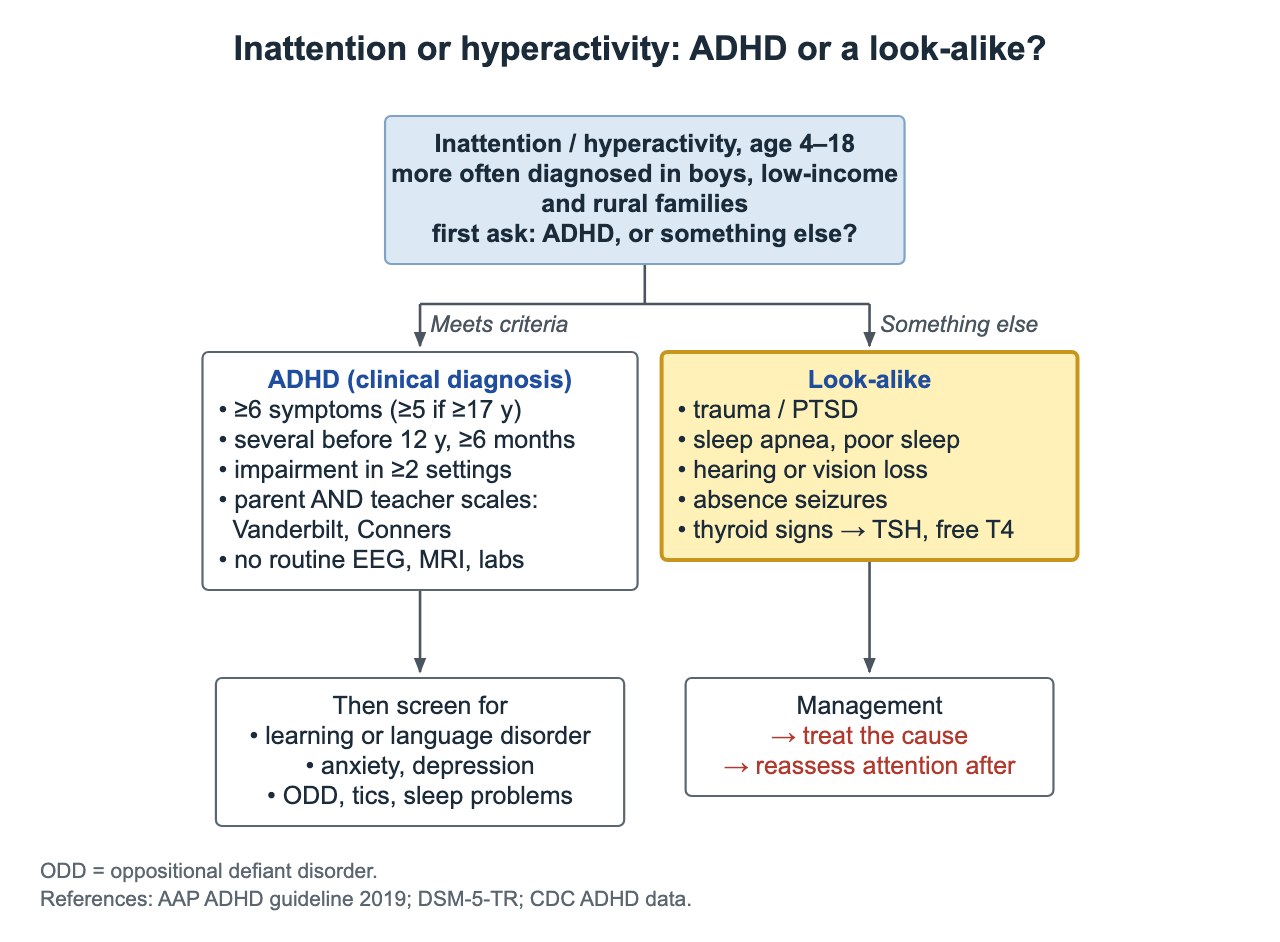
If a look-alike is found, treat the cause and reassess attention afterward.
When ADHD is confirmed, screen for coexisting conditions: learning and language disorders, anxiety, depression, oppositional defiant disorder, tics and sleep problems. In school-age children, learning disorders, anxiety and ODD are the classic ones to look for.
| Look-alike | Clue and next step |
|---|---|
| Trauma / PTSD | Foster care, neglect or abuse; screen for trauma symptoms before labeling ADHD |
| Sleep apnea or poor sleep | Snoring, daytime sleepiness; treat the sleep problem first |
| Hearing or vision loss | Check hearing and vision |
| Absence seizures | Brief staring spells with eye flutter |
| Hyperthyroidism | Weight loss, tremor, heat intolerance → TSH and free T4 |
Treatment by age
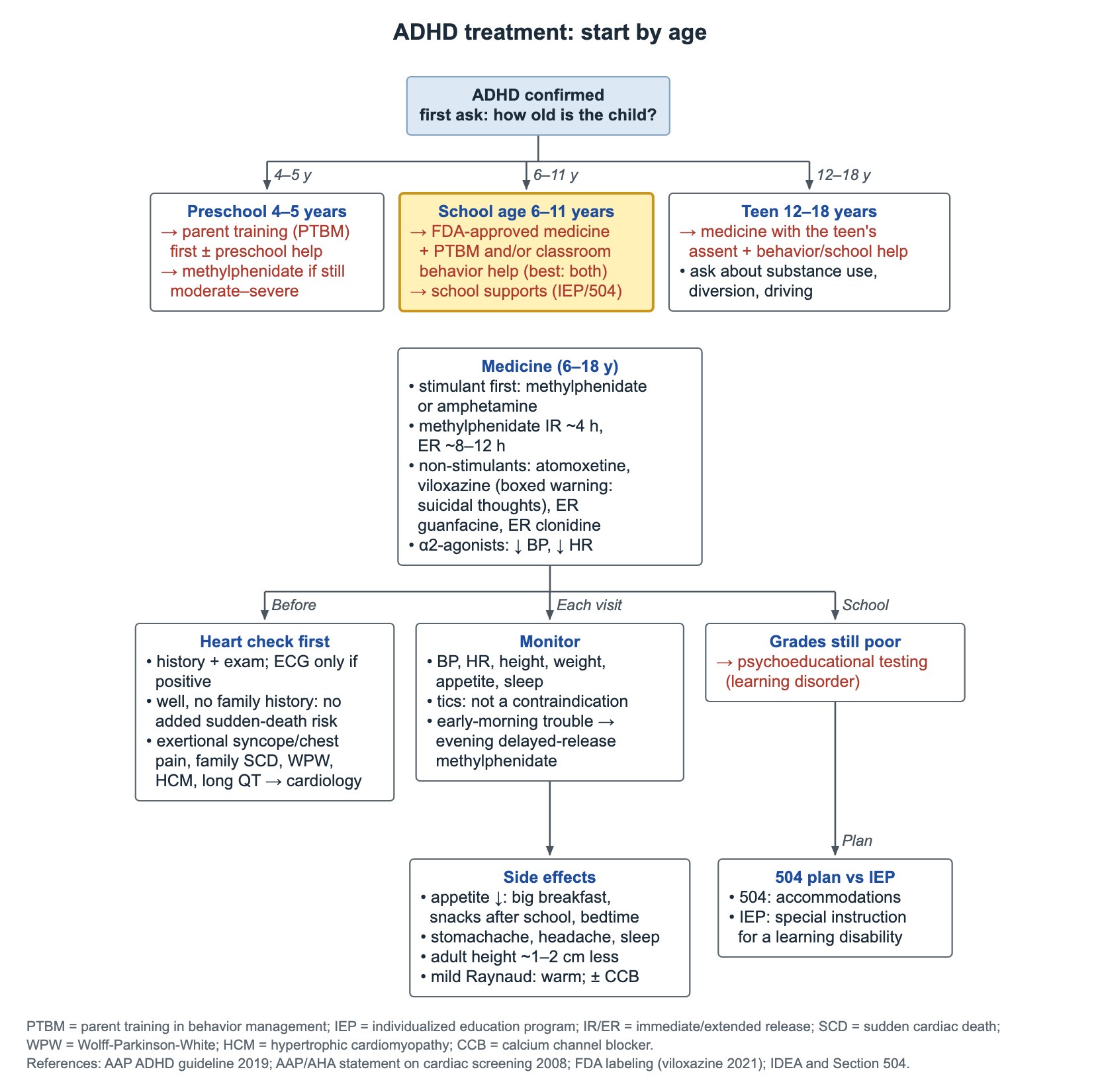
A preschooler about to be expelled for hitting and running off still starts with behavioral treatment, not medicine.
If attention improves on medicine but reading and grades stay poor, order psychoeducational testing for a learning disorder. A child with a learning disorder usually stays in a mainstream class with an IEP (special instruction); a 504 plan gives accommodations only.
| Age | First treatment |
|---|---|
| 4–5 years | Parent training in behavior management (PTBM) ± preschool behavior help; add methylphenidate only if symptoms stay moderate–severe |
| 6–11 years | FDA-approved medicine plus PTBM and/or classroom behavior help (both is best), with school supports (IEP or 504 plan) |
| 12–18 years | FDA-approved medicine with the teen's assent, plus behavioral and school supports; ask about substance use, diversion and driving |
Medicines: stimulants and nonstimulants
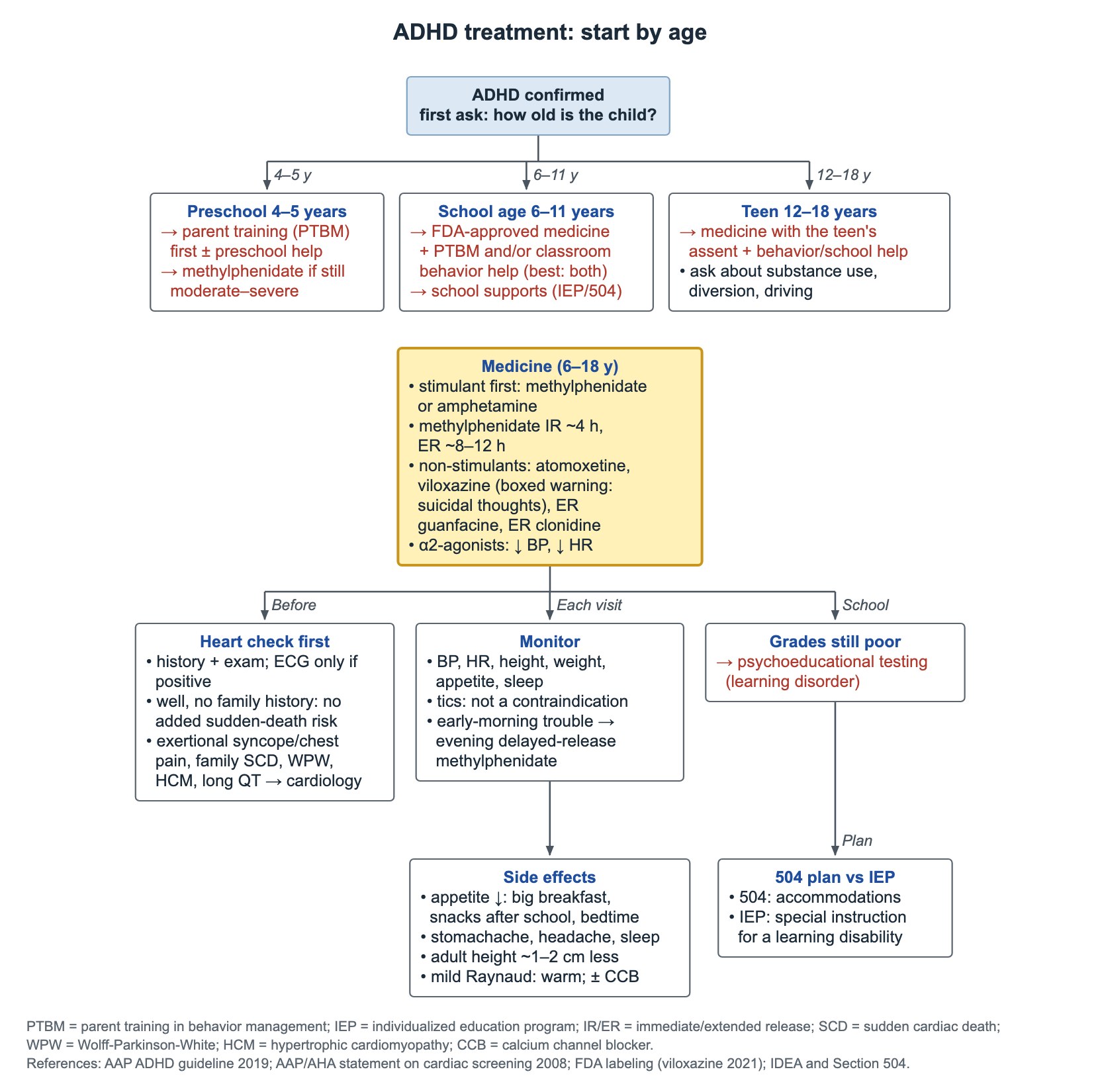
- Stimulants first: methylphenidate or amphetamine.
- Methylphenidate immediate release lasts about 3–5 hours; extended release about 8–12 hours.
- Chaotic early mornings before the morning dose works: an evening-dosed delayed-release/extended-release methylphenidate capsule.
- FDA-approved nonstimulants: atomoxetine, viloxazine, guanfacine ER and clonidine ER.
- Atomoxetine and viloxazine carry a boxed warning for suicidal thoughts and behavior; watch closely in the first months and after dose changes.
- Guanfacine and clonidine can cause hypotension and bradycardia (and sleepiness); taper rather than stop suddenly.
- Tics are not a contraindication to stimulants.
Cardiac screening before a stimulant
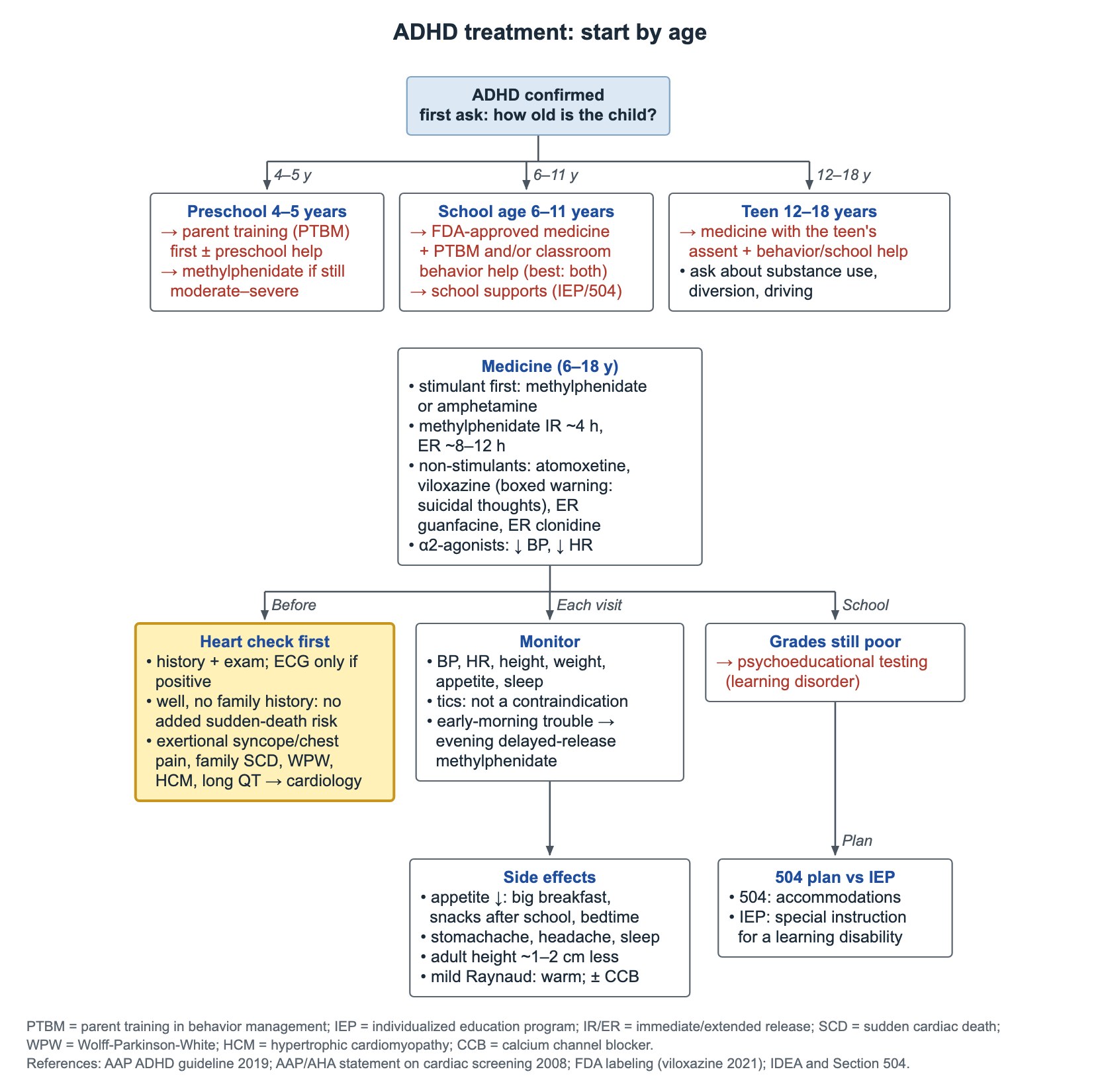
Before starting a stimulant, take a targeted history and examine the heart. Ask about fainting or chest pain with exercise, palpitations, and sudden or early cardiac death in the family. A routine ECG is not needed in a healthy child.
In a healthy child with no cardiac symptoms and no family history, stimulants do not raise the risk of sudden cardiac death.
- Refer to cardiology first for exertional syncope or chest pain, family sudden cardiac death, Wolff-Parkinson-White, hypertrophic cardiomyopathy or long QT.
Monitoring, side effects and sleep
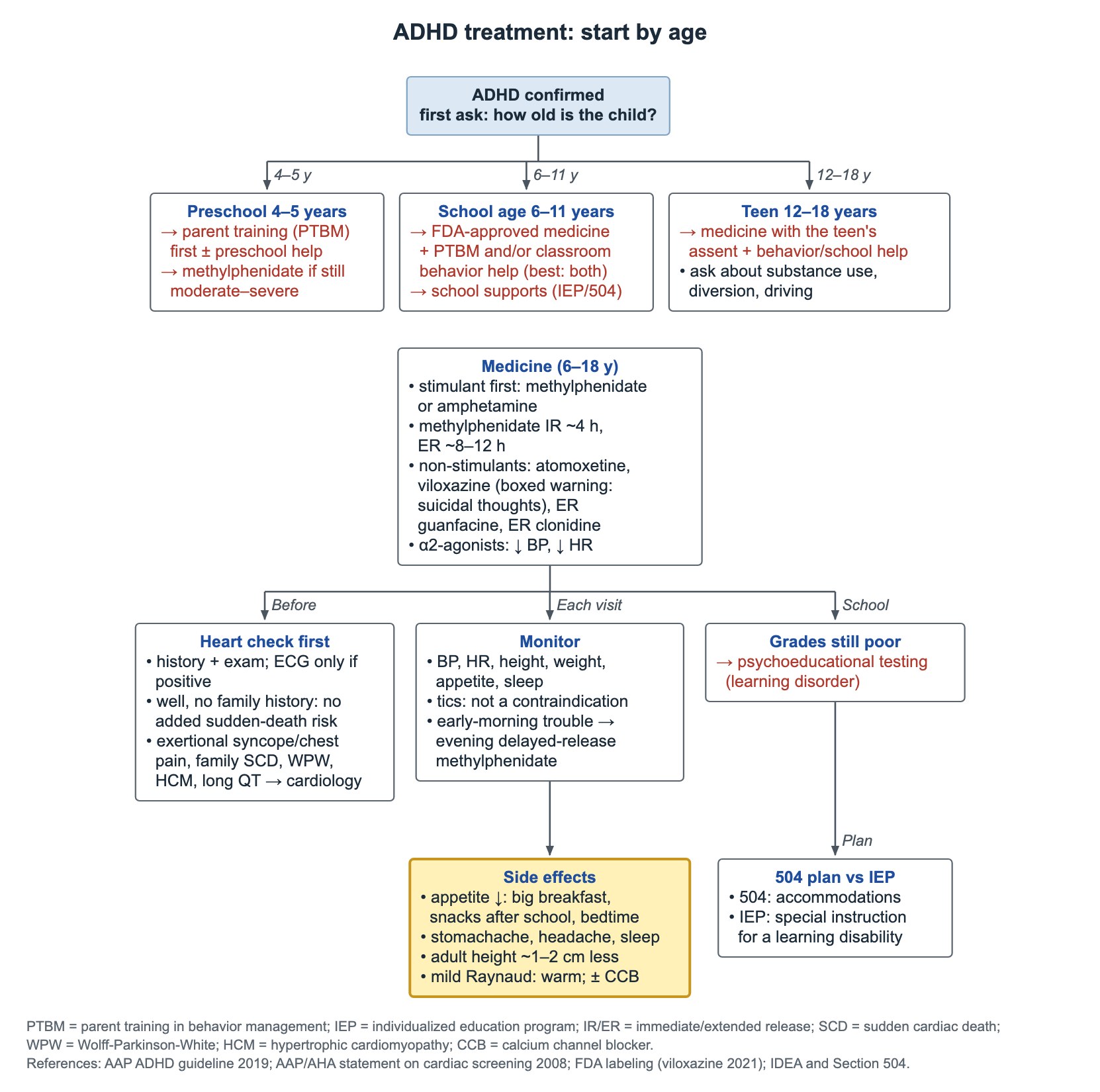
- Every visit: blood pressure, heart rate, height, weight, appetite and sleep.
- Decreased appetite is the most common side effect: give a big breakfast before the dose, then snacks after school and at bedtime.
- Other common effects: stomachache, headache and trouble sleeping.
- Long-term stimulant use may reduce adult height by about 1–2 cm.
- Mild Raynaud phenomenon: keep the stimulant; use warming measures, ± a calcium channel blocker. Ulcers, abnormal nailfold capillaries or systemic signs suggest secondary Raynaud and need work-up.
| Bedtime problem | Likely cause | Fix |
|---|---|---|
| Cannot fall asleep | Stimulant still working (late or evening dose) | Move the dose earlier or use a suitable morning long-acting form |
| Wild and hyperactive at bedtime | Rebound as the dose wears off | Adjust timing or add a small afternoon dose |
| Still awake after those fixes | Insomnia (ask about snoring, restless legs) | Consider melatonin only after sleep hygiene and medicine changes fail |
Common questions
Does a child need an ECG before starting ADHD medicine?
No, not routinely. A targeted cardiac history and exam is enough; get an ECG or cardiology review only if the history or exam is positive.
What is the first-line ADHD treatment for a 4-year-old?
Parent training in behavior management. Methylphenidate is added only if symptoms remain moderate to severe.
Can ADHD be diagnosed from a teacher's report alone?
No. Symptoms must be present in at least 2 settings, so collect ratings from both parents and teachers.
Do stimulants stunt growth?
Long-term use may lower adult height by about 1–2 cm. Track height and weight at every visit.
Study this topic
Sources
- AAP 2019: Clinical practice guideline for ADHD in children and adolescents (Pediatrics)
- CDC 2024: ADHD prevalence among US children in 2022 (J Clin Child Adolesc Psychol)
- AAP/AHA 2008: Cardiovascular monitoring and stimulant drugs for ADHD (Pediatrics)
Written for Pedemy in our own words from the sources above; checked November 2026. For education only, not medical advice; check doses and local protocols before treating a patient. Pedemy is independent and not affiliated with or endorsed by the organizations cited.