

Main decision tree
Anxiety in school-age children and teens: which fear?
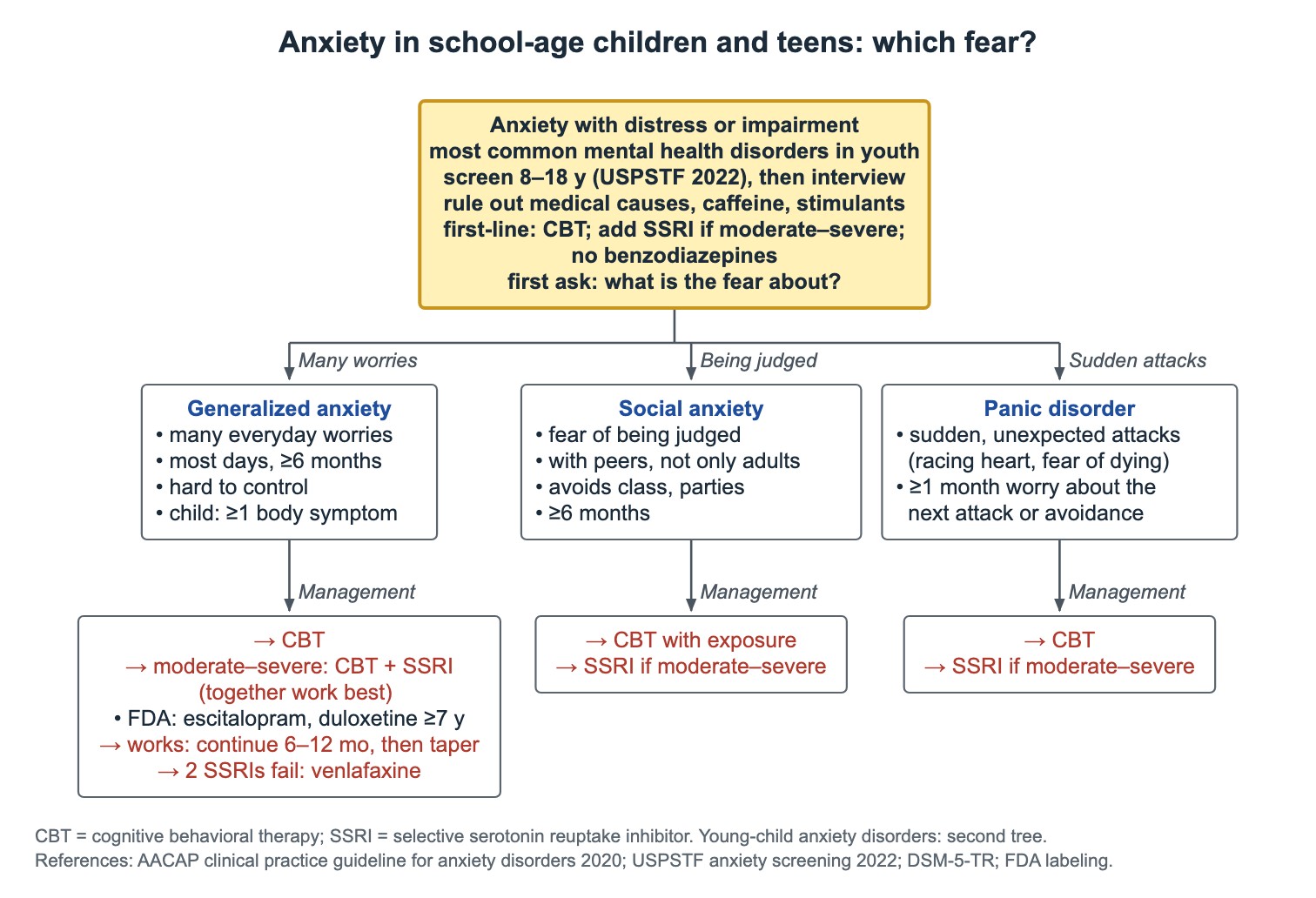
Key points
- USPSTF 2022: screen all children and teens aged 8–18 years for anxiety (for example SCARED or GAD-7).
- First-line treatment for every anxiety disorder: CBT with graded exposure.
- Moderate–severe anxiety or poor CBT response: add an SSRI; CBT plus an SSRI works best.
- After response, continue the medicine 6–12 months, then taper; avoid benzodiazepines.
- Duration: separation anxiety ≥4 weeks; GAD, social anxiety and specific phobia ≥6 months.
- GAD in children needs only 1 physical symptom (adults need 3).
- Selective mutism: silent outside home for >1 month, not counting the first month of school.
Screening and the general approach
Anxiety disorders are the most common mental health problems in adolescents. The USPSTF recommends screening all children and teens aged 8–18 years, even with no complaints, using a tool such as SCARED or GAD-7. A positive screen is followed by an interview.
Rule out medical causes and substances that mimic anxiety, such as hyperthyroidism, caffeine and stimulants. Then ask what the fear is about: that decides the diagnosis.
- First-line: CBT, built on gradual exposure to the feared situation.
- Add an SSRI for moderate–severe symptoms or when CBT alone is not enough.
- Benzodiazepines are not recommended for childhood anxiety disorders.
Generalized anxiety disorder
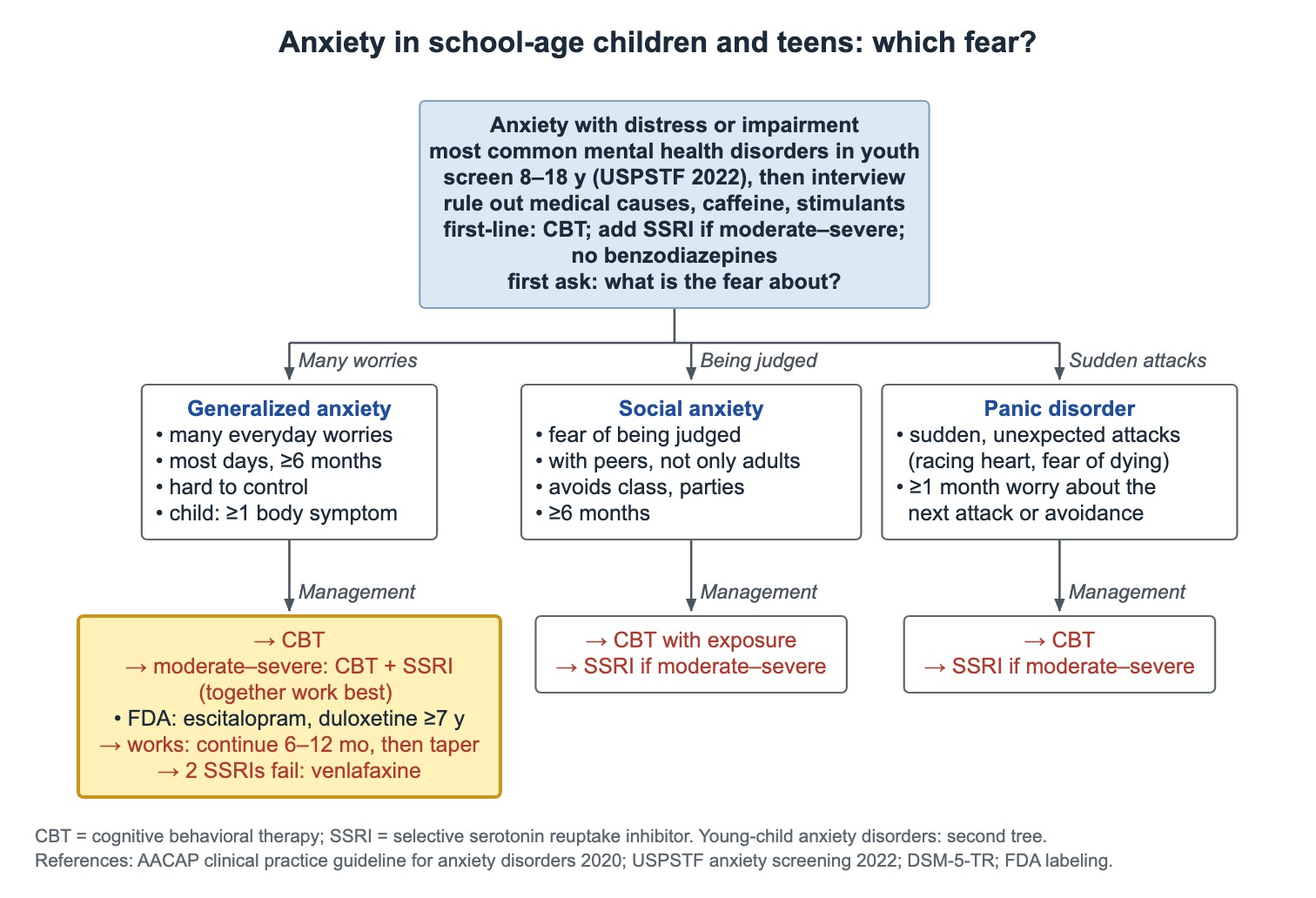
- Many everyday worries (school, health, family money) on most days for ≥6 months.
- The worry is hard to control.
- Children need only 1 associated symptom, such as poor sleep, restlessness, fatigue, poor focus, irritability or muscle tension.
- Moderate–severe GAD: CBT plus an SSRI; the combination works better than either alone.
- FDA-approved for pediatric GAD from age 7: escitalopram and duloxetine (an SNRI).
- After response, continue 6–12 months, then taper slowly.
- Venlafaxine (an SNRI) is used after 2 SSRI trials have failed.
Separation anxiety disorder
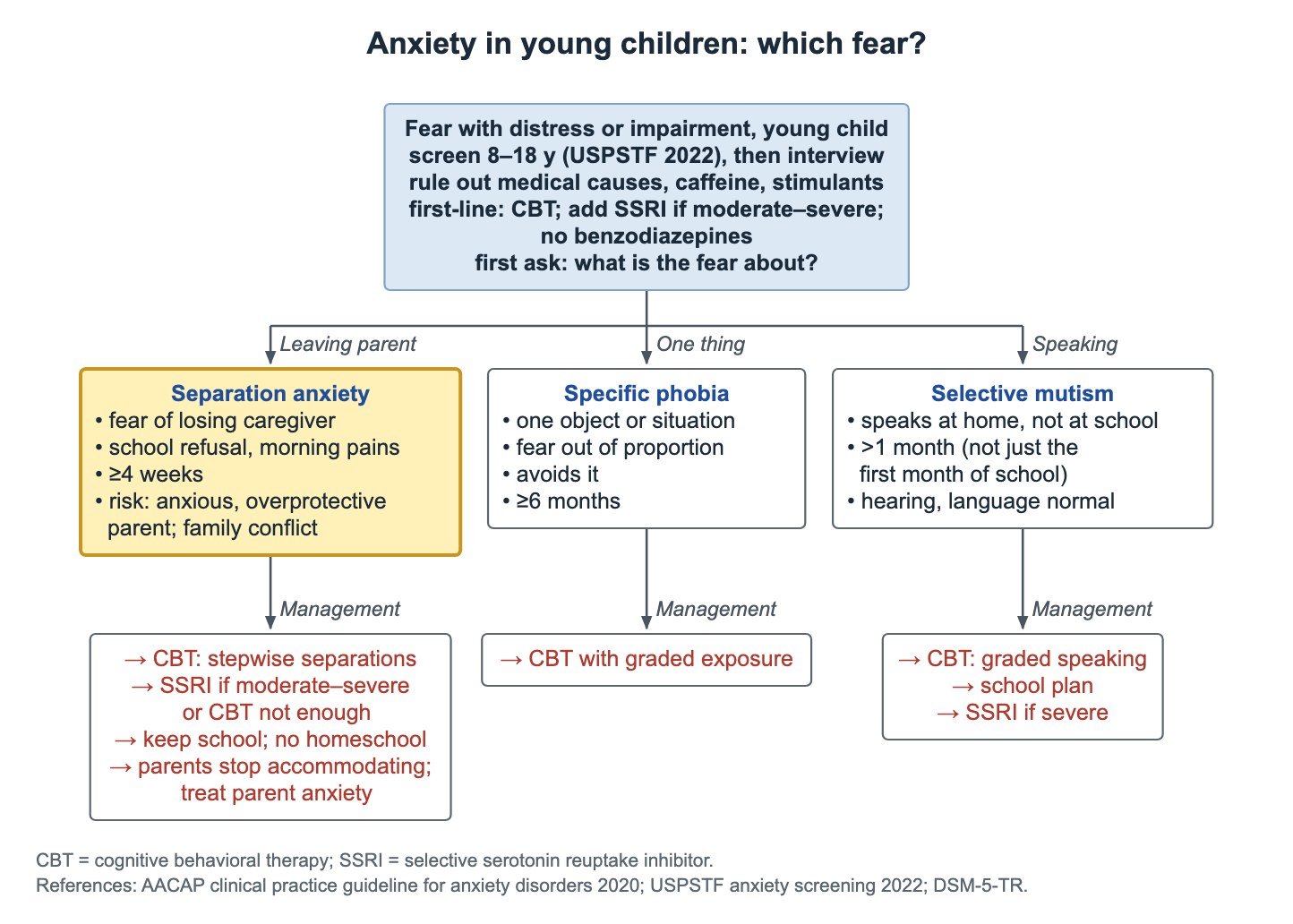
- Excessive fear of losing or being apart from a caregiver: worry that the parent will die or be hurt, or that the child will be lost or kidnapped.
- Signs: school refusal, refusing sleepovers or sleeping alone, nightmares about separation, morning stomachaches or vomiting.
- Duration: at least 4 weeks in children.
- Strongest family risk factor: a parent with an anxiety disorder, especially with overprotective, accommodating parenting; family conflict also adds risk.
Treating separation anxiety
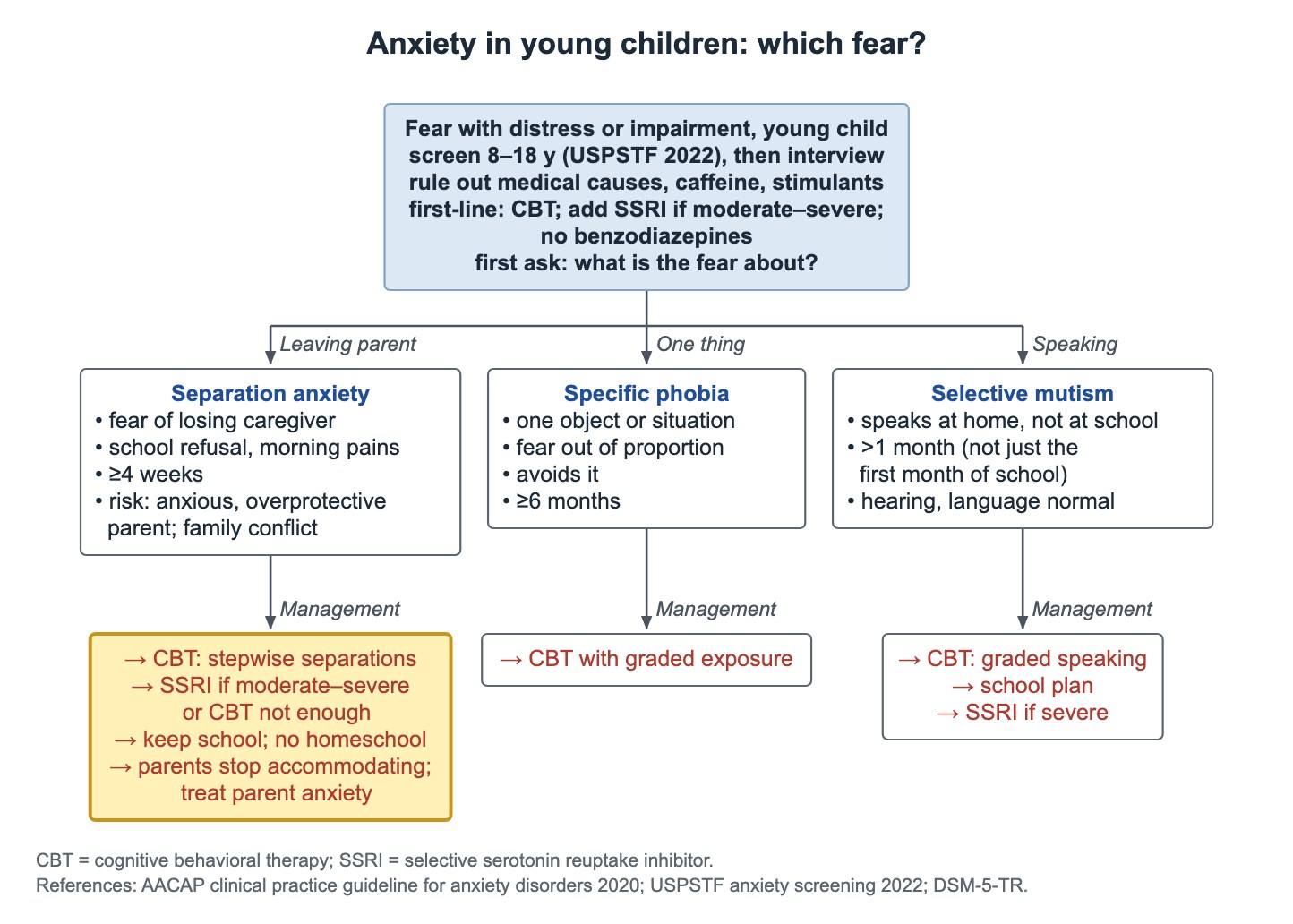
- CBT first. The exposure ladder practices stepwise, manageable separations from the caregiver.
- Keep the child in school. Homeschooling or staying home keeps the avoidance going and prolongs impairment.
- Parents should stop accommodating (for example, picking the child up whenever worried texts arrive); accommodation raises anxiety and blunts treatment response.
- Treat the parent's own anxiety.
- Add an SSRI for moderate–severe symptoms or when CBT is not enough.
Specific phobia and selective mutism
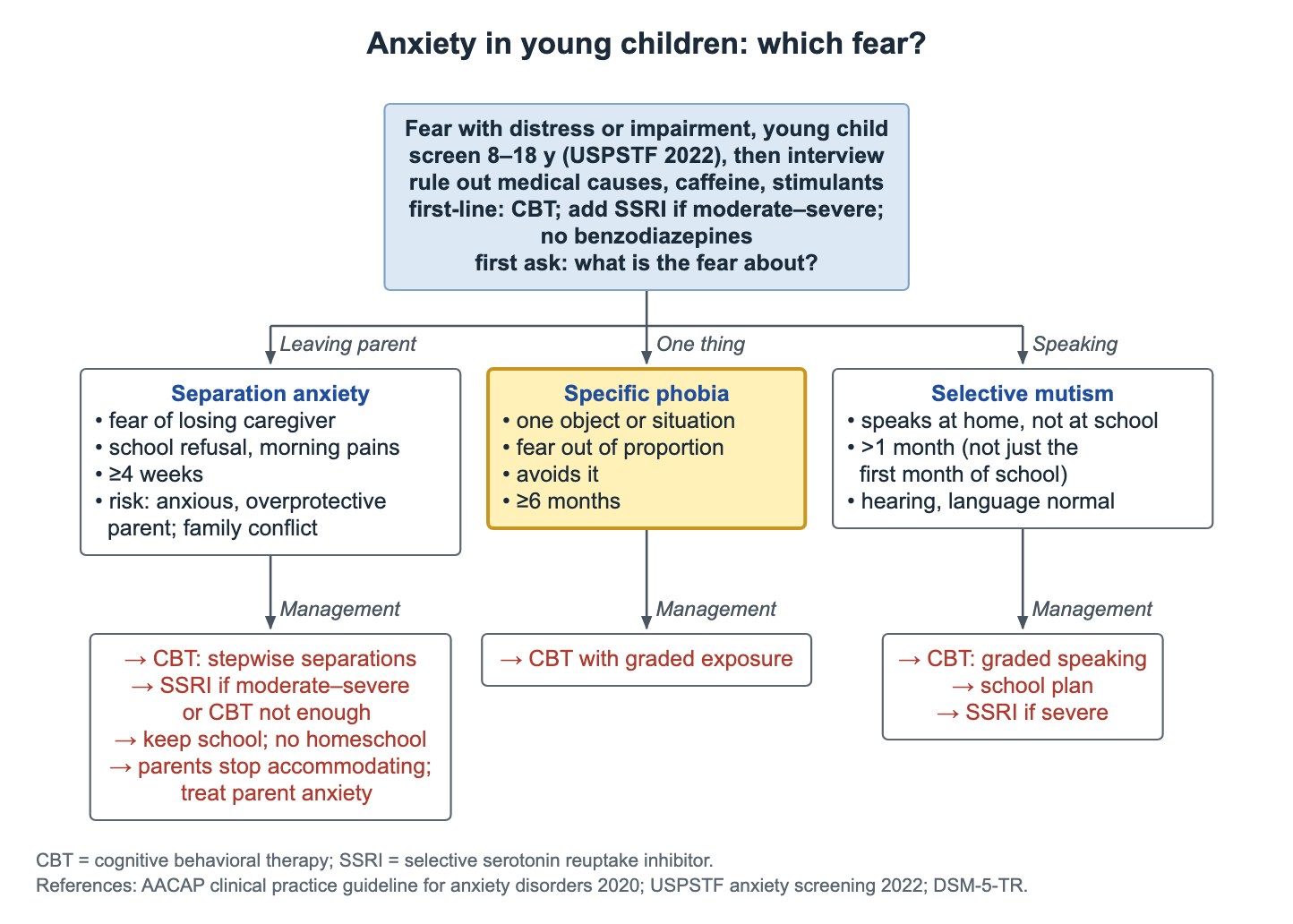
| Specific phobia | Selective mutism | |
|---|---|---|
| Picture | Fear of one object or situation (dogs, storms), out of proportion, with avoidance | Speaks normally at home but not at school or with others |
| Duration | ≥6 months | >1 month; the first month of school does not count |
| Check first | Fear is beyond the real danger, not a normal developmental fear | Hearing and language are normal |
| Treatment | CBT with graded exposure | CBT with graded speaking tasks, a school plan; SSRI if severe |
Common questions
At what age should children be screened for anxiety?
The USPSTF recommends anxiety screening for children and teens aged 8–18 years, even without symptoms.
What is the first-line treatment for anxiety in children?
Cognitive behavioral therapy with gradual exposure. An SSRI is added for moderate to severe symptoms or a poor response to CBT.
How long should an SSRI be continued for childhood anxiety?
Usually 6–12 months after a good response, then a slow taper.
Study this topic
Sources
- AACAP 2020: Clinical practice guideline for anxiety disorders in children and adolescents (JAACAP)
- USPSTF 2022: Screening for anxiety in children and adolescents (JAMA)
Written for Pedemy in our own words from the sources above; checked November 2026. For education only, not medical advice; check doses and local protocols before treating a patient. Pedemy is independent and not affiliated with or endorsed by the organizations cited.
Social anxiety and panic disorder