

Main decision tree
Suspected autism: are both domains present?
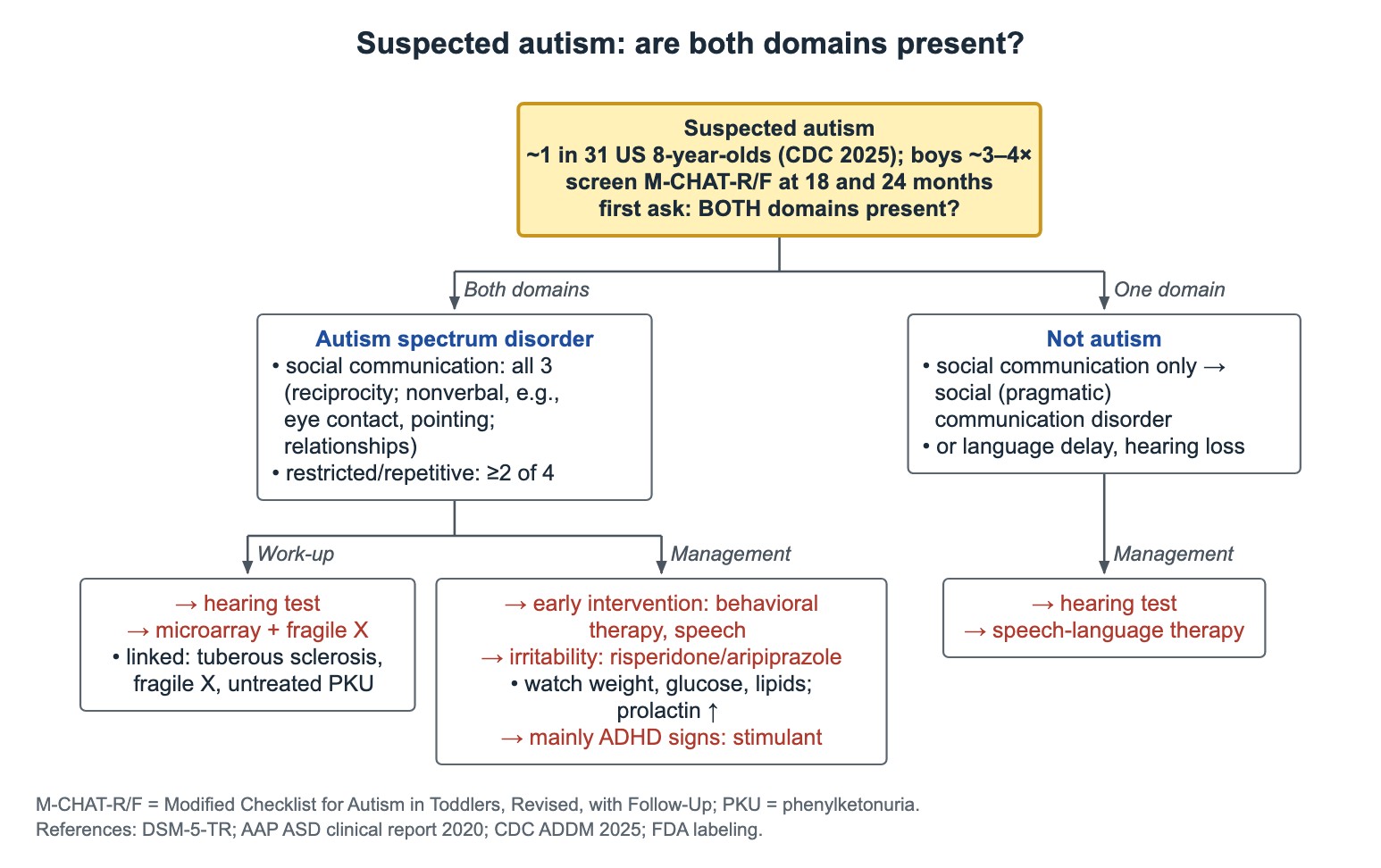
Key points
- CDC 2025 (2022 data): about 1 in 31 US 8-year-olds has autism; boys are identified about 3–4 times as often as girls.
- Screen all toddlers with the M-CHAT-R/F at 18 and 24 months.
- Autism needs all 3 social-communication deficits plus ≥2 of 4 restricted/repetitive behaviors.
- Work-up for every new diagnosis: formal hearing test, chromosomal microarray and fragile X (FMR1) testing.
- Irritability with aggression or self-injury: risperidone or aripiprazole (FDA-approved); watch weight, glucose, lipids and prolactin.
- Rett syndrome: girl, MECP2, normal early development, then loss of hand use and speech, hand-wringing and slowing head growth.
- Trofinetide is FDA-approved for Rett syndrome from age 2; diarrhea is the main side effect.
Suspected autism: are both domains present?
The latest CDC ADDM estimate, using 2022 data and published in 2025, is about 1 in 31 US 8-year-olds, with boys identified about 3–4 times as often as girls.
The AAP recommends standardized autism screening with the M-CHAT-R/F at the 18- and 24-month visits, plus developmental surveillance at every visit. A positive screen leads to referral for diagnostic evaluation and early intervention without waiting for the final diagnosis.
DSM-5-TR criteria
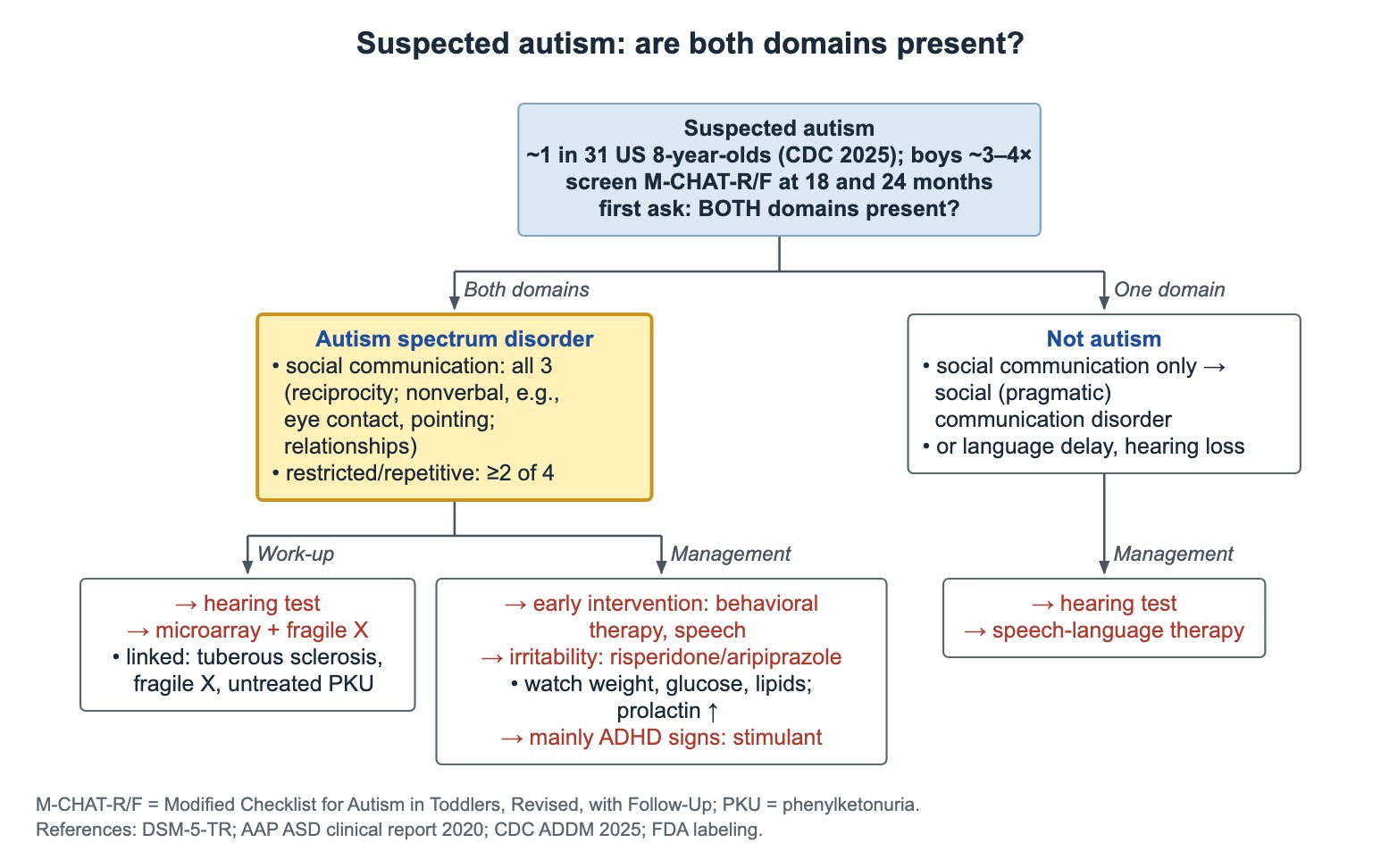
Symptoms begin in early childhood and impair function. Language delay and intellectual disability are not required: they are recorded as specifiers.
If only social communication is affected, with no restricted or repetitive behavior, think of social (pragmatic) communication disorder, language delay or hearing loss. Those children need a hearing test and speech-language therapy.
| Domain | What is needed | Examples |
|---|---|---|
| Social communication and interaction | All 3 | Poor back-and-forth reciprocity; poor nonverbal communication (eye contact, pointing, gestures, facial expression); trouble with relationships and pretend play |
| Restricted, repetitive behavior | At least 2 of 4 | Hand-flapping or lining up toys; insistence on sameness (same route every day); intense narrow interests (wheels); unusual sensory responses |
Medical and genetic work-up
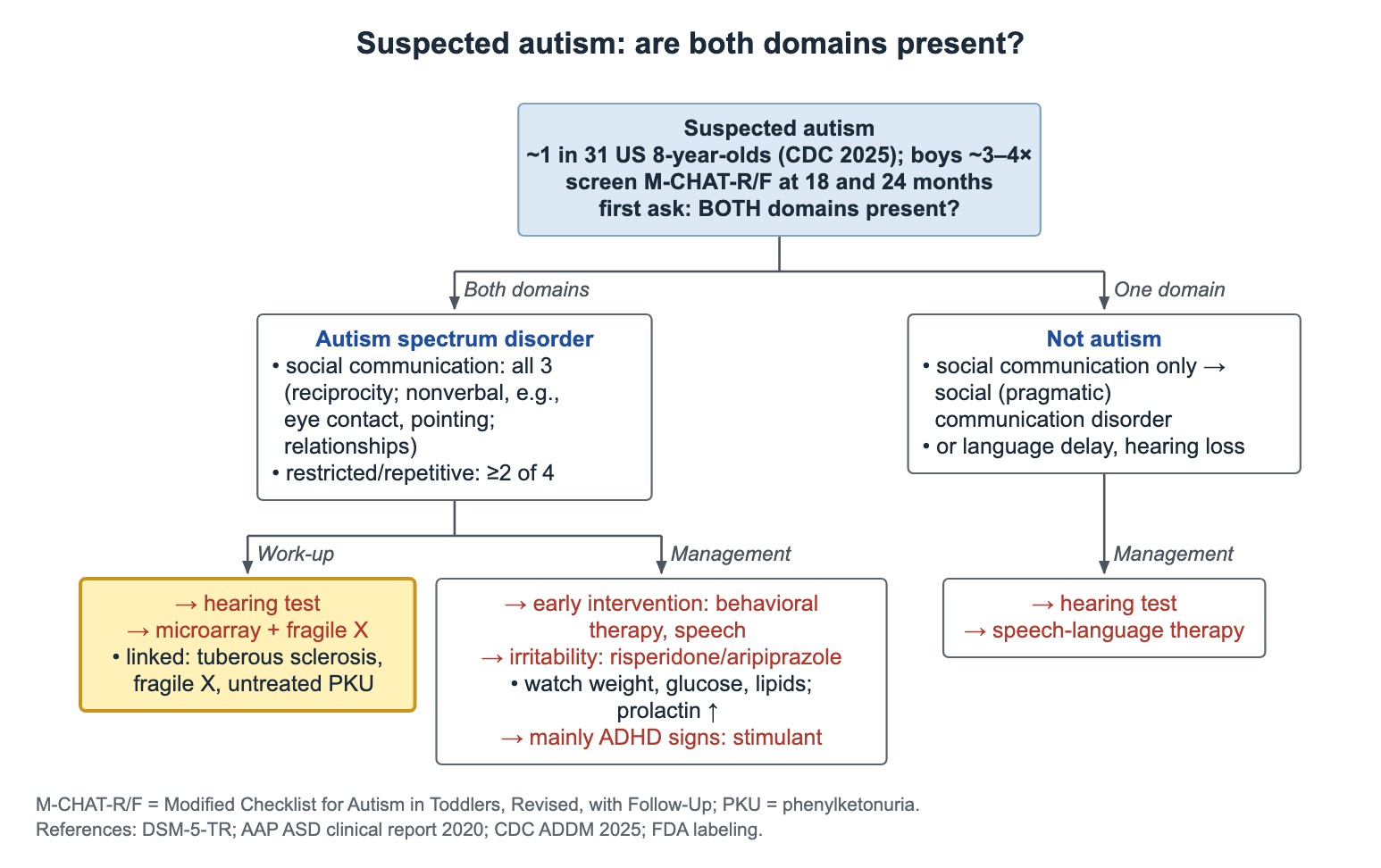
- Formal audiology evaluation in every child.
- Chromosomal microarray plus fragile X (FMR1) testing, even with normal growth, exam and no dysmorphic features.
- Conditions that commonly present with autistic features: tuberous sclerosis, fragile X syndrome and untreated phenylketonuria.
- Other tests (EEG, MRI, metabolic studies) only when the history or exam points to them, such as seizures, regression or abnormal head size.
Treatment and medicines
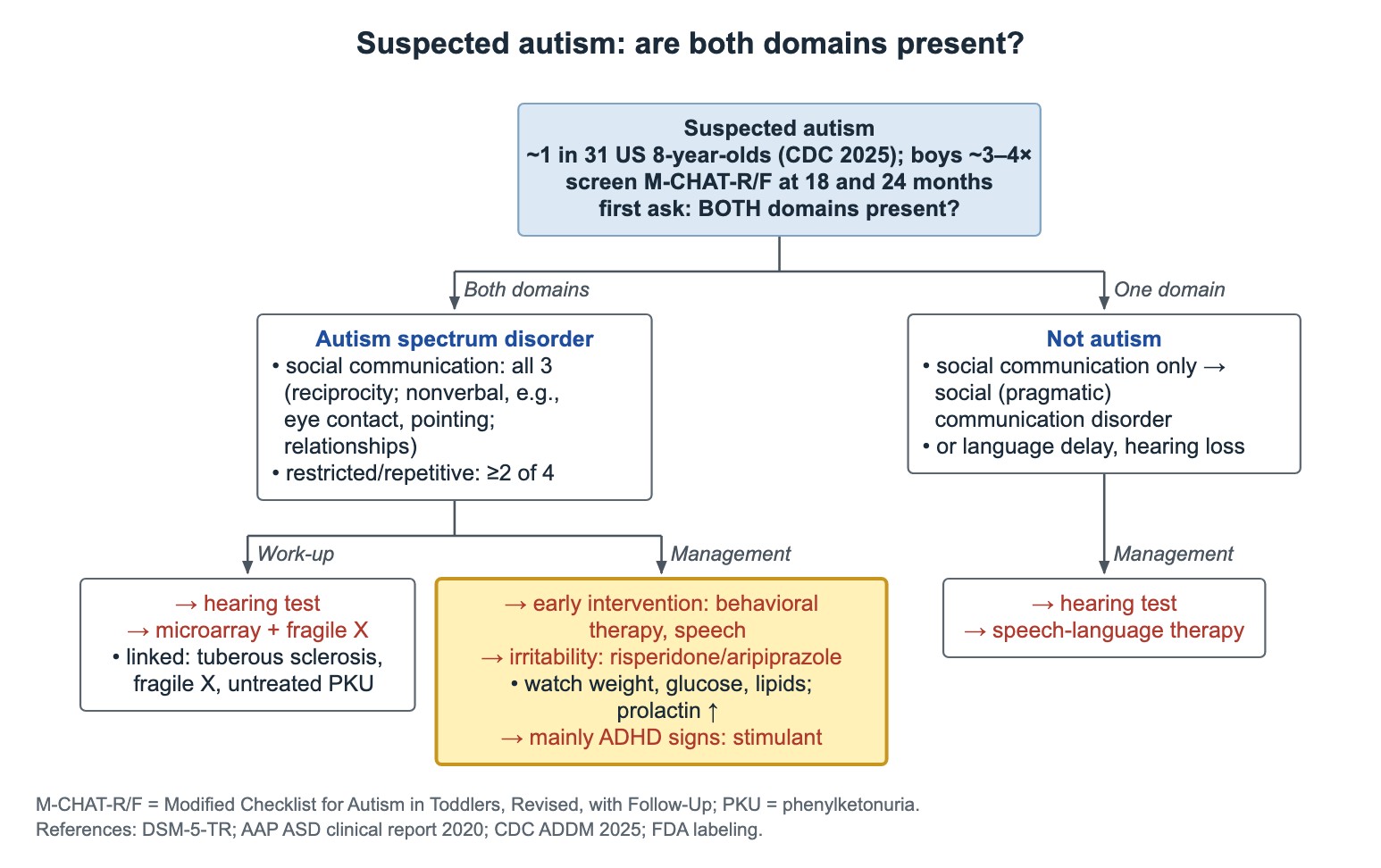
- Core treatment: early intensive behavioral intervention and speech-language therapy, plus school supports.
- Severe irritability, aggression or self-injury despite behavioral therapy: risperidone or aripiprazole, the 2 FDA-approved drugs for autism-related irritability.
- Most common adverse effect of risperidone: weight gain; track BMI, fasting glucose and lipids.
- Risperidone raises prolactin: gynecomastia or galactorrhea, and amenorrhea in girls.
- Mainly hyperactivity and inattention: treat as ADHD, with a stimulant (methylphenidate) first.
Rett syndrome: recognition
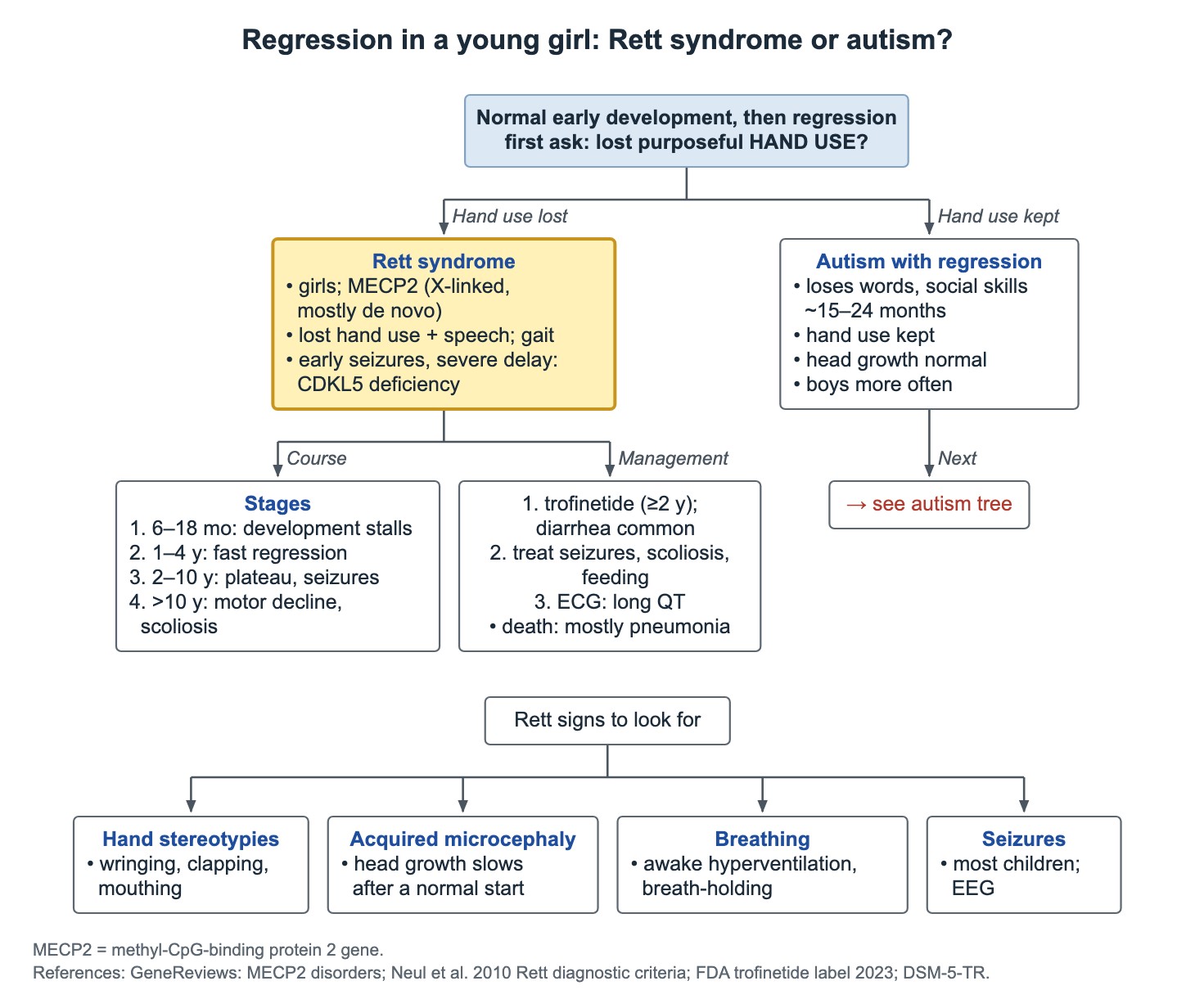
Think of Rett syndrome in a girl with normal early development who then regresses. The first question is whether she has lost purposeful hand use. Autism with regression keeps hand use and normal head growth and is more common in boys.
- Gene: MECP2 on the X chromosome, mostly de novo; almost all patients are girls.
- Loss of purposeful hand use and spoken words, with gait problems.
- Hand stereotypies: wringing, clapping, mouthing.
- Acquired microcephaly: head growth slows after a normal start.
- Breathing problems while awake: hyperventilation and breath-holding spells.
- Seizures in most children.
- Rett-like girl with seizures from the first months of life and severe delay: CDKL5 deficiency disorder.
| Stage | Typical age | Features |
|---|---|---|
| 1 | 6–18 months | Development stalls |
| 2 | 1–4 years | Rapid regression |
| 3 | 2–10 years | Plateau; seizures |
| 4 | Over 10 years | Motor decline, scoliosis |
Rett syndrome: treatment and long-term risks
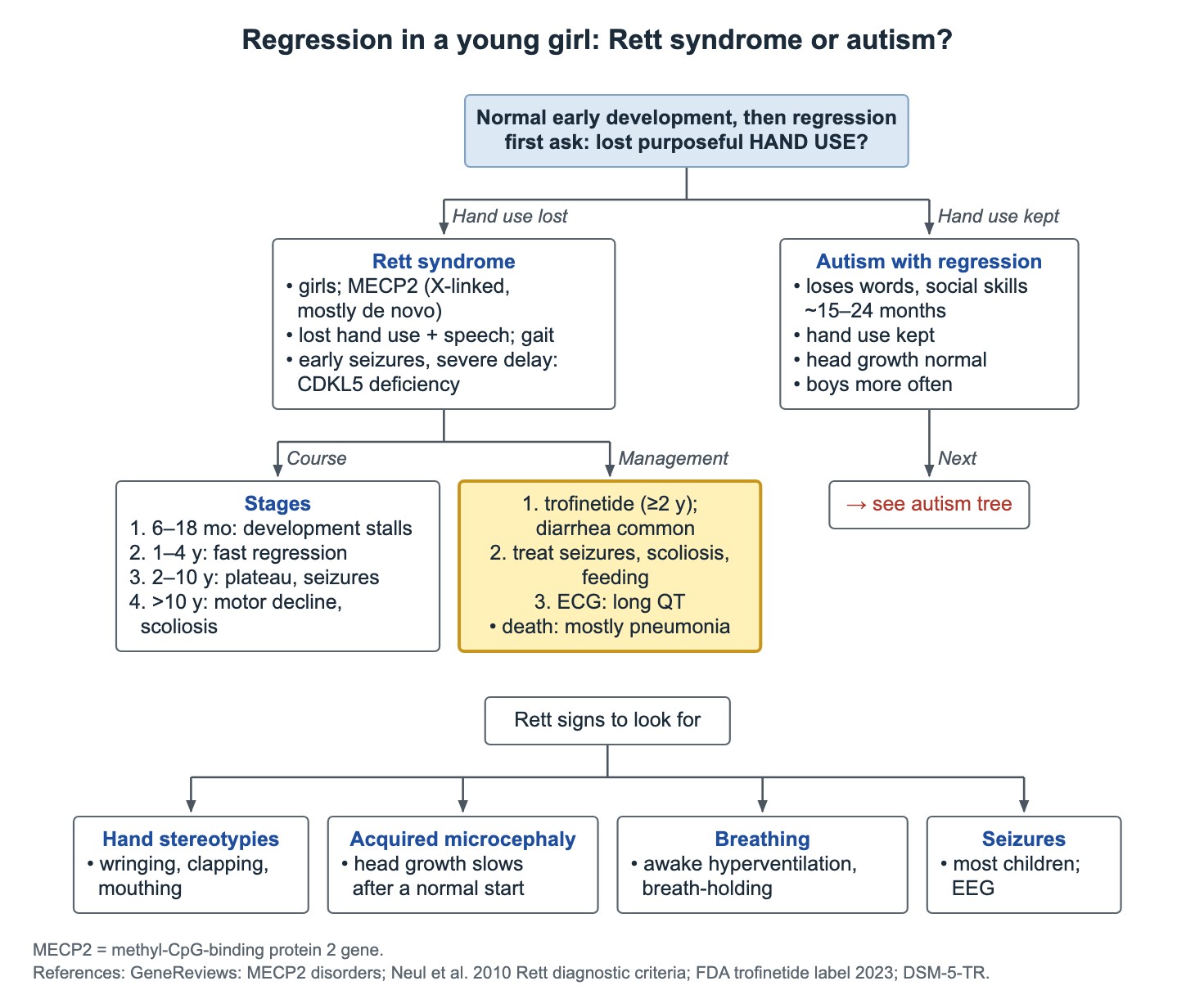
- Trofinetide: the first disease-specific drug, FDA-approved in 2023 for age 2 years and older; diarrhea is the main adverse effect (vomiting and weight loss also occur).
- Treat seizures, scoliosis and feeding problems.
- Periodic ECG to screen for a prolonged QT interval.
- Leading cause of death: respiratory illness, especially pneumonia.
Common questions
When should toddlers be screened for autism?
With a standardized tool such as the M-CHAT-R/F at the 18- and 24-month well visits, plus surveillance at every visit.
What genetic tests are recommended after an autism diagnosis?
Chromosomal microarray and fragile X (FMR1) testing for all children, plus a formal hearing evaluation.
How is Rett syndrome different from autism with regression?
Girls with Rett syndrome lose purposeful hand use, develop hand-wringing and slowing head growth, and have MECP2 variants. Children with autism regression keep hand use and normal head growth.
Study this topic
Sources
- AAP 2020: Identification, evaluation and management of children with autism spectrum disorder (Pediatrics)
- CDC ADDM 2025: Prevalence of autism among children aged 4 and 8 years, 2022 (MMWR)
- Neul et al. 2010: Rett syndrome revised diagnostic criteria (Ann Neurol)
- GeneReviews: MECP2 disorders
Written for Pedemy in our own words from the sources above; checked November 2026. For education only, not medical advice; check doses and local protocols before treating a patient. Pedemy is independent and not affiliated with or endorsed by the organizations cited.