

Main decision tree
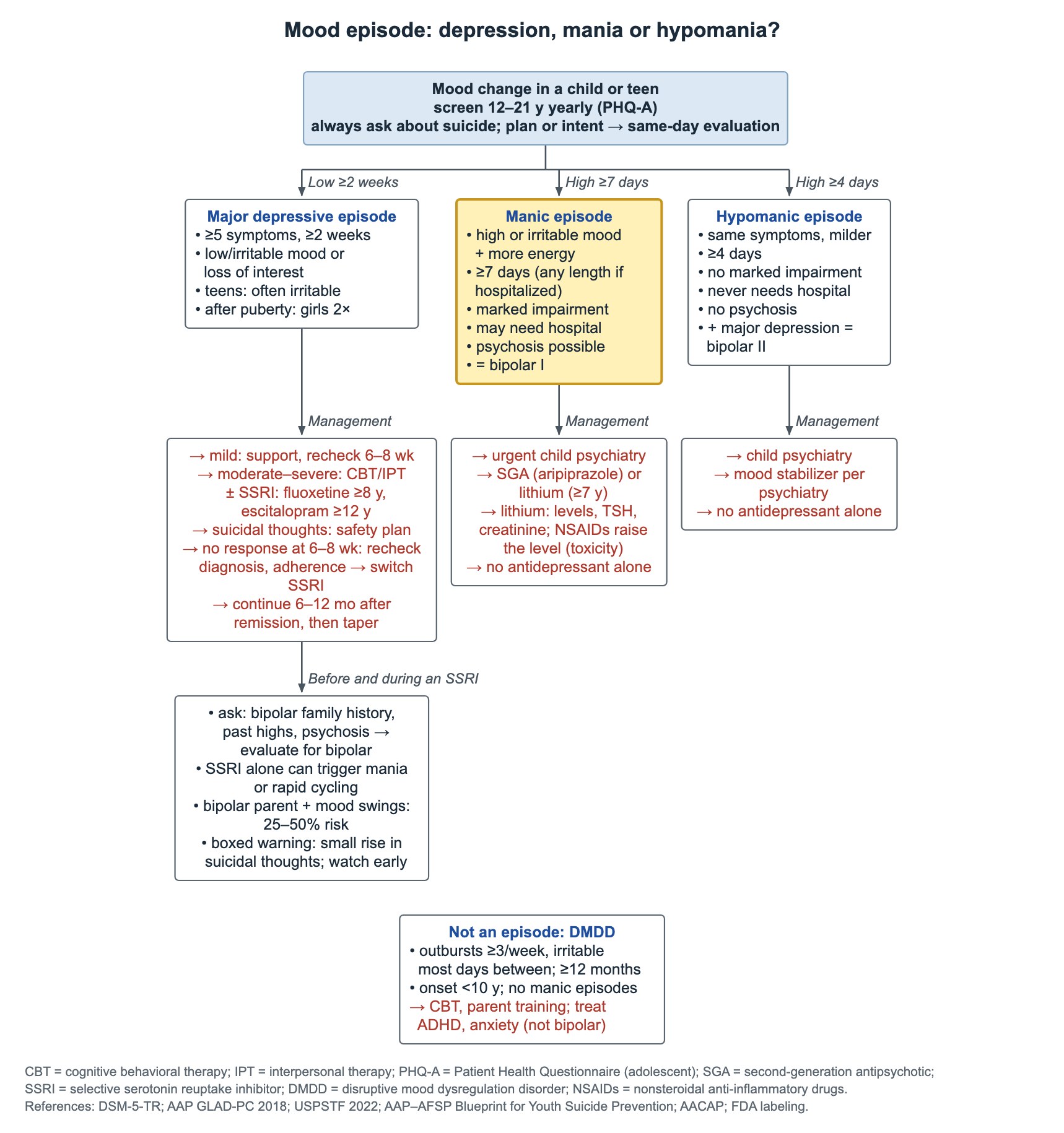
Mood episode: depression, mania or hypomania?
Key points
- Manic episode: ≥7 days (any length if hospitalized) of high or irritable mood plus more energy, with marked impairment.
- Hypomanic episode: same symptoms, milder, ≥4 days, no marked impairment, no psychosis, no hospital.
- A child with a bipolar parent and mood swings has roughly a 25–50% risk of bipolar disorder.
- Before an SSRI, ask about bipolar family history, past highs and psychosis: an antidepressant alone can trigger mania or rapid cycling.
- Acute mania: second-generation antipsychotic (e.g., aripiprazole) or lithium (FDA-approved from age 7).
- NSAIDs raise lithium levels: vomiting, coarse tremor and ataxia → check a serum lithium level.
- DMDD: outbursts ≥3 times a week, irritable between, ≥12 months, onset before age 10, no manic episodes.
Manic and hypomanic episodes
During the episode at least 3 more symptoms are present (4 if the mood is only irritable): inflated self-esteem, less need for sleep, pressured speech, racing thoughts, distractibility, more goal-directed activity, and risky behavior such as spending all one's savings.
A teen with no past mood episodes who has 10 days of euphoria, no sleep and reckless spending, with a negative drug screen, has bipolar I disorder.
| Manic episode | Hypomanic episode | |
|---|---|---|
| Mood | Abnormally high, expansive or irritable, with more energy or activity | Same |
| Duration | ≥7 days, or any length if hospitalized | ≥4 days |
| Impairment | Marked; may need hospital | No marked impairment; never needs hospital |
| Psychosis | Possible | Never |
| Diagnosis | One manic episode = bipolar I | Hypomania plus a major depressive episode = bipolar II |
Family risk and antidepressants
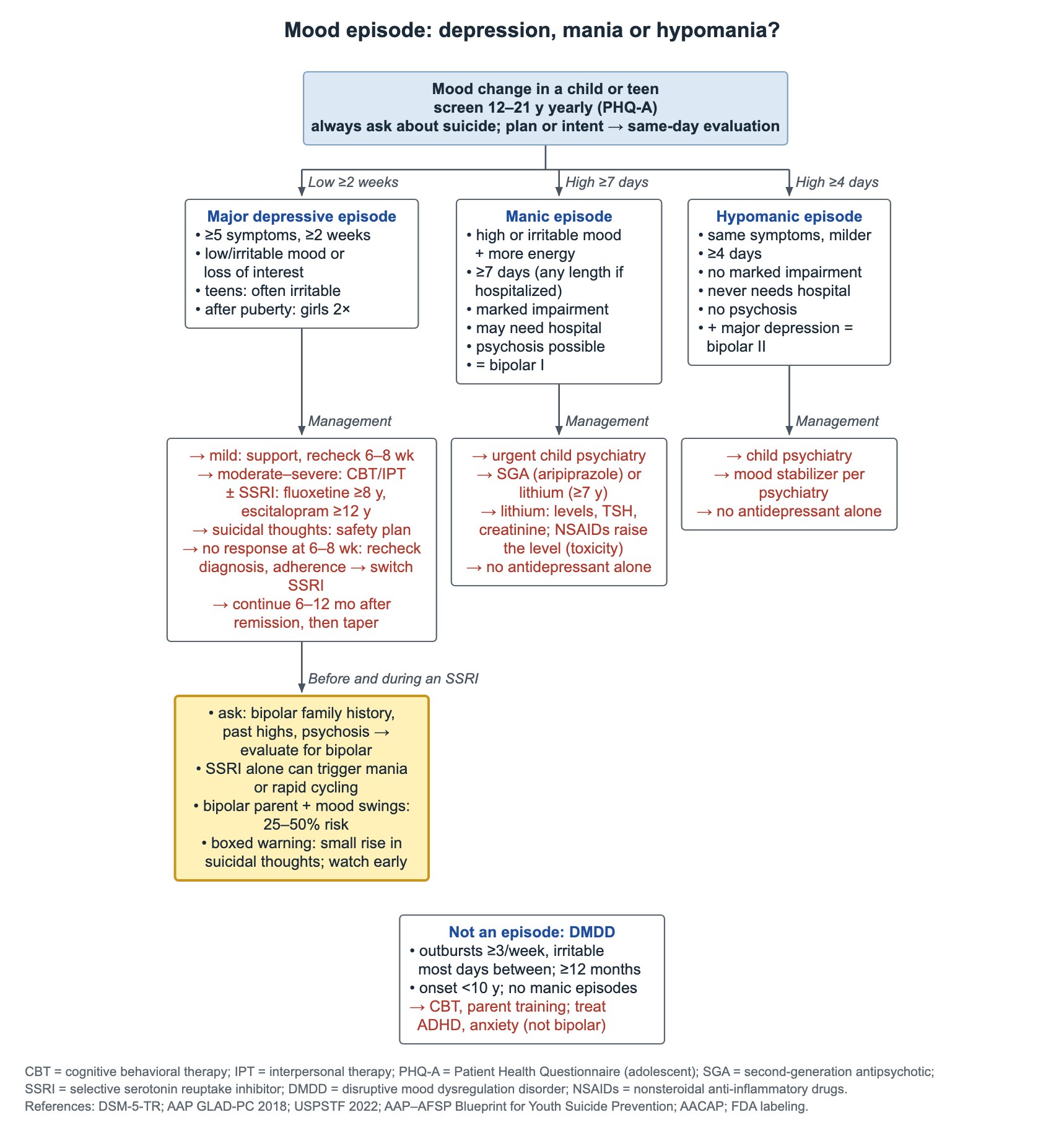
- A child or teen with a parent who has bipolar disorder and who has mood swings or brief hypomanic spells has about a 25–50% risk of developing bipolar disorder, especially when the parent's illness began early.
- Before starting an SSRI for depression, ask about a family history of bipolar disorder, past manic or hypomanic periods, and psychosis. Depression with psychotic features plus a bipolar parent calls for a bipolar evaluation first.
- An antidepressant alone can trigger mania or rapid cycling in a youth with bipolar risk.
- All antidepressants carry a boxed warning for a small rise in suicidal thoughts in youth; watch closely early in treatment.
Treating acute mania
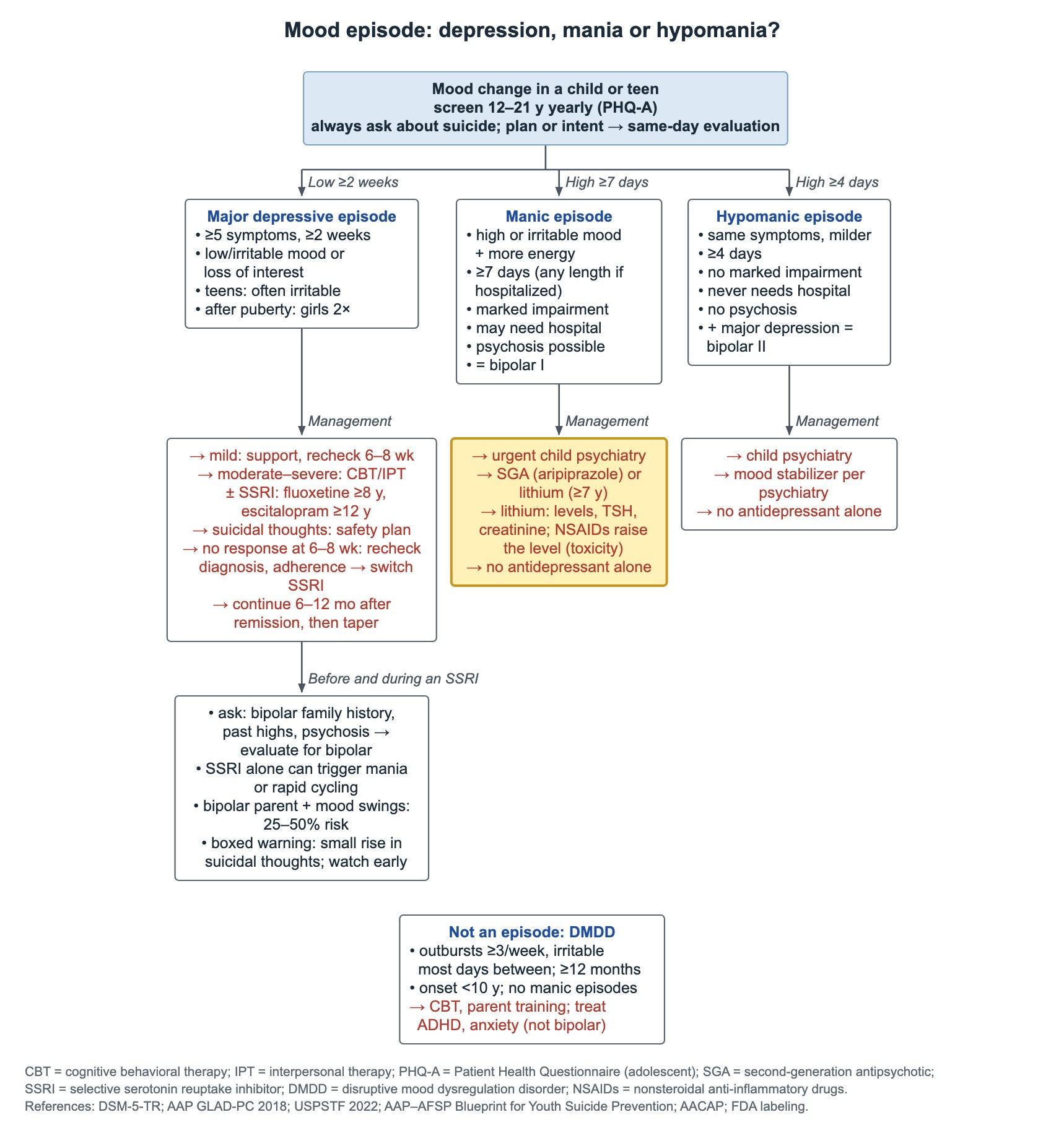
- Refer urgently to child psychiatry.
- First-line for acute mania with agitation, with or without psychosis: a second-generation antipsychotic such as aripiprazole.
- No response after 3–4 weeks at an adequate dose: switch to another SGA or to lithium.
- Lithium is FDA-approved for bipolar disorder from age 7; it is the option when the family declines antipsychotics.
- Do not treat bipolar depression with an antidepressant alone.
Lithium monitoring and toxicity
- Monitor serum lithium levels, thyroid function (TSH) and kidney function (creatinine).
- NSAIDs such as ibuprofen raise lithium levels, as do dehydration, ACE inhibitors and thiazides.
- Toxicity: vomiting, diarrhea, coarse tremor, unsteady gait, confusion. Next step: check a serum lithium level.
Disruptive mood dysregulation disorder
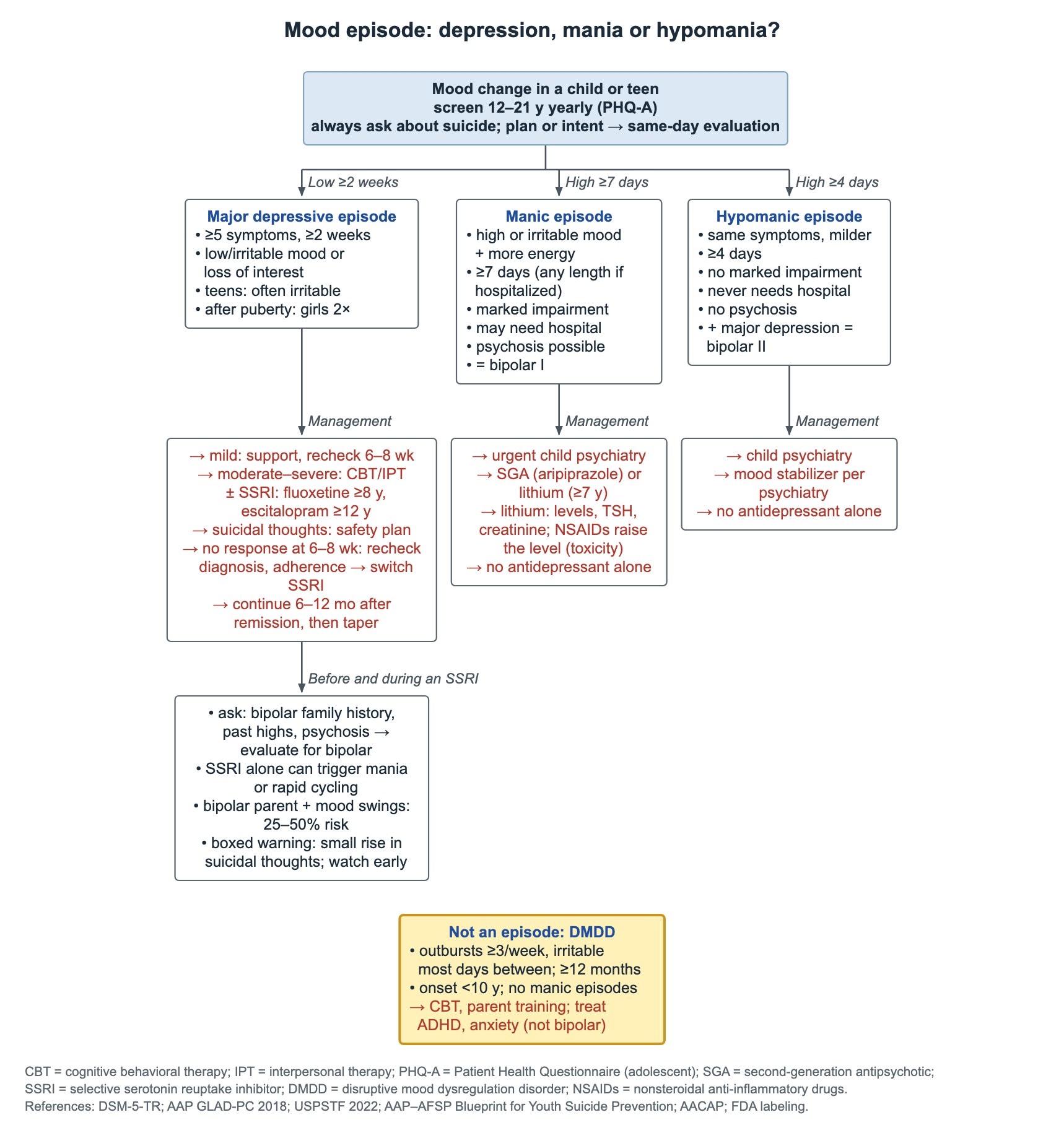
- Severe temper outbursts about 3 or more times a week, out of proportion to the trigger.
- Irritable or angry mood most of the day, nearly every day, between outbursts.
- Symptoms for at least 12 months, in at least 2 settings (home, school, peers).
- Onset before age 10; diagnosis is made between ages 6 and 18.
- No discrete manic or hypomanic episodes.
- Treatment: CBT and parent training; treat coexisting ADHD and anxiety. It is not treated as bipolar disorder.
Common questions
How long must mania last to diagnose bipolar I disorder?
At least 7 days, or any length if the teen needs hospitalization.
What is the difference between DMDD and pediatric bipolar disorder?
DMDD is chronic, nonepisodic irritability with frequent outbursts starting before age 10. Bipolar disorder has distinct episodes of mania or hypomania.
Why do NSAIDs matter in a teen taking lithium?
NSAIDs reduce lithium clearance and can cause toxicity. Check a serum lithium level if vomiting, tremor or ataxia appear.
Study this topic
Sources
- AACAP 2007: Practice parameter for bipolar disorder in children and adolescents (JAACAP)
- GLAD-PC Part II 2018: Treatment and ongoing management of adolescent depression (Pediatrics)
Written for Pedemy in our own words from the sources above; checked November 2026. For education only, not medical advice; check doses and local protocols before treating a patient. Pedemy is independent and not affiliated with or endorsed by the organizations cited.