

Main decision tree
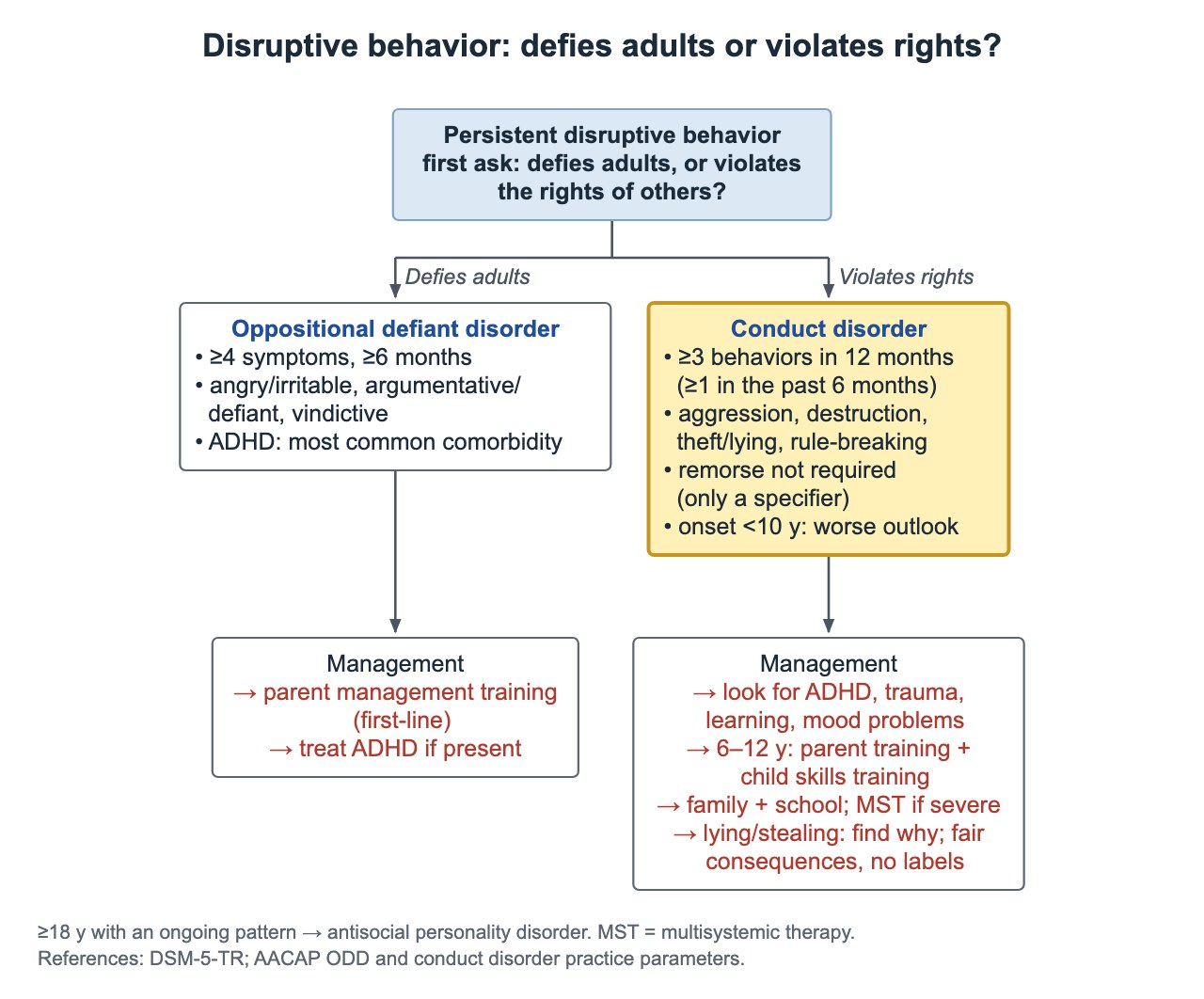
Disruptive behavior: defies adults or violates rights?
Key points
- Criteria: at least 3 specified behaviors in the past 12 months, with at least 1 in the past 6 months.
- 4 groups: aggression to people or animals, destruction of property, deceit or theft, serious rule violations.
- Lack of remorse is not required; it is a specifier (limited prosocial emotions).
- Childhood onset (before age 10) has a worse outlook than adolescent onset.
- ODD defies adults; conduct disorder violates the rights of others.
- First-line treatment: parent management training plus child behavioral skills training.
- At 18 years or older, an ongoing pattern is diagnosed as antisocial personality disorder.
Recognize conduct disorder
The first question with persistent disruptive behavior is whether the child mainly defies adults (oppositional defiant disorder) or violates the rights of others (conduct disorder). Repeated stealing, lying, cruelty to animals, fire-setting and fighting point to conduct disorder.
- At least 3 behaviors in the past 12 months, at least 1 of them in the past 6 months.
- Aggression to people or animals: bullying, starting fights, using a weapon, cruelty to animals.
- Destruction of property: fire-setting, vandalism.
- Deceit or theft: lying to obtain things, shoplifting, breaking in.
- Serious rule violations: staying out at night before age 13, running away, truancy before age 13.
- Real guilt afterward does not exclude the diagnosis. Limited prosocial emotions (little remorse or empathy) is only a specifier.
Onset type and ODD
Onset type matters. Childhood-onset conduct disorder (at least 1 behavior before age 10) has a worse outlook, with more persistent aggression and antisocial outcomes in adulthood, than adolescent-onset disease.
| Oppositional defiant disorder | Conduct disorder | |
|---|---|---|
| Core pattern | Angry or irritable, argumentative or defiant, vindictive | Aggression, destruction, theft or lying, rule-breaking |
| Criteria | ≥4 symptoms for ≥6 months | ≥3 behaviors in 12 months (≥1 in past 6 months) |
| Common comorbidity | ADHD | ADHD, learning and mood problems, trauma |
| First-line treatment | Parent management training; treat ADHD if present | Parent training plus child skills training; family and school work |
Evaluation and treatment
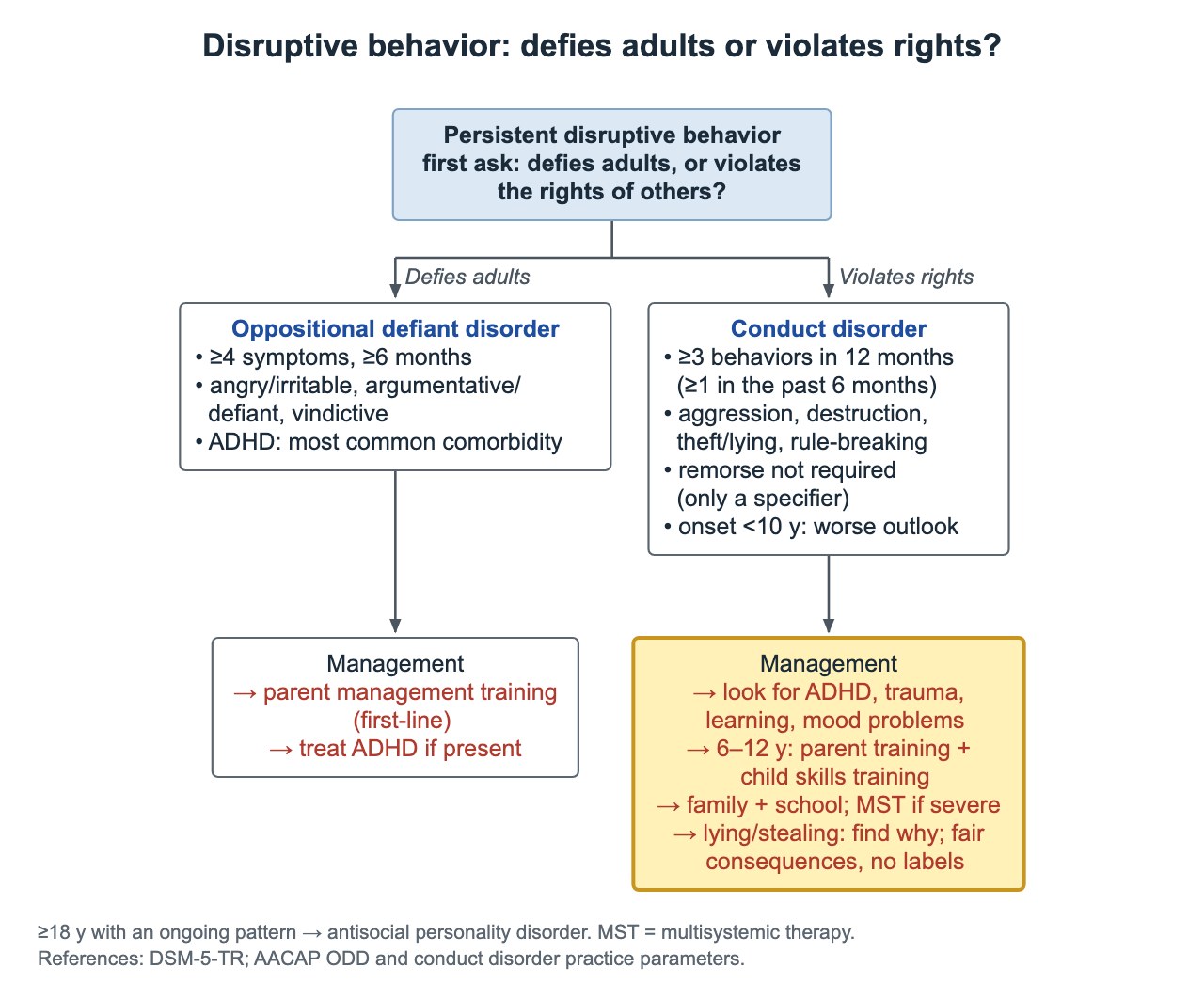
For a parent asking how to respond to stealing or lying: find the cause, use fair and proportionate consequences (such as returning or paying for what was taken), praise honesty, and avoid shaming labels such as calling the child a thief or a liar.
- Evaluate for coexisting psychiatric and developmental conditions: ADHD, trauma, learning disorders and mood problems.
- Age about 6–12 years: parent management training plus child behavioral skills training.
- Involve the family and school; multisystemic therapy for severe cases.
- Medicines treat coexisting conditions such as ADHD; they are not the core treatment of conduct disorder itself.
Common questions
Does conduct disorder require a lack of remorse?
No. Limited prosocial emotions, including lack of remorse, is a specifier, not a required criterion.
What is the difference between ODD and conduct disorder?
ODD is a pattern of angry, defiant and vindictive behavior toward adults. Conduct disorder violates the basic rights of others or major rules, such as fighting, theft and cruelty.
What is the first-line treatment for conduct disorder?
Parent management training combined with child behavioral skills training, with family and school involvement.
Study this topic
Sources
- AACAP 2007: Practice parameter for oppositional defiant disorder (JAACAP)
- AAP 2019: Mental health competencies for pediatric practice (Pediatrics)
Written for Pedemy in our own words from the sources above; checked November 2026. For education only, not medical advice; check doses and local protocols before treating a patient. Pedemy is independent and not affiliated with or endorsed by the organizations cited.