

Main decision tree
Mood episode: depression, mania or hypomania?
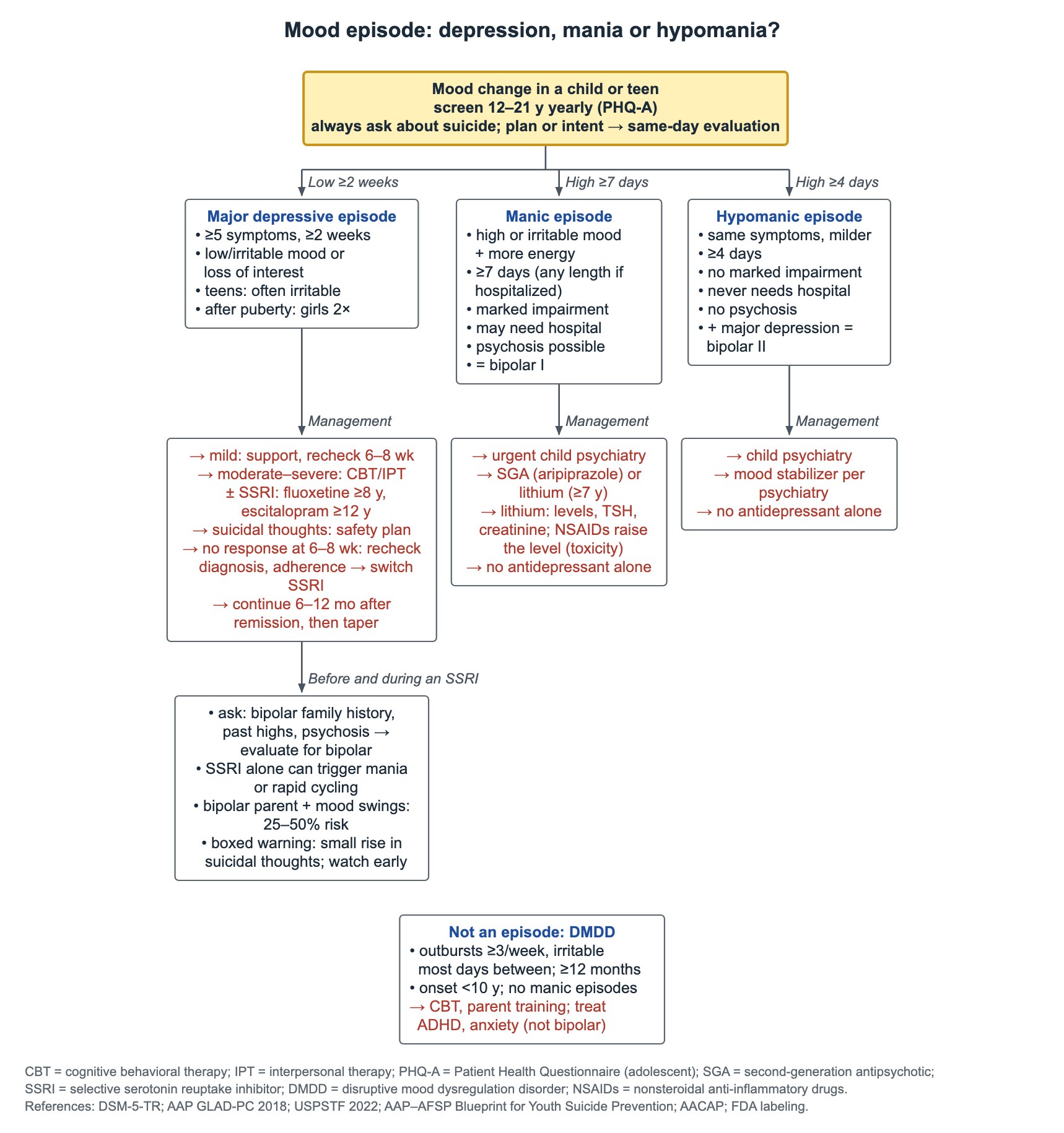
Key points
- Screen for depression every year from age 12 (for example PHQ-A); USPSTF covers 12–18 years, Bright Futures and GLAD-PC to 21.
- MDD: ≥5 symptoms for ≥2 weeks, including depressed or irritable mood or loss of interest or pleasure.
- In youth, depressed mood may show as irritability.
- Before puberty rates are similar in boys and girls; after puberty depression is about twice as common in girls.
- Mild depression: active support and monitoring for 6–8 weeks.
- FDA-approved SSRIs for depression: fluoxetine from age 8, escitalopram from age 12.
- After full remission, continue the SSRI 6–12 months, then taper.
Screening and suicide risk
Screen every adolescent for depression once a year from age 12, even without complaints, using a tool such as the PHQ-A. The USPSTF recommends screening at 12–18 years; it found too little evidence to screen children 11 and younger.
In every teen assessed for depression, ask directly about self-harm and suicidal thoughts as well as severity. A plan or intent means same-day evaluation.
Diagnosing a major depressive episode
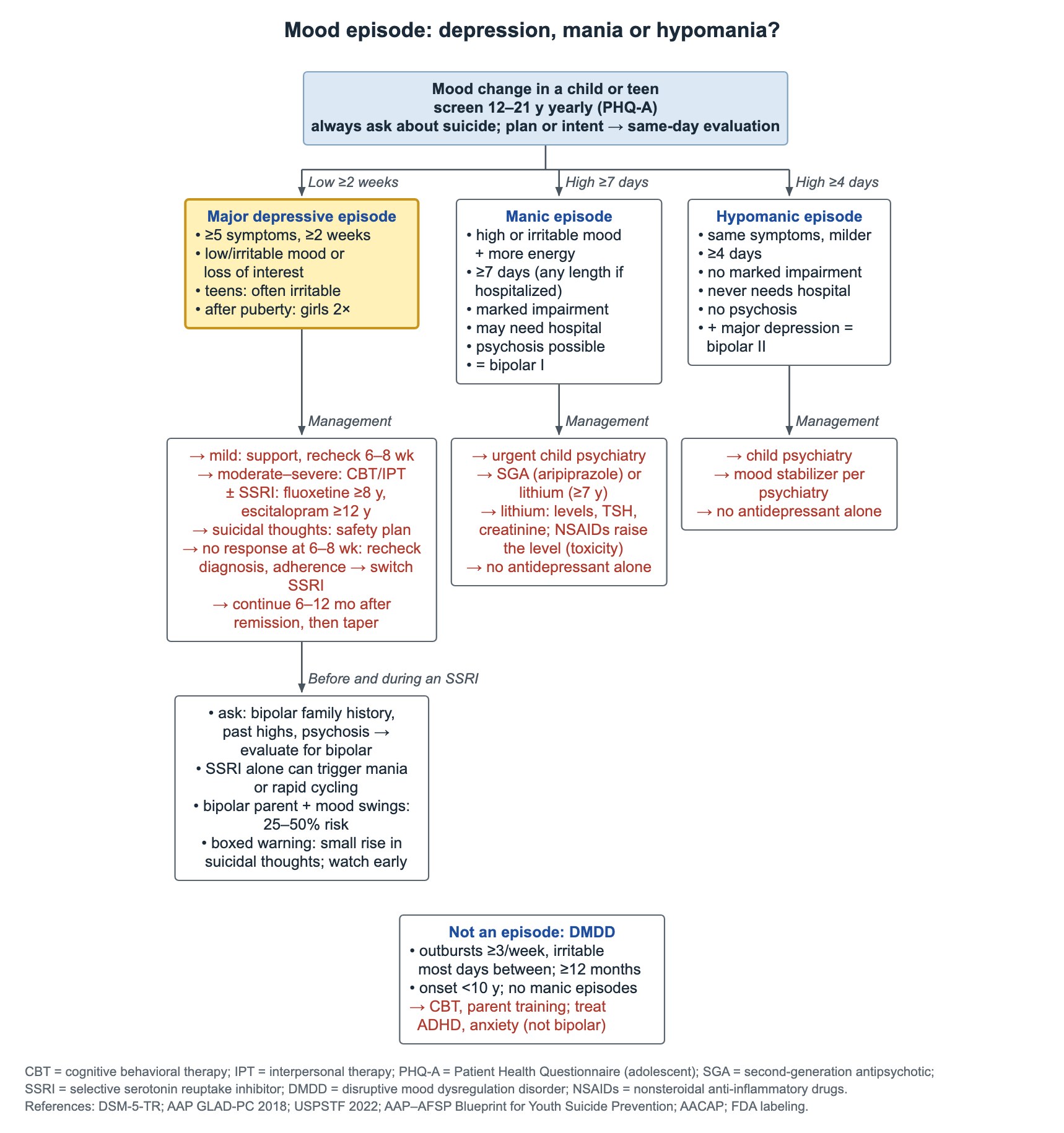
- At least 5 symptoms for at least 2 consecutive weeks.
- One must be depressed (or, in youth, irritable) mood or loss of interest or pleasure. Sleep, energy, appetite and guilt symptoms alone are not enough.
- Other symptoms: change in appetite or weight, insomnia or hypersomnia, agitation or slowing, fatigue, worthlessness or guilt, poor concentration, thoughts of death or suicide.
- Children and teens often show irritability (snapping at family) and loss of interest in sport, and may deny feeling sad.
- Sex difference: rates are similar before puberty (boys slightly higher); after puberty depression is about twice as common in girls.
Not major depression
| Diagnosis | Key difference |
|---|---|
| Brief low mood | Under 2 weeks (for example 9 days after a breakup, then recovered): not MDD |
| Adjustment disorder | Mood or behavior symptoms within 3 months of a stressor (such as divorce), too few for MDD |
| Persistent depressive disorder | Depressed or irritable mood for ≥1 year in youth (2 years in adults) |
| Bipolar depression | Past manic or hypomanic episodes, or psychosis with a bipolar family history: evaluate before an SSRI |
Treatment by severity
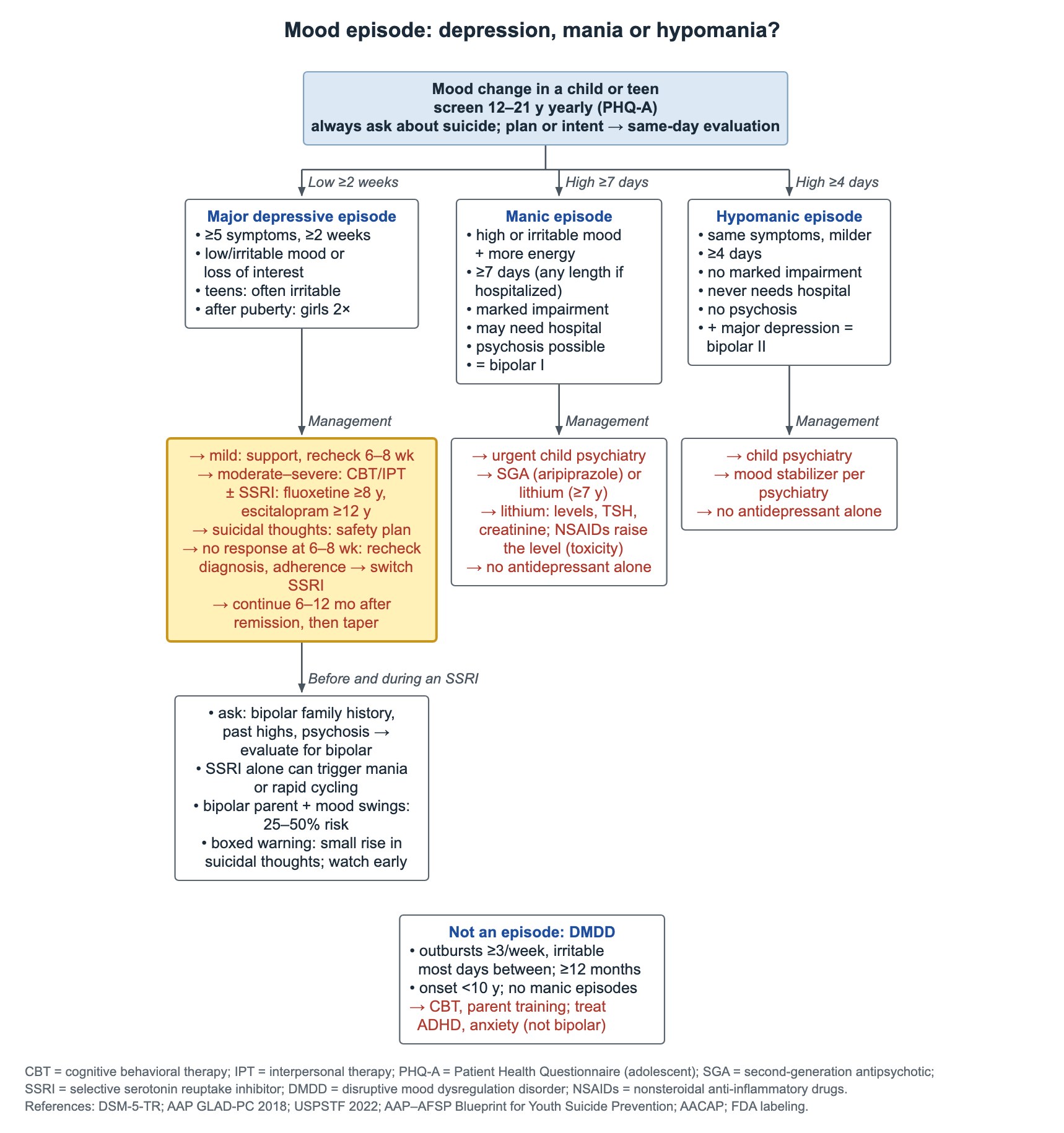
- Mild depression, no suicidal thoughts, still functioning: active support and monitoring for 6–8 weeks.
- Moderate–severe: psychotherapy (CBT or interpersonal therapy) and consider an SSRI.
- Suicidal thoughts without a plan: make a safety plan, start psychotherapy and consider an SSRI such as fluoxetine.
- Fluoxetine is FDA-approved for depression from age 8; escitalopram from age 12.
- A child no better after 8 weeks of CBT whose family agrees to medicine: fluoxetine.
- After full remission, continue the SSRI for 6–12 months, then taper.
SSRI safety and poor response
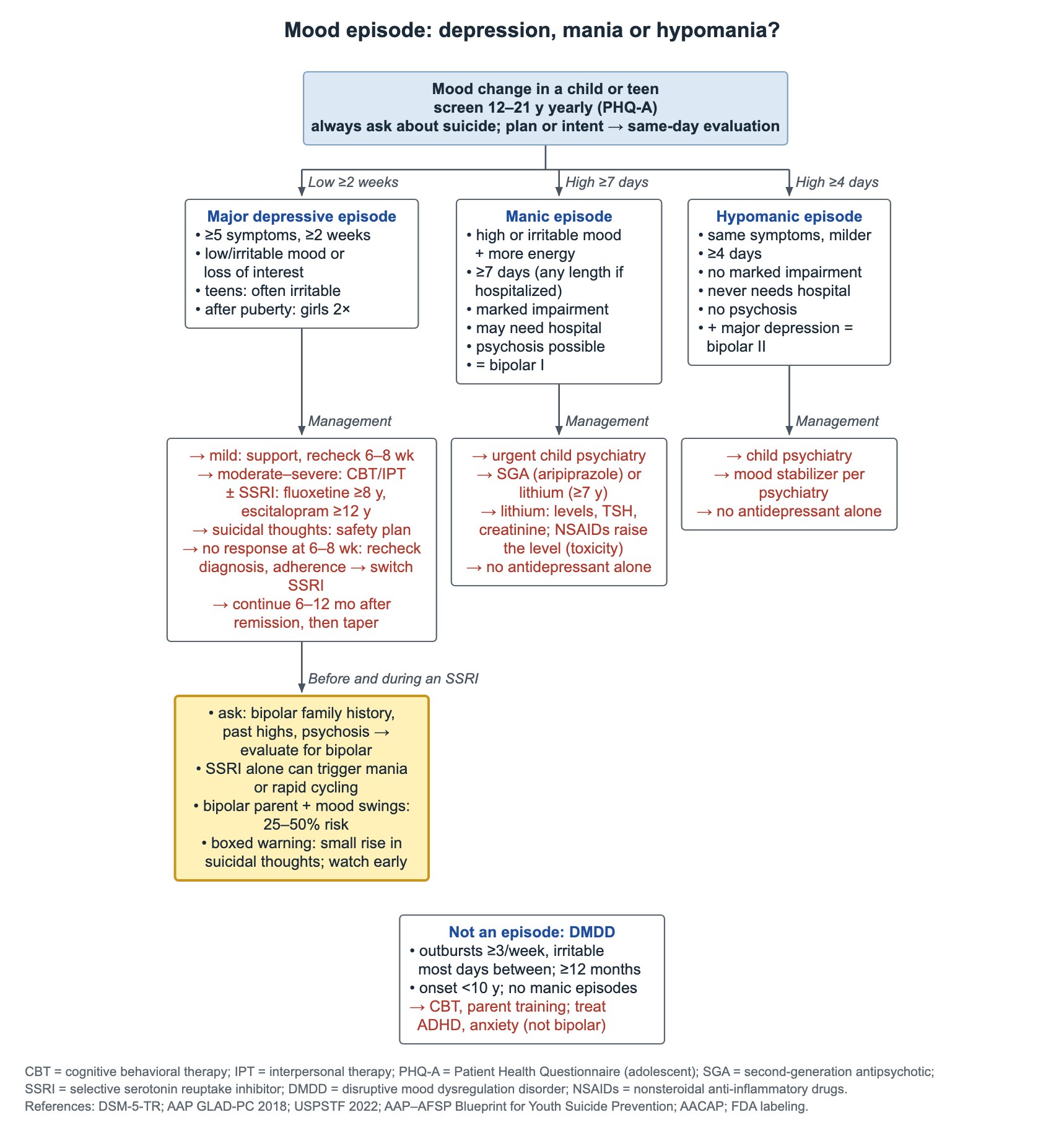
- Before an SSRI, ask about a family history of bipolar disorder, past highs and psychosis; an SSRI alone can trigger mania or rapid cycling.
- No improvement after 6–8 weeks of an adequate SSRI dose plus therapy: recheck the diagnosis, adherence, substance use and comorbidity.
- Then switch to a different SSRI and consult mental health.
- Venlafaxine is a later option after SSRIs have failed.
- ECT is considered only for severe, treatment-resistant or life-threatening depression.
- Boxed warning on all antidepressants: a small rise in suicidal thoughts and behavior in children, adolescents and young adults. Watch closely early in treatment and after dose changes.
Common questions
At what age should depression screening start?
Every year from age 12, using a tool such as the PHQ-A.
Which antidepressants are FDA-approved for teen depression?
Fluoxetine (from age 8) and escitalopram (from age 12).
How long should an SSRI continue after a teen's depression improves?
For 6–12 months after full remission, then a gradual taper.
What is the antidepressant boxed warning?
A small increase in suicidal thoughts and behaviors in children, adolescents and young adults, so close follow-up is needed, especially early on.
Study this topic
Sources
- USPSTF 2022: Screening for depression and suicide risk in children and adolescents (JAMA)
- GLAD-PC Part I 2018: Identification, assessment and initial management (Pediatrics)
- GLAD-PC Part II 2018: Treatment and ongoing management (Pediatrics)
- AACAP 2023: Clinical practice guideline for major and persistent depressive disorders (JAACAP)
Written for Pedemy in our own words from the sources above; checked November 2026. For education only, not medical advice; check doses and local protocols before treating a patient. Pedemy is independent and not affiliated with or endorsed by the organizations cited.