

Main decision tree
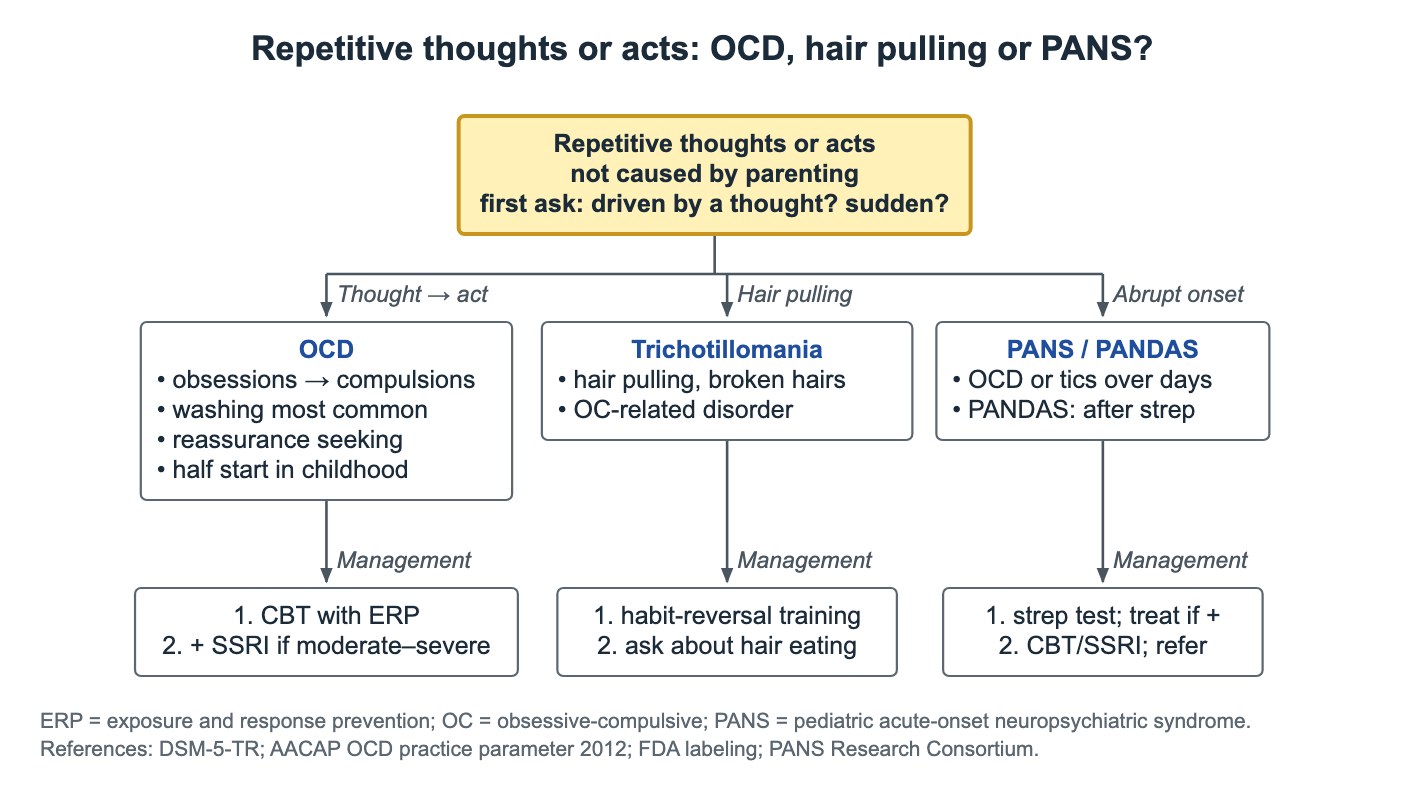
Repetitive thoughts or acts: OCD, hair pulling or PANS?
Key points
- About half of all OCD starts in childhood or adolescence.
- Washing or cleaning is the most common compulsion in children; repeated reassurance seeking is a common added behavior.
- OCD has a neurobiological and familial basis; it is not caused by parenting.
- First-line treatment for mild to moderate OCD: CBT with exposure and response prevention (ERP).
- Moderate to severe OCD or partial response to ERP: add an SSRI (sertraline, fluoxetine or fluvoxamine).
- Trichotillomania is an obsessive-compulsive related disorder: patchy loss with broken hairs of different lengths; first-line treatment is habit-reversal training.
- PANS/PANDAS: OCD or tics that appear over days; in PANDAS the onset follows group A strep infection.
Repetitive thoughts or acts: which pattern?
Start with two questions. Is the act driven by an intrusive thought? Did the symptoms start suddenly? The answers point to OCD, trichotillomania or PANS/PANDAS.
Parents often fear they caused the problem. Tell them that OCD and related disorders have a neurobiological and familial component and are not a parenting failure or a simple bad habit.
Recognize OCD
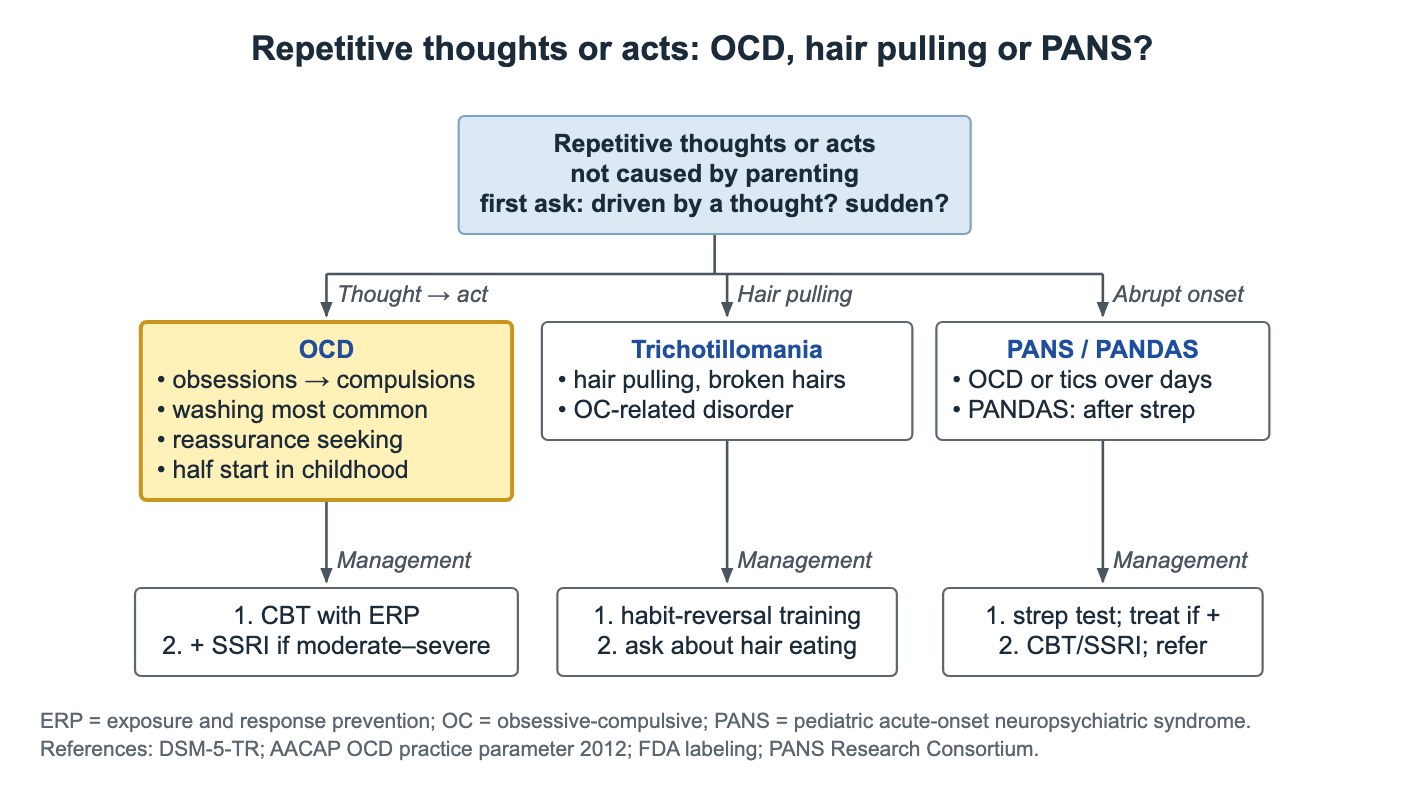
Obsessions are unwanted, intrusive thoughts, urges or images that cause anxiety. Compulsions are repeated acts or mental rituals done to reduce that anxiety or to prevent a feared event, such as tapping 3 times "so nothing bad happens".
Children may not see their rituals as excessive. Symptoms take time (often more than 1 hour a day), cause distress or get in the way of school, family or friends.
- Most common ritual in children: washing or cleaning.
- Other common rituals: checking, counting, ordering, repeating an act until it feels "just right".
- Reassurance seeking ("Are you sure it's OK?" many times a day) is a compulsion: the answer calms the child only briefly.
- About half of all cases begin in childhood or adolescence; boys tend to start earlier.
- Screen for tics, anxiety, depression and ADHD, which often coexist.
Treating OCD: ERP first, then an SSRI
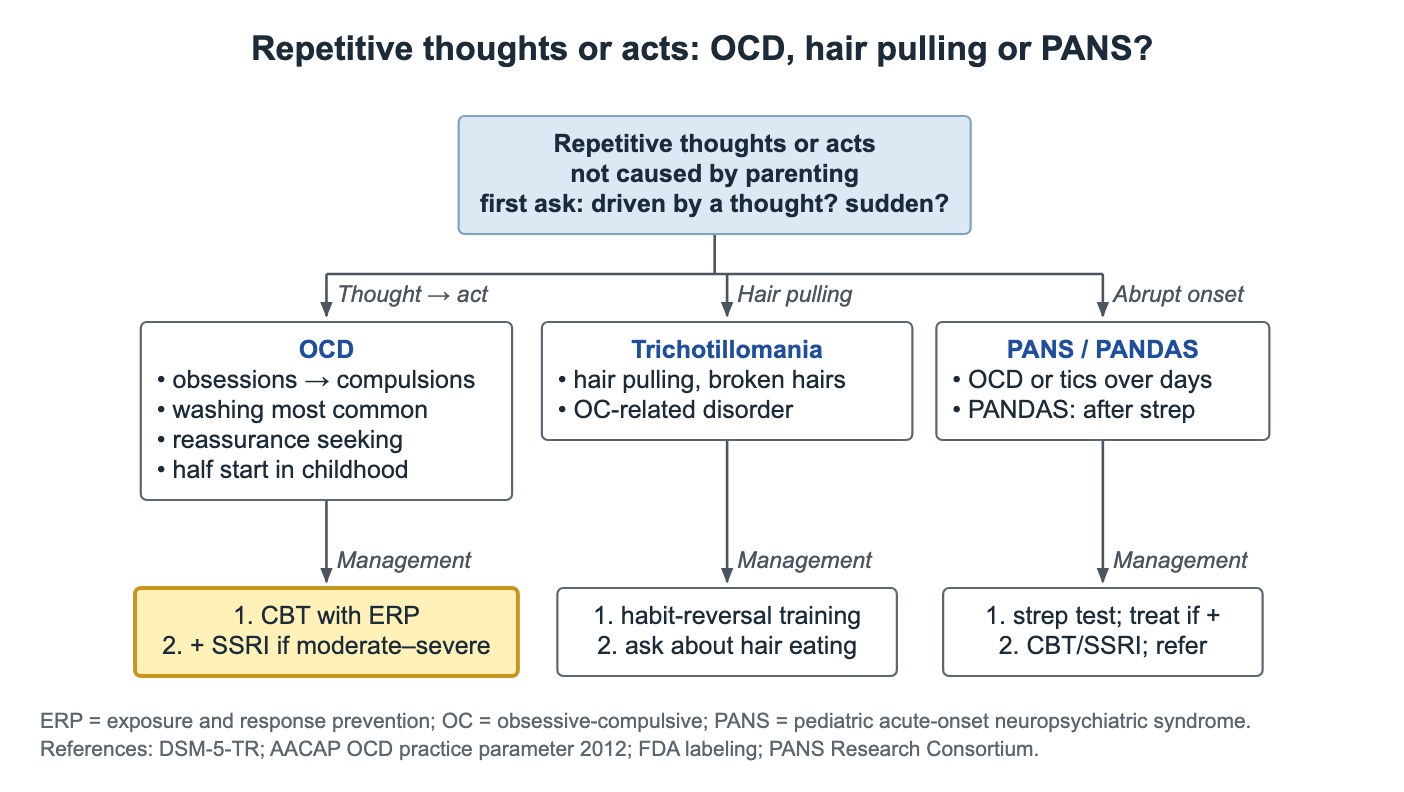
- Mild to moderate OCD: CBT with exposure and response prevention (ERP). The child faces the feared trigger step by step and resists the ritual.
- Moderate to severe OCD, or only partial response to ERP: add an SSRI. Combined CBT and SSRI works better than either alone in moderate to severe cases.
- FDA-approved SSRIs for pediatric OCD: sertraline (6 years and older), fluoxetine (7 years and older) and fluvoxamine (8 years and older).
- Clomipramine (10 years and older) is a second-line option because of more side effects, including cardiac effects.
- Start low, increase slowly and allow 10–12 weeks at an adequate dose before judging response.
- Watch for new suicidal thoughts after starting an SSRI (boxed warning for people under 25 years).
- Parents should stop joining in rituals and stop giving repeated reassurance; this is part of ERP.
Trichotillomania (hair pulling)
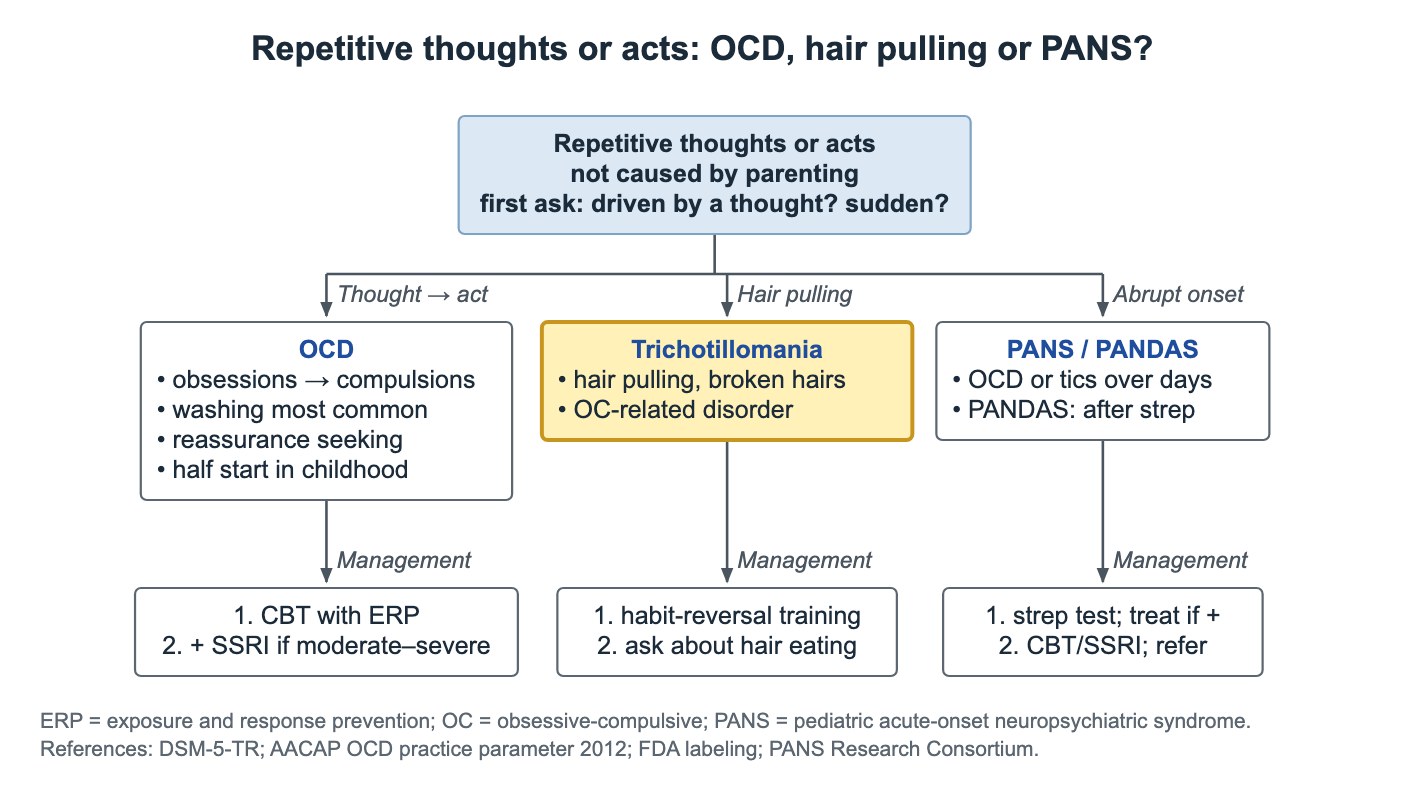
Trichotillomania is repeated pulling out of one's own hair, with hair loss and failed attempts to stop. DSM-5-TR places it in the obsessive-compulsive and related disorders group. It may coexist with OCD.
Pulling often rises with stress or boredom. Many children pull without full awareness, for example while reading or watching a screen.
- Scalp: patches with odd, geometric shapes and broken hairs of different lengths; the skin looks normal.
- Eyebrows and eyelashes are also common sites.
- Alopecia areata, by contrast, gives smooth round patches with exclamation-point hairs; tinea capitis gives scale and often nodes.
Treating trichotillomania
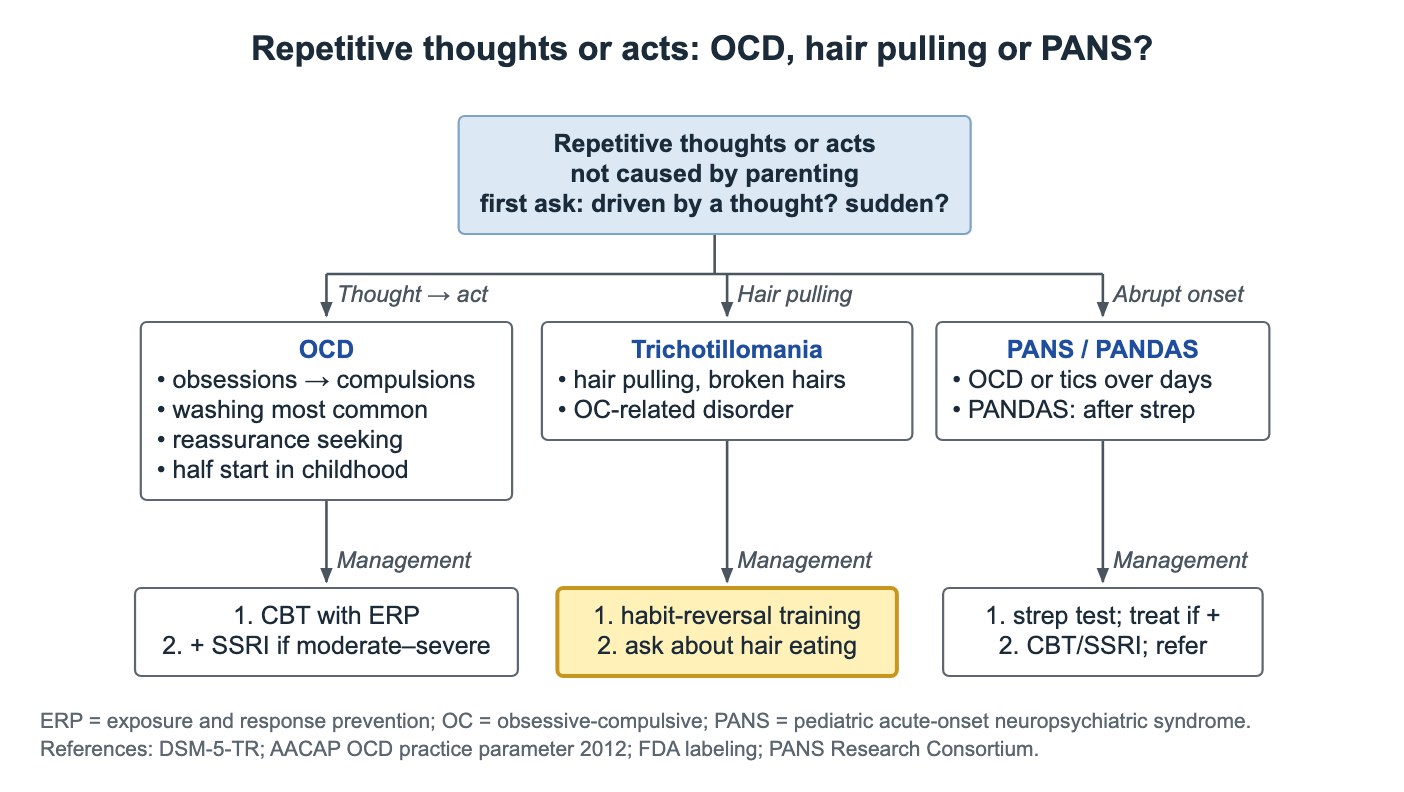
- First-line: habit-reversal training, a behavioral therapy. The child learns to notice the urge and to do a competing action with the hands instead.
- Ask about eating pulled hair (trichophagia): it can form a trichobezoar with abdominal pain, vomiting or obstruction.
- SSRIs have not shown clear benefit for hair pulling itself; use them only for a coexisting disorder such as OCD, anxiety or depression.
- N-acetylcysteine has some supporting evidence in adults; pediatric evidence is limited.
PANS and PANDAS
PANS (pediatric acute-onset neuropsychiatric syndrome) is the abrupt onset, over days, of OCD or severe food restriction, together with other neuropsychiatric symptoms such as anxiety, mood swings, irritability, school decline, sleep problems or bedwetting.
PANDAS is the subgroup in which onset follows group A streptococcal infection and tics may be the main feature. It is a proposed, still debated diagnosis.
- Ask about sudden onset and recent sore throat or strep exposure.
- Do a strep test and treat a positive result with standard antibiotics.
- Treat the OCD itself with CBT and, if needed, an SSRI, and refer to a specialist.
Common questions
What is the most common compulsion in children with OCD?
Washing or cleaning. Checking, counting, ordering and repeated reassurance seeking are also common.
What is the first-line treatment for OCD in children?
CBT with exposure and response prevention. An SSRI such as sertraline, fluoxetine or fluvoxamine is added for moderate to severe OCD or when therapy alone helps only partly.
How do you treat trichotillomania in a child?
Habit-reversal training is first-line. Also ask whether the child eats the hair, because swallowed hair can form a trichobezoar.
Study this topic
Sources
- AACAP practice parameter: obsessive-compulsive disorder in children and adolescents (JAACAP 2012)
- Grant and Chamberlain: Trichotillomania (Am J Psychiatry 2016)
- Clinical evaluation of youth with PANS: 2013 PANS Consensus Conference (J Child Adolesc Psychopharmacol)
Written for Pedemy in our own words from the sources above; checked November 2026. For education only, not medical advice; check doses and local protocols before treating a patient. Pedemy is independent and not affiliated with or endorsed by the organizations cited.