

Main decision tree
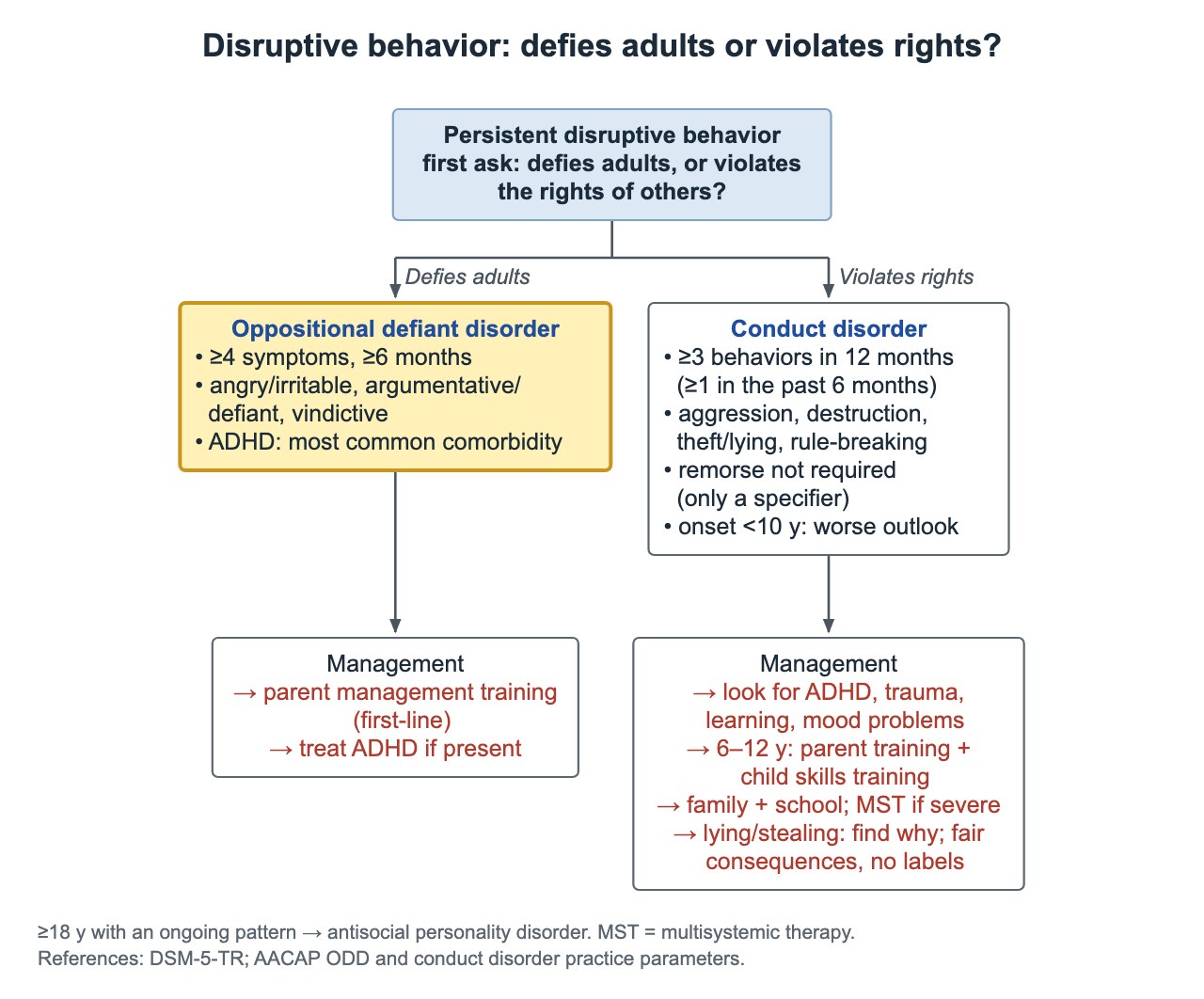
Disruptive behavior: defies adults or violates rights?
Key points
- ODD needs at least 4 symptoms lasting at least 6 months.
- Three symptom groups: angry/irritable mood, argumentative/defiant behavior and vindictiveness.
- Symptoms must show with at least one person who is not a sibling.
- ADHD is the most common coexisting condition: screen every child with ODD.
- First-line treatment: parent management training; treat ADHD if present.
- Aggression to people or animals, destruction, theft or serious rule-breaking points to conduct disorder instead.
Diagnosing ODD
Ask first: does the child defy adults, or violate the rights of others? Defiance alone fits ODD. Aggression, destruction, theft or serious rule-breaking fit conduct disorder.
ODD needs at least 4 symptoms from the three groups, lasting at least 6 months, seen with at least one person who is not a sibling, and causing distress or problems at home, school or with friends.
- Under 5 years: the behavior must occur on most days; from 5 years: at least once a week.
- Severity: mild if symptoms are in one setting, moderate in 2 settings, severe in 3 or more.
- A short reaction to stress, such as 3 months of defiance after a new sibling arrives, is not yet ODD.
| Symptom group | Examples |
|---|---|
| Angry/irritable mood | Often loses temper; touchy or easily annoyed; often angry and resentful |
| Argumentative/defiant behavior | Argues with adults; refuses rules or requests; deliberately annoys others; blames others for own mistakes |
| Vindictiveness | Spiteful or tries to get back at others at least twice in 6 months |
Coexisting conditions and look-alikes
- ADHD is the most common coexisting condition; impulsivity and poor attention make defiance worse.
- Also look for anxiety, depression, learning or language disorders, trauma and family stress.
- Conduct disorder: at least 3 rule- or rights-violating behaviors in 12 months, with at least 1 in the past 6 months. Onset before 10 years has a worse outlook.
- Disruptive mood dysregulation disorder: severe temper outbursts with persistently irritable mood between them; it is not diagnosed together with ODD.
- Some children with ODD later develop conduct disorder, so follow them over time.
Treatment: parent management training
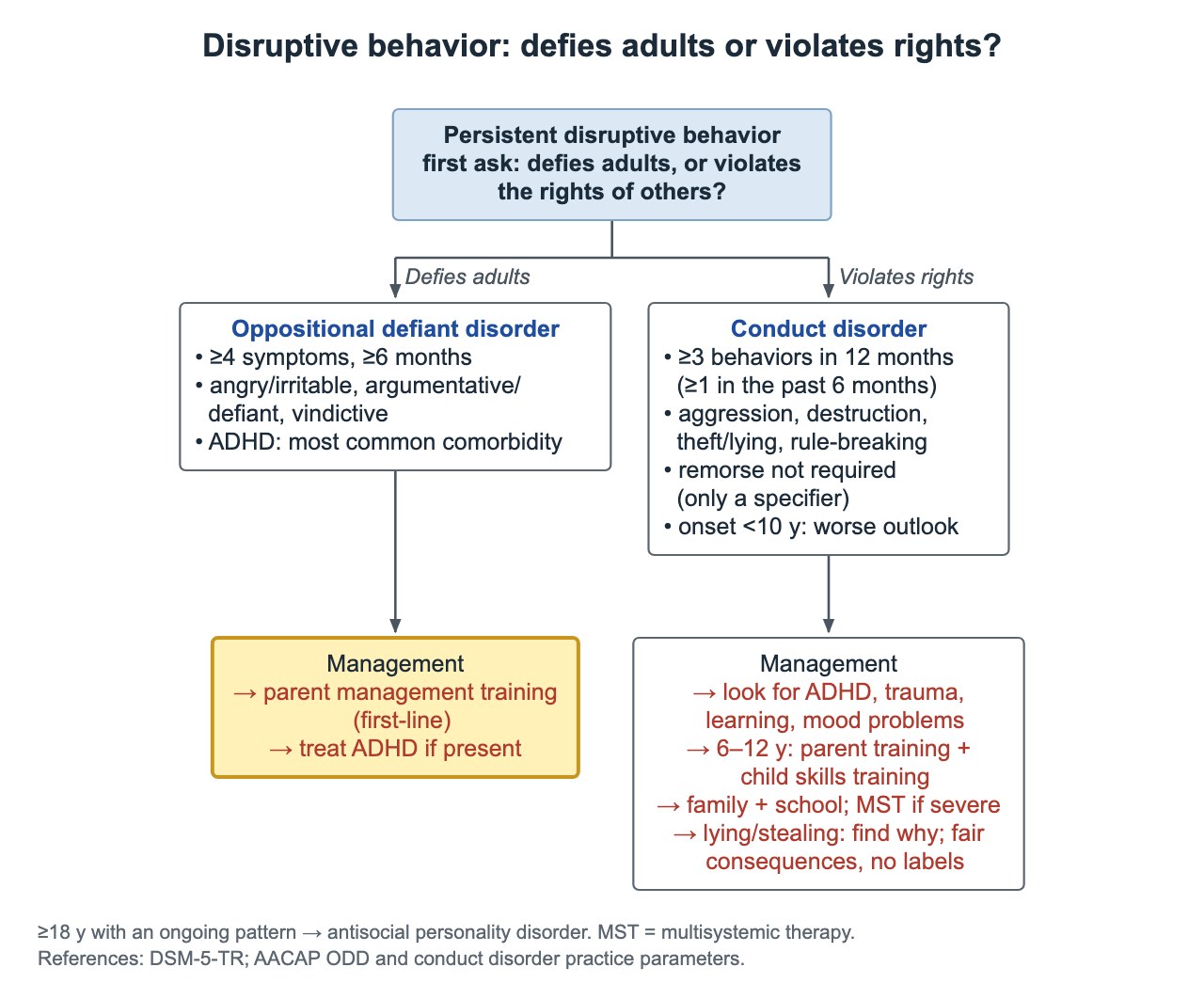
Parent management training is first-line. Parents learn to give clear commands, praise good behavior, ignore minor misbehavior and use calm, predictable consequences such as time-out.
Treat coexisting ADHD; stimulants often reduce oppositional behavior too. There is no medicine for ODD itself.
- School-age children: add school support and, when needed, child skills training (problem solving, anger control).
- Teens: family therapy and collaborative problem solving.
- Avoid harsh or inconsistent punishment; it keeps the cycle going.
Common questions
How long must symptoms last to diagnose ODD?
At least 6 months, with at least 4 symptoms, causing problems at home, school or with friends.
What is the difference between ODD and conduct disorder?
ODD is defiance and anger toward adults. Conduct disorder involves violating the rights of others: aggression, destruction, theft or serious rule-breaking.
What is the best treatment for ODD?
Parent management training, plus treatment of ADHD or any other coexisting condition.
Study this topic
Sources
- AACAP practice parameter: oppositional defiant disorder (JAACAP 2007)
- AAP clinical practice guideline for ADHD (Pediatrics 2019)
Written for Pedemy in our own words from the sources above; checked November 2026. For education only, not medical advice; check doses and local protocols before treating a patient. Pedemy is independent and not affiliated with or endorsed by the organizations cited.