

Main decision tree
Discipline: ignore it, or set a limit?
Key points
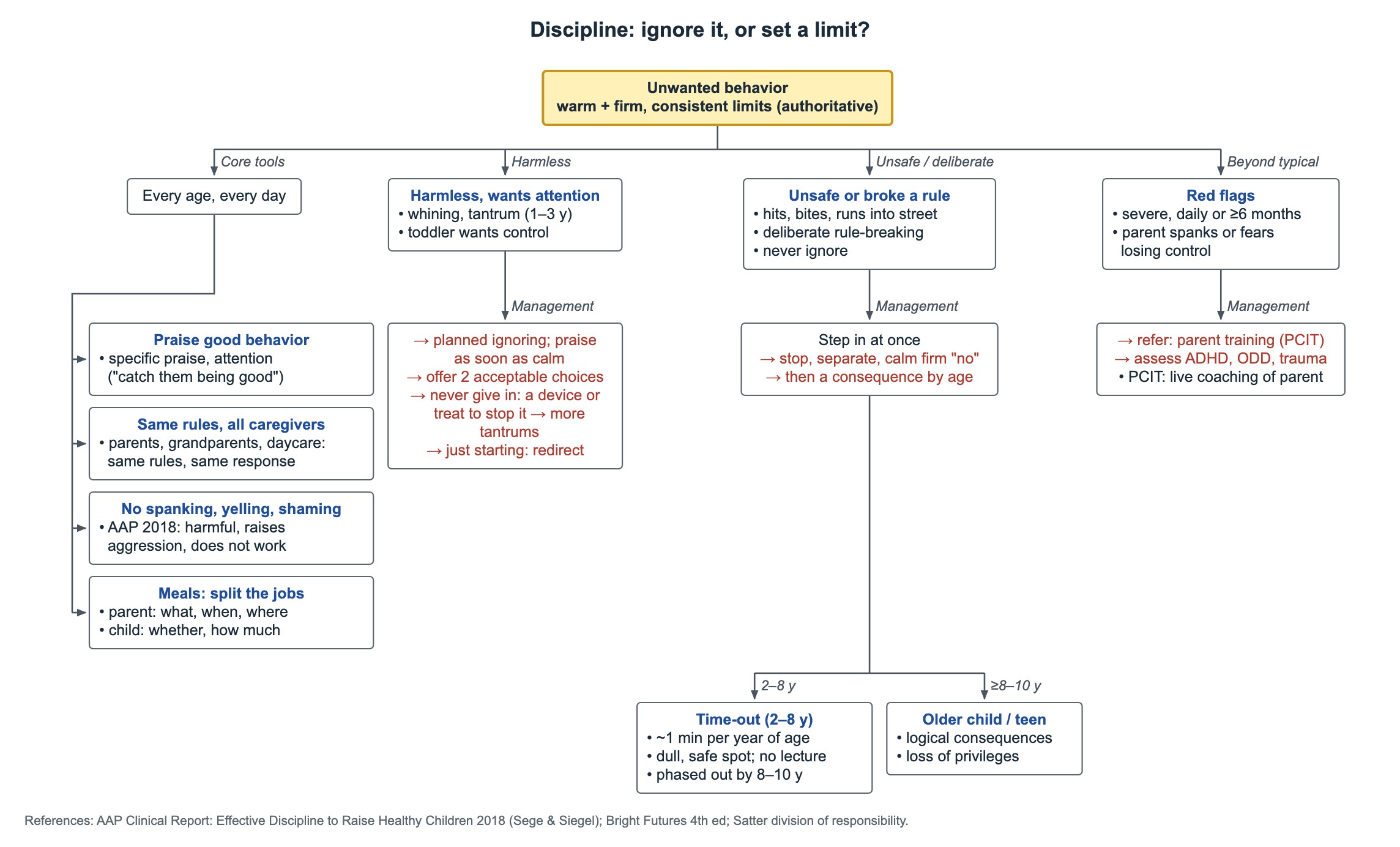
- AAP 2018: no spanking, yelling or shaming; praise good behavior and set warm, firm, consistent limits.
- Time-out for ages 2–8 years: about 1 minute per year of age in a dull, safe spot; phased out by 8–10 years.
- Colic: a well, growing infant crying more than 3 hours a day on more than 3 days a week; peaks at 6–8 weeks, fades by 3–4 months.
- Breath-holding spells: trigger first, then color change, then brief limpness; start at 6–18 months and stop by about 5–6 years.
- Iron reduces breath-holding spells, even without anemia; an atypical spell needs an ECG for long QT.
- Separation anxiety starts about 6 months, peaks at 9–18 months and fades by about 3 years.
- Most children stop thumb sucking by 5 years; front teeth tilting forward → dentist.
Discipline: the authoritative approach
The style with the best outcomes, from toddlers to teens, is warm and supportive with firm, consistent limits (authoritative parenting).
The AAP advises against all physical punishment, yelling and shaming. They do not work in the long run and raise the risk of aggression and emotional and behavior problems.
- Specific praise and attention when the child behaves well ("catch them being good") is the strongest tool for more good behavior.
- All caregivers (parents, grandparents, child care) agree on the same rules and respond the same way.
- Mealtimes: the parent decides what, when and where food is offered; the child decides whether and how much to eat.
Tantrums, aggression and time-out
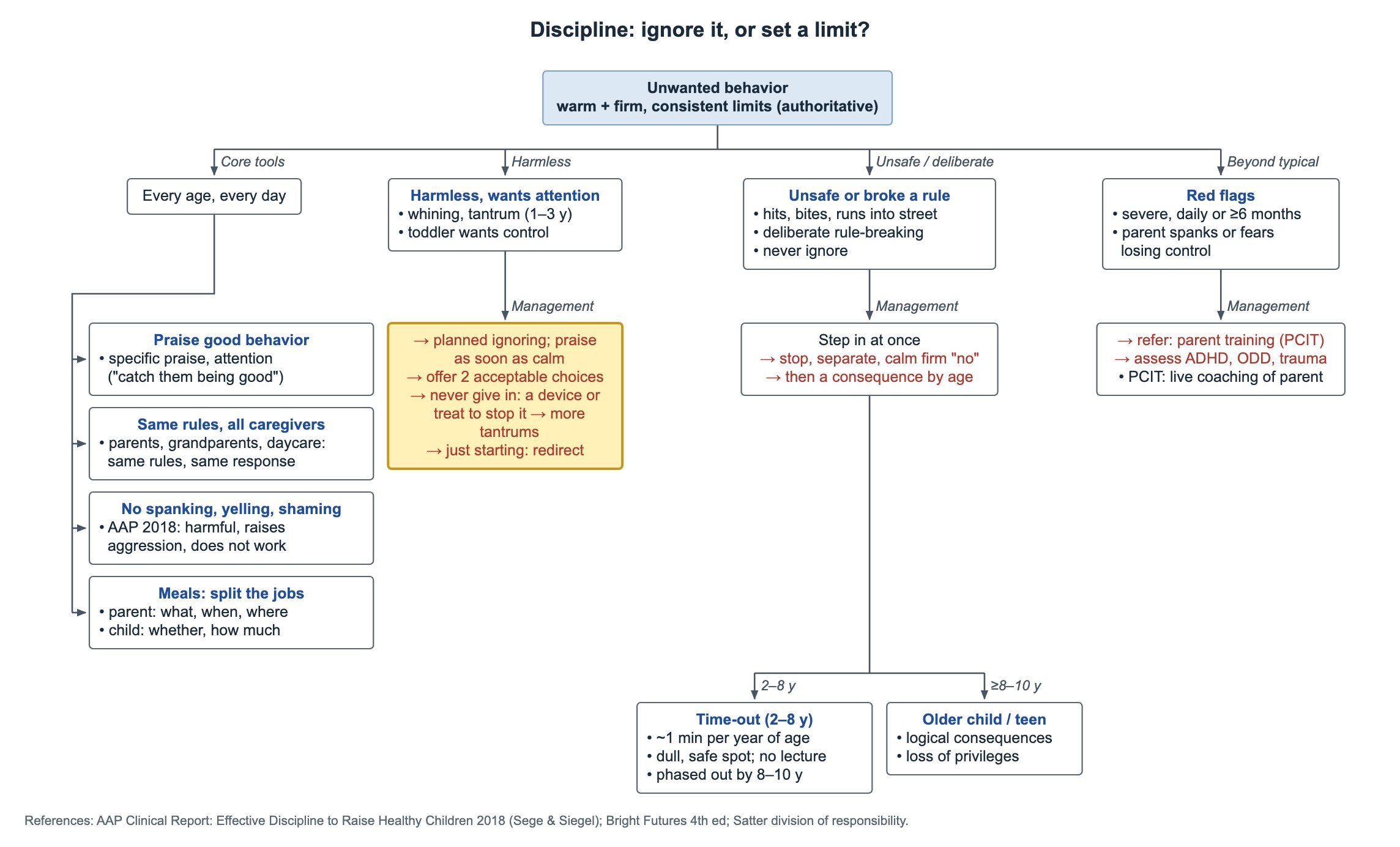
Tantrums and whining are common at 1–3 years. A toddler wants control and attention, so the response decides whether the behavior grows or fades.
- Harmless behavior: planned ignoring, then praise as soon as the child is calm.
- Offer 2 acceptable choices ("red shirt or blue shirt?") to give a sense of control.
- Never give in or hand over a phone or treat to stop a tantrum: that rewards the tantrum.
- A tantrum just starting: redirect or distract early.
- Unsafe behavior (hitting, biting, running into the street): step in at once, say a calm, firm "no", separate the child and give a brief time-out.
- Time-out (2–8 years): about 1 minute per year of age in a dull, safe spot, then carry on without a lecture.
- Older children and teens: logical consequences and loss of privileges; time-out is phased out by 8–10 years.
When behavior is beyond typical: PCIT
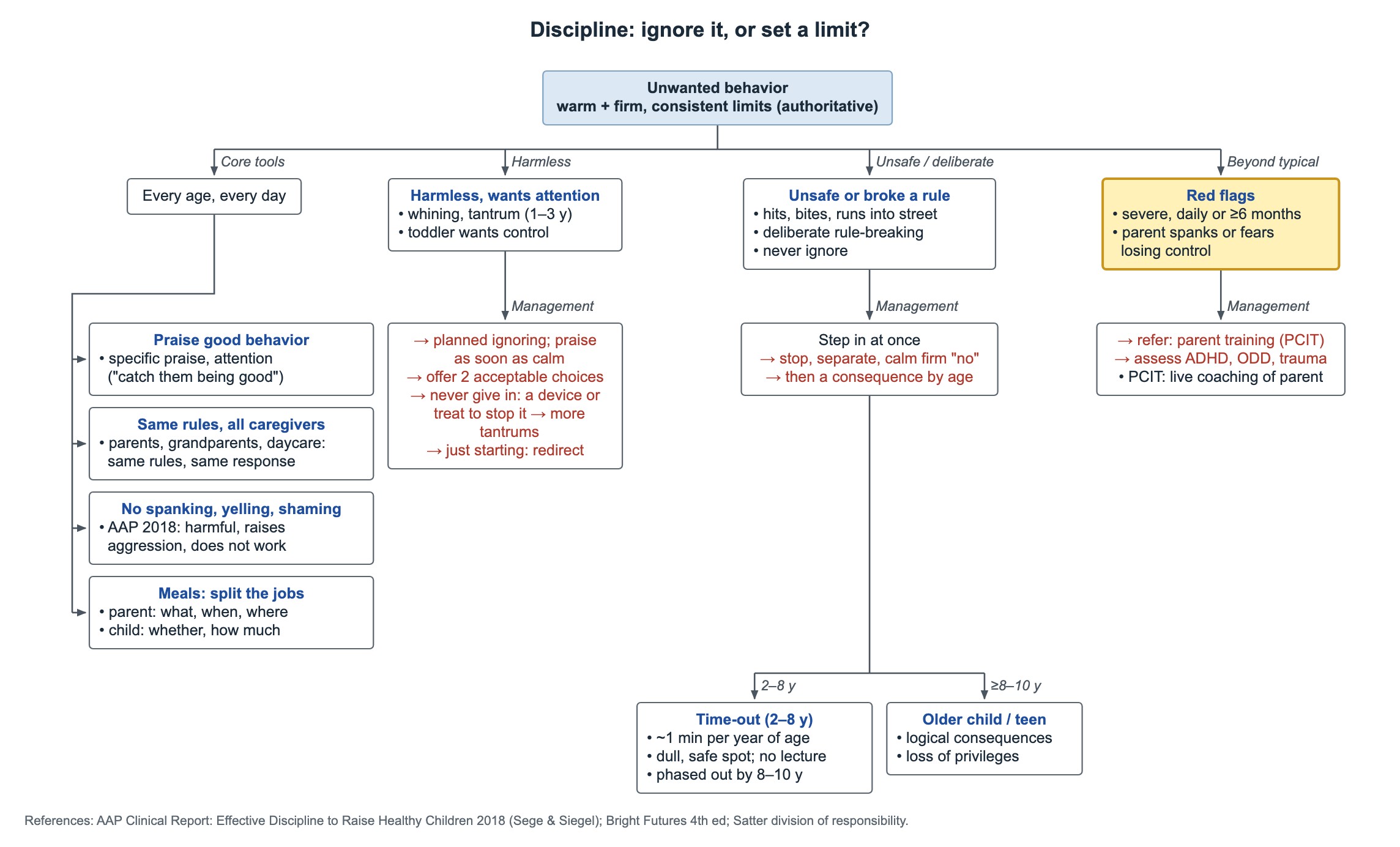
Refer when tantrums are severe (longer than about 25 minutes, with self-injury or aggression), happen daily, last 6 months or more, or when a parent spanks or fears losing control. Assess for ADHD, oppositional defiant disorder and trauma, and ask about family stress such as poverty and food insecurity.
Parent–child interaction therapy (PCIT) is the best-supported treatment for disruptive behavior in preschoolers. A therapist coaches the parent live during play, from behind a one-way mirror or by video, through an earpiece. It treats the parent–child relationship, and its evidence is stronger than for child-only play therapy.
Infant crying and colic
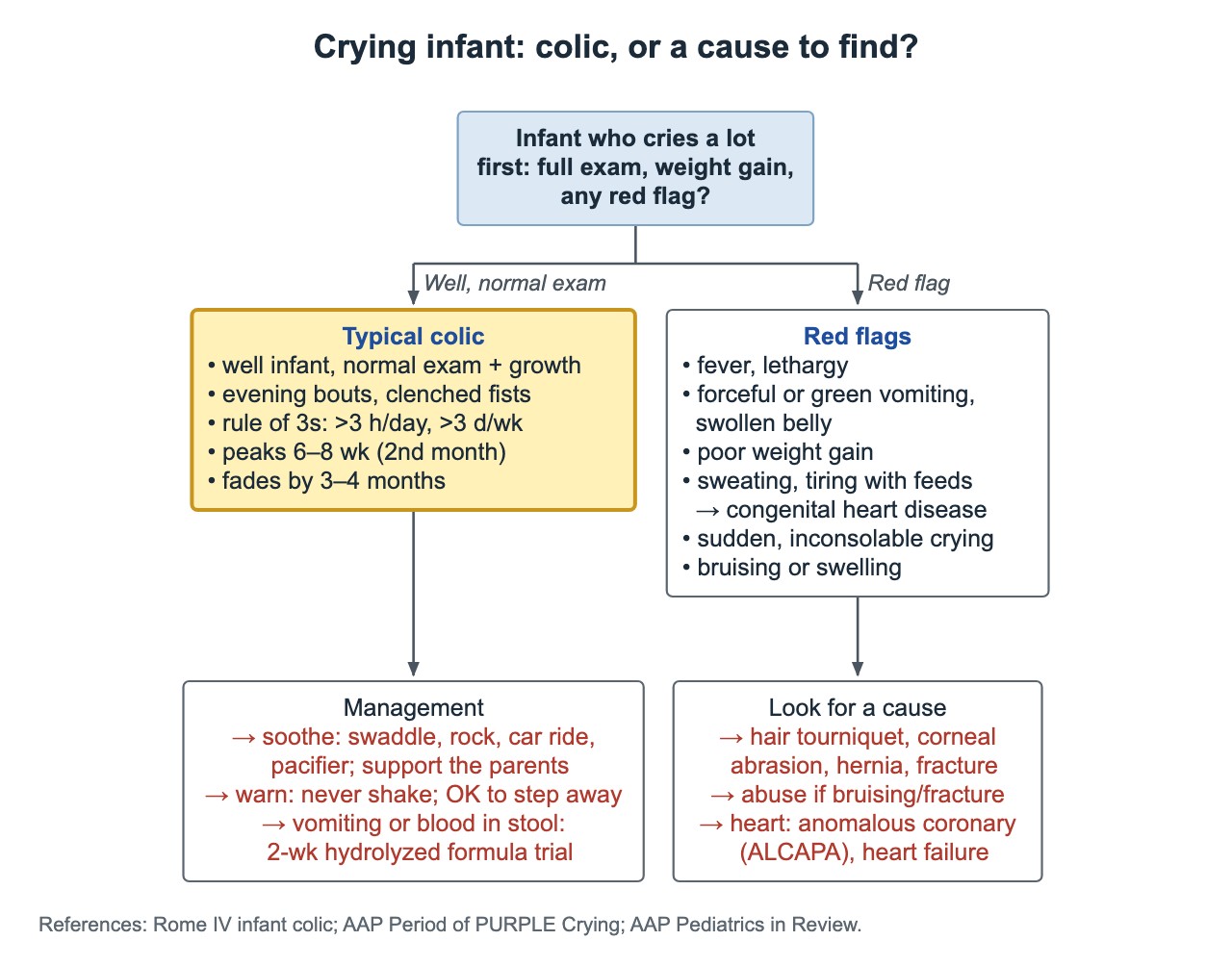
Colic is long bouts of crying, often in the evening, with clenched fists, in a well infant with a normal exam and normal growth. The classic Wessel "rule of threes" is crying more than 3 hours a day on more than 3 days a week for more than 3 weeks. Rome IV (2016) uses a looser clinical definition: prolonged crying the parent cannot prevent or soothe, starting and ending before 5 months, with no fever, illness or poor growth.
Crying peaks in the second month (6–8 weeks) and fades by 3–4 months. Persistent crying after that age should not be labeled colic without a fresh look.
- First line after a normal exam: soothing (swaddling, rocking, a car ride, a pacifier) and support for the parents.
- Warn parents never to shake a baby; it is fine to put the baby down safely and step away.
- Colic with vomiting or blood in the stool: a 2-week trial of extensively hydrolyzed formula.
| Red flag (not colic) | Look for |
|---|---|
| Fever, lethargy | Infection |
| Forceful or green vomiting, swollen belly | Obstruction or other surgical cause |
| Poor weight gain | Feeding problem or organic disease |
| Sweating and tiring with feeds | Congenital heart disease, including ALCAPA and heart failure |
| Sudden, inconsolable crying | Hair tourniquet, corneal abrasion, hernia, fracture |
| Bruising, swelling or a fracture | Abuse |
Breath-holding spells
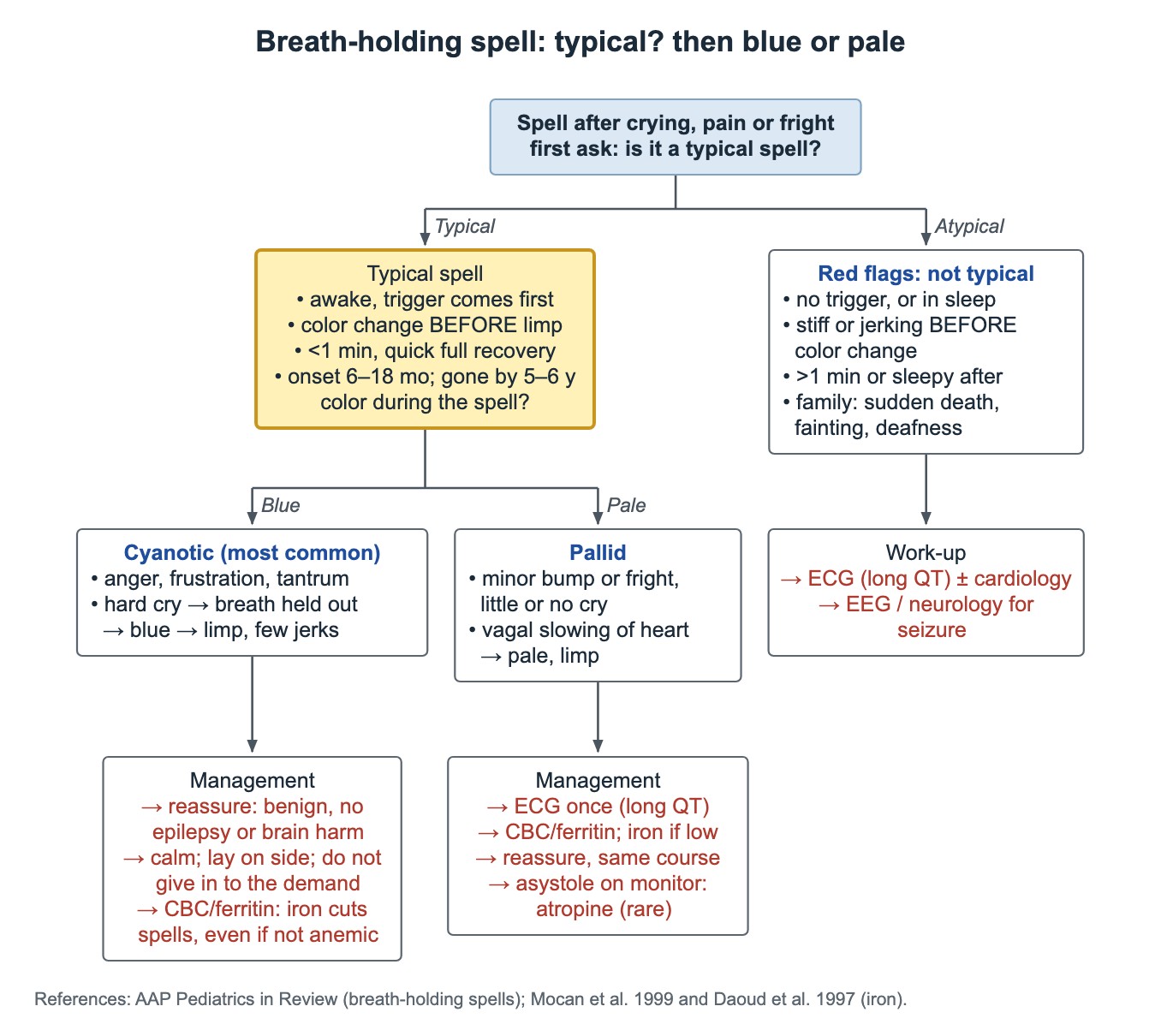
A typical spell happens while the child is awake. A trigger comes first, then the color change, then brief limpness, sometimes with a few jerks. It lasts under 1 minute with a quick full recovery. Spells start at 6–18 months and usually stop by 5–6 years. This order of events separates a spell from an epileptic seizure.
- Check CBC and ferritin: oral iron reduces spells, sometimes even when iron studies are normal.
- Not typical (no trigger, during sleep, stiffening or jerking before the color change, longer than 1 minute, sleepy after, or a family history of sudden death, fainting or deafness): ECG for long QT first, then cardiology or EEG and neurology.
| Cyanotic (most common) | Pallid | |
|---|---|---|
| Trigger | Anger, frustration, being told "no" | Minor bump or fright, little or no crying |
| Mechanism | Hard crying, breath held out, then blue and limp | Vagal slowing of the heart (vasovagal), then pale and limp |
| Management | Reassure: benign, no epilepsy or brain harm; lay on the side and watch, no CPR; do not give in to the demand | Same reassurance; ECG once for long QT; atropine only for rare severe spells with asystole |
Habits and head banging
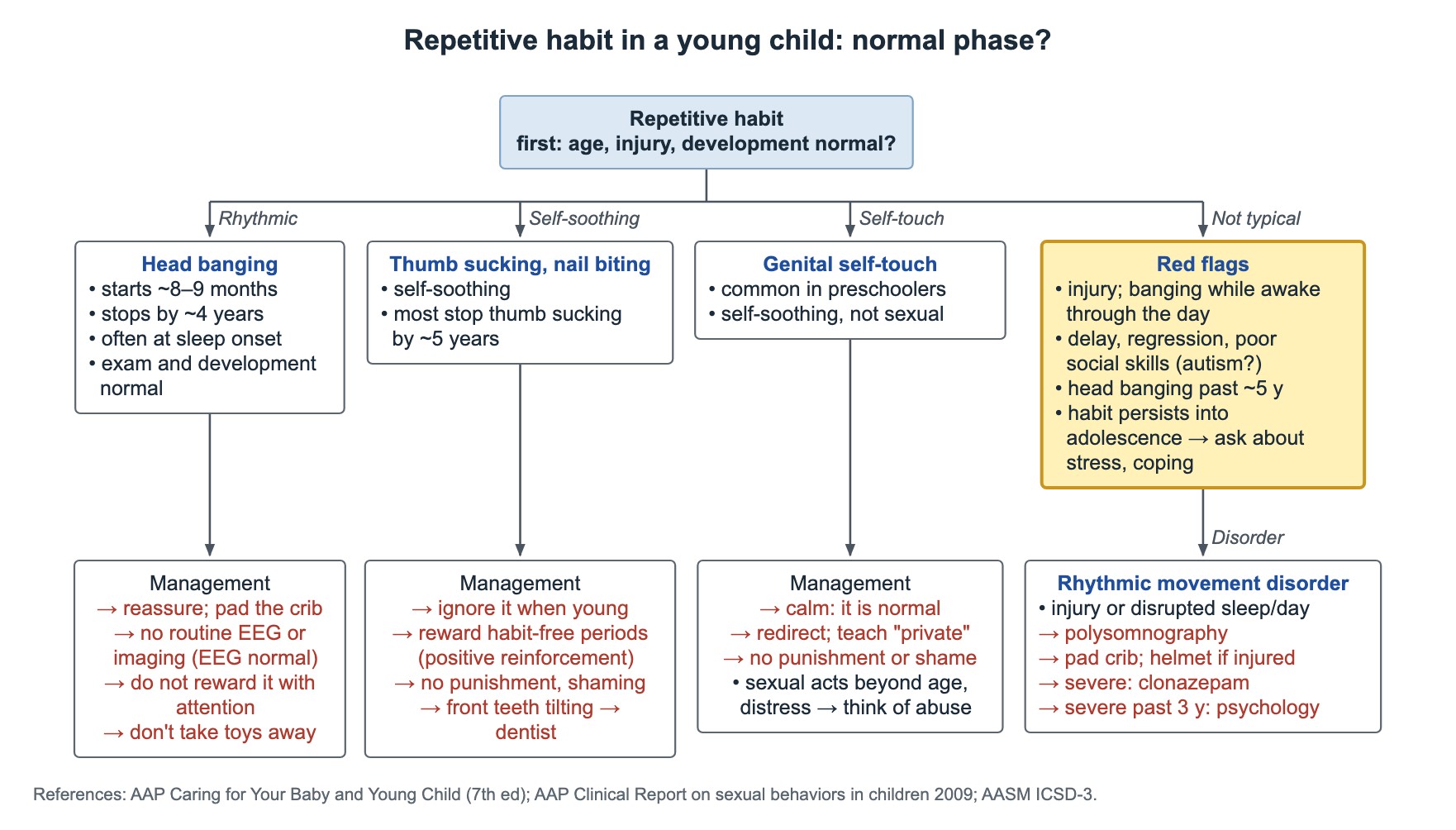
Head banging often starts at about 8–9 months, usually at sleep onset, and stops by about 4 years. In a child with a normal exam and development, reassure and pad the crib; no EEG or imaging is needed. When banging happens with upset, ignore it while keeping the child safe, and give attention when the child is not banging. Do not take toys away: it acts as punishment, removes self-soothing and can make it worse.
Thumb sucking and nail biting are self-soothing. Most children stop thumb sucking by 5 years. Reward habit-free periods instead of scolding; refer to a dentist if the upper front teeth tilt forward. Genital self-touch is common in preschoolers: calmly redirect and teach that it is private, without punishment.
- Red flags: injury, banging while awake through the day, banging past about 5 years, delayed development or poor social skills (think of autism).
- Stereotypies and self-injury are more common with autism, developmental delay and visual or hearing impairment.
- Rhythmic movement disorder: rhythmic movements with self-injury or disrupted sleep or daytime function. Polysomnography characterizes it; pad the crib, a helmet if injured; clonazepam for severe cases; psychology or psychiatry if severe past 3 years.
- A habit that persists into adolescence prompts questions about stress and coping.
Separation anxiety and a new sibling
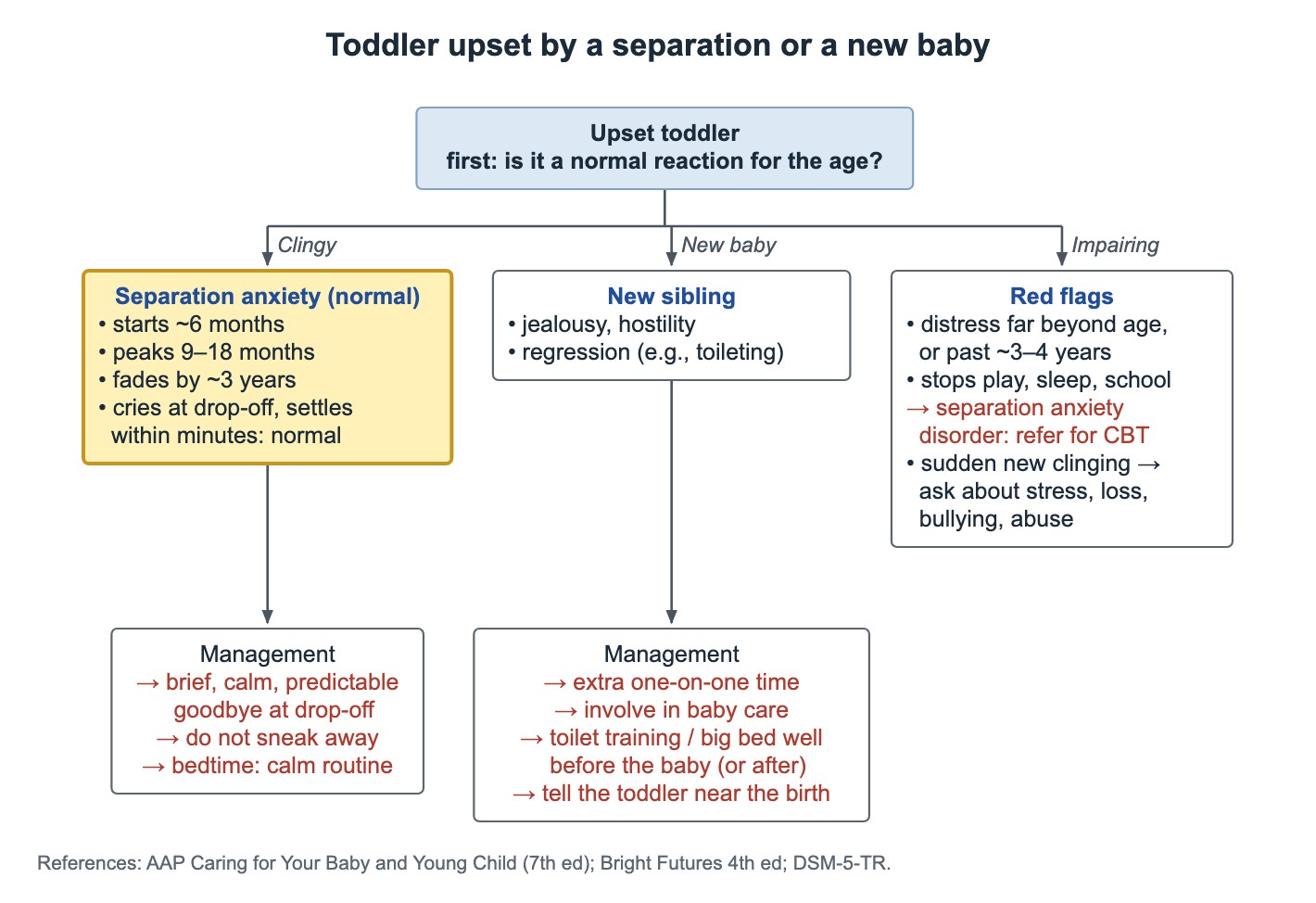
- Separation anxiety starts about 6 months, peaks at 9–18 months and fades by about 3 years. A child who cries at drop-off but plays happily within minutes is normal: use a brief, calm, predictable goodbye and do not sneak away.
- A child who suddenly becomes clingy after months of easy separation: ask about stress or loss (move, illness or death, family conflict, bullying, abuse).
- New sibling: jealousy, hostility and regression are common. Give extra one-on-one time and involve the child in baby care. Do toilet training or the move to a bed well before the birth, or wait until after; tell a toddler about the baby near the birth.
- Distress far beyond the age, past about 3–4 years, or stopping play, sleep or school: think of separation anxiety disorder and refer for CBT.
Common questions
How long should a time-out last?
About 1 minute per year of age, in a dull, safe spot, then carry on without a lecture. Time-out suits ages 2–8 years.
Are breath-holding spells dangerous?
Typical spells are benign and do not cause epilepsy or brain damage. Check iron, because iron reduces spells. Spells without a trigger, during sleep or with a family history of sudden death need an ECG for long QT.
When does colic peak and stop?
Crying peaks at about 6–8 weeks and usually fades by 3–4 months.
Does the AAP allow spanking?
No. The AAP advises against all physical punishment, yelling and shaming, because they harm children and do not improve behavior.
Study this topic
Sources
- AAP 2018: Effective discipline to raise healthy children (Pediatrics)
- AAP 2021: Preventing childhood toxic stress (Pediatrics)
- AAP 2020: Abusive head trauma in infants and children (Pediatrics)
Written for Pedemy in our own words from the sources above; checked November 2026. For education only, not medical advice; check doses and local protocols before treating a patient. Pedemy is independent and not affiliated with or endorsed by the organizations cited.