

Main decision tree
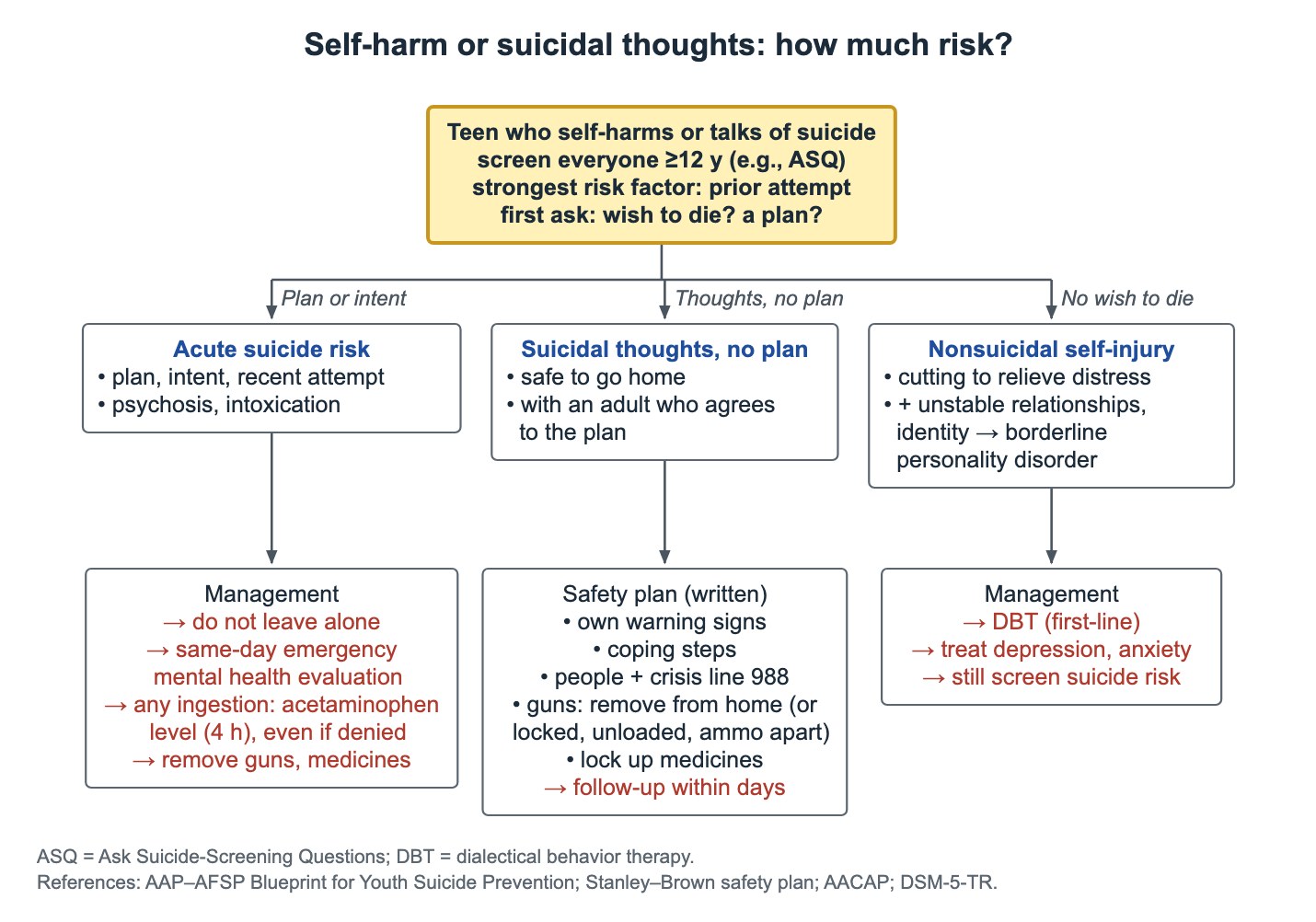
Self-harm or suicidal thoughts: how much risk?
Key points
- Screen all patients 12 years and older for suicide risk with a validated tool such as the ASQ, even at a sports physical.
- Strongest single predictor of a future attempt: a prior suicide attempt.
- Plan, intent or a recent attempt → do not leave the teen alone; same-day emergency mental health evaluation.
- Any intentional ingestion → serum acetaminophen level 4 hours after ingestion, even if the teen denies taking it.
- Most effective lethal-means advice: remove guns from the home; if not, store them locked and unloaded with ammunition locked separately.
- A written safety plan lists warning signs, coping steps, people and crisis lines (988) and lethal-means steps.
- Repeated nonsuicidal self-injury: dialectical behavior therapy (DBT) has the best evidence; medicine only for a coexisting disorder.
Screen every teen and sort the risk
Bright Futures and the AAP recommend suicide-risk screening for all patients 12 years and older with a validated tool, such as the 4-question ASQ. Ask the teen privately. Asking about suicide does not plant the idea.
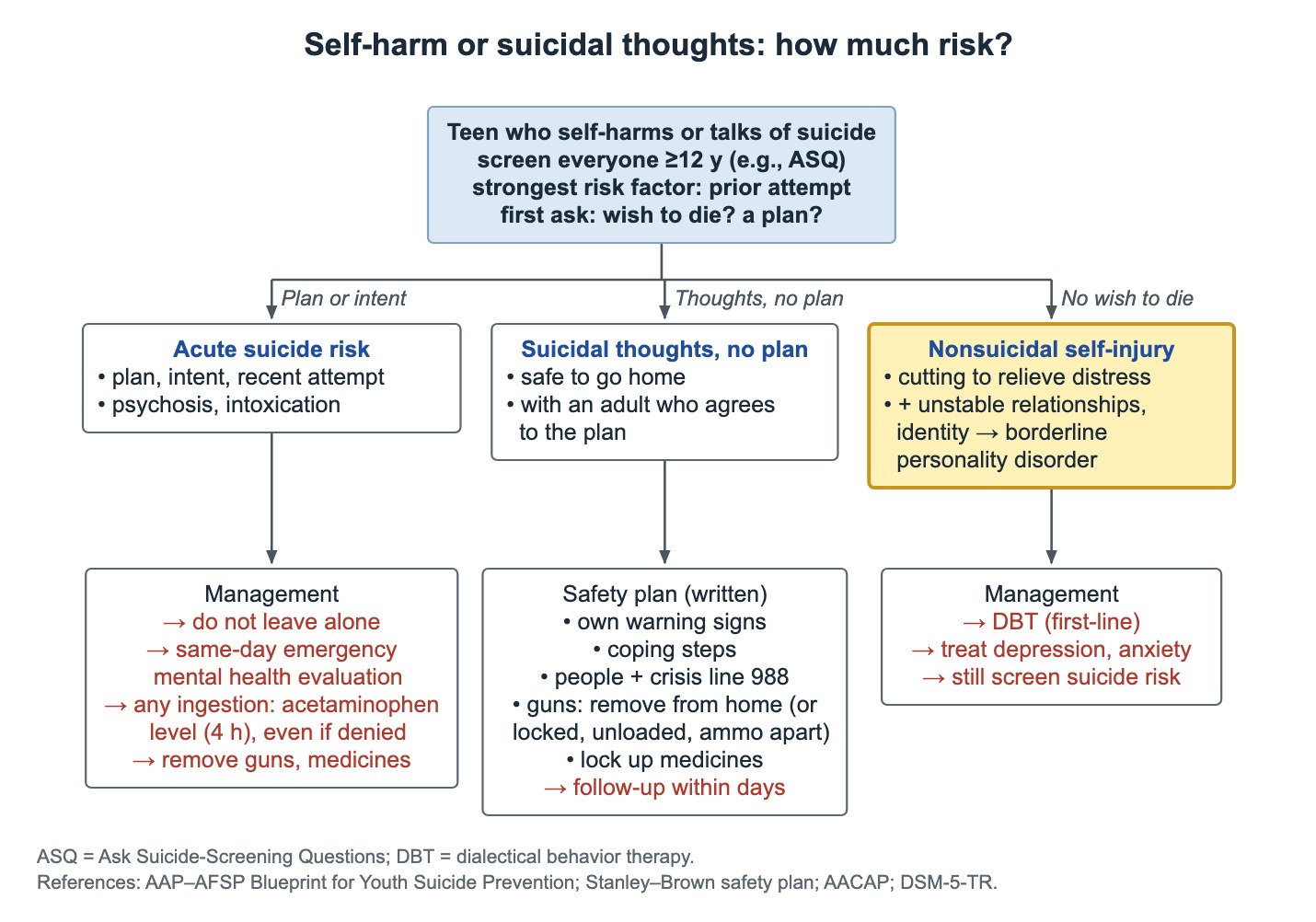
A positive screen leads to a brief assessment: is there a wish to die, a plan, intent or a recent attempt?
- Strongest risk factor: a prior suicide attempt.
- Other risk factors: depression and other mental illness, substance use, bullying, LGBTQ+ identity with rejection, abuse, recent loss, and a gun in the home.
- Plan or intent, recent attempt, psychosis or intoxication: acute risk.
- Suicidal thoughts without a plan: may go home with a safety plan and an adult who agrees to it.
- Self-harm without a wish to die: nonsuicidal self-injury; still screen for suicide risk.
Acute suicide risk and ingestions
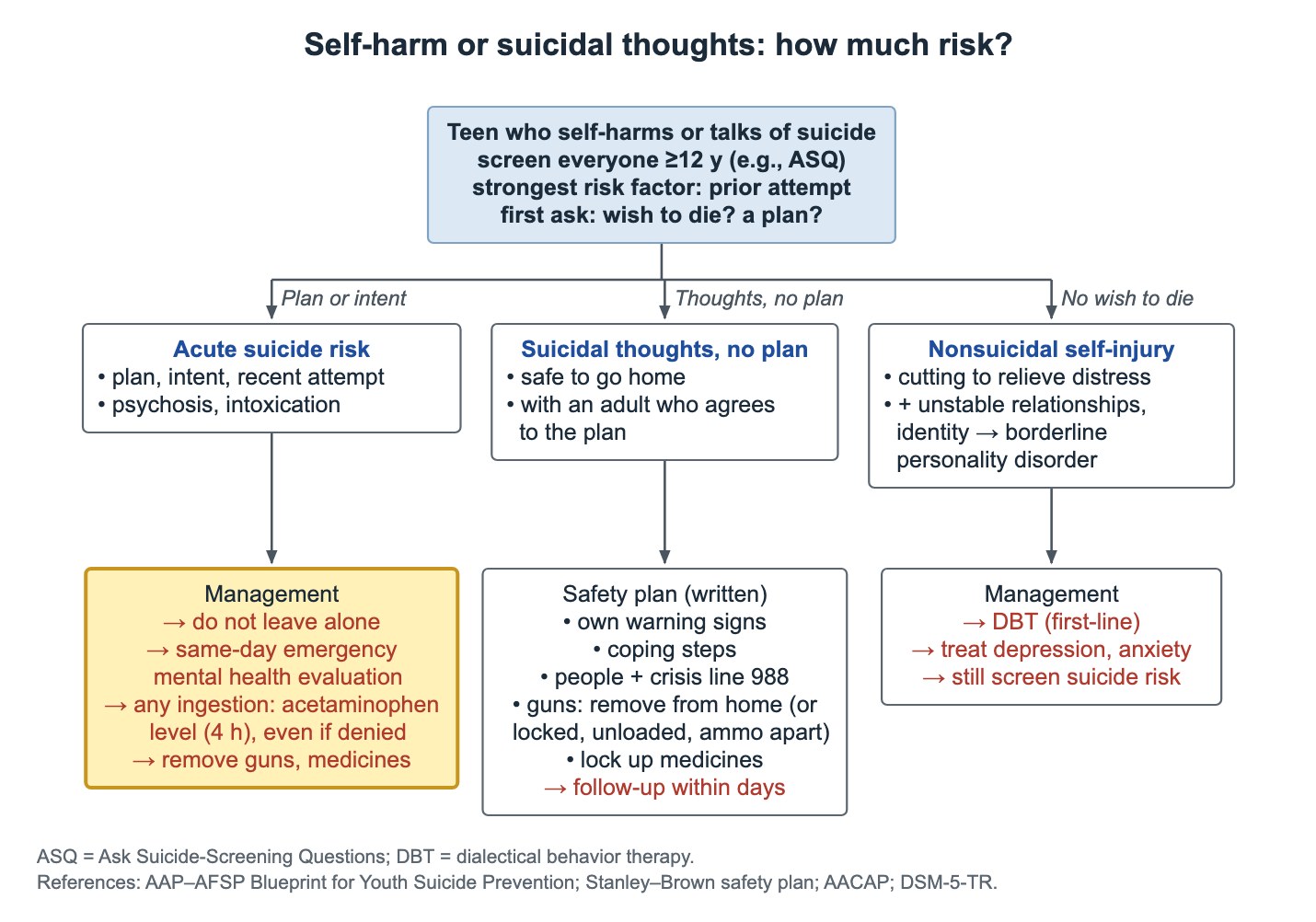
- Do not leave the teen alone; arrange a same-day emergency mental health evaluation.
- Any intentional ingestion: send a serum acetaminophen level 4 hours after ingestion (or on arrival if later), even when the teen names another drug and denies acetaminophen. Early acetaminophen poisoning has few symptoms and has an antidote.
- Remove guns and medicines before discharge.
Safety planning and lethal means
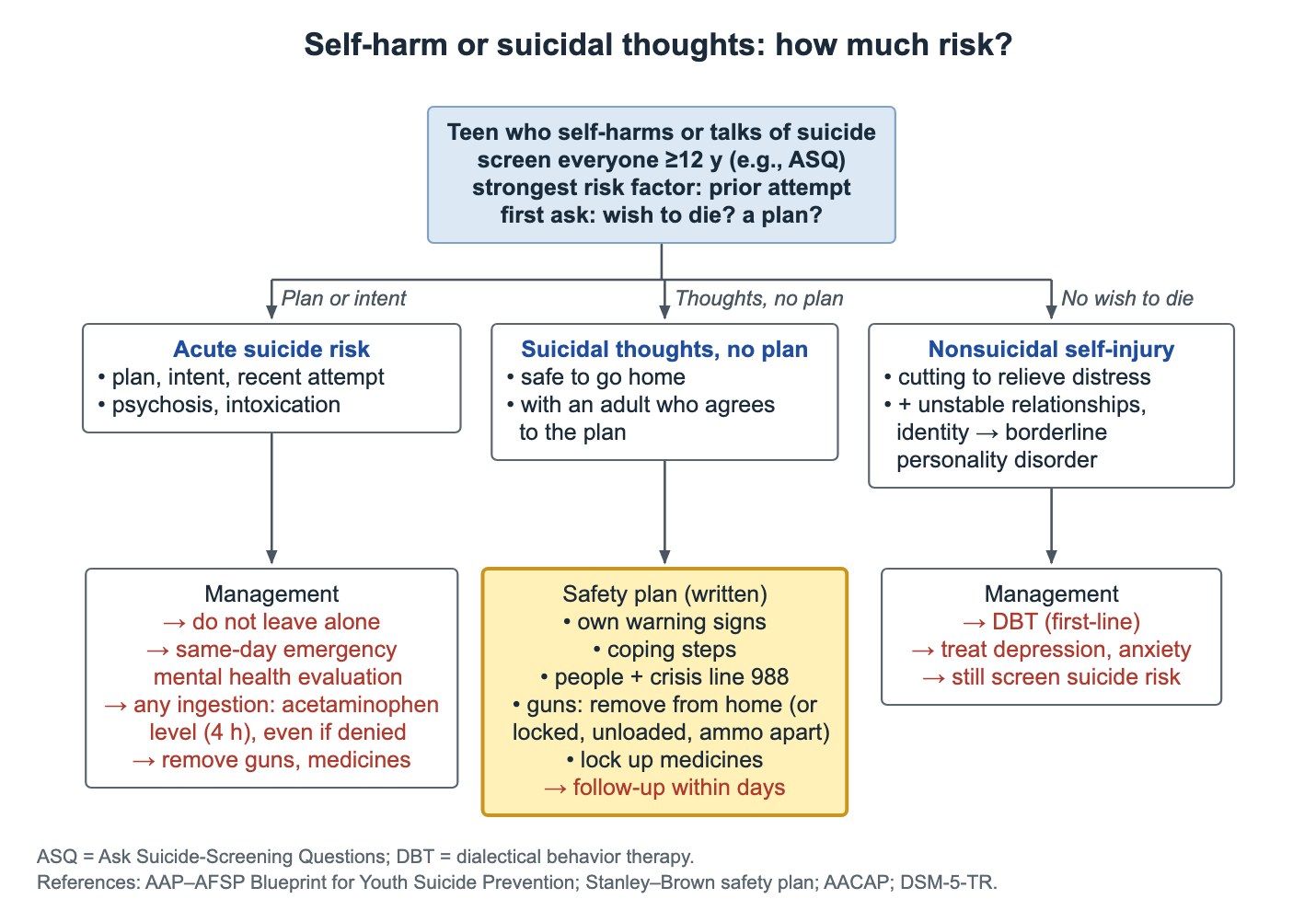
A teen with suicidal thoughts but no plan can go home when a caring adult agrees to the plan. Write the plan with the teen and family.
- The teen's own warning signs.
- Coping steps the teen can take alone.
- People and places for distraction and support, and crisis contacts, including the 988 Suicide & Crisis Lifeline (call or text 988).
- Guns: removing them from the home is most effective; otherwise store them locked and unloaded, with ammunition locked separately.
- Lock up medicines, including over-the-counter pain relievers.
- Follow-up within days.
Nonsuicidal self-injury
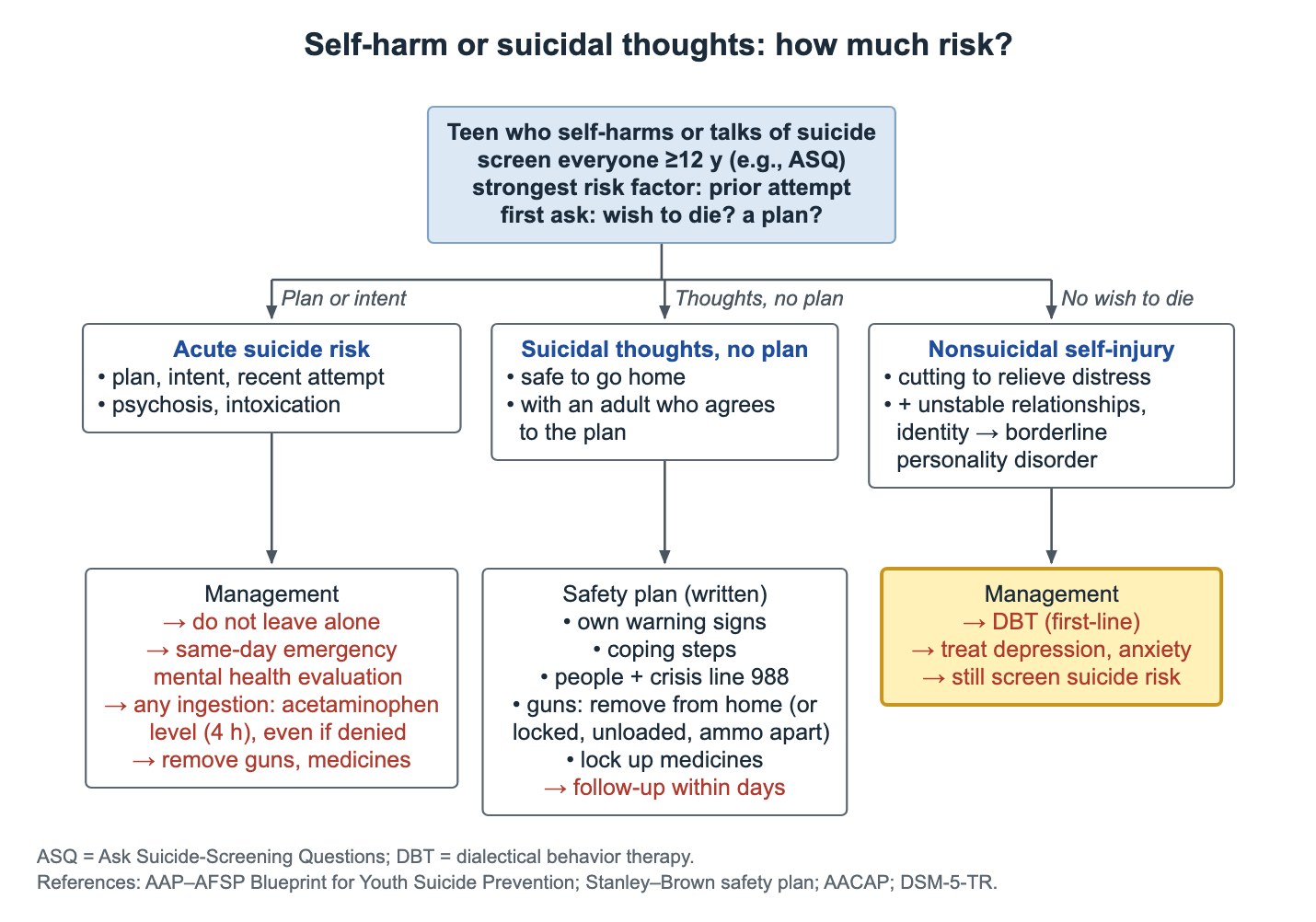
Nonsuicidal self-injury, most often cutting, is done to relieve distress without a wish to die. It still raises the risk of later suicide attempts.
- DBT has the best evidence for adolescents with repeated self-harm.
- Do not start fluoxetine just for self-harm; treat coexisting depression or anxiety.
- Keep screening for suicide risk at each visit.
Borderline personality disorder
Self-harm with unstable relationships, a shifting sense of identity, chronic emptiness, impulsivity and fear of abandonment suggests borderline personality disorder. It can be diagnosed before 18 years when the pattern has lasted at least 1 year.
DBT is also the main treatment.
Common questions
At what age should suicide screening start?
The AAP and Bright Futures recommend screening all patients 12 years and older with a validated tool such as the ASQ.
What is the strongest risk factor for suicide in adolescents?
A prior suicide attempt. Access to a gun greatly raises the chance that an attempt is fatal.
What goes in a suicide safety plan?
The teen's warning signs, coping steps, people and crisis lines to contact (988), steps to remove guns and lock up medicines, and a follow-up visit within days.
Study this topic
Sources
- AAP clinical report: Suicide and suicide risk in adolescents (Pediatrics 2024)
- McCauley et al.: DBT for adolescents at high risk for suicide, randomized trial (JAMA Psychiatry 2018)
- Management of acetaminophen poisoning in the US and Canada: consensus statement (JAMA Netw Open 2023)
Written for Pedemy in our own words from the sources above; checked November 2026. For education only, not medical advice; check doses and local protocols before treating a patient. Pedemy is independent and not affiliated with or endorsed by the organizations cited.