

Main decision tree
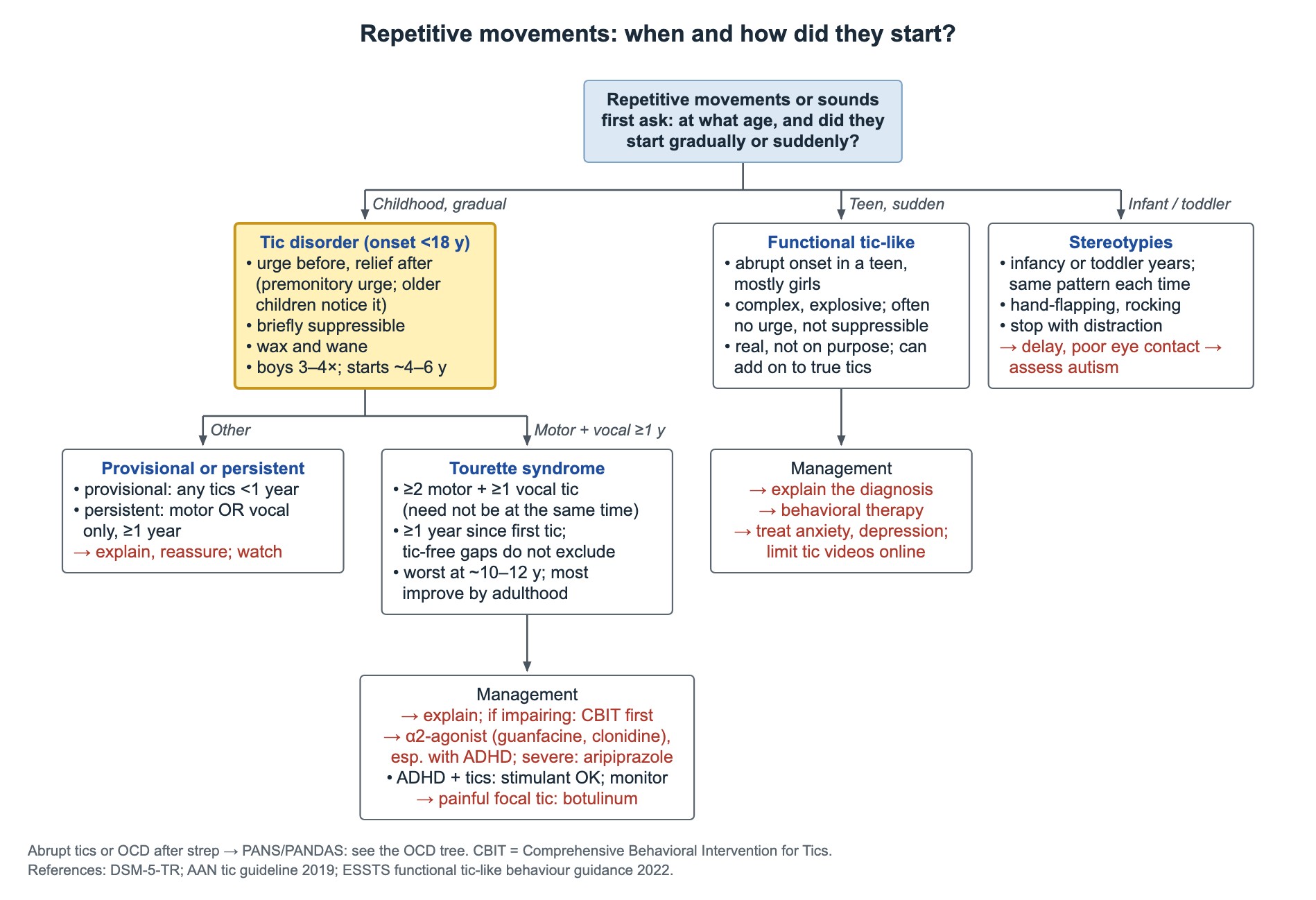
Repetitive movements: when and how did they start?
Key points
- Tourette syndrome: at least 2 motor tics and at least 1 vocal tic, not necessarily at the same time, for at least 1 year, starting before age 18.
- Tic-free stretches do not exclude Tourette syndrome; the 1-year clock runs from the first tic.
- Tics usually start at 4–6 years, are worst at about 10–12 years and improve for most by adulthood; boys are affected 3–4 times more often.
- Premonitory urge: an itch-like pressure before a tic that the tic briefly relieves; tics can be held back for a short time.
- Impairing tics: CBIT first; alpha-2 agonists (guanfacine, clonidine) next, especially with ADHD; botulinum toxin for a painful focal tic.
- Tics do not rule out a stimulant for ADHD: tics that appear on a stimulant usually reflect a coexisting tic disorder.
- Sudden complex, explosive tic-like movements in a teen without an urge suggest functional tic-like behaviors.
Is it a tic? First ask age and speed of onset
Start with two questions: how old was the child, and did the movements come on gradually or suddenly? Gradual onset in childhood points to a tic disorder, sudden onset in a teen to functional tic-like behaviors, and onset in infancy or the toddler years to stereotypies.
Tics are sudden, rapid, non-rhythmic movements (motor tics) or sounds (vocal tics). Simple tics include blinking, shrugging, sniffing and throat clearing; complex tics are longer, purposeful-looking sequences or words.
- Premonitory urge: an uncomfortable, itch-like or pressure feeling before the tic that the tic briefly relieves. Older children describe it; young children often cannot.
- Suppressible for a short time, often with a rebound afterward.
- Wax and wane over weeks to months, and change type over time.
- Worse with stress, excitement, fatigue or illness; often less during focused activity.
- Onset usually at 4–6 years; boys 3–4 times more often than girls; the neurologic exam is otherwise normal.
Diagnosing Tourette syndrome and other tic disorders
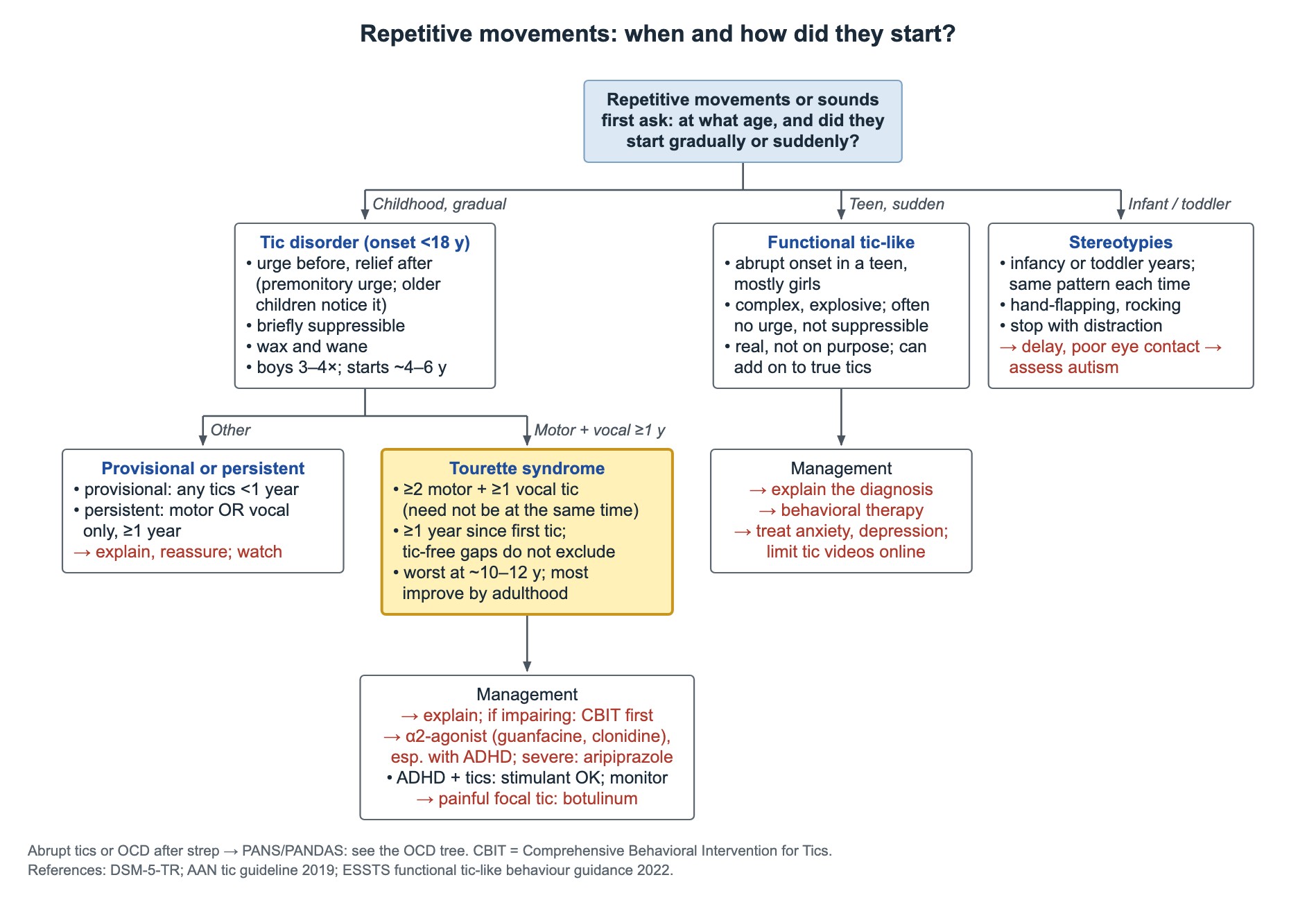
Tic disorders are diagnosed by history and examination. No blood test or imaging is needed when the history is typical and the neurologic exam is normal. All tic disorders start before age 18 and are not caused by a drug or another medical condition.
- Several motor tics and one vocal tic for 7 months is not yet Tourette syndrome: the tics must have been present for at least 1 year.
- A tic-free stretch of several months does not exclude Tourette syndrome.
- Tics peak in severity at about 10–12 years, and most children improve a great deal by late adolescence or adulthood.
- Ask about ADHD, OCD, anxiety, learning problems and mood: these often cause more impairment than the tics.
| Tic disorder | Criteria |
|---|---|
| Tourette syndrome | At least 2 motor tics and at least 1 vocal tic at some point (not necessarily at the same time), for at least 1 year since the first tic |
| Persistent (chronic) motor or vocal tic disorder | Motor tics or vocal tics, but not both, for at least 1 year |
| Provisional tic disorder | Any tics present for less than 1 year |
Treating tics: education, CBIT, then medicine
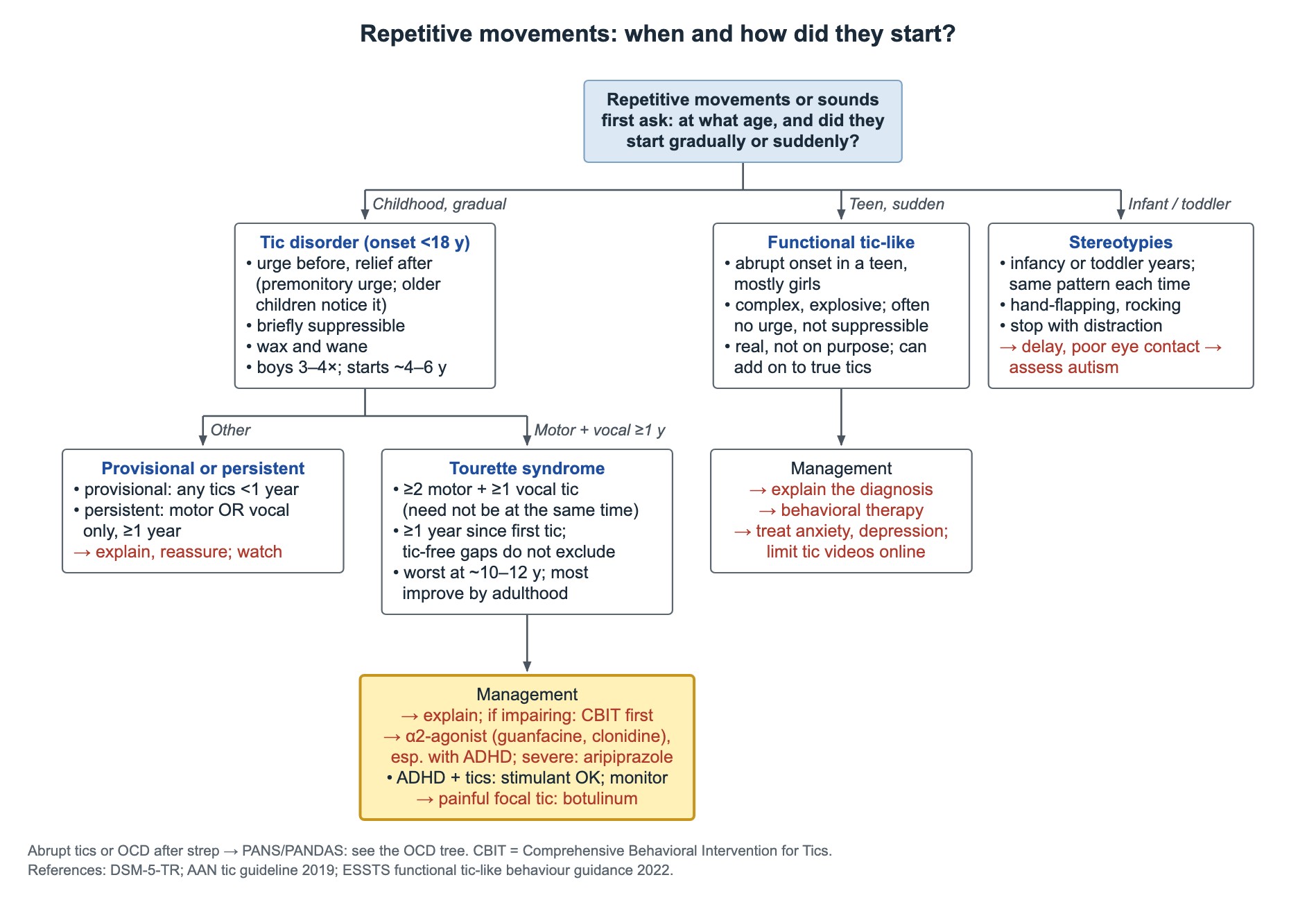
Many children need only an explanation for the family and school, plus watchful waiting. Treat when tics cause pain, social problems such as teasing, school problems or distress.
Medicine lowers tic severity but rarely stops tics completely, so the aim is less impairment, not zero tics.
- Education: explain the natural history; teach teachers and classmates what tics are.
- CBIT (Comprehensive Behavioral Intervention for Tics) is first-line when treatment is needed: habit reversal training, in which the child learns to notice the urge and do a competing response, plus changes to situations that worsen tics.
- Alpha-2 agonists (guanfacine, clonidine) are the usual first medicines, especially when ADHD coexists.
- Severe tics that do not respond: an antipsychotic such as aripiprazole, with monitoring of weight and metabolic effects.
- A single painful or impairing focal tic, such as a forceful neck tic, despite CBIT: botulinum toxin injection into the involved muscle.
- Review the need for treatment regularly, because tics change on their own over time.
ADHD, stimulants and tics
ADHD is the commonest condition that occurs with tic disorders. Tics are not a reason to withhold a stimulant: in most children with tics, stimulants do not make tics worse, and they treat the ADHD that often impairs the child more.
When blinking or throat clearing starts a few weeks after a child begins methylphenidate, the likely explanation is a coexisting tic disorder that would have appeared anyway at this age, not a drug-caused tic disorder. Keep the stimulant if it helps the ADHD and monitor the tics; change the dose or drug only if tics clearly worsen.
- ADHD with mild tics: a stimulant is acceptable; monitor tics.
- ADHD with impairing tics: an alpha-2 agonist can treat both.
Functional tic-like behaviors
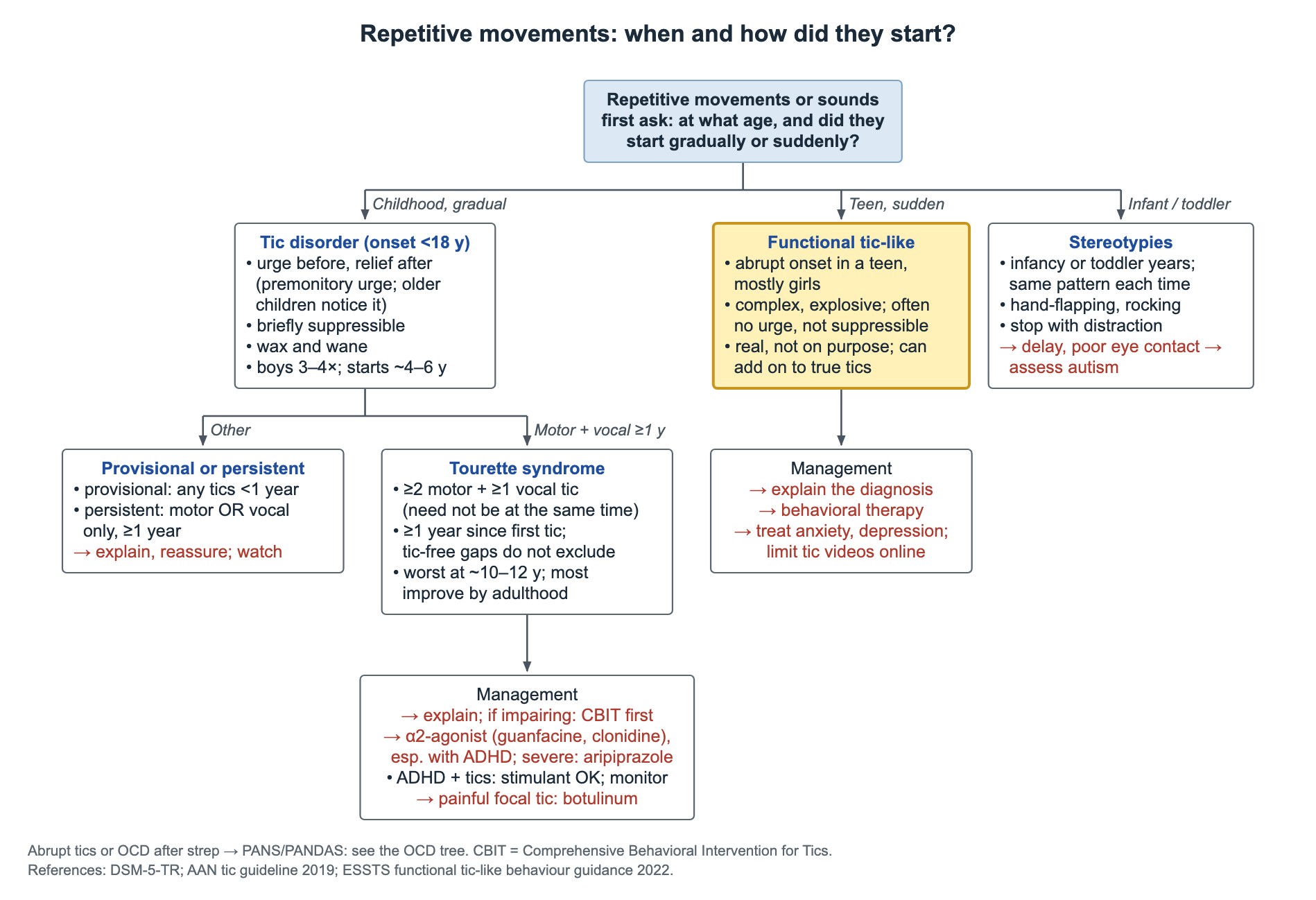
Functional tic-like behaviors are a functional neurological disorder. They begin suddenly, usually in a teen, mostly in girls, and are often linked to watching tic videos on social media. They are real and involuntary, not faked, and they can improve.
- Both can coexist: a teen with mild simple tics since early childhood can add sudden explosive complex movements without an urge. These are functional tic-like behaviors on top of a tic disorder.
| Feature | Primary tic disorder | Functional tic-like behaviors |
|---|---|---|
| Age at onset | Childhood, usually 4–6 years | Teen years, often 12 or older |
| Onset | Gradual, simple tics first | Abrupt, complex from the start |
| Sex | Mostly boys | Mostly girls |
| Movements | Simple, rostral (eyes, face, neck) first | Complex, explosive, often limbs and trunk; complex words or phrases |
| Premonitory urge and suppression | Urge present; briefly suppressible | Often no urge; not suppressible |
| Common association | ADHD, OCD | Anxiety, depression |
Managing functional tic-like behaviors
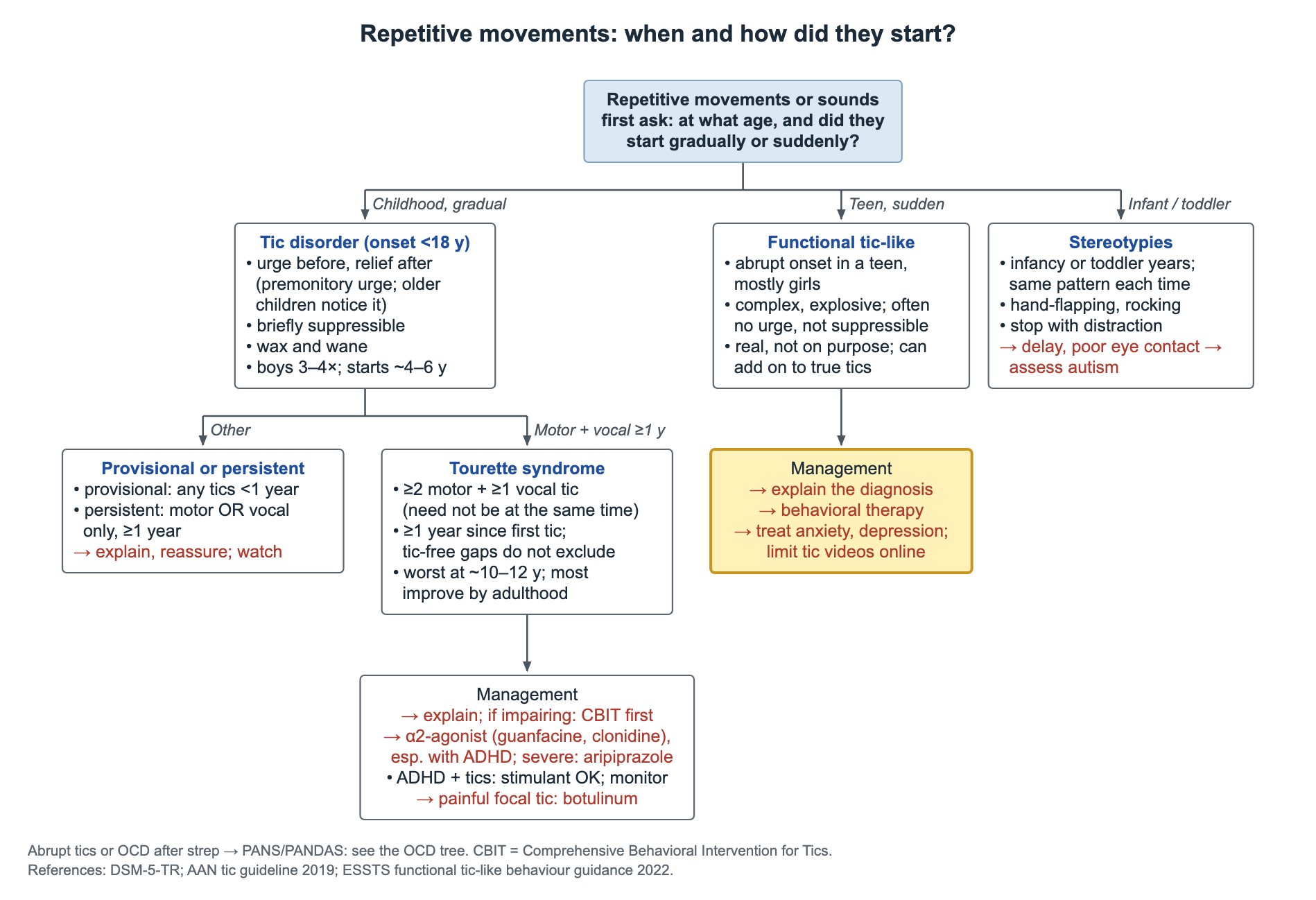
- Explain the diagnosis clearly: the movements are real, involuntary and potentially reversible, and they are not faked.
- Behavioral therapy, such as CBT-based approaches aimed at functional symptoms.
- Find and treat anxiety and depression.
- Limit exposure to tic videos on social media.
- Tic medicines are usually not helpful for the functional movements.
Stereotypies and PANS/PANDAS
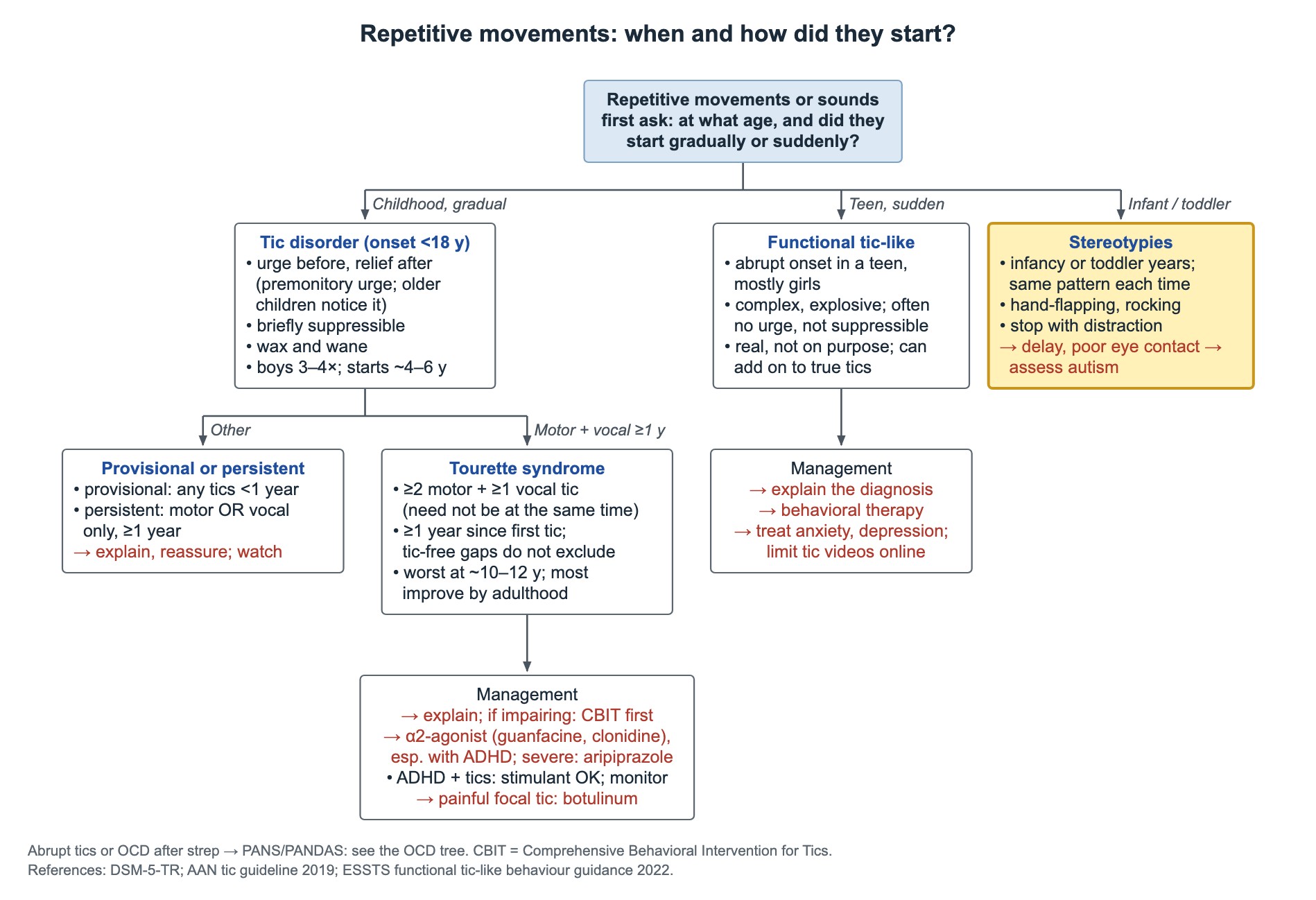
Stereotypies start in infancy or the toddler years. They are rhythmic, repeated the same way each time, often bilateral (hand flapping, rocking, arm waving) and appear with excitement, boredom or concentration. They have no premonitory urge and stop when the child is redirected or distracted.
Stereotypies occur in typically developing children, but with language delay, poor eye contact or limited social interest, assess for autism.
PANS (pediatric acute-onset neuropsychiatric syndrome) is the abrupt, dramatic onset over days of obsessive-compulsive symptoms or severely restricted eating, with other neuropsychiatric symptoms. PANDAS is the subtype linked to a group A streptococcal infection: for example, severe tics, contamination fears and rituals appearing over 2 days, 3 weeks after strep pharyngitis.
- PANS/PANDAS work-up: test for group A strep and treat if positive.
- Treat OCD symptoms with CBT and, if needed, an SSRI; refer to a specialist.
Common questions
How long must tics last to diagnose Tourette syndrome?
At least 1 year since the first tic, with at least 2 motor tics and at least 1 vocal tic at some point. Tic-free stretches during that year are allowed.
Can a child with tics take a stimulant for ADHD?
Yes. Tics do not rule out a stimulant. Most children's tics do not worsen on stimulants; monitor the tics and adjust only if they clearly get worse.
What is the first-line treatment for Tourette syndrome?
Education and watchful waiting for mild tics. When tics impair the child, CBIT is first-line, and alpha-2 agonists such as guanfacine or clonidine are the usual first medicines.
Do children outgrow Tourette syndrome?
Tics are usually worst at about 10–12 years, and most people have far fewer tics by late adolescence or adulthood.
Study this topic
Sources
- AAN 2019: Practice guideline summary, treatment of tics in Tourette syndrome and chronic tic disorders (Neurology)
- ESSTS 2022: Criteria for the clinical diagnosis of functional tic-like behaviours (Eur J Neurol)
- AAP 2019: Clinical practice guideline for ADHD (Pediatrics)
- PANS Research Consortium 2015: Clinical evaluation of youth with PANS (J Child Adolesc Psychopharmacol)
Written for Pedemy in our own words from the sources above; checked November 2026. For education only, not medical advice; check doses and local protocols before treating a patient. Pedemy is independent and not affiliated with or endorsed by the organizations cited.