

Main decision tree
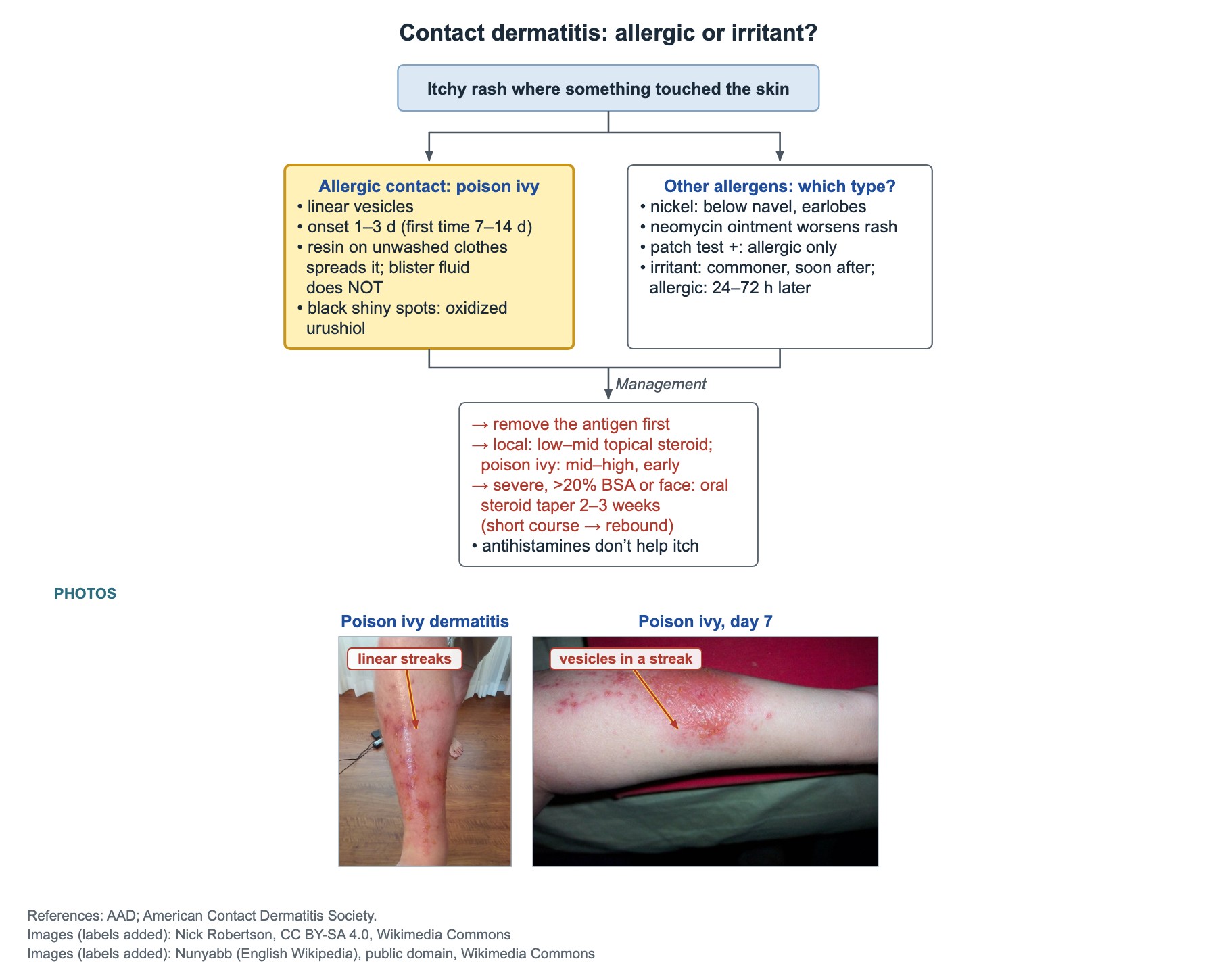
Contact dermatitis: allergic or irritant?
Key points
- Irritant contact dermatitis is more common and starts soon after exposure; allergic starts 24–72 hours later.
- Poison ivy: rash 1–3 days after contact in a sensitized child, 7–14 days after a first exposure.
- Linear streaks of itchy vesicles on exposed skin in summer = poison ivy (Toxicodendron) dermatitis.
- Patch testing is positive in allergic contact dermatitis and negative in irritant dermatitis.
- First step: remove the allergen; poison ivy: wash with soap and water right away and scrub under the nails.
- Localized poison ivy: mid- to high-potency topical steroid, started early; >20% BSA or marked facial swelling: oral steroid taper over 2–3 weeks.
- Antihistamines do not help the itch: allergic contact dermatitis is T-cell mediated, not histamine mediated.
Poison ivy: the classic allergic contact rash
Poison ivy, oak and sumac contain urushiol, a plant resin. It causes a delayed (type IV) allergic reaction, so the rash shows the shape of the contact: straight lines and streaks of intensely itchy papules and vesicles on exposed arms and legs, most often in summer.
- Timing: 1–3 days after contact in a child who was sensitized before; 7–14 days after the first-ever exposure.
- Spread: resin left on unwashed clothes, shoes, tools or pet fur can cause new rash. Blister fluid does not spread it.
- New lesions for several days are usually areas that got less resin, not spread of the rash.
- Black-spot poison ivy: shiny black macules where resin oxidized on the skin.
Allergic or irritant contact dermatitis?
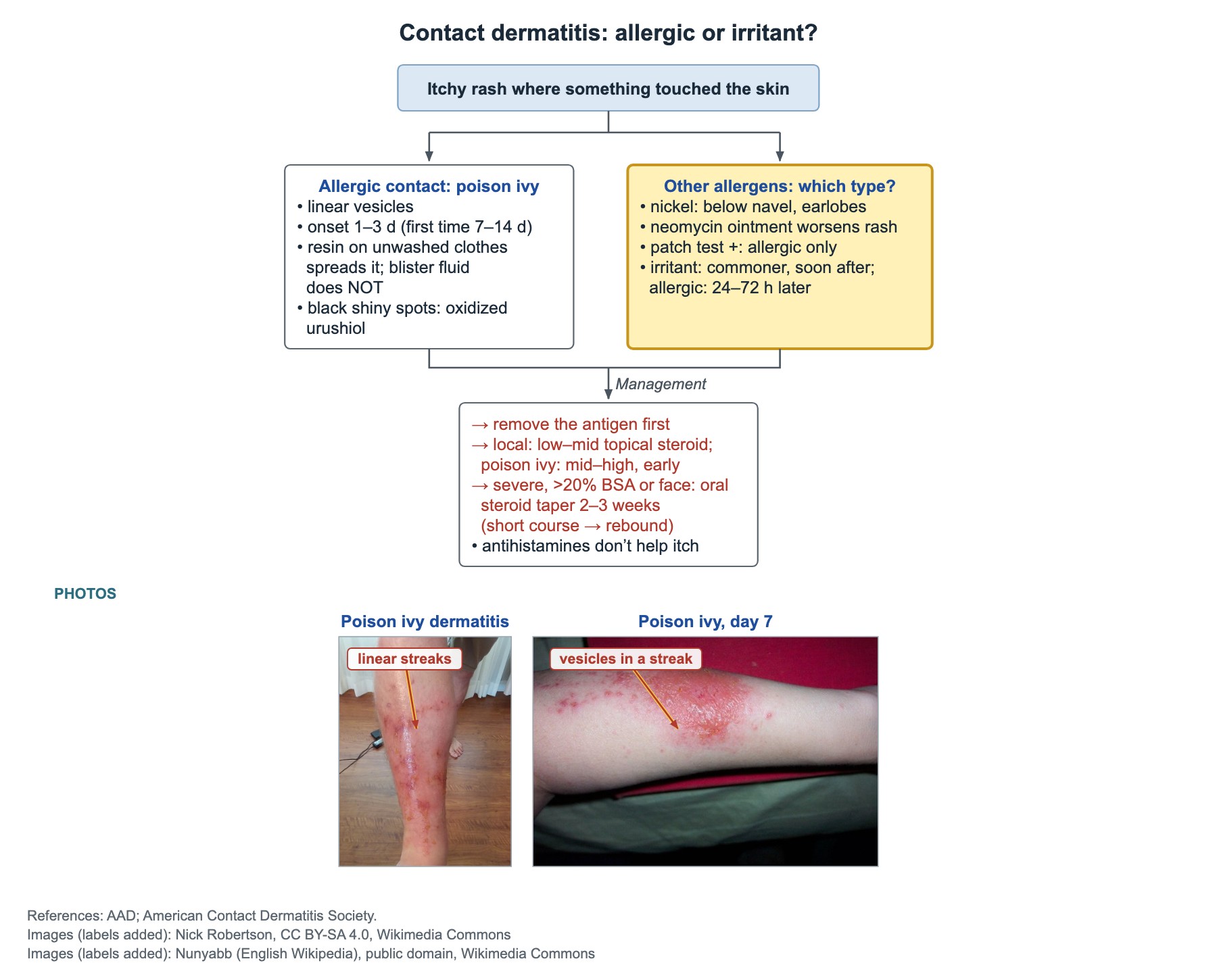
- Nickel: itchy eczematous plaque just below the navel (belt buckle, jeans snaps) or on the earlobes at earring sites. Chronic rubbing can leave a hyperpigmented, thick plaque.
- Neomycin or bacitracin ointment: a wound rash that gets worse with the ointment.
- Benzoyl peroxide for acne can cause marked redness, swelling and itch. That is allergic contact dermatitis: stop it and choose another acne treatment.
- Patch testing confirms the allergen when the rash is chronic or the cause is unclear.
| Feature | Irritant | Allergic |
|---|---|---|
| How common | More common | Less common |
| Mechanism | Direct skin damage (soap, saliva, urine, wet wipes) | Delayed T-cell (type IV) reaction |
| Onset | Soon after exposure (minutes to hours) | 24–72 hours after exposure |
| Symptom | Burning, stinging | Intense itch |
| Patch test | Negative | Positive |
Treatment
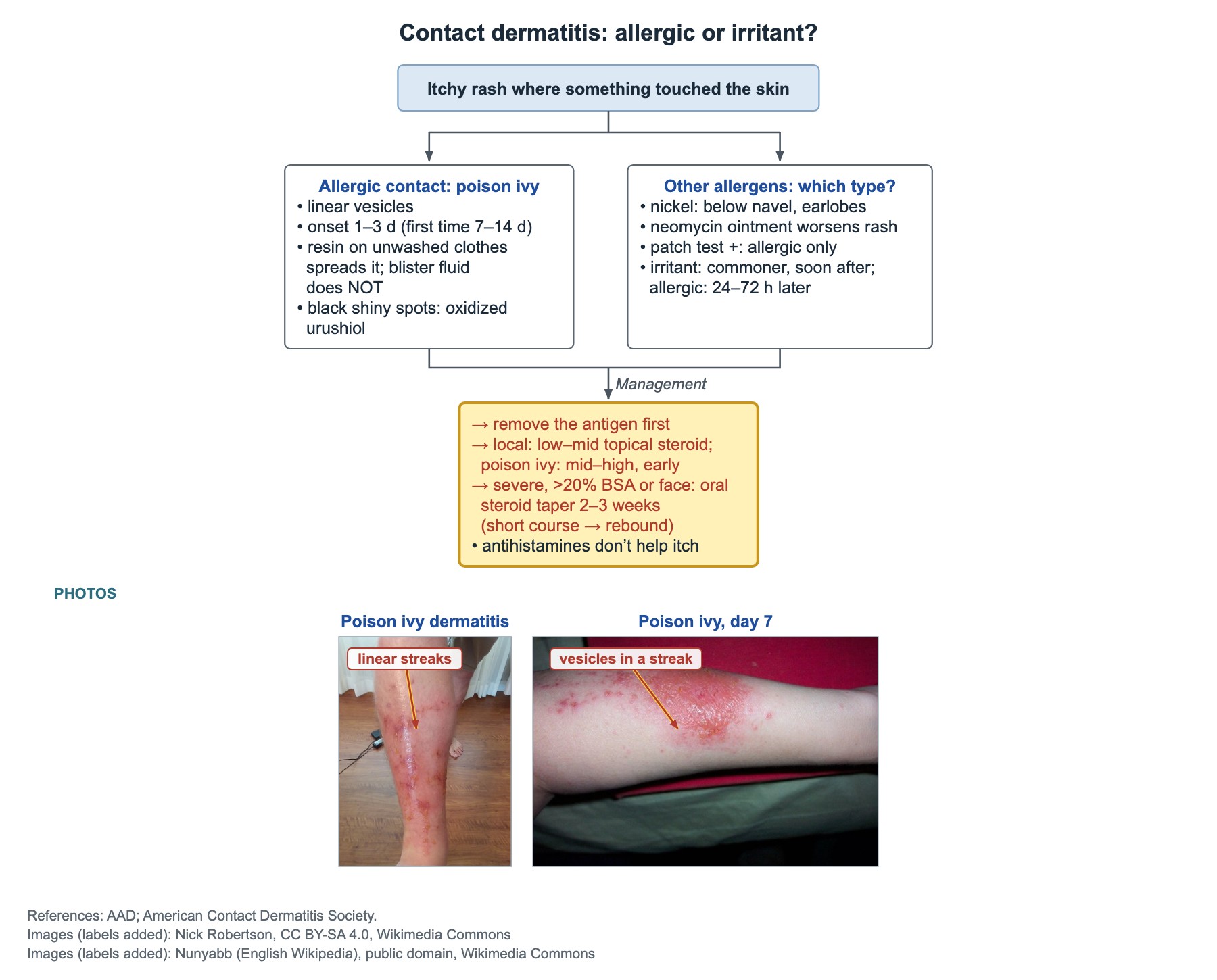
The first step is always to remove the cause. After poison ivy contact, wash the skin with soap and water right away, scrub under the nails, and wash clothes and shoes.
- Localized contact dermatitis: low- to mid-potency topical steroid plus avoiding the allergen.
- Localized poison ivy: mid- to high-potency topical steroid, started early. Avoid high-potency steroid on the face and skin folds.
- Extensive rash (more than 20% of body surface area) or marked facial swelling: oral steroid tapered over 2–3 weeks.
- A short 5–7 day steroid pack often leads to rebound of the rash.
- Antihistamines do not relieve the itch, which is not histamine mediated. A sedating dose at night may only help sleep.
- Cool compresses and calamine can soothe weeping vesicles.
Common questions
Is poison ivy contagious?
No. Blister fluid does not spread the rash. New rash comes from resin still on the skin, clothes, shoes or pets, so wash all of them.
When does a poison ivy rash need oral steroids?
When it covers more than about 20% of the body or causes marked facial or eyelid swelling. Use a 2–3 week taper; shorter courses often rebound.
How do you tell irritant from allergic contact dermatitis?
Irritant rash starts soon after exposure and burns; allergic rash starts 24–72 hours later and itches. Patch testing is positive only in allergic contact dermatitis.
Study this topic
Sources
- AAAAI/ACAAI Joint Task Force: Contact dermatitis practice parameter update 2015 (J Allergy Clin Immunol Pract)
- A practical guide to patch testing (J Allergy Clin Immunol Pract, 2015)
Written for Pedemy in our own words from the sources above; checked November 2026. For education only, not medical advice; check doses and local protocols before treating a patient. Pedemy is independent and not affiliated with or endorsed by the organizations cited.