

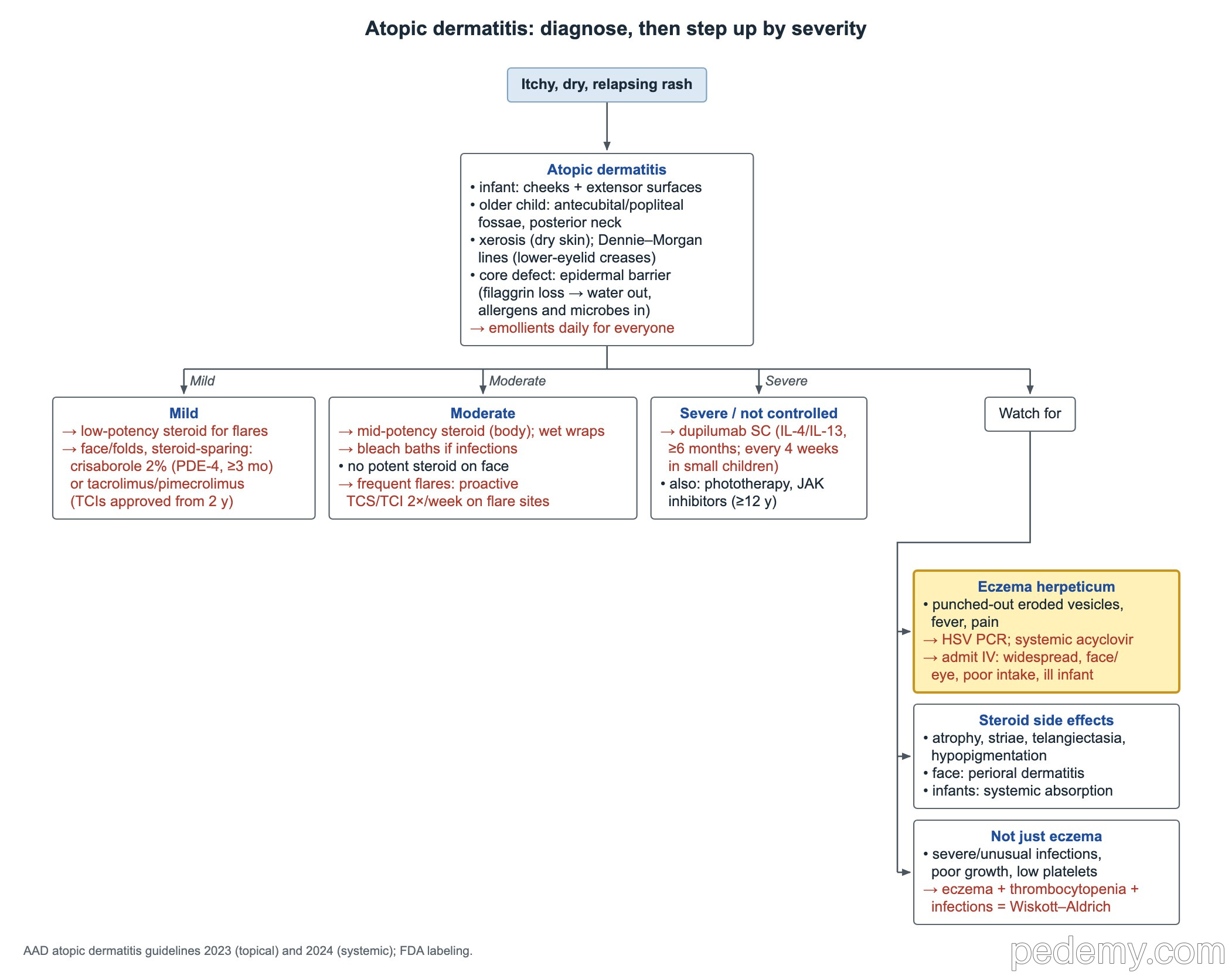
Main decision tree
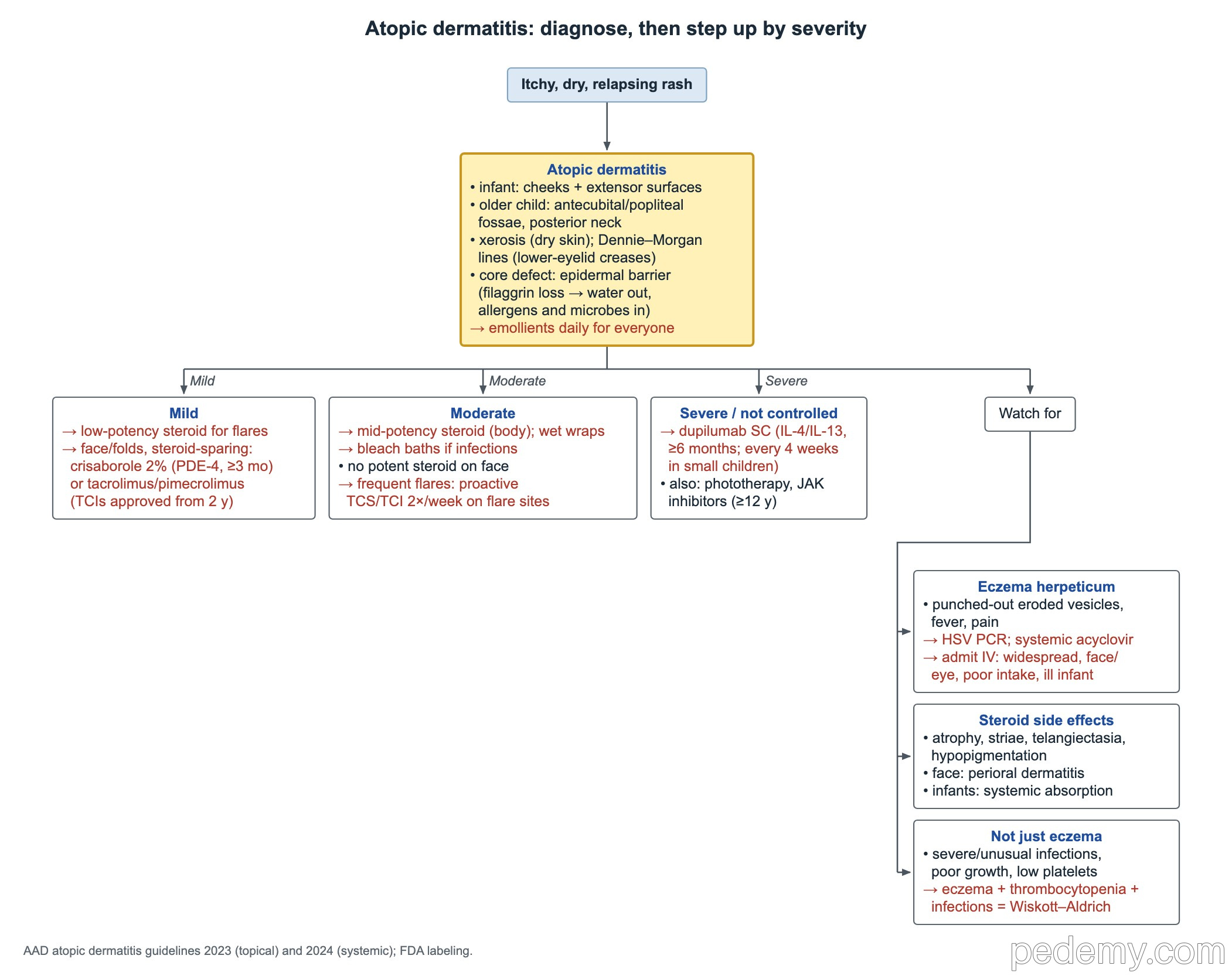
Atopic dermatitis: diagnose, then step up by severity
Key points
- Core defect: epidermal barrier dysfunction (filaggrin loss → water out, allergens and microbes in).
- Infants: cheeks and extensor surfaces, diaper area spared; older children: antecubital and popliteal fossae and posterior neck.
- Flares: low-potency steroid for mild, medium-potency for moderate–severe, twice daily until about 3 days after the skin clears.
- Frequent flares: proactive steroid or TCI twice weekly on flare-prone sites; TCIs are approved from age 2, crisaborole from 3 months.
- Severe disease: dupilumab (IL-4/IL-13 blocker) from 6 months of age; no oral corticosteroids for flares.
- Eczema herpeticum: punched-out eroded vesicles, fever, pain → HSV PCR and systemic acyclovir without waiting for the result.
- Eczema + small platelets or bleeding + recurrent infections in a boy = Wiskott–Aldrich syndrome.
Recognize atopic dermatitis
Atopic dermatitis is an itchy, dry, relapsing rash. About 60% of children show it by age 1 and about 90% by age 5. Daily emollients are the base of care for every child.
- Infants: cheeks and extensor surfaces of the limbs; the diaper area is typically spared.
- Older children: antecubital and popliteal fossae, posterior neck, wrists and ankles; chronic rubbing causes lichenification.
- Other signs: xerosis (dry skin) and Dennie–Morgan lines (double or triple creases under the lower eyelid).
- Core defect: a weak epidermal barrier. Filaggrin loss lets water out and allergens and microbes in.
- Itch that disrupts sleep: a sedating antihistamine at night can help sleep, but antihistamines do not treat the eczema.
Mild disease: low-potency steroid and steroid-sparing creams
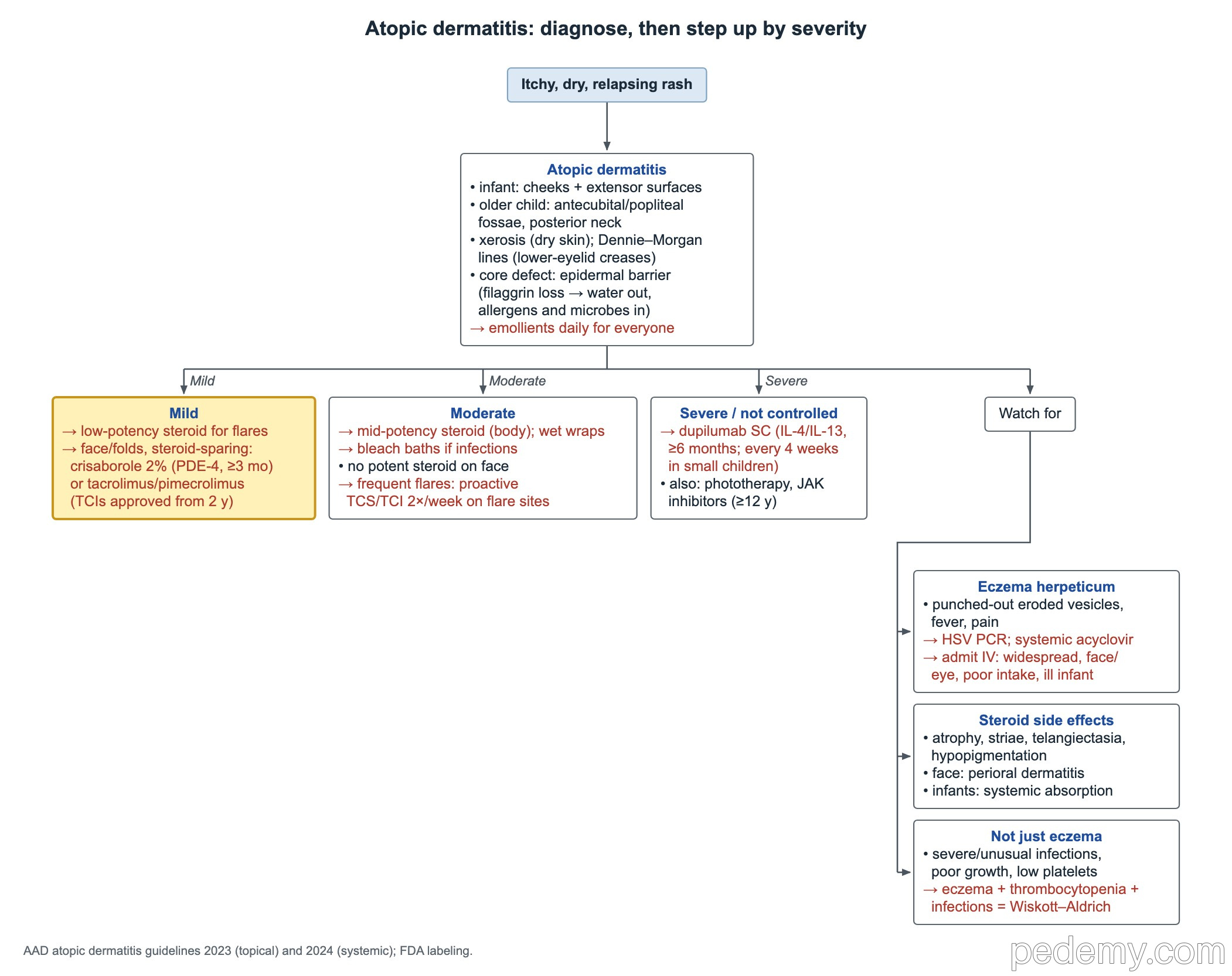
- Flares: low-potency topical steroid (for example hydrocortisone 2.5%) twice daily until about 3 days after the lesions clear.
- Face and skin folds, or families worried about steroids: crisaborole 2% ointment (PDE-4 inhibitor), approved from 3 months.
- Topical calcineurin inhibitors (tacrolimus, pimecrolimus): labeled from age 2. The boxed cancer warning has not been borne out in long-term studies.
- Oral antibiotics only for clear secondary infection.
Moderate disease: mid-potency steroid and proactive therapy
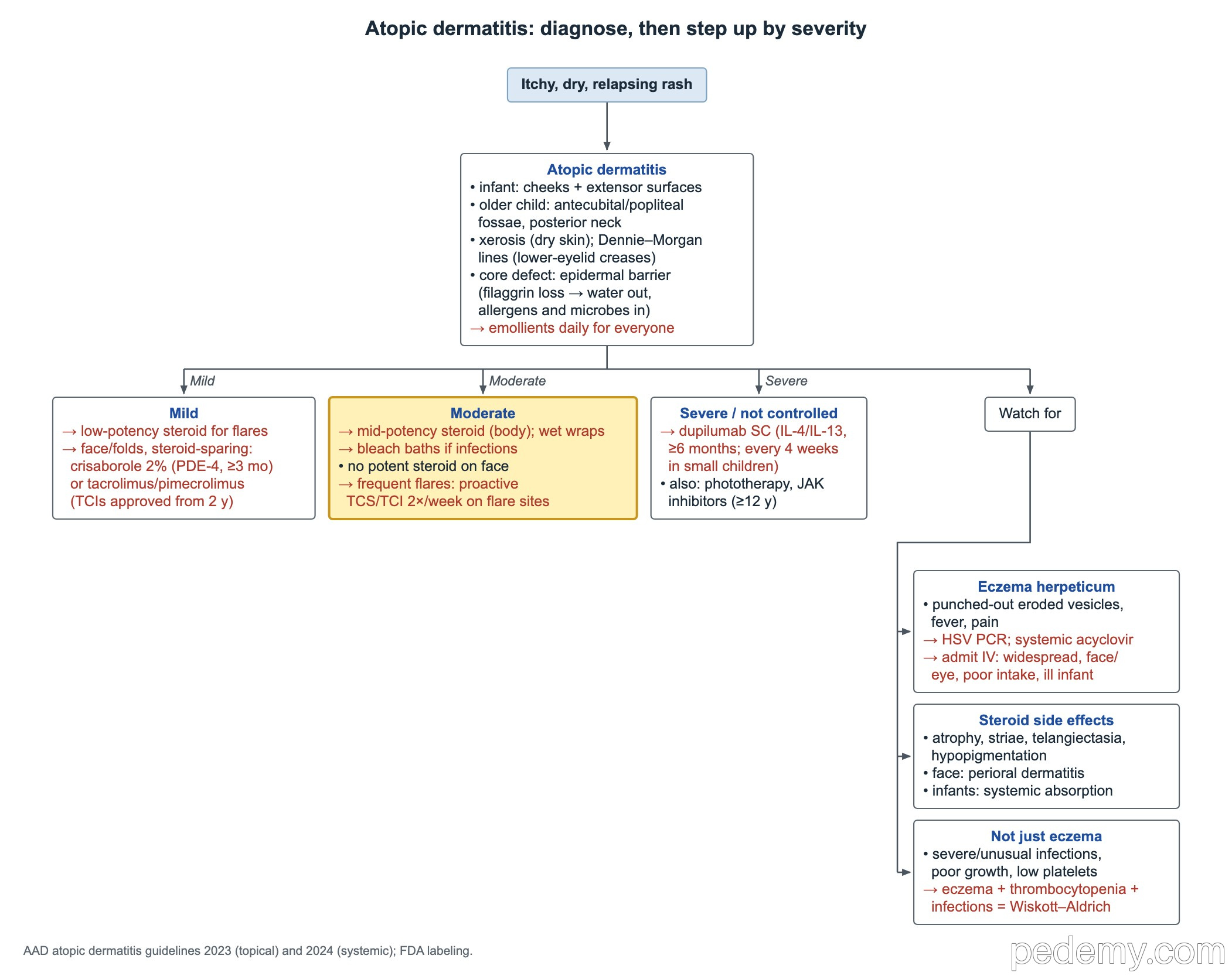
- Flares: medium-potency topical steroid (for example triamcinolone 0.1%) on the body; wet wraps for bad flares.
- No potent steroid on the face, folds or diaper area.
- Frequent flares: proactive maintenance on flare-prone sites, a TCI 2–3 times a week or a medium-potency steroid 1–2 times a week, even when the skin looks clear.
- Recurrent skin infections: dilute bleach baths about twice a week.
- Not better after 7 days of treatment: check adherence, look for secondary infection, rethink the diagnosis, and refer if unsure.
| Topical steroid side effect | Where or who |
|---|---|
| Atrophy, striae, telangiectasia, hypopigmentation | High-potency or long use, thin skin |
| Perioral dermatitis | Steroid on the face |
| Systemic absorption (adrenal suppression) | Infants, large areas, occlusion |
Severe disease: systemic therapy
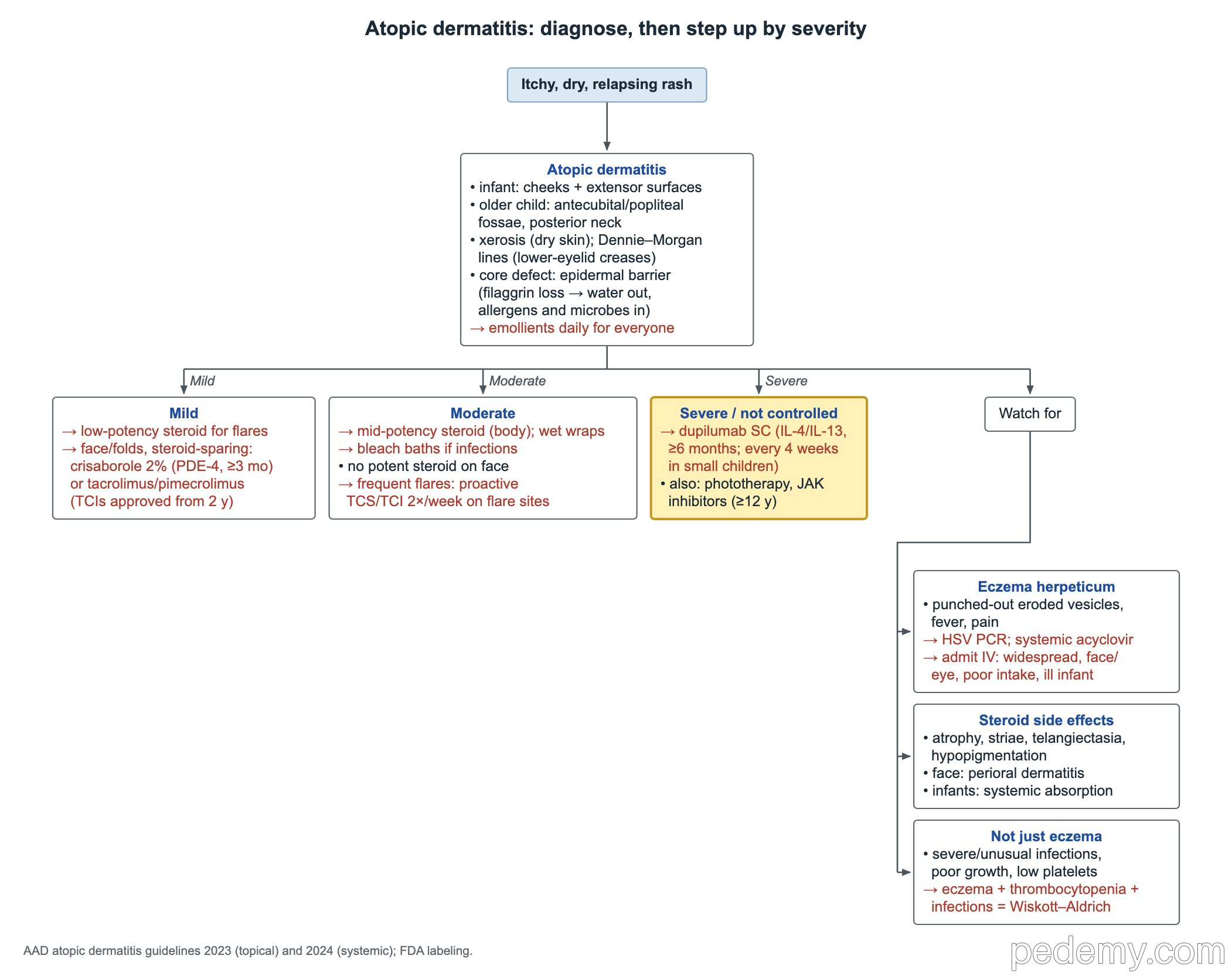
- Moderate–severe disease not controlled with topicals: dupilumab, a subcutaneous IL-4/IL-13 blocker approved from 6 months; small children get it every 4 weeks by weight.
- Other options: phototherapy; oral JAK inhibitors and other biologics from age 12.
- Do not use oral corticosteroids for atopic dermatitis flares: rebound flares are common when they stop.
Warning signs: eczema herpeticum and look-alikes
Eczema herpeticum is HSV spreading through eczematous skin. Look for punched-out eroded vesicles, fever and pain in a child with eczema.
- Test: HSV PCR of a lesion swab.
- Treat: systemic acyclovir right away; do not wait for the PCR result.
- Admit for IV acyclovir if the rash is widespread, involves the face or eye, intake is poor, or the infant looks ill. Eye involvement needs ophthalmology.
- Not just eczema: severe or unusual infections, poor growth, or low platelets or bleeding need an immunology work-up (CBC with platelet size).
- Eczema + small platelets or bleeding + recurrent infections in a boy = Wiskott–Aldrich syndrome.
Ichthyoses
Treatment for ichthyosis vulgaris is regular emollients plus keratolytics such as urea or lactic acid.
| Disorder | Clues | Key facts |
|---|---|---|
| Ichthyosis vulgaris | Fine scale on the legs and trunk, hyperlinear palms and soles; flexures spared; better in hot, humid weather | FLG (filaggrin) loss-of-function; autosomal semidominant; often occurs with atopic dermatitis; FLG testing if needed |
| X-linked ichthyosis | Boys; large dark scale on the trunk and neck; palms and soles spared | Steroid sulfatase deficiency; mother may have had prolonged labor; check for undescended testes (testicular cancer risk) |
| Collodion baby | Newborn in a shiny, tight, parchment-like membrane | Usually autosomal recessive congenital ichthyosis; humidified incubator, emollients, watch fluids, temperature and infection |
Other eczematous and scaly rashes
- Pityriasis alba: pale, finely scaly cheek patches in a school-age atopic child; more noticeable in summer because the patches do not tan. Emollient and sunscreen; fades over months.
- Dyshidrotic eczema (pompholyx): intensely itchy deep-seated vesicles on the palms and sides of the fingers, often with hyperhidrosis or frequent hand washing. High-potency topical steroid, emollients, avoid irritants.
- Juvenile plantar dermatosis: shiny, red, cracked soles in a school-age child, toe webs spared, little itch. Frequent emollients; avoid occlusive shoes and synthetic socks.
- Keratosis pilaris: rough follicular papules ('chicken skin') on the outer upper arms and thighs. Emollients with keratolytics (lactic acid, urea, salicylic acid).
Common questions
How long should I use a topical steroid for an eczema flare?
Twice daily until about 3 days after the skin clears, then stop or move to twice-weekly proactive use on spots that flare often.
At what age can dupilumab be used for eczema?
From 6 months of age for moderate to severe atopic dermatitis that topical treatment does not control.
Are bleach baths safe for children with eczema?
Yes. Dilute bleach baths about twice a week are used for children with moderate to severe eczema and repeated skin infections.
Do antihistamines help eczema?
They do not treat the rash. A sedating antihistamine at bedtime may help a child sleep when itch keeps them awake.
Study this topic
Sources
- AAAAI/ACAAI Joint Task Force: Atopic dermatitis (eczema) guidelines 2023 (Ann Allergy Asthma Immunol)
- AAD: Guidelines of care for atopic dermatitis with topical therapies (J Am Acad Dermatol, 2023)
- AAD: Guidelines of care for atopic dermatitis with phototherapy and systemic therapies (J Am Acad Dermatol, 2024)
Written for Pedemy in our own words from the sources above; checked November 2026. For education only, not medical advice; check doses and local protocols before treating a patient. Pedemy is independent and not affiliated with or endorsed by the organizations cited.